
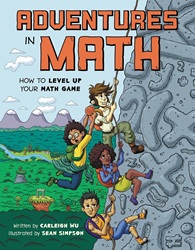
 Adventures in Math
How to Level Up Your Math Game
Review posted February 25, 2026.
Kids Can Press, 2025. 80 pages.
Review written January 5, 2026, from a book sent to me by the publisher.
Starred Review
Mathical Book Prize Honor Book, Grades 6-8
I love what the author is doing here. Instead of giving you specific techniques for solving certain math problems, this book tells you how to think about doing math and gives you techniques based on psychological research for approaching math problems successfully.
There are five chapters, each giving a simple principle and busting a myth about math. And short biographies are given of mathematicians whose lives bust the myths.
The first myth is that you have to be born with a math brain to be good at math. The truth is that everyone can work at it to get better, and the author explains a growth mindset. We learn about great mathematicians who didn't start out good at math.
Next they tackle the myth that you should be able to solve math problems by yourself.
Math is social. It's better together.
The mathematicians here worked with collaborators. One of the tips in this section is about an interesting study done that if you physically move closer to a problem, it will seem more difficult, but if you take a step back, it will seem easier. This encourages kids to see the big picture.
Another myth tackled is that if you make mistakes, you're not smart. A whole chapter emphasizes how important mistakes are to help you learn. They give an example of astronauts who need to make zero mistakes in space - so they train in simulations on earth, where they can make lots of mistakes and perfect their techniques. Another example that most kids can relate to is video games. Most kids don't think they're bad at video games if they lose a life quickly the first time they play. They keep playing, and get better each time. Other fields - including math - are like that, too.
And there's much more in this book. There's discussion of using diagrams to solve problems, thoughts on how there are usually multiple ways to solve math problems, how creativity can help with math problems, and an example of out-of-the-box thinking about a contest to design toilets without plumbing or electricity.
This book makes me think of The Willpower Instinct, except for kids, because it's about how to think about math in order to get better at doing it. I'd love to give this to a kid who doesn't think they're "good at" math.