
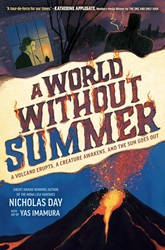
 A World Without Summer
A Volcano Erupts, a Creature Awakens, and the Sun Goes Out
Review posted March 25, 2026.
Random House Studio, 2025. 294 pages.
Review written February 17, 2026, from a library book.
Starred Review
2026 Sibert Honor Book
2026 YALSA Excellence in Nonfiction Award Finalist
A World Without Summer won Honor in the nonfiction award from both the Young Adult Library Services Association (YALSA) and the Association for Library Services to Children (ALSC) - which highlights that here is a nonfiction book perfect for middle school students. It also gives me a dilemma where to post the review - on the Teen Nonfiction page or the Children's Nonfiction page? Recently, I've started leaning toward putting any nonfiction longer than a picture book on the Teen Nonfiction page, but since I put Nicholas Day's debut book and Sibert winner, The Mona Lisa Vanishes, on the Children's Nonfiction page, and they are very much alike, I'm going to post this one there, too - but be aware that the sweet spot for this book is middle school and upper elementary.
Because I read an adult fantasy novel called Without a Summer, by Mary Robinette Kowal, I already knew that it snowed in Washington, D. C., in July 1816 because of a volcano that erupted in another part of the world. This book told me much, much more.
The author keeps the conversational tone he used in The Mona Lisa Vanishes and starts off by telling the reader about Tambora, a volcano in Indonesia that erupted in 1815 - and just how utterly enormous that eruption was. He talks about the people who died in that eruption - and the thousands who died in the aftermath. But the later thousands who died as a direct result of that eruption didn't even know it was because of the eruption.
After talking about the original eruption, Nicholas Day takes us to Europe, where the oddities began with yellow and brown snow, which nobody knew was from the ash of the volcano. As it turned out, summer never came in places across the globe - and neither did harvest.
But besides talking about gruesome deaths that were a result of Tambora, the author also tells us the story of Mary Godwin, who became Mary Shelley - and wrote Frankenstein the same year the climate was all out of whack. We get the whole story of her elopement and trip to Switzerland - and just how much they complained about the weather.
Nicholas Day is exceptionally good at bringing the reader into the story, getting them thinking with questions, and helping them see the connections between that past world, disrupted by climate shock, and our present world, which has some new technologies (like forecasting weather) thanks to the disruptions of Tambora, but is still vulnerable to global events.
I'm going to go ahead and quote from a closing section, because it shows where he goes with this story, and I don't think it's a spoiler in nonfiction.
While Mary Shelley was writing the great novel of catastrophe, people across the world were working in wholly new ways to prevent catastrophe. These were governments, and they were ordinary people, too. They were working on behalf of a simple idea, a new idea: that those who were suffering could survive - that they should survive - that they deserved to survive.
That there were things that could be done and should be done.
When we remember Tambora, what stands out is the bleak and the strange: the skeletal figures, the sawdust bread, the boils on the face of the sun. The disease. The distress.
But we should remember this part, too.
Without this idealistic work - without the invention of this idealistic idea - far more would have suffered. Far more would have perished. Tambora was a warning.
But hidden inside it is this deeply hopeful truth: We can act.
Read this book to learn, to hear a good story, and to think about the ways we earthlings are connected.