
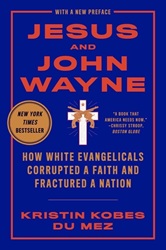
 Jesus and John Wayne
How White Evangelicals Corrupted a Faith and Fractured a Nation
Review posted September 26, 2026.
Liveright Publishing, 2020. 356 pages.
Review written September 25, 2026, from my own copy, purchased via Amazon.com.
Starred Review
I don't remember which of many recommendations prompted me to order my own copy of Jesus and John Wayne right around the time it first came out, but I know there were many, and I was happy to order it. Once I had it, I'm afraid it competed with the library books I had checked out, but didn't have a due date. (This is something I often have to contend with.) This is also a history book, and a little dense. Yes, it's a history of what Christians were doing, but it didn't seem right for devotional reading, which often jumps to the top of my queue.
But then after my proposal was accepted and I got to be a co-creator at Wild Goose Festival, I saw that Kristin Du Mez was going to be there, too! And her new book, Live Laugh Love sounded similar, but talking more about "Christian femininity" than the focus on masculinity in Jesus and John Wayne. So I preordered the new book, and decided I really should get the old one read before the festival.
Well, I was halfway through Jesus and John Wayne when I went to Wild Goose Festival and got to hear the author speak twice. She talked about both books, and now I'm all the more eager to read the next one, which arrived on the publication date this week.
This is a history book about white evangelicalism in America, and how the movement got carried away with the idea of rugged masculinity epitomized by John Wayne.
The book starts with the early twentieth century and looks at people like Billy Sunday, Billy Graham, and John Wayne. It finishes in 2020 and Donald Trump - who got support from 80% of white evangelicals.
Along the way, we see a turn toward rugged masculinity as the way God designed men and complementarianism as God's plan for marriage, and overall structures of authoritarianism as God's design for society.
I grew up pretty deep in evangelical circles. I attended Christian schools through college (I was a little disappointed that my alma mater, Biola University, wasn't mentioned.), and went to Bill Gothard's Institute in Basic Youth Conflicts seminars before I was even a teen.
However, I got more and more progressive in my politics after college, and from 1996 to 2006, lived in Germany with my husband in the military - and thus completely missed the rise of Fox News and some of these other developments. Reading this book was fascinating to me, because so much was familiar, yet a lot I hadn't noticed at all.
Another interesting thing to me was that while I was physically reading this book, a chapter at a time, I was listening to the audiobook version of Ibram X. Kendi's latest book, Chain of Ideas, about right-wing political parties all over the globe. There were times when I was listening that I thought, "Yeah, they just mentioned that" - and I realized, no, I'd read about it in the other book (or vice versa).
This book also dovetails well with Sheila Wray Gregoire's writings on marriage and Marissa Franks Burt's writings on parenting, because both marriage and parenting are affected by the developing teaching that men are to be authority figures in the church and in the home.
It's also interesting reading for me as someone coming out of evangelicalism, having my eyes opened to some trends I went along with and didn't see. Sheila Wray Gregoire had already opened my eyes about books like Love and Respect, but this book helped me notice the militaristic background to John Eldredge's writings that had blown right past me.
Back in 2016, I was incredulous that the same folks who told me that Bill Clinton should not be president because of his immorality were now supporting Donald Trump, who bragged about "not even asking" women before he sexually assaulted them. This book helped me understand the way the culture of evangelicalism and all its trends slowly changed so that Donald Trump epitomized exactly what people were looking for.
At Wild Goose Festival, the author explained that her editor told her she had to end on a hopeful note, but she had trouble coming up with anything. Here's how the book finishes:
Although the evangelical cult of masculinity stretches back decades, its emergence was never inevitable. Over the years it has been embraced, amplified, challenged, and resisted. Evangelical men themselves have promoted alternative models, elevating gentleness and self-control, a commitment to peace, and a divestment of power as expressions of authentic Christian manhood. Yet, understanding the catalyzing role militant Christian masculinity has played over the past half century is critical to understanding American evangelicalism today, and the nation's fractured political landscape. Appreciating how this ideology developed over time is also essential for those who wish to dismantle it. What was once done might also be undone.
You'll find detailed, well-researched history here, supported with 32 pages of small-print citations at the back. As someone who grew up in that world, I gained wider understanding of how it morphed to what it is today. I can't wait to read her next book, focusing on women!