
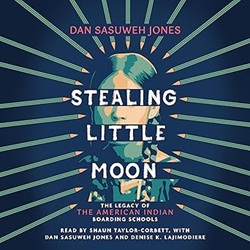
The Legacy of the American Indian Boarding Schools
Scholastic Audio Books, 2024. 6 hours, 10 minutes.
Review written April 8, 2026, from a library eaudiobook.
Stealing Little Moon is a story about American Indian Boarding Schools, but also a family story. Dan SaSuWeh Jones's grandmother was taken from her family at gunpoint when she was four years old. Her name was Little Moon There Are No Stars Tonight. She arrived when Chilocco Indian Agricultural School had just opened - and the author was a maintenance worker after the school closed. In between, four generations of his family attended the school.
I expected a story of horrific abuse in the Indian Boarding Schools. I had no idea that children as young as four years old were taken, which adds to the horror, but I wasn't exactly surprised by stories of abuse, poor nutrition, hard work, lack of medical care, and a refusal to let the children speak their own languages - yes, horrified, but not surprised. (The Witness Blanket, by Carey Newman and Kirstie Hudson, gave me a powerful overview of what happened in the schools.)
However, this book contained much more than that. The author would often digress, telling about notable people who attended the Indian schools, telling about legislation that tried to erase them, and also telling about steps taken to fight back and reclaim the schools as a positive force in Indian lives. It was after Native Americans themselves were in charge of the schools that they were forced to close. But their legacy lives on, in both good and bad ways.
Listening to this book as an audiobook, it felt pretty unorganized because of all the digressions. I think if I'd had the book in front of me and the chapter headings in mind, it would have felt less so. But still, the digressions were all very interesting. They often had a personal touch with the author's family. I did like how he pointed out that by bringing children from many different Indian nations together, they gained new solidarity with one another and this shared experience - traumatic in many ways, but also with some positives.
Above all, he demonstrates how the United States government tried to wipe out the indigenous people and make them assimilate - but they failed in that goal.