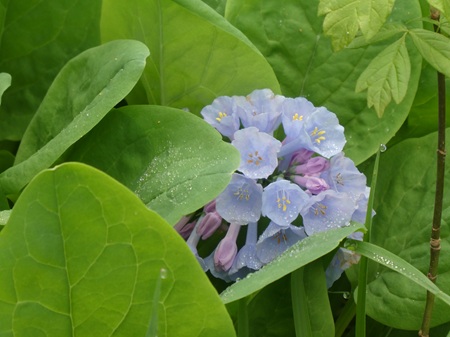
It’s Good Friday. Today I walked among the bluebells in the biggest stand of bluebells on the East Coast at Bull Run Regional Park. And I sang in an amazing Good Friday cantata. My heart is full.
It’s late, but I did want to finish off my Laments for Lent blog series with a post for Good Friday.
Instead of writing my own example lament today, let’s look at the Lament that Jesus quoted on the cross, Psalm 22.
To mix things up, I’m going to quote Wilda C. Gafney’s translation in A Women’s Lectionary for the Whole Church, Year W, where she includes it in the reading for today.
First let me comment that I got some feedback from early readers of my book, Praying with the Psalmists because I included Psalm 22 in the chapter on Laments and not in the chapter on Messianic Psalms. Yes, Psalm 22 is Messianic – Jesus quoted it on the cross and the gospel writers quoted it as being fulfilled by Jesus’ suffering. And people have often made the point that the description fits crucifixion. But I suspect that the psalmist who wrote it was simply writing a lament. It doesn’t come across as trying to predict anything – just someone expressing their pain. And then Jesus cried out with that very Lament.
To me, this reminds us that Jesus was fully human and entered into human suffering. And I do believe God inspired the psalmist so that their words were wiser than they knew.
Psalm 22 has all the parts of a Lament, but doesn’t follow the order strictly.
It starts with one of those Addresses to God that’s a question – which slides immediately into the Complaint:
My God, my God, why have you forsaken me?
Why are you so far from my deliverance, from the words of my groaning?
Here’s the beginning of the Complaint:
My God, I cry out by day, and you do not answer;
and by night, and there is found no rest for me.
Then it slips into the Confession of Trust:
Yet you are holy,
enthroned on the praises of Israel.
In you our mothers and fathers trusted;
they trusted, and you rescued them.
To you they cried, and were freed:
in you they trusted, and they were not put to shame.
But the psalmist wasn’t done with the Complaint:
But I am a worm, and not human;
scorned by humankind, and despised by people.
All who see me mock me;
they flap their lips at me, they shake their heads:
“Commit yourself to the SAVING ONE: let God rescue
and deliver the one in whom God delights!”
Back to the Confession of Trust – instead of finishing one and going on to the next part, this Psalm weaves them back and forth together.
Yet it was you who drew me from the womb;
keeping me safe on my mother’s breast.
On you was I cast from birth,
and since my mother’s womb you have been my God.
Back to the Complaint:
Be not far from me,
for trouble is near
and there is none to help.
Many bulls surround me,
mighty bulls of Bashan encompass me,
like a lion, ravaging and roaring.
I am poured out like water,
and all my bones are disjointed.
My heart is like wax;
it is melted within my being.
My mouth is dried up like a potsherd,
and my tongue cleaves to my jaws;
in the dust of death you lay me down.
For dogs are all around me;
a conclave of evildoers encircles me.
Like a lion they ravage my hands and feet.
I can count all my bones.
They gloat and stare at me.
They divide my clothes among themselves,
and for my clothing they cast lots.
And then! We get to the Entreaty. (Notice how much shorter it is than the Complaint.)
SAVING GOD, be not far away!
My strength, hasten to help me!
Deliver my soul from the sword,
my life from the clutch of the dog!
Save me from the mouth of the lion!
And in this translation, the next line is Sureness of Help:
For on the horns of the wild oxen you have responded to me.
From here on out there’s more back-and-forth, this time between Sureness of Help and Subsequent Praise. This next part is Subsequent Praise:
I will tell of your name to my sisters and brothers;
in the midst of the congregation I will praise you:
You who revere the FOUNT OF LIFE, praise her!
all the offspring of Leah and Rachel, Bilhah and Zilpah glorify her.
Stand in awe of her all you of Rebekah’s line.
I’m calling this Sureness of Help:
For she did not despise or abhor
the affliction of the afflicted;
she did not hide her face from me,
and when I cried to her, she heard.
And really, the rest is Subsequent Praise, though it kind of merges with Sureness of Help. And, in fact, this part talks about a future where God makes things right – and this is the part that makes the strongest case for calling it a Messianic Psalm, even though this part isn’t quoted in the New Testament.
On your account is my praise in the great congregation;
my vows I will pay before those who revere her.
The poor shall eat and be satisfied;
those who seek her shall praise the MOTHER OF ALL.
May your hearts live forever!
All the ends of the earth shall remember
and turn to the WELLSPRING OF LIFE;
and all the families of the nations
shall worship before her.
For sovereignty belongs to the SHE WHO IS HOLY,
and she rules over the nations.
They consume and they bow down, all the fat ones of the earth before her,
they bend their knees, all who go down to the dust,
and cannot save their soul.
Later descendants will serve her;
future generations will be told about our God;
they will go and proclaim her deliverance to a people yet unborn,
saying that she has done it.
And looking at the Cross from centuries later – we are even more certain that the end result is triumph and praise. Christ’s living the suffering of this Psalm foreshadows that he will also live the triumph of this Psalm, when the poor shall eat and be satisfied and all the families of the nations will worship God with joy, proclaiming God’s deliverance.
Amen. May it be so.