Too Busy Loving Us

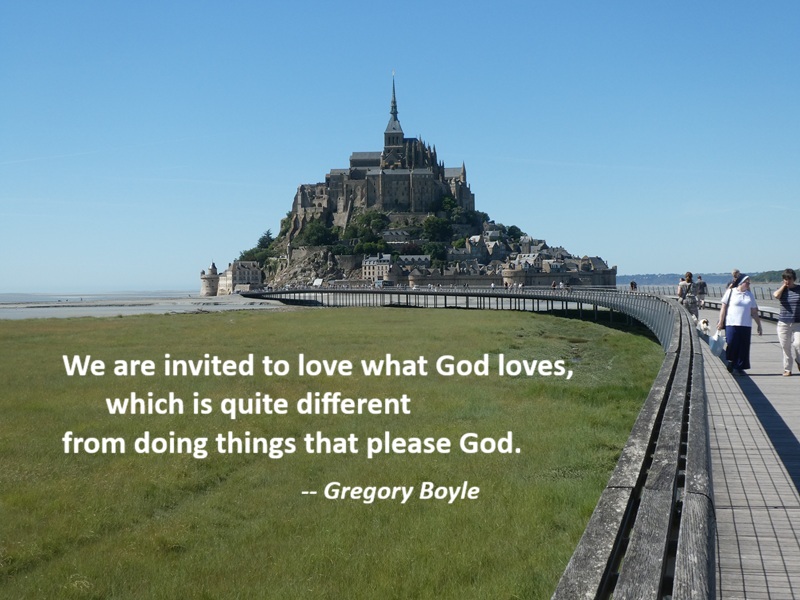
Part of the quest is to be freed from everything that is not God. Eckhart thought we should rid ourselves of the irrelevant stuff, the tired views of God and religious language that block the pores of our soul. Richard Rohr says that your image of God creates you. Our God is self-effacing. We aren’t. This may be one of the reasons why we have such a hard time connecting to the God of love. God is not needy. We are. God does not long to be liked. We do. God is never fishing for a compliment. That’s our thing. Homies are endlessly insisting, for example, that everything happens for a reason. God is behind every reasonableness and everything unreasonable. When the opportunity affords itself, I will tell homies that God is too busy loving them to have any time left for orchestration. Sometimes we are saddled with an image of God that does not create us in God’s image.

— Gregory Boyle, Cherished Belonging, p. 17

Photo: Burnside Farms, Nokesville, Virginia, April 7, 2026

God Didn’t Make Us to Hate Us

God is not so small-minded or vindictive as to make people in order to just . . . hate them. I mean, look at the sheer multitude of galaxies in the universe. The membranes of butterfly wings. The way a toddler’s teeth make the most crooked and sublime smile when they laugh. The dreamer-upper of these things isn’t an asshole. I just don’t buy it. The Bible doesn’t sell it, either; while full of challenging and complex stories that do dip into the lament and wrath of God, scripture on the whole has an undercurrent and over-arc of God’s delight in God’s people.

— Rev. Lizzie McManus-Dail, God Didn’t Make Us to Hate Us, p. xii-xiv

Photo: Goslings, South Riding, Virginia, May 8, 2026

A Lover, Not a Dictator

Everything belongs. God uses everything. There are no dead-ends. There is no wasted energy. Everything is recycled. Sin history and salvation history are two sides of one coin. I believe with all my heart that the Gospel is all about the mystery of forgiveness. When you “get” forgiveness, you get it. We use the phrase “falling in love.” I think forgiveness is almost the same thing. It’s a mystery we fall into: the mystery is God. God forgives all things for being imperfect, broken, and poor. Not only Jesus but all the great people who pray that I have met in my life say the same thing. That’s the conclusion they come to. The people who know God well – the mystics, the hermits, those who risk everything to find God – always meet a lover, not a dictator. God is never found to be an abusive father or a tyrannical mother, but always a lover who is more than we dared hope for. How different than the “account manager” that most people seem to worship.

— Richard Rohr, Everything Belongs, p. 130-131

Photo: Irises, South Riding, Virginia, May 2, 2026

Power With

But Jesus gave up power and privilege to stand in solidarity with humanity. In this way, the Spirit of God sets aside power-over in favor of power-with for the sake of justice. Where power-over is marked by dominance, coercion, and control, power-with is marked by collaboration and cocreation. It is a power rooted in collective action and relationship. A God who invites us to “argue it out” is a God of power-with, power shared. This God is dynamic: one who feels, who responds to our pleas, and who can be accessed by humans. This is a God many of us were not introduced to but had to discover on our own.

— Kat Armas, Sacred Belonging, p. 62

Photo: Bluebells at Bull Run Regional Park, Virginia, April 3, 2026

Children of Light

To be “children of light” – people in whom the gospel shines brightly – is different from being morally perfect or never failing. Any focus on perfection was an utterly false and illusory goal that made Christianity into a cult of innocence, whose adherents are so often full of blame and denial that they allow their fault to be projected onto others, unable to see similar failings in themselves.

When Jesus said we are “the light of the world” (Matthew 5:14), he said we must extend this light to “everyone in the house” (5:15) in the form of our own “good works” (5:16), not just exposing others’ bad works. But light does what light does. It clarifies, helps us see fully, and gives us the insight, freedom, and courage to perceive ourselves rightly. Divine light does not inflate us with the pride of “I know,” but illuminates those around us with the gratitude of “I am, too” – a kind of joining “everyone in the house.” Both light and love reveal not our separate superiority, but rather our radical sameness. That quality is, in fact, the way you can tell divine light from human glaring.

— Richard Rohr, The Tears of Things, p. 145-146

Photo: Tulips at Burnside Farms, Virginia, April 7, 2026

Chosen to Love

Think of the many, many stories about God choosing people. There are Moses, Abraham, and Sarah. There are David, Jeremiah, Gideon, Samuel, Jonah, and Isaiah. There is Israel itself. Much later, there are Peter and Paul, and, most especially, Mary.

God is always choosing people. First impressions aside, God is not primarily choosing them for a role or a task, although it might appear that way. God is really choosing them to be God’s self in this world, each in a unique situation. If they allow themselves to experience being chosen, being a beloved, being somehow God’s presence in the world, they invariably communicate that same chosenness to others. Thus the Mystery passes on, from age to age. Yes, we do have roles and tasks in this world, but finally they are all the same — to uniquely be divine love in a way that on one else can or will.

— Richard Rohr, Yes . . . And: Daily Meditations, p. 286

Photo: South Riding, Virginia, March 24, 2026

Be on the Lookout

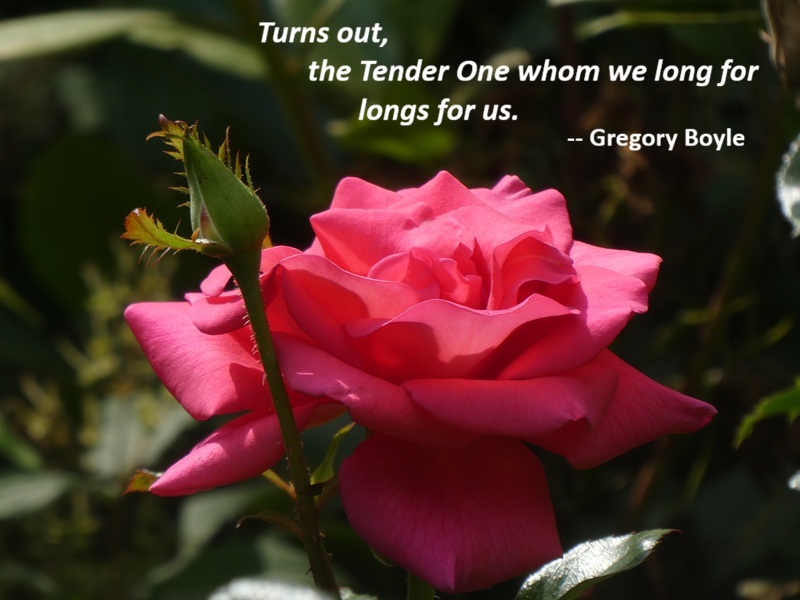
My friend Mirabai Starr, a mystic who writes about mystics, says, “Once you know the God of Love, you fire all the other gods.” It is always hard for us to believe in the nonjudgmental, loving, and merciful God, and yet, that is the God we actually have.

Joel, a man who did considerable time in prison, told me, “When my toes hit the floor in the morning, I’m on the lookout.”

“On the lookout for what?” I asked him.

“For God,” he said. “God is always leaving me hints. He’s dropping me anonymous tips all the time.” This is the God of love trying to break through. This God will not be outdone in extravagant tenderness. Leaving hints as “deep as the nether world or high as the sky,” as the prophet Isaiah reminds us. We get to choose: the god who judges and is embarrassed, or the One who notices and delights in us.

— Gregory Boyle, Forgive Everyone Everything, p. 23

Photo: Great blue heron at lake side, March 1, 2026

Winning Us with Love

These metaphors do not mean that he literally took on our sin or our infirmities as a mysterious imputation or had our punishmet transferred to his person and, consequently, by his suffering satisfied the justice of God. That kind of penal suffering would only satisfy the very worst injustice. And think about it. If Jesus did take on the punishment for our sin, why would anyone need to suffer in an eternal hell? According to the penal and satisfaction theories, Jesus suffered for all humanity. He paid the price, satisfied the debt, and said “it is finished.” So it would be a grave injustice if God required two punishments for sin – one paid by Jesus and one paid by eternal suffering. Instead, Jesus took upon himself our sinning enmity by bearing all the abuse we handed ut to him. He was painfully burdened by our fallen and broken condition, and he agonized with us in the most profound way possible – he suffered on account of our sin. Jesus knows how to treat his enemies – he suffers with them (us) as a friend. He suffers all our wickedness in order to win us with his love.

— Sharon L. Baker, Executing God, p. 136

Photo: Sunrise in South Riding, Virginia, March 10, 2026

Relentless Love

Jesus has no doubt about the salvific efficacy of the cross. Ultimately it will drag all people to himself. Does this imply that salvation is forced upon us through overpowering coercion? No, I don’t think so. Saving grace can always be resisted by a rebellious will. Rather, I think this has to do with the utter relentlessness of the divine love seen in Christ upon the cross. The gravity of grace is always pulling upon us. At any given mment we can resist the love of God, but, as Psalm 136 says so relentlessly – twenty-six consecutive times – “His steadfast love endures forever.”

From the cross of Christ there emanates a tractor beam of steadfast love that pulls upon all people. At any given moment any given person can resist it, but how long can a love that endures forever be resisted?

— Brian Zahnd, Wood Between the Worlds, p. 91

Photo: Cherry blossoms, South Riding, Virginia, March 28, 2025

Believing in Love

I don’t think I’m at death’s door, but I find myself assessing things I believe as I inch toward that door. I believe the following things:

  1. God is in the loving.
  2. God IS inclusion.
  3. Demonizing is always untruth
  4. We belong to each other.
  5. Separation is an illusion.
  6. Tenderness is the highest form of spiritual maturity.
  7. “Kindness is the only non-delusional response to everything” (George Saunders).
  8. Love your neighbor as you love your child.
  9. We are all unshakably good.
  10. A community of cherished belonging is God’s dream come true.

For what it’s worth, this book just wants to lure us to embracing God’s heart and punto de vista. It proposes a mystical view that perhaps can lift us above those things that keep us apart. Nobody VS. Anybody. God’s dream come true.

— Gregory Boyle, Cherished Belonging, p. 12

Photo: South Riding, Virginia, January 26, 2026