Be Willing to See.

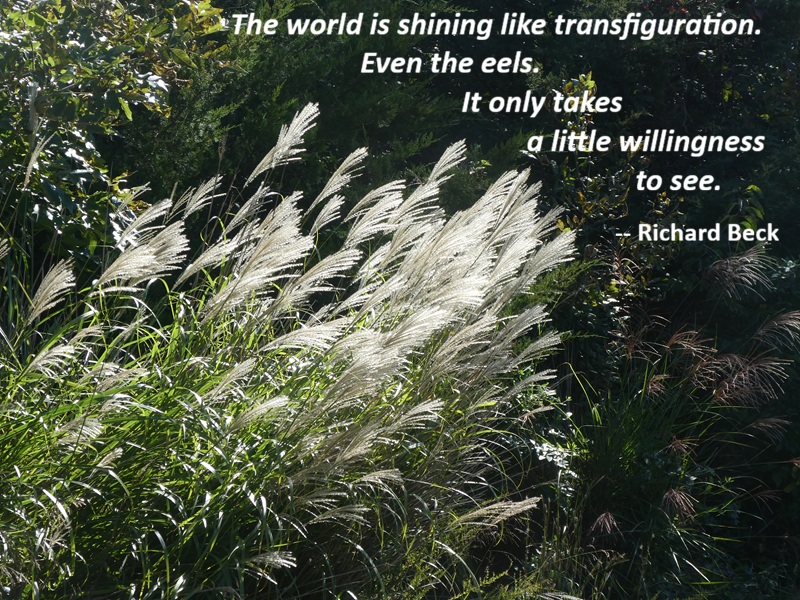
And so, dear reader, this is my final encouragement: Love like the sunshine and the rain. Ask forgiveness of the birds. Be a drop more gracious, tender, and kind. Go gently in this mean world. Offer up prayers of Thanks, Help, and Wow. Recover your sacramental wonder. Count your blessings. Look to the horizon in the Valley of Dry Bones. Remember that you are a child of God. Rush to kiss the lepers. Listen to the voice in the night calling you to the cross. Turn your attention to the God dancing right in front of you. God is everywhere present, breathing on this world and turning it to fire. Where you stand is the gateway to heaven. The world is shining like transfiguration. Even the eels.

It only takes a little willingness to see.

— Richard Beck, Hunting Magic Eels, p. 234

Photo: South Riding, Virginia, October 6, 2026.
Sacramental Noticing

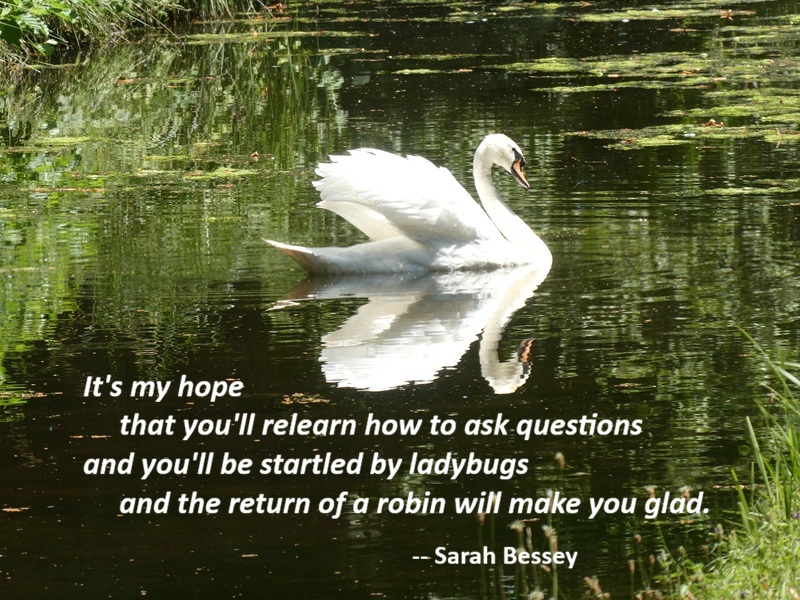
It is my hope that the wilderness will restore your capacity for wonder. It’s my hope that you’ll relearn how to ask questions and you’ll be startled by ladybugs and the return of a robin will make you glad. It’s my hope that children and elders will find you a patient presence. And it’s my hope that you’ll realize that being useful and having answers isn’t everything. There has to be room for nonsensical, wasteful, and sacramental noticing, because through it you begin to witness God’s heavy pour of love into your cup.

— Sarah Bessey, Field Notes for the Wilderness, p. 101

Photo: Grounds of the Abbaye de Royaumont, France, June 24, 2026

Keep Blooming

I still believe in heaven, but I am compelled by the breath of God permeating this love-crafted world and by the whole lot of us who are knocking around, messing up, and grateful for do-overs, mercy, and gentle human contact along the way. Anyone paying attention is painfully aware of the stark injustices that plague our land. I, regrettably, have no easy answers for this. It is not my task to explain or defend God.

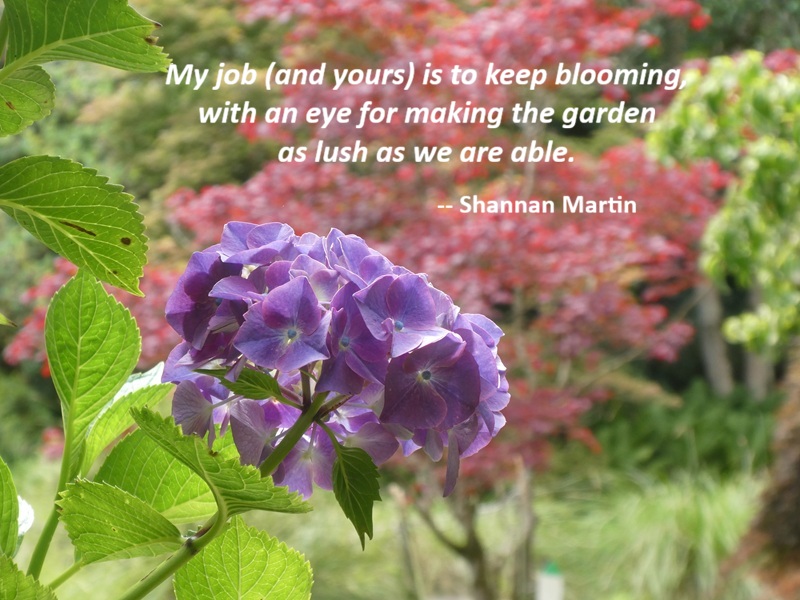
My job (and yours) is to keep blooming, with an eye for making the garden as lush as we are able. As we do this slow, daily work, God’s kingdom is made known, right here, right now, to all who live. Escaping earth’s pain and confusion by being beamed into heaven was never God’s holy endgame. The Good News is not that God will save us from reality but that God will redeem it, healing everything bruised and broken – even us.

— Shannan Martin, Counterweights, p. 24-25

Photo: Parc Botanique de Haut Bretagne, France, June 19, 2026

The Enchantment of the World

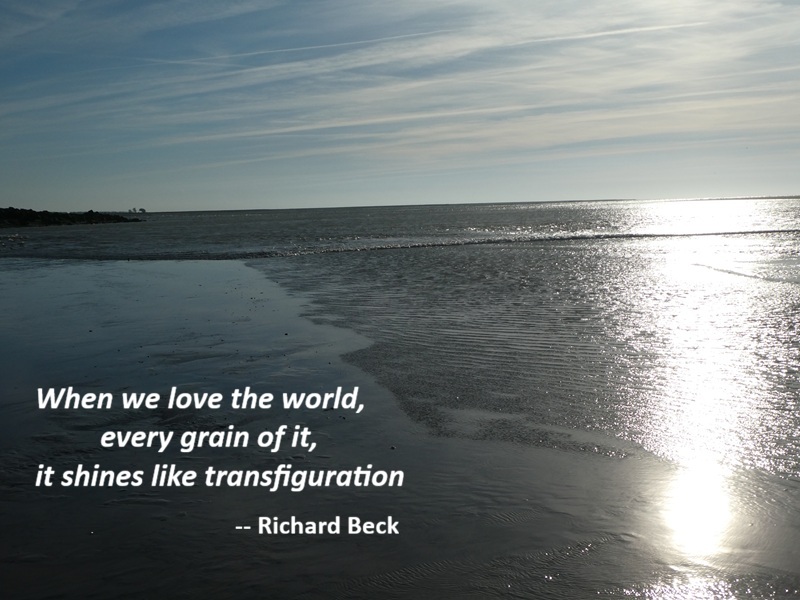
Love is the enchantment of the world. When we love the world, every grain of it, it shines like transfiguration. Love, as Tolkien said, helps us recover the world, turns everything into a fairy tale. Every leaf, every ray of light. Animals and plants. Mead and good music. The kiss of rain on your skin. The face of a friend and loved one. It all becomes magical. Even the eels.

— Richard Beck, Hunting Magic Eels, p. 233

Photo: Tide coming in, Bay of Mont Saint-Michel, June 17, 2026

A Joyous Yes

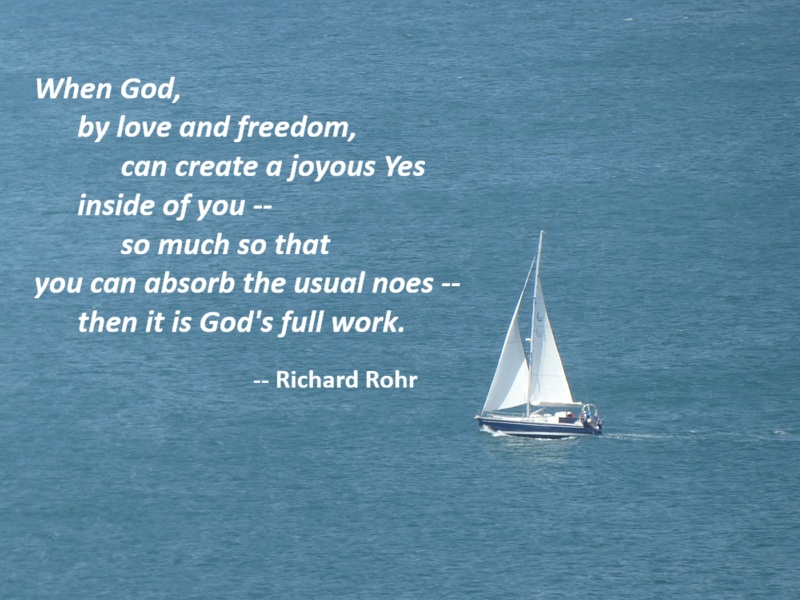
Saying No to the self does not necessarily please God or please anybody. There is too much resentment and self-pity involved. When God, by love and freedom, can create a joyous Yes inside of you — so much so that you can absorb the usual noes — then it is God’s full work. The first might be resentful dieting; the second is a spiritual banquet.

— Richard Rohr, Yes . . . And: Daily Meditations, p. 309

Photo: Sailboat off the coast of Étretat, France, June 23, 2026

Made for Joy

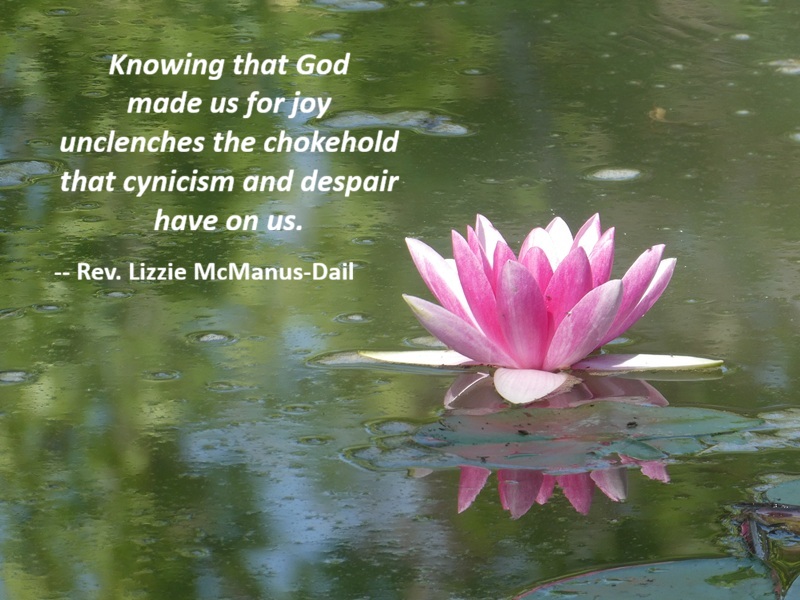
I am deeply convicted that God’s heart for us is and always has been to live with us. God made us for and out of joy. As my best friend Nora said the day my daughter was baptized: being naked in the Garden was the original plan. This is a key that unlocks so much bad theology, but even more important, knowing that God made us for joy unclenches the chokehold that cynicism and despair have on us.

If God made us – all of us, with tummies and wrinkles and libido and hearts that break and burst with life – for joy, then imagine how joyful life with God could be. If we fully accept this godly delight, who might we become? Who are we already if we let ourselves meet ourselves without malice or intent to harm? What freedom is already here? And what might be even more beautiful than it already is?

— Rev. Lizzie McManus-Dail, God Didn’t Make Us to Hate Us, p. xv

Photo: Water lily from Monet’s Garden, France, June 22, 2026

Wonder

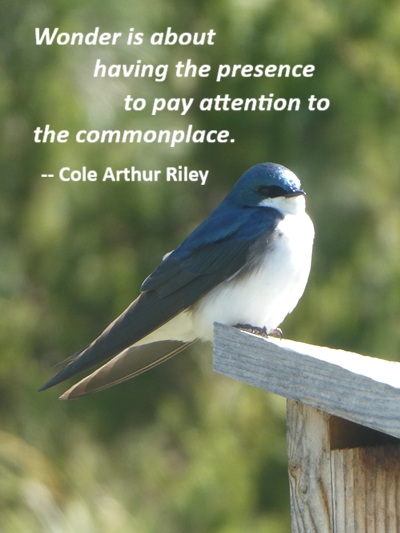
When I speak of wonder, I mean the practice of beholding the beautiful. Beholding the majestic – the snow-capped Himalayas, the sun setting on the sea – but also the perfectly mundane – that soap bubble reflecting your kitchen, the oxidized underbelly of that stainless steel pan. More than the grand beauties of our lives, wonder is about having the presence to pay attention to the commonplace. It could be said that to find beauty in the ordinary is a deeper exercise than climbing to the mountaintop.

— Cole Arthur Riley, This Here Flesh, p. 32

Photo: Tree Swallow, South Riding, Virginia, April 21, 2026

Wonder and Awe

People who truly know how to wonder don’t expend a great deal of energy talking about it; they are off catching snowflakes on hot tongues. They’re folding themselves in half to smell the sweet potatoes in the oven just one more time. I no longer try to convince someone of the delight of soup dumplings; I take them to Dim Sum Garden on Race Street in Philly and let them watch me slurp. I let the steaming miracle broth run down my face and lap it up in remembrance.

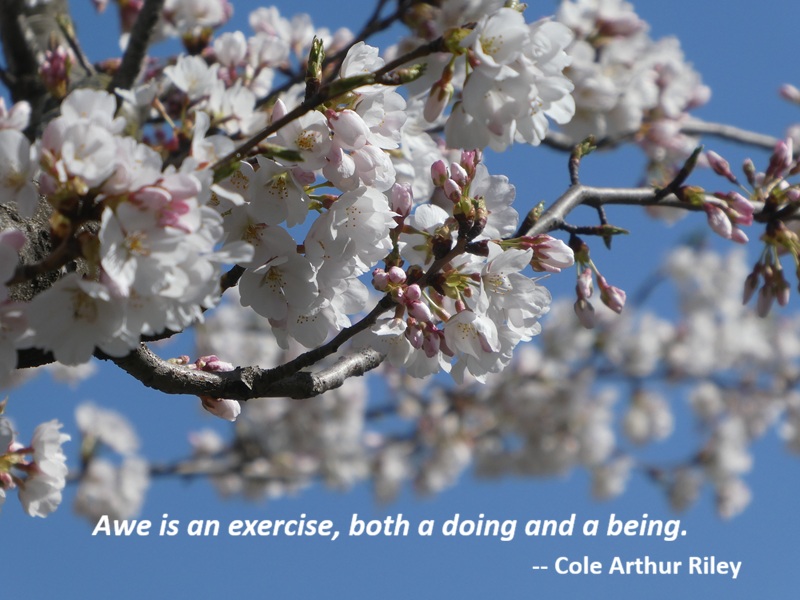
I think awe is an exercise, both a doing and a being. It is a spiritual muscle of our humanity that we can only keep from atrophying if we exercise it habitually. I sit in the clearing behind Wisewood listening to the song of the barn swallows mix with the sound of cars speeding by. I watch the milk current through my tea and the little leaves dance free from their pouch. I linger in the mirror and I don’t look away. I trace the shadows hugging my lips and I don’t look away. Awe is not a lens through which to see the world but our sole path to seeing. Any other lens is not a lens but a veil. And I’ve come to believe that our beholding – seeing the veils of this world peeled back again and again, if only for a moment – is no small form of salvation.

— Cole Arthur Riley, This Here Flesh, p. 31

Photo: Cherry blossoms, South Riding, Virginia, March 24, 2026

God Didn’t Make Me to Hate Me.

So how do we melt away the fear?

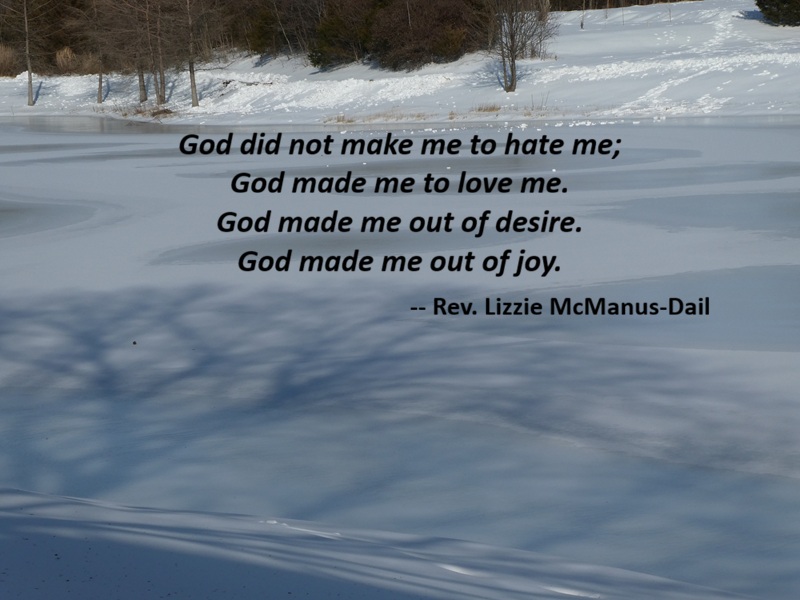
I believe it begins here: by looking at the heavens, and looking at the dandelion in the cracks, and looking at scripture, and looking at God, and trying an older and wilder way of trust. It begins by saying: God did not make me to hate me; God made me to love me. God made me out of desire. God made me out of joy.

— Rev. Lizzie McManus-Dail, God Didn’t Make Us to Hate Us, p, xiii

Photo: Shadows of tree branches on frozen lake, South Riding, Virginia, January 30, 2026