Unshakably Good

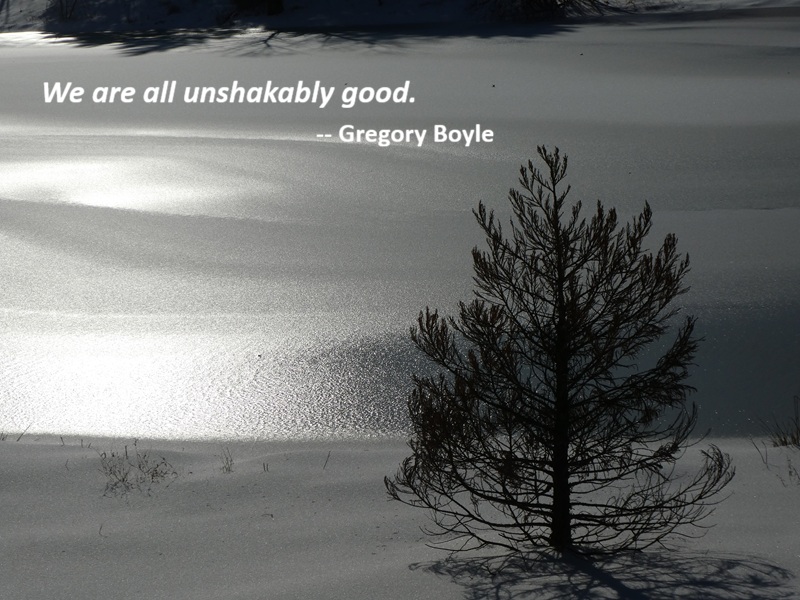
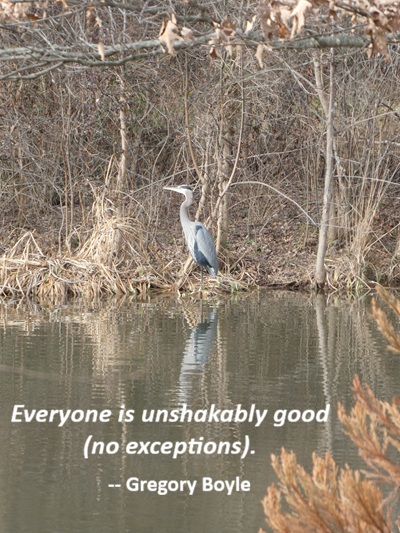
I told the crowd that two unwavering principles held at Homeboy Industries were the following: 1) Everyone is unshakably good (no exceptions) and 2) We belong to each other (no exceptions). Then I posited: “Now, do I think all our vexing and complex social dilemmas would disappear if we embraced these two notions?” I paused, then continued, “Yes, I do.” And the entire audience exploded in laughter. I was startled. When the laughter subsided, I repeated quietly: “Yes, I do.”

These two ideas allow us to roll up our sleeves so that we can actually make progress. So that we can love without measure and without regret. So that we can cultivate a new way of seeing. We finally understand that the answer to every question is, indeed, compassion.

— Gregory Boyle, Cherished Belonging, p. 2.

Photo: South Riding, Virginia, December 27, 2025.

Look at the World

So clean your windows. Take a look again at the world and see it, this time, the way you were meant to see it. Recover your sacramental wonder and be shocked anew by the color green. Become like a child and enter the kingdom of heaven. Count your blessings and rejoice. Always rejoice. Look to the horizon in hope, even in the Valley of Dry Bones. And remember why you matter. You are a child of God.

–Richard Beck, Hunting Magic Eels, p. 116

Photo: Blackwater River Valley, West Virginia, October 8, 2025

Beloved

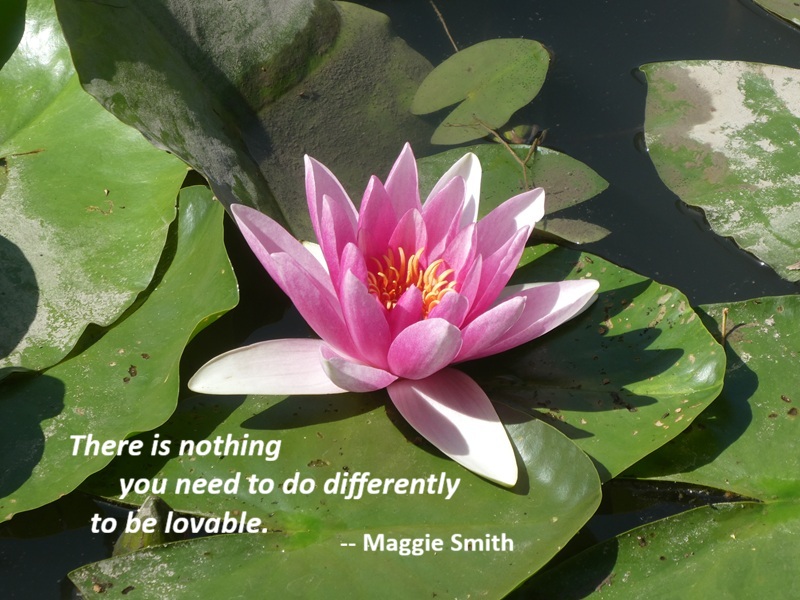
The gospel – the good news – is that you are already fully loved and accepted. That’s the message of grace at the heart of Christianity. You don’t have to do anything to be loved. Not anything at all. The work is always to receive it, to believe it. You don’t need to “be saved” to be loved. Salvation is just a way of describing the moment we come to know and believe that we are already loved, that we have always been loved. And our belovedness is not inspite of who we are but simply because we are worthy of love.

— Brian Recker, Hell Bent, p. 45

Photo: South Riding, Virginia, November 4, 2025

Reflecting the Image of God

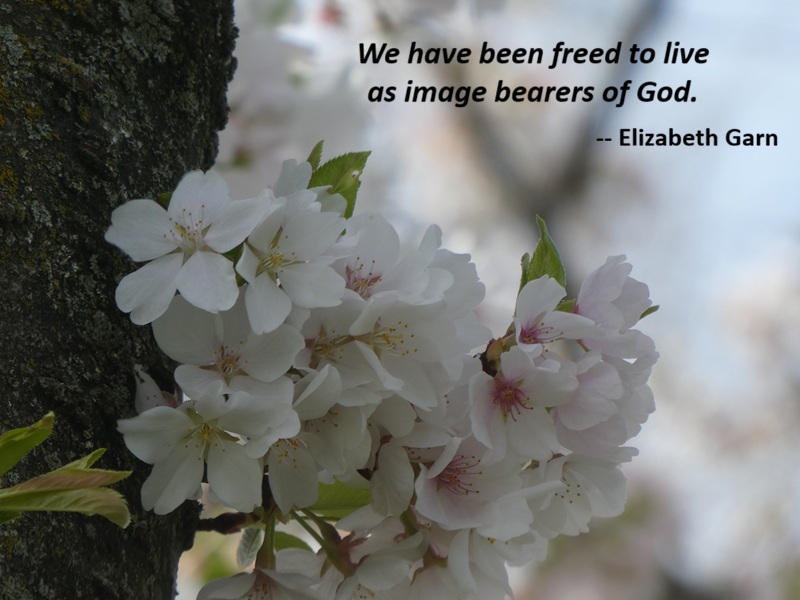
Abraham Kuyper, the Dutch Reformer, taught that filling the earth referred to “the filling of the Garden with the products and processes of cultural activity. . . . In that sense, not only the family, but also art, science, technology, politics (as the collective patterns of decision making), recreation, and the like were all programmed into the original creation order to display different patterns of cultural flourishing.” Filling the earth is a big, beautiful, huge invitation to imitate God and bring flourishing to the world. Whatever you do to fill the earth and bring flourishing to the world reflects the image of God.

— Elizabeth Garn, Freedom to Flourish, p. 58

Photo: Falls Creek Falls, Washington, June 16, 2025

The Image of God

For this reason, I disagree with those who say we bear the image of God only, or even primarily, by living out our faith in our labor. The thought is reductive, and it evidences that we are content to exclude those who will never work, who may never speak, who no longer make or do. Their image-bearing is not dispensable; it is essential.

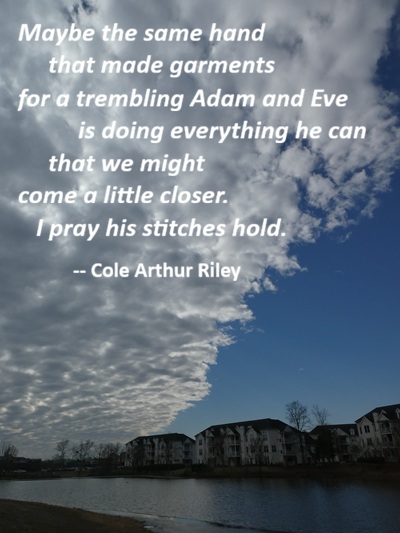
Our dignity may involve our doing, but it is foremost in our very being – our tears and emotions, our bodies lying in the grass, our scabs healing. I try to remember that Eve and Adam bore the image of God before they did anything at all. This is very mysterious to me, and it must be protected.

— Cole Arthur Riley, This Here Flesh, p. 12

Photo: Purple Iris, South Riding, Virginia, May 17, 2025

Seeing Differently

It’s about seeing differently. We then undertake the search for innocence in the other. We cease to find the guilty party. We no longer divide into camps: Heroes and Villains. We end up only seeing heroes. We look for the unchangeable goodness that’s always there in the other. Love as the Geiger counter watching for any sign of light and strength. This goodness is a heat-seeking force. Love always sees how far we’ve come. You see Lefty and presume “he’s up to all good.” This real self, truly the Christ self, is experienced as expansive and huge.

It will always be less exhausting to love than to find fault. When we see fault, we immediately believe that something has to be done about it. But love knows that nothing is ever needed. Ever. As the homie Stevie says daily: “Love, love, and more love.” Only love sees.

— Gregory Boyle, The Whole Language, p. 40-41.

Photo: Purple irises by a lake, South Riding, Virginia, May 6, 2025

Go High

If our postmodern world seems highly subject to cynicism, skepticism, and what it does not believe in, if we now live in a post-truth America, then we “believers” must take at least partial responsibility for aiming our culture in this sad direction. The best criticism of the bad is still the practice of the better. Oppositional energy only creates more of the same. All problem solving must first be guided by a positive and overarching vision.

We must reclaim the Christian project, building from the true starting point of Original Goodness. We must reclaim Jesus as an inclusive Savior instead of an exclusionary Judge, as a Christ who holds history together as the cosmic Alpha and Omega. Then, both history and the individual can live inside of a collective safety and an assured success. Some would call this the very shape of salvation.

–Richard Rohr, The Universal Christ, p. 67-68

Photo: South Riding, Virginia, February 12, 2025

My Own Small Role

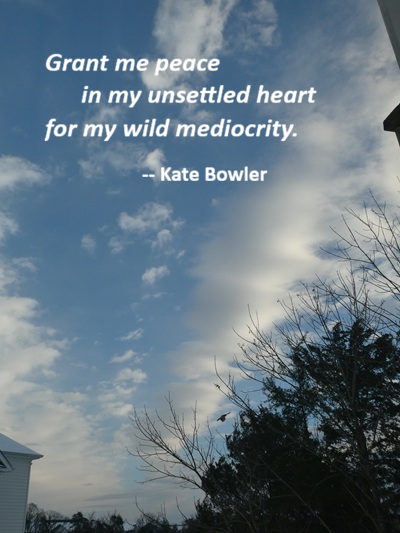
We too easily minimize the good that can be done by seemingly insignificant people in inconsequential places. Ours is a world where influence is measured by the number of likes or followers on social media. For every fantastic story that goes viral, there are countless others that are never told – stories about faithful people aware of their smallness in obscure or forgotten places who bless the world. History reminds us that those “small” stories matter, more than we may ever know.

I have my own small role to play, and so do you.

–Tracy Balzer, A Journey of Sea and Stone, p. 50-51

Photo: South Riding, Virginia, January 17, 2025

Unshakable

People settle for saying that every human being is “worthy” or “valuable.” But these ideas are still stuck in the “measurable.” “He is a valuable member of our team.” “He is unworthy to be president.” But goodness is unshakable. Solid. The truth. There is not a thing one can do to make this not so. God does not hope that we become something other than what we are. The Pharisees kept trying to be somebody, but they didn’t know they already were. You teach children that they are valuable by valuing them. Not by insisting that they prove their value to you. There are lots of things and toxins and blindness that keep us from acknowledging this and seeing it as true, but nonetheless, it is immutably certain. Before we can love goodness, we need to find it, and see it. It’s there. It’s there.

— Gregory Boyle, The Whole Language, p. 37

Photo: Bull Run Regional Park, Virginia, March 29, 2024