Practicing Lament

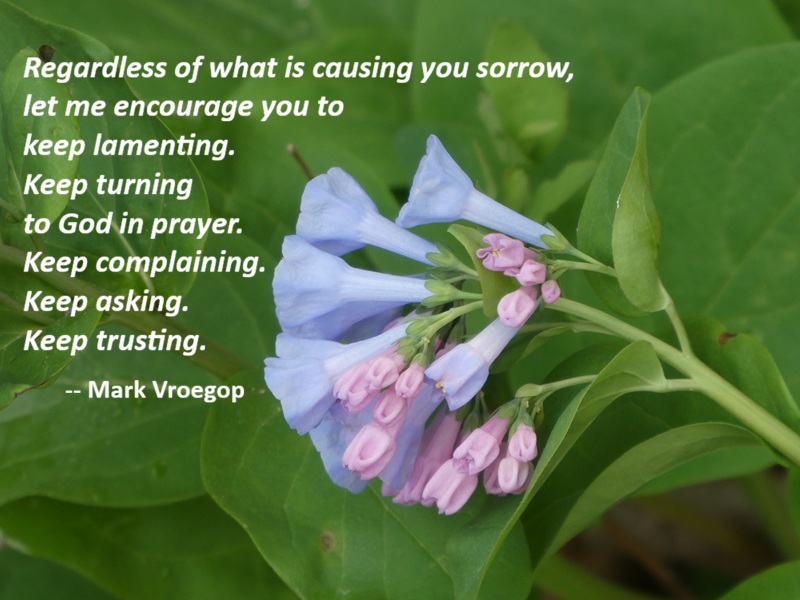
Practicing lament in the more common frustrations and less severe sorrows not only brings comfort but also develops a fluency in the language of loss. The heart behind this book is to help you discover the grace of putting lament into practice in ways that fit with all the pains of life. Regardless of what is causing you sorrow, let me encourage you to keep lamenting. Keep turning to God in prayer. Keep complaining. Keep asking. Keep trusting. In the same way that working a muscle trains it to carry greater weight, the spiritual exercise in lament prepares us for future hardship.

— Mark Vroegop, Dark Clouds, Deep Mercy, p. 163

Photo: Bluebells at Bull Run Regional Park, Virginia, April 3, 2026

Invitation of Lament

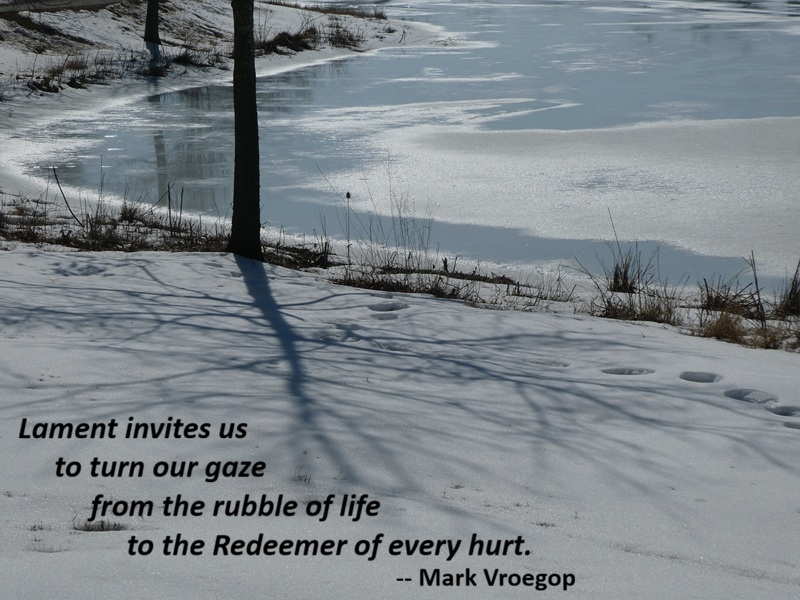
Lament begins by turning to God in prayer. We’ll discover the supply of grace that comes as we take the step of faith to reach out to God. Lament invites us to turn our gaze from the rubble of life to the Redeemer of every hurt. It calls us to turn toward promise while still in pain.

— Mark Vroegop, Dark Clouds, Deep Mercy, p. 29

Photo: South Riding, Virginia, February 14, 2026

Prayer Takes Time

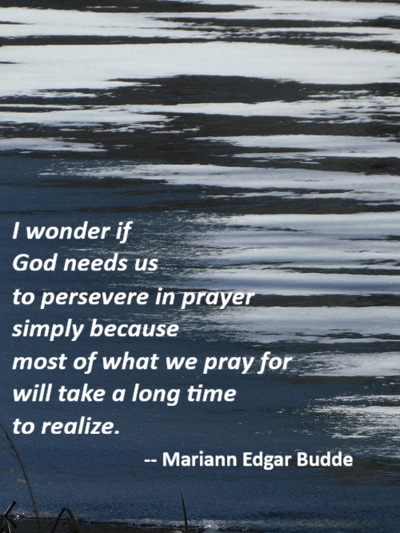
I wonder if God needs us to persevere in prayer simply because most of what we pray for will take a long time to realize. We pray for healing for ourselves and those we love, knowing that in most cases the process is slow. We pray for peace within our families or in the human family, and we know that peace isn’t readily attained and often comes at a dreadfully high price. We pray for justice, knowing that it is always hard-won and takes generations to accomplish.

— Mariann Edgar Budde, How We Learn to Be Brave, p. 176

Photo: Snow on frozen lake, January 1, 2026

Lament as a Path to Praise

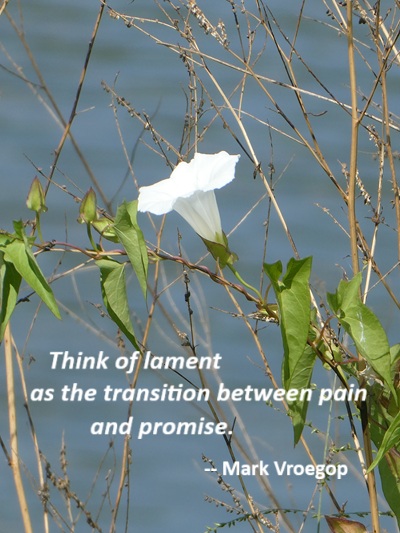
You might think lament is the opposite of praise. It isn’t. Instead, lament is a path to praise as we are led through our brokenness and disappointment. The space between brokenness and God’s mercy is where this song is sung. Think of lament as the transition between pain and promise.

It is the path from heartbreak to hope.

— Mark Vroegop, Dark Clouds, Deep Mercy, p. 28

Photo: South Riding, Virginia, August 9, 2025

It’s Okay to Have Needs.

The feeder is empty again
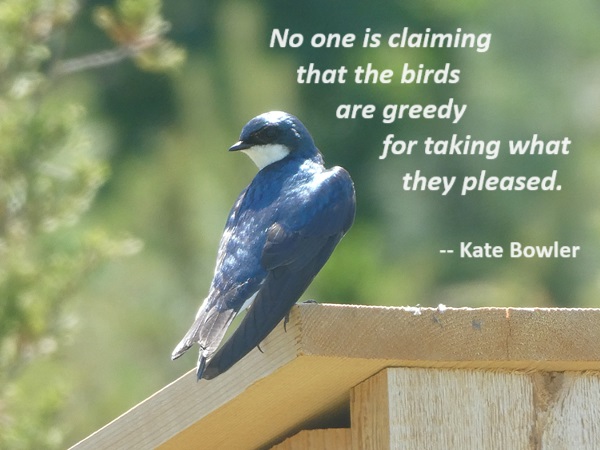
and no one is claiming
that the birds are greedy
for taking what they pleased.

Look at how the fat, pink flowers
are weighing the end of each branch,
sucking nutrients into each velvet petal.
How selfish.

Nature hungers, takes, and needs.
God, why can’t I?

Blessed are we, learning to take
what we need.
Sleeping past our alarms.
Reaching for another helping.
Staying a little longer
when the evening is unwinding.

— Kate Bowler, Have a Beautiful, Terrible Day! Daily Meditations for the Ups, Downs, and In-Betweens, p. 19

Photo: Tree Swallow, South Riding, Virginia, May 21, 2024

How Prayers Are Answered

That’s how prayers are answered: some doors get locked and others get opened. And then there’s the waiting room. I know my friend is now in that waiting room, fearing that no door will open for her again now that this one has shut. I know better, though I have no idea what you’re up to. I told her to just surrender the mess of everything to You. Earthly chaos is really your sandbox. You will reroute her life. I told her not to interfere with Your plans for her. No offering You advice or limitations or restrictions. Surrender means surrender. Let go, and let You have at it.

— Caroline Myss, Intimate Conversations with the Divine, p. 119

Photo: Bluebell Trail, Bull Run Regional Park, April 18, 2008

Rejection Is Protection

I saw such sorrow on a friend’s face today, Lord. Something did not work out the way she had hoped. There was once a time when I would have prayed for her to get the position she was aiming for. When I think of that now, how I used to pray, I wince in my soul. It took me years — and maybe lifetimes — to understand my folly. Thinking that I know what is best for someone, and that You require my guidance — my intervention — to direct another person’s life! I often replay the dream I had years ago, at the time I felt the doors had suddenly closed on the career I had chosen. I had been lamenting not getting my way. I was feeling sorry for myself, rejected by something I wanted, and abandoned by heaven, so to speak. I was not in good shape. But in a dream visitation I was informed that “earthly rejection is holy protection.” I woke up calm. Tranquil, as if I had slept under a blanket of grace. I have never doubted again — not once. When I released my unmet expectations to You, You led me down a path I did not see coming. One I could not have imagined because I never knew it existed.

— Caroline Myss, Intimate Conversations with the Divine, p. 118

Photo: South Riding, Virginia, February 27, 2021

Lifting People Up in Prayer

Intercession is really no more than loving people in prayer. It means setting their faces before us and sitting in their presence, still and quiet, for long enough to find out who they are and what they need — in short, for long enough to love them. In prayer meetings one often hears the words, “Lord, we lift up so-and-so before You.” As a formula this can grow tiresome; nevertheless it is exactly what we are to do. In our hearts we lift up people before the Lord, setting them above ourselves, above and beyond all our personal opinions and prejudices. We lift up people to God in order to see them not with our eyes but with His. Without this divine perception, we cannot pray rightly. We cannot bless others until we see them as God created them to be, pure and blameless.

— Mike Mason, Practicing the Presence of People, p. 197-198

Photo: South Riding, Virginia, December 31, 2015