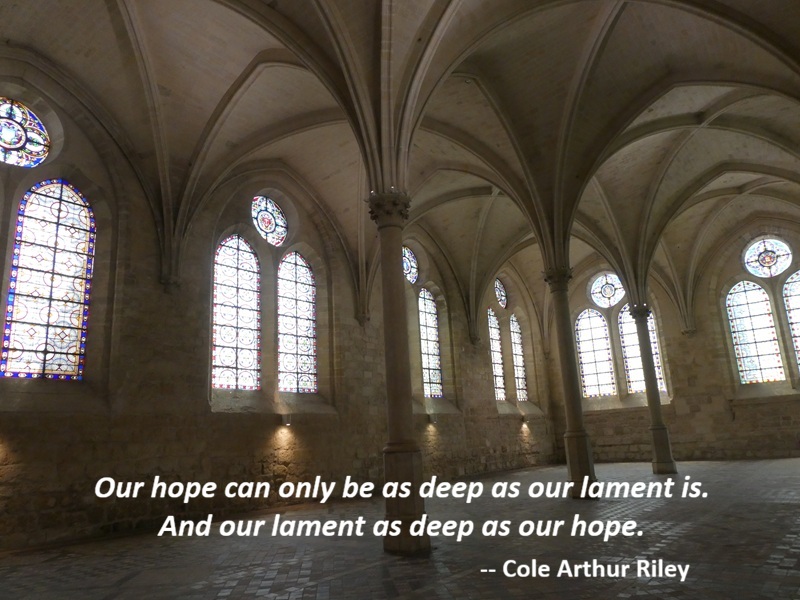
Lament and Hope

Too often I have heard people’s pain met with a Christia consolation which essentially communicates that the person in pain should learn to cling to hope, to trust in God. More often than not, I’ve found this unhelpful, and at worst a form of spiritual abuse that uses language of hope to manipulate the hurting into a feigned happiness.

This is also a foundational misrendering of lament. Lament is not anti-hope. It’s not even a stepping-stone to hope. Lament itself is a form of hope. It’s an innate awareness that what is should not be. As if something is written on our hearts that tells us exactly what we are meant for, and whenever confronted with something contrary to this, we experience a crumbling. And in the rubble, we say, God, you promised. We ask, Why? And how could we experience such a devastation if we were not on some mysterious plane, hoping for something different. Our hope can only be as deep as our lament is. And our lament as deep as our hope.

— Cole Arthur Riley, This Here Flesh, p. 101

Photo: Abbaye de Royaumont, France, June 24, 2026
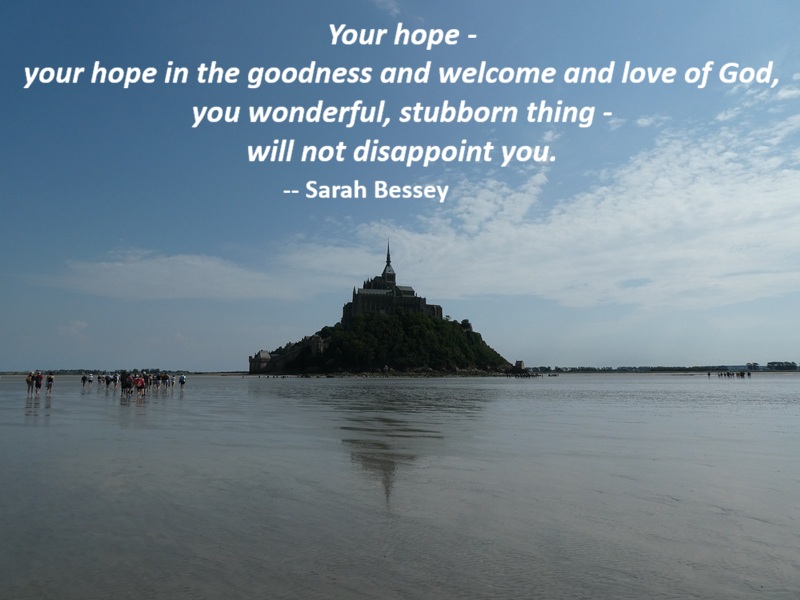
Don’t Surrender Your Hope.

Don’t surrender your hope just yet. Don’t let them take it from you. Bring it with you even as you travel. Tend it even as you leave behind the toxic beliefs and habits and spaces that do not bring flourishing to you or to the world. Your hope – your hope in the goodness and welcome and love of God, you wonderful, stubborn thing – will not disappoint you. You can take a risk on hope again. A longing fulfilled is a tree of life, and Revelation tells us about that tree of life, that its leaves are for the healing of the nations and the renewal of all things. We’re still walking toward Emmaus. Our hope is with us. And soon our eyes will be opened to who was walking us home all along.

— Sarah Bessey, Field Notes for the Wilderness, p. 72

Photo: The Bay of Mont Saint-Michel, June 20, 2026

People of Hope

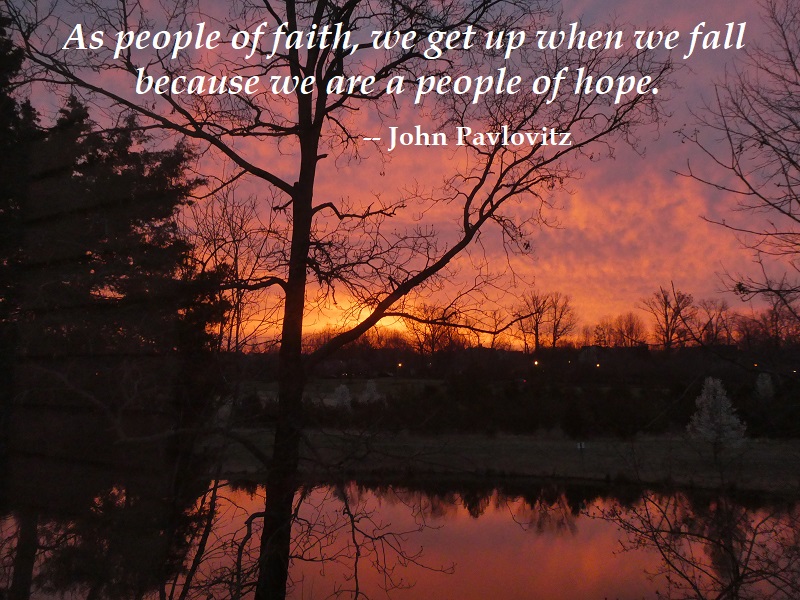
I don’t believe our suffering is a premeditated test that forces us to find meaning, but I believe that pain is a present opportunity to choose: a sacred space where we get to decide who we will be and what we will believe and how we will respond. As people of faith, we get up when we fall because we are a people of hope, we accept the descent as an invitation to rise again. The spiritual journey — like the human experience — is not a level, linear path where pitfalls are uniform and where growth is predictable and progress comfortable. It is a messy, meandering, awkward path of stops and starts. It is made of both the falling and the getting back up — and the former is often far easier than the latter.

— John Pavlovitz, Rise: An Authentic Lenten Devotional, p. 1-2

Photo: Sunrise, South Riding, Virginia, March 23, 2022

Cosmic Hope

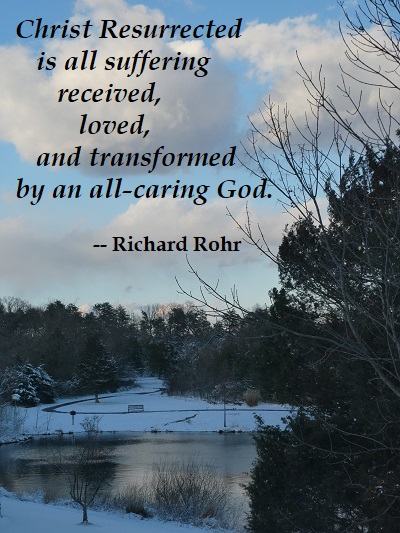
Christ Crucified is all the hidden, private, tragic pain of history made public and given over to God. Christ Resurrected is all suffering received, loved, and transformed by an all-caring God. How else could we have any kind of cosmic hope? How else would we not die of sadness for what humanity has done to itself and what we have done to one another?

The cross is the standing statement of what we do to one another and to ourselves. The resurrection is the standing statement of what God does to us in return.

— Richard Rohr, Yes, And…, p. 76

Photo: South Riding, Virginia, March 12, 2022

Love With Skin On

We are being shepherded beyond our fears and needs to becoming our actual selves. This sucks and hurts some days, and I frequently do not want it or agree to it. But it persists, like water wearing through a boulder in the river. Hope springs from realizing we are loved, can love, and are love with skin on. Then we are unstoppable.

— Anne Lamott, Dusk Night Dawn, p. 190-191

Photo: South Riding, Virginia, March 30, 2021