Always Growing

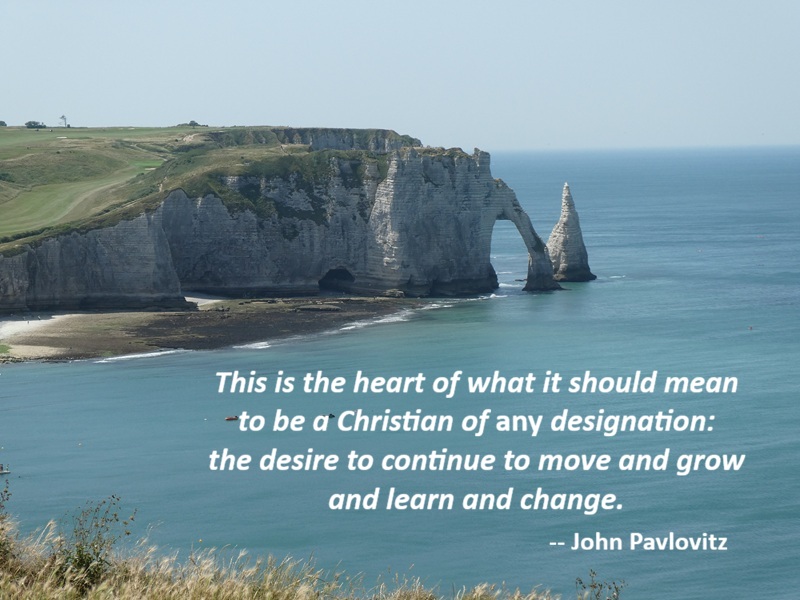
This is the heart of what it should mean to be a Christian of any designation: the desire to continue to move and grow and learn and change, even if those things place us in opposition to the person we once were or the beliefs we once held firmly or the testimony we once gave. As we move through space and time, our faith should be in continual evolution. We should always look back at the previous version of ourselves and realize how much we didn’t know then. We should be able to see how far we’ve come in matters of spirituality.

— John Pavlovitz, Worth Fighting For, p. 75

Photo: Étretat, France, June 23, 2026

Curiosity

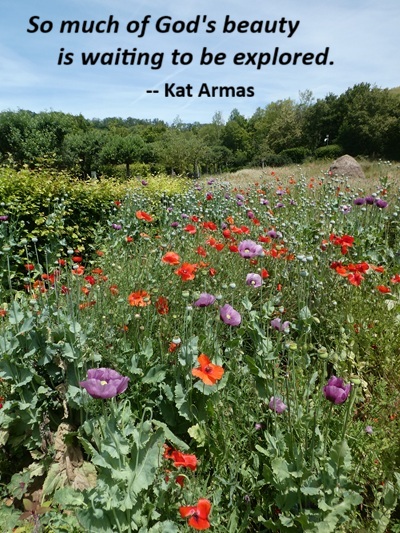
Curiosity is suspect in many Christian circles where people are convinced our faith rests only on following rules. It’s a slippery slope, some of us have been told. When it came to my spirituality, I was taught to seek answers over and above the sacred discipline of asking questions, and this proved detrimental when I became afraid to wonder and dream about God for fear of “straying from the faith.” I’m still not sure what that means. Curiosity has since become a great companion, a trusted friend who meanders along with me in kinship – in both the familiar and the unknown. We both know, Curiosity and I, that so much of God’s beauty is waiting to be explored. These are the paths of discovery that take root in us and eventually become passions, callings, and vocations. In this way, curiosity sometimes even saves us, enlivening us with purpose.

“Questioning is just as vital to awareness as using all our senses,” notes Haines. Questions are a direct reflection of our curiosity, inviting us to keep paying attention and to live as active characters in our own story. Too many have stopped noticing the Spirit because they believe they already have the answers they need. But a holistic and robust faith is a faith that is engaged – a faith that remains curious.

— Kat Armas, Sacred Belonging, p. 84-85

Photo: Field at Giverny, France, June 16, 2026
The Heart of It All

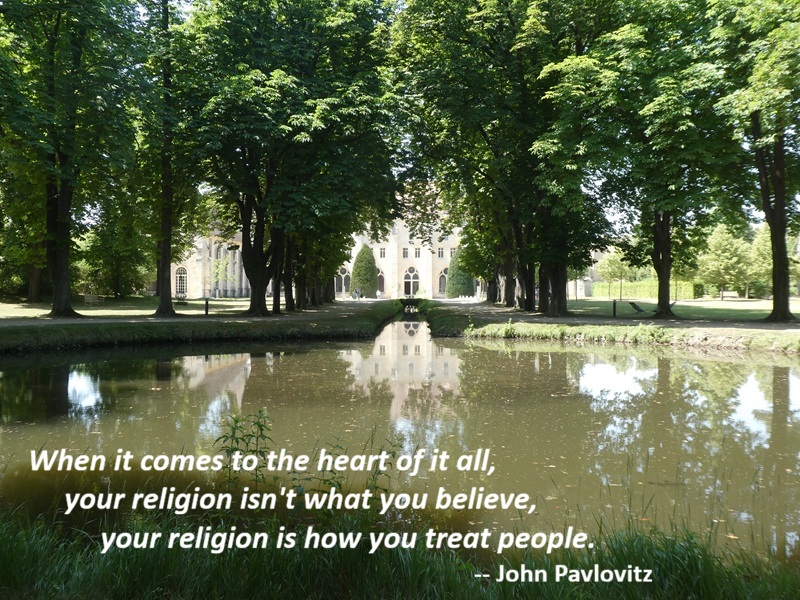
The way you treat other people is the only meaningful expression of your belief system anyway; it is the space where your values are on full display. Theologians and seminary students call this orthopraxy (your actions) as opposed to orthodoxy (your beliefs). Jesus called it the “fruit” of a life: the tangible, visible, feel-able part of human beings that reflects whatever has taken root in their hearts. Most people call it being a person of your word. When it comes to the heart of it all, your religion isn’t what you believe, your religion is how you treat people. The only real theology that’s of worth is relational theology. It exists in no other way that is meaningful to another human being. Whatever you have floating around inside your head or might preach about regarding a God of love is ultimately inconsequential. Your beliefs take the infinite, stratospheric, wonder-filled things of the cosmos and shrink them down into something you can hold in your hand. As we live alongside people, the theoretical and the abstract become tangible, personal realities. Our theological stance is revealed in the small places where our lives rub shoulders with someone else’s. It’s really easy to parrot back that you “love your neighbor” but a far greater challenge to love your actual neighbor when your neighbor is an abject jackass.

— John Pavlovitz, Worth Fighting For, p. 62-63

Photo: Abbaye de Royaumont, France, June 24, 2026

The Opposite of Faith

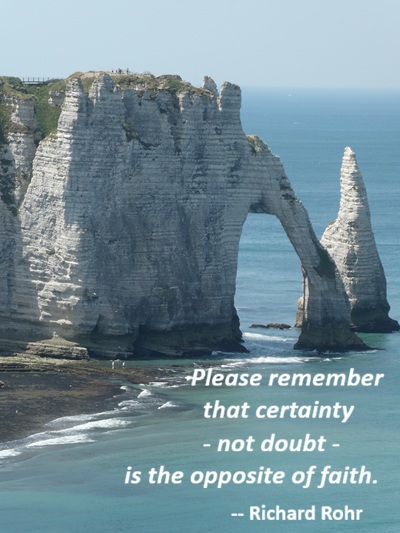
Please remember that certainty – not doubt – is the opposite of faith. The insistence on certainty reveals a need for control, not a need for love or understanding. Historians agree that much violence in human history has been religiously based, the predictable collision of two absolutely certain or dogmatic worldviews. Those views can be relied on to give us certitudes about our superiority, our judgments, and our actions, and they are also our most reliable justifications for scapegoating others. In light of such thinking, punishment becomes a moral mandate. If we are the loved ones and the “best,” then the ever-present other has to be punished or eliminated. These are the obstacles to love that must be shaved away in all of us.

— Richard Rohr, The Tears of Things, p. 154

Photo: Cliffs of Étretat, June 23, 2026

Missteps and Joys

One of the things we often deconstruct is the allure of a linear model of faith that says your life was always meant to be a strict progression from A to B, with requisite milestones, litmus tests, and boundary markers.

That was a nice fairy tale while it lasted, wasn’t it? By now you’ve learned the hard way that life is less about if-this-then-that certainties than it is a gorgeous and frustrating improvisation with missteps and joys as we grow up and into who we were meant to be all along. We all begin somewhere different, and your journey won’t be the same as mine (if you’re lucky).

Let your story be yours. Let your evolving faith be your own. Let God meet you in the particular goodness of you, not a printer copy of someone else’s best-case scenario for your life.

— Sarah Bessey, Field Notes for the Wilderness, p. 36-37

Photo: South Riding, Virginia, January 29, 2026

The Sacred Dance

When we believe the divine wills something absolutely, we stop wrestling with the complexity of the world. It’s how dualism still thrives in religious spaces today. I’ve felt it in many church settings – the pressure to see my own will as something to be set aside, to understand my desires as inherently in conflict with God’s. What I wanted, thought, or felt was always considered at odds with the divine. It wasn’t a both/and but an either/or. Either God was at work or I was. This set up a relentless internal tension, not just with God but with myself.

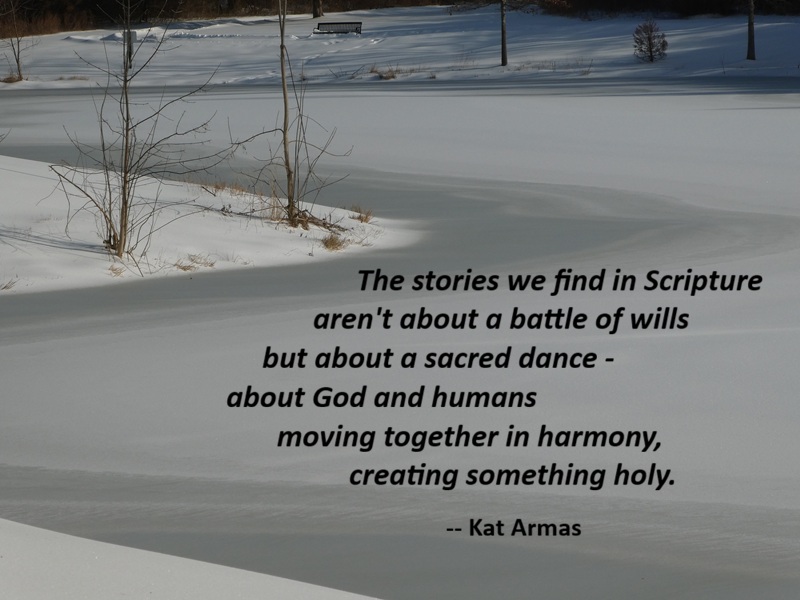
But the more I immersed myself in Scripture, the more I saw that God isn’t at war with humanity. The stories we find there aren’t about a battle of wills but about a sacred dance – about God and humans moving together in harmony, creating something holy. This reframing shifted something deep within me, reminding me that the religious life isn’t a struggle for control but a movement of grace and love.

— Kat Armas, Liturgies for Resisting Empire, p. 105-106

Photo: Icy lake, South Riding, Virginia, January 26, 2026

Witnesses to Resurrection

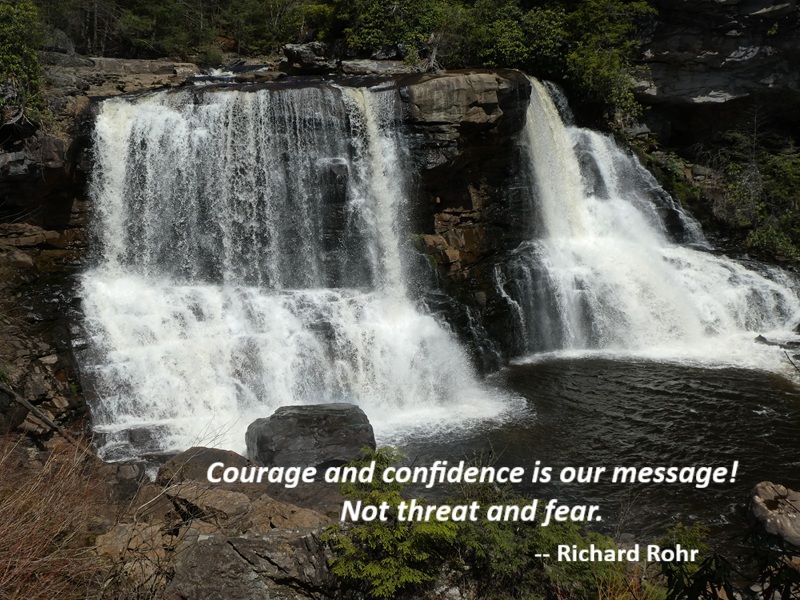
It is very interesting to me that the New Testament only “sends out” those (apostolos) who can be “witnesses to resurrection” (Luke 24:48, Acts 1:22, 3:15b, 13:31), that is, witnesses to this immense inner and outer conversation that is always going on. Otherwise, we have little to say that is really helpful, and we just create unnecessary problems for people. Negative or cynical people, conspiracy theorists, and all predictors of Armageddon are the polar opposites of witnesses to resurrection. And many such people appear to be running the world and even the churches. The Christ of John’s Gospel says, “Be brave. I have overcome the world” (16:33) and its hopelessness. Courage and confidence is our message! Not threat and fear.

— Richard Rohr, The Universal Christ, p. 175-176

Photo: Blackwater Falls, West Virginia, April 23, 2025.

He First Loved Us.

We can be gracious because we are grateful. We can love because we have been loved.

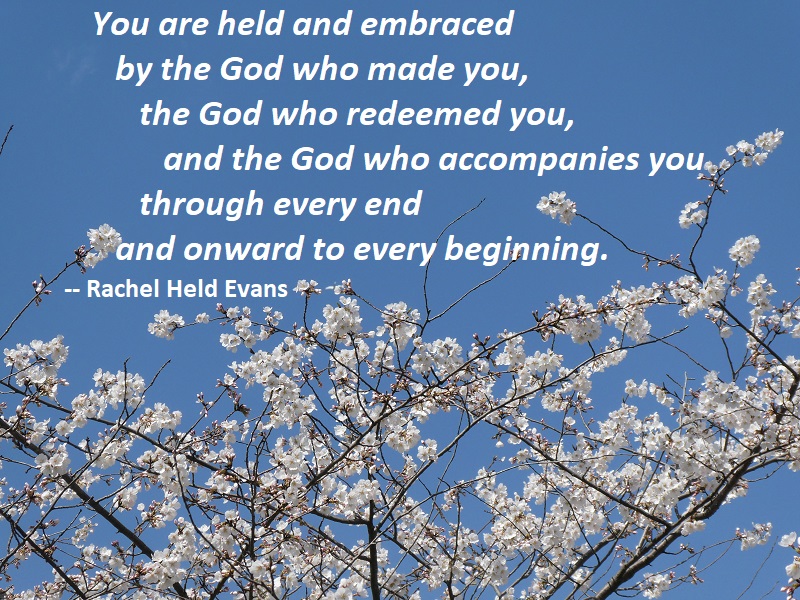
On the days when I believe, I know all this to be true. On the days when you believe, I hope you’ll know this to be true too. I hope you’ll feel deep within your heart and with every cell of your being that you are held and embraced by the God who made you, the God who redeemed you, and the God who accompanies you through every end and onward to every beginning.

Even on the days when I’m not sure I can believe it wholeheartedly, this is still the story I’m willing to be wrong about.

— Rachel Held Evans, Wholehearted Faith, p. 180-181

Photo: South Riding, Virginia, March 21, 2022