Shame Removed

Eve is being suffocated by her shame, but God calls her out. And he doesn’t call her out to rub her face in it. He calls her out of the bushes, out of her shame, to offer his grace and remind her of his love. But it doesn’t stop there. To me, the most amazing thing about this whole story is what comes next. Not only does God call Adam and Eve out of their shame, he also removes it altogether.

— Elizabeth Garn, Freedom to Flourish, p. 136

Photo: South Riding, Virginia, January 19, 2026

Metamorphosis

I am still learning this new life, and in many ways it still feels strange to me. I’ve begun filling the space that loss created around me. I can color the space around me however I want — finally — because now there is room. What I’m discovering is as surprising to me as the caterpillar’s transformation: life on the other side of loss is not only livable but may be better, richer, more meaningful. I am more of myself for having gone through this strange and painful transformation, like entering the darkness and coming out with wings.

— Maggie Smith, Keep Moving, p. 173

Photo: Sunrise over lake, South Riding, Virginia, December 17, 2025

Prayer Takes Time

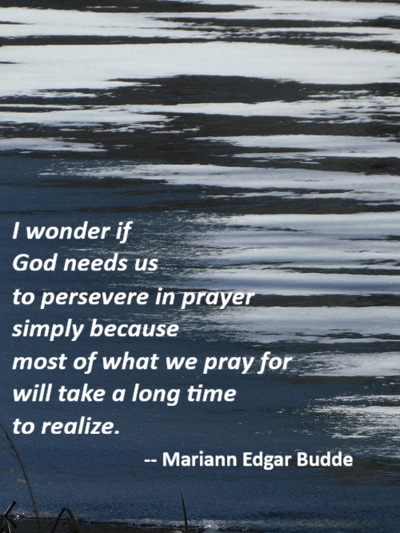
I wonder if God needs us to persevere in prayer simply because most of what we pray for will take a long time to realize. We pray for healing for ourselves and those we love, knowing that in most cases the process is slow. We pray for peace within our families or in the human family, and we know that peace isn’t readily attained and often comes at a dreadfully high price. We pray for justice, knowing that it is always hard-won and takes generations to accomplish.

— Mariann Edgar Budde, How We Learn to Be Brave, p. 176

Photo: Snow on frozen lake, January 1, 2026

Making Things Right

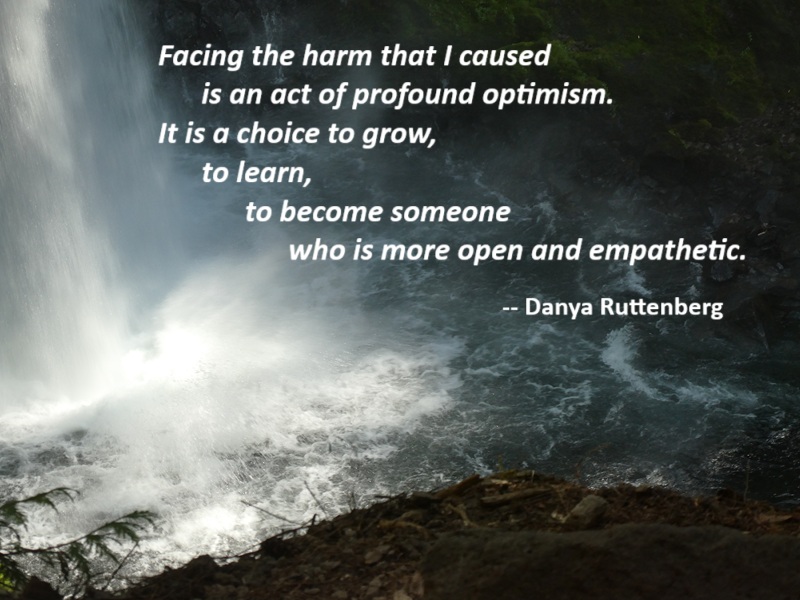
The reason to do repentance work is not because you are BAD BAD BAD until you DO THESE THINGS but because we should care about each other, about taking care of each other, about making sure we’re all OK. Taking seriously that I might have hurt you — even inadvertently! even because I wasn’t at my best! — is an act of love and care. It is an opportunity to open my heart wider than it has been, to let in more empathy, more curiosity about how my choices or knee-jerk reactions have impacted you, have impacted others. To care about others’ perspectives. To let your experience matter, deeply, to me. To look at another person — or a community, or a team of people — and say: Where are you? What are you feeling and experiencing now, and how might I have (even unwittingly) brought you pain or difficulty? And to care about making that as right as I can.

It’s an act of concern. And facing the harm that I caused is an act of profound optimism. It is a choice to grow, to learn, to become someone who is more open and empathetic.

It’s also important to remember that sincere repentance work isn’t the same as self-flagellation — in fact, the latter can become a convenient way to stay stuck in inaction. We probably all know at least one person who, when told they have done something harmful, will go deep into their feelings and their reasons and the ways they were acting out of their pain, and they feel so bad and they know that it’s so not OK and on and on. And yet — they don’t focus on the needs of the person they hurt, and they don’t do the work of change.

— Danya Ruttenberg, On Repentance and Repair, p. 58

Photo: Falls Creek Falls, Washington, June 16, 2025
Repairing What’s Broken

We can never undo what we have done. We can never go back in time. We write history with our decisions and our actions. But we also write history with our responses to those actions. We can leave the pain and the damage in our wake, unattended, or we can do the work of acknowledging and fixing, to whatever extent possible, the harm that we have caused. Repentance — tshuvah — is like the Japanese art of kintsugi, repairing broken pottery with gold. You can never unbreak what you have broken. But with the sincere and deep work of transformation, acts of repair have the potential to make something new.

— Danya Ruttenberg, On Repentance and Repair, p. 45

Photo: South Riding, Virginia, December 22, 2023

Jesus sees us.

Take a look at Luke 13:10-17. Jesus is in a synagogue on the Sabbath. The rabbis had rules about what you could and could not do on the Sabbath, but Jesus sees a powerless and infirm woman there, feeble and frail, bent over. She’d been disabled, Luke says, “by a spirit for eighteen years.” “When he saw her, Jesus called her to him and said, ‘Woman, you are set free from your sickness.’ He placed his hands on her and she straightened up at once and praised God” (verses 12-13). Can I tell you how much I love this picture of Jesus? He knows what he’s about to do is against the rules. Furthermore, he is in the synagogue and there is a religious leader there! But he cannot help himself. This woman has been in pain for eighteen years. This is one of the things I hope you will remember about Jesus: Jesus put people ahead of rules. The synagogue leader is undone and he chastises this woman and the crowd around, “There are six days during which work is permitted. Come and be healed on those days, not on the Sabbath day” (verse 14). I’ll let you read Jesus’s response in Luke 13:15-16 and how the crowd responded in verse 17.

Notice, though, that he saw the woman. Notice that he had compassion for her. Notice that he refused to let her suffer anymore, Sabbath or not.

— Adam Hamilton, Luke: Jesus and the Outsiders, Outcasts, and Outlaws, p. 67.

Photo: From Klosterruine Disibodenberg, Germany, August 23, 2008.

Savior

It was not just the rich young man who asked Jesus how to be saved. All sorts of people in the gospels got saved before Jesus died on the cross. When Jesus healed, they experienced salvus, God’s salvation. They followed him. Lives were changed, transformed. Disciples did give up riches and goods that they might inherit eternal life. Tax collectors abandoned their jobs and surrendered their social standing to eat with him. Children, slaves, soldiers, peasants, fishermen, farmers, prisoners, the sick, the blind, the lame — when they encountered Jesus, they found salvation, the wholeness, the healing, the oneness with God that had only been the stuff of longing. Every miracle, every act of hospitality, all the bread broken and wine served, everything that Jesus did saved people long before Rome arrested and murdered him.

It was all this loving and healing and saving that got him in trouble with authorities. He was not killed so his death would save people; he was killed because he was already saving them. He threatened a world based in fear, one held in the grip of Roman imperialism, by proving that a community could gather in love, set a table of plenty, and live in peace with a compassionate God. Jesus did at-one-ment long before being nailed to a cross. At-one-ment was the reason the authorities did away with him. No empire can stand if the people it oppresses figure out that reconciliation, love, liberation, and oneness hold more power than the sword. So Rome lynched Jesus: tortured him and hung him on a tree. That is the raw truth under all those sophisticated atonement theories.

Jesus was born a savior, and he saved during his lifetime. “Fear not!” “Peace on earth!” He did not wait around for thirty-three years and suddenly become a savior in an act of ruthless, bloody execution. Indeed, the death was senseless, stupid, shameful, evil. It meant little other than silence without the next act — resurrection — God’s final word that even the most brutal of empires cannot destroy salvus. This is no quid pro quo. Rather, Easter proclaims that God overcoes all oppression and injustice, even the murder of an innocent one. At-one-ment means just that. Through Jesus, all will be renewed, made whole, brought back into oneness, reunited with God. Salvation is not a transaction to get to heaven after death; rather it is an experience of love and beauty and of paradise here and now. No single metaphor, not even one of Paul’s, can truly describe this. We need a prism of stories to begin to understand the cross and a lifetime to experience it.

— Diana Butler Bass, Freeing Jesus, p. 96-98.

Photo: Dunluce Castle, Ireland, July 2001

What You’ve Learned

Consider what you’ve learned about yourself through grief: Now you know how strong you are. Now you know what you can bear. Think about this strange gift — being confident in what you are capable of. Go forward with that strength.

KEEP MOVING.

— Maggie Smith, Keep Moving, p. 113

Photo: Cooper’s Hawk, South Riding, Virginia, March 14, 2022