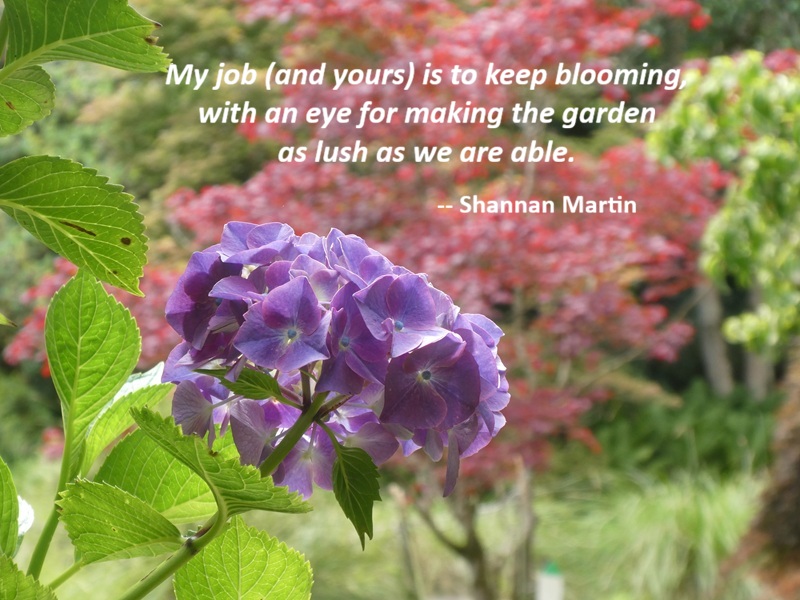
Keep Blooming

I still believe in heaven, but I am compelled by the breath of God permeating this love-crafted world and by the whole lot of us who are knocking around, messing up, and grateful for do-overs, mercy, and gentle human contact along the way. Anyone paying attention is painfully aware of the stark injustices that plague our land. I, regrettably, have no easy answers for this. It is not my task to explain or defend God.

My job (and yours) is to keep blooming, with an eye for making the garden as lush as we are able. As we do this slow, daily work, God’s kingdom is made known, right here, right now, to all who live. Escaping earth’s pain and confusion by being beamed into heaven was never God’s holy endgame. The Good News is not that God will save us from reality but that God will redeem it, healing everything bruised and broken – even us.

— Shannan Martin, Counterweights, p. 24-25

Photo: Parc Botanique de Haut Bretagne, France, June 19, 2026
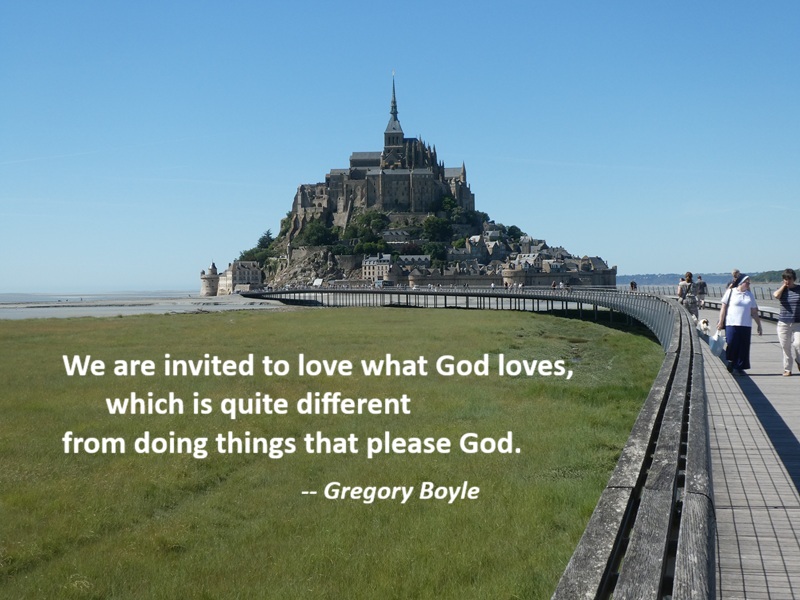
Love What God Loves

What we get most wrong about God is that God can be pleased or displeased. I was directing a group retreat on Zoom during the pandemic, and one of the retreatants asked, “Well, isn’t God pleased with some things and displeased with other things?”

I said: “We smile and frown, ‘cuz we’re human beings. God doesn’t smile at us … God adores us. And God doesn’t frown, either, ‘cuz God’s too busy adoring us.” God’s whole being says, “There is nothing you can do to make me stop loving you.” We want to be rooted in this loving presence. Find the pony. Feel God’s adoration. Julian of Norwich called it “Oneing.” Gregory of Nyssa described it as “intimacy with God,” where we are granted a taste of our oneness with God, and when we don’t feel it, the taste only serves to galvanize our longing for more. Kabir said, ” When the Guest is being searched for, it is the intensity of the longing for the Guest that does all the work.” We are invited to love what God loves, which is quite different from doing things that please God. The prayer of our life is to lean toward the God of love and say, “Give me your eyes. Then all we’ll see is glorious.”

— Gregory Boyle, Cherished Belonging, p. 24

Photo: Mont Saint-Michel, June 17, 2026

Children of Light

To be “children of light” – people in whom the gospel shines brightly – is different from being morally perfect or never failing. Any focus on perfection was an utterly false and illusory goal that made Christianity into a cult of innocence, whose adherents are so often full of blame and denial that they allow their fault to be projected onto others, unable to see similar failings in themselves.

When Jesus said we are “the light of the world” (Matthew 5:14), he said we must extend this light to “everyone in the house” (5:15) in the form of our own “good works” (5:16), not just exposing others’ bad works. But light does what light does. It clarifies, helps us see fully, and gives us the insight, freedom, and courage to perceive ourselves rightly. Divine light does not inflate us with the pride of “I know,” but illuminates those around us with the gratitude of “I am, too” – a kind of joining “everyone in the house.” Both light and love reveal not our separate superiority, but rather our radical sameness. That quality is, in fact, the way you can tell divine light from human glaring.

— Richard Rohr, The Tears of Things, p. 145-146

Photo: Tulips at Burnside Farms, Virginia, April 7, 2026

Rest

We often see rest as a tool to help us be more efficient later or as a way to prevent burnout, as if burnout is the natural order of things. But here’s a truth I find pressing for our time: Never did Jesus say “rest now so you can work harder later.” Rest was never framed as something we do only to be more productive afterward. In a world obsessed with efficiency, where rest is seen as a way to recharge for more labor, Jesus shows us something else. He offers rest as an end in itself, as a way of being, a gift that is not earned but given freely. His rest is not about being more useful tomorrow; it’s about being fully human today.

— Kat Armas, Liturgies for Resisting Empire, p. 124

Photo: Tulips at Burnside Farms, Nokesville, Virginia, April 8, 2026

Image Bearers

Adam and Eve walked out from the garden loved, called, and chosen. Their eyes were firmly fixed on God’s promise to make all things new. They weren’t wandering, and they weren’t lost, and we don’t need to be either. We are image bearers of God. We are created out of his abundant love, we were called with a purpose, and we have been equipped to imitate him! We live out the image of God together and in every sphere of our lives. We imitate him at home, at work, and at church. We fill and subdue; we create and bring order both in the secular and spiritual realms. We have been called to bring the fullness of God to the world, and we do that by living as his image.

We have been freed to live as image bearers of God.

— Elizabeth Garn, Freedom to Flourish, p. 138-139

Photo: Cherry blossoms, South Riding, Virginia, March 31, 2026

My Wild Mediocrity

God, give me satisfaction in the trying.
Give me joy in the never-quite-there.
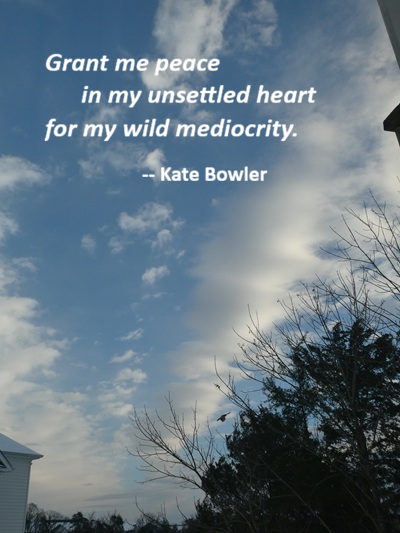
Grant me peace in my unsettled heart
for my wild mediocrity.
Help me smile back
at the truth that no one,
not one, knows perfection but you.
And you already looked at this
messy creation
at the beginning of time
and pronounced it pretty darn good.

— Kate Bowler, Have a Beautiful, Terrible Day! p. 79

Photo: South Riding, Virginia, January 26, 2026

Missteps and Joys

One of the things we often deconstruct is the allure of a linear model of faith that says your life was always meant to be a strict progression from A to B, with requisite milestones, litmus tests, and boundary markers.

That was a nice fairy tale while it lasted, wasn’t it? By now you’ve learned the hard way that life is less about if-this-then-that certainties than it is a gorgeous and frustrating improvisation with missteps and joys as we grow up and into who we were meant to be all along. We all begin somewhere different, and your journey won’t be the same as mine (if you’re lucky).

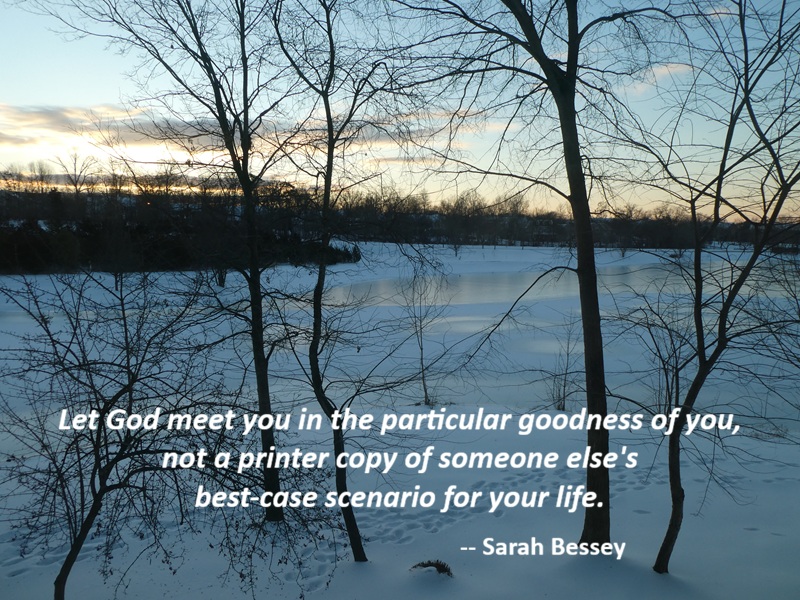
Let your story be yours. Let your evolving faith be your own. Let God meet you in the particular goodness of you, not a printer copy of someone else’s best-case scenario for your life.

— Sarah Bessey, Field Notes for the Wilderness, p. 36-37

Photo: South Riding, Virginia, January 29, 2026

The Sacred Dance

When we believe the divine wills something absolutely, we stop wrestling with the complexity of the world. It’s how dualism still thrives in religious spaces today. I’ve felt it in many church settings – the pressure to see my own will as something to be set aside, to understand my desires as inherently in conflict with God’s. What I wanted, thought, or felt was always considered at odds with the divine. It wasn’t a both/and but an either/or. Either God was at work or I was. This set up a relentless internal tension, not just with God but with myself.

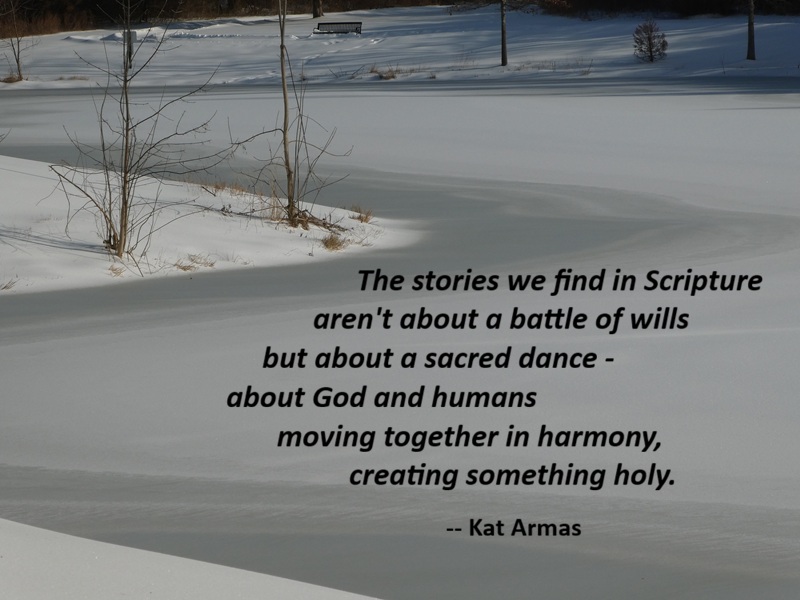
But the more I immersed myself in Scripture, the more I saw that God isn’t at war with humanity. The stories we find there aren’t about a battle of wills but about a sacred dance – about God and humans moving together in harmony, creating something holy. This reframing shifted something deep within me, reminding me that the religious life isn’t a struggle for control but a movement of grace and love.

— Kat Armas, Liturgies for Resisting Empire, p. 105-106

Photo: Icy lake, South Riding, Virginia, January 26, 2026

Metamorphosis

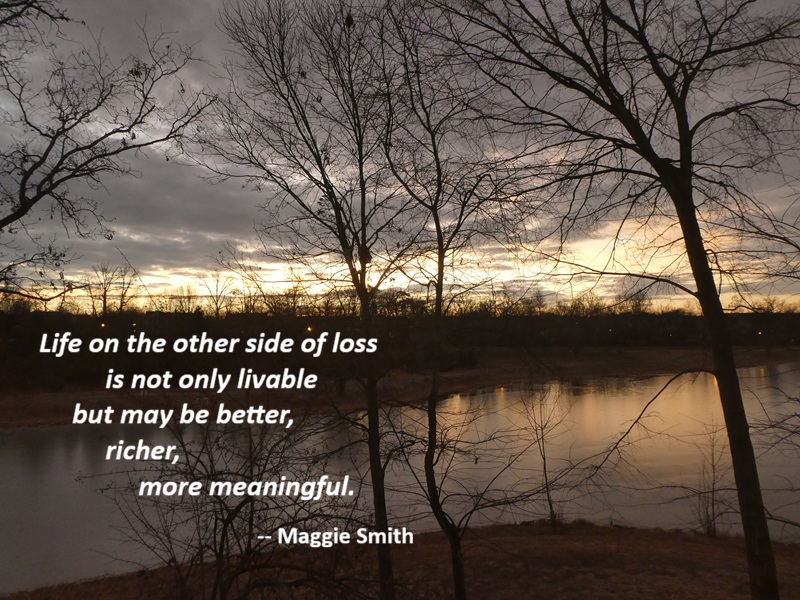
I am still learning this new life, and in many ways it still feels strange to me. I’ve begun filling the space that loss created around me. I can color the space around me however I want — finally — because now there is room. What I’m discovering is as surprising to me as the caterpillar’s transformation: life on the other side of loss is not only livable but may be better, richer, more meaningful. I am more of myself for having gone through this strange and painful transformation, like entering the darkness and coming out with wings.

— Maggie Smith, Keep Moving, p. 173

Photo: Sunrise over lake, South Riding, Virginia, December 17, 2025