Multitude of Stories

[About the Tower of Babel:]
But God intervenes, not to punish them, but to disrupt their project of homogenization. God creates diversity where there was uniformity, scattering them with new languages, new cultures, and a plethora of voices. They wanted control, but God imposed chaos – a kind of holy chaos that prevents the concentration of power.

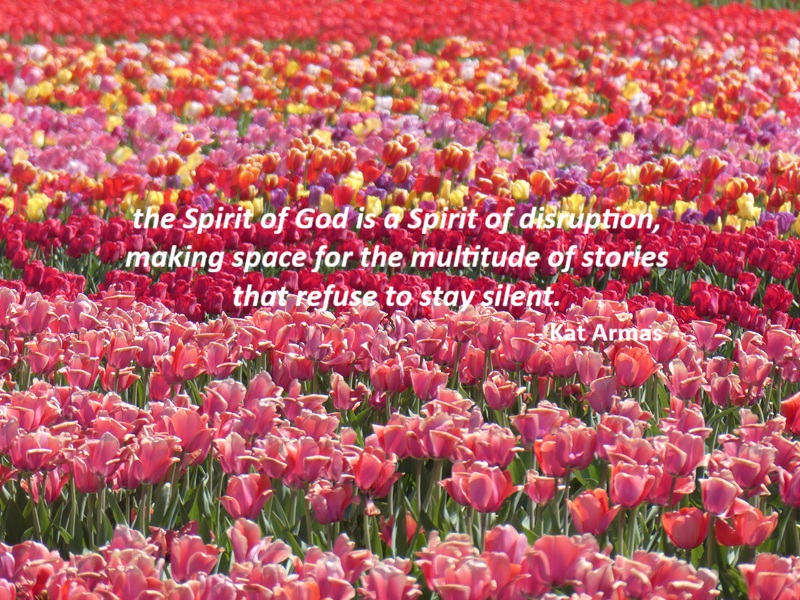
Walter Brueggemann speaks to this, noting that a human unity, when built outside God’s will, often ends in “oppressive conformity.” The people of Babel weren’t just unified; they were uniform. And in that uniformity was a desire to control what was different and unpredictable. But the Spirit of God is a Spirit of disruption, making space for the multitude of stories that refuse to stay silent.

— Kat Armas, Liturgies for Resisting Empire, p. 145

Photo: Burnside Farms, Nokesville, Virginia, April 7, 2026

God Persists in Love.

Since God persists in love, no matter how dark things get, God is not preoccupied nor enfeebled by our “sin.” This is true because God doesn’t see sin but wholeness. God sees right through it. A homie texted me, sending a YouTube homily by a bishop who spoke of sin and the need for a “contrite heart.” This gave the homie a passageway to deem himself really, “a worthless piece of shit.” I texted back only this: “God doesn’t see sin. God sees son.” The relief in his next text was palpable. His notion of sin was self-estranging. He wanted to accept that he was “son” but didn’t know how to dare to believe it.

— Gregory Boyle, Forgive Everyone Everything, p. 26

Photo: Bluebells at Bull Run Regional Park, Virginia, April 3, 2026

To Win Us Over

Jesus did not die in order to win God’s love for us, but to win us over with God’s love. God’s love went to the limit for us, dove into the depths of the human condition, suffered the consequences of our sin by dying a terrible death as an innocent man. And in the midst of that suffering love, Jesus revealed the greatest love of all — forgiving his enemies and praying to God to do the same. Through the incarnation, God took on human flesh and gave human flesh the life of God.

— Sharon L. Baker, Executing God, p. 147

Photo: South Riding, Virginia, May 16, 2026

Too Busy Loving Us

Part of the quest is to be freed from everything that is not God. Eckhart thought we should rid ourselves of the irrelevant stuff, the tired views of God and religious language that block the pores of our soul. Richard Rohr says that your image of God creates you. Our God is self-effacing. We aren’t. This may be one of the reasons why we have such a hard time connecting to the God of love. God is not needy. We are. God does not long to be liked. We do. God is never fishing for a compliment. That’s our thing. Homies are endlessly insisting, for example, that everything happens for a reason. God is behind every reasonableness and everything unreasonable. When the opportunity affords itself, I will tell homies that God is too busy loving them to have any time left for orchestration. Sometimes we are saddled with an image of God that does not create us in God’s image.

— Gregory Boyle, Cherished Belonging, p. 17

Photo: Burnside Farms, Nokesville, Virginia, April 7, 2026

God Didn’t Make Us to Hate Us

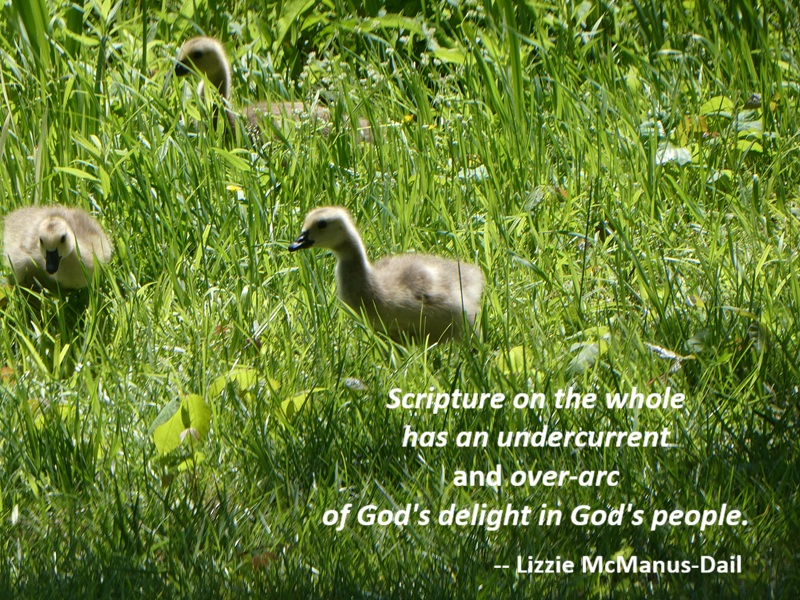
God is not so small-minded or vindictive as to make people in order to just . . . hate them. I mean, look at the sheer multitude of galaxies in the universe. The membranes of butterfly wings. The way a toddler’s teeth make the most crooked and sublime smile when they laugh. The dreamer-upper of these things isn’t an asshole. I just don’t buy it. The Bible doesn’t sell it, either; while full of challenging and complex stories that do dip into the lament and wrath of God, scripture on the whole has an undercurrent and over-arc of God’s delight in God’s people.

— Rev. Lizzie McManus-Dail, God Didn’t Make Us to Hate Us, p. xii-xiv

Photo: Goslings, South Riding, Virginia, May 8, 2026

A Lover, Not a Dictator

Everything belongs. God uses everything. There are no dead-ends. There is no wasted energy. Everything is recycled. Sin history and salvation history are two sides of one coin. I believe with all my heart that the Gospel is all about the mystery of forgiveness. When you “get” forgiveness, you get it. We use the phrase “falling in love.” I think forgiveness is almost the same thing. It’s a mystery we fall into: the mystery is God. God forgives all things for being imperfect, broken, and poor. Not only Jesus but all the great people who pray that I have met in my life say the same thing. That’s the conclusion they come to. The people who know God well – the mystics, the hermits, those who risk everything to find God – always meet a lover, not a dictator. God is never found to be an abusive father or a tyrannical mother, but always a lover who is more than we dared hope for. How different than the “account manager” that most people seem to worship.

— Richard Rohr, Everything Belongs, p. 130-131

Photo: Irises, South Riding, Virginia, May 2, 2026

Power With

But Jesus gave up power and privilege to stand in solidarity with humanity. In this way, the Spirit of God sets aside power-over in favor of power-with for the sake of justice. Where power-over is marked by dominance, coercion, and control, power-with is marked by collaboration and cocreation. It is a power rooted in collective action and relationship. A God who invites us to “argue it out” is a God of power-with, power shared. This God is dynamic: one who feels, who responds to our pleas, and who can be accessed by humans. This is a God many of us were not introduced to but had to discover on our own.

— Kat Armas, Sacred Belonging, p. 62

Photo: Bluebells at Bull Run Regional Park, Virginia, April 3, 2026

Chosen to Love

Think of the many, many stories about God choosing people. There are Moses, Abraham, and Sarah. There are David, Jeremiah, Gideon, Samuel, Jonah, and Isaiah. There is Israel itself. Much later, there are Peter and Paul, and, most especially, Mary.

God is always choosing people. First impressions aside, God is not primarily choosing them for a role or a task, although it might appear that way. God is really choosing them to be God’s self in this world, each in a unique situation. If they allow themselves to experience being chosen, being a beloved, being somehow God’s presence in the world, they invariably communicate that same chosenness to others. Thus the Mystery passes on, from age to age. Yes, we do have roles and tasks in this world, but finally they are all the same — to uniquely be divine love in a way that on one else can or will.

— Richard Rohr, Yes . . . And: Daily Meditations, p. 286

Photo: South Riding, Virginia, March 24, 2026

Image Bearers

Adam and Eve walked out from the garden loved, called, and chosen. Their eyes were firmly fixed on God’s promise to make all things new. They weren’t wandering, and they weren’t lost, and we don’t need to be either. We are image bearers of God. We are created out of his abundant love, we were called with a purpose, and we have been equipped to imitate him! We live out the image of God together and in every sphere of our lives. We imitate him at home, at work, and at church. We fill and subdue; we create and bring order both in the secular and spiritual realms. We have been called to bring the fullness of God to the world, and we do that by living as his image.

We have been freed to live as image bearers of God.

— Elizabeth Garn, Freedom to Flourish, p. 138-139

Photo: Cherry blossoms, South Riding, Virginia, March 31, 2026