Unbounded Enthusiasm

If anything, loss is not meant to ruin us or our sleep for the rest of our lives. It simply prepares us to lose better the next time, to go into life over and over again, knowing full well that this phase, too, will end so that we can take our own unbounded enthusiasm into the next part of coming to wholeness. Whatever that may be.

— Joan Chittister, Between the Dark and the Daylight, p. 105

Photo: South Riding, Virginia, February 10, 2017

Changing Your Story

A victim is one who often feels helpless to respond to painful circumstances or to control thoughts and feelings. A hero has worked hard to overcome adversity and refuses to be beaten by difficult life events. Forgiveness is the journey of moving from telling the story as a victim to telling the story as a hero. Forgiveness means that your story changes so that you and not the grievance are in control.

— Fred Luskin, Forgive for Good, p. 138

Photo: South Riding, Virginia, February 20, 2019

Rejoice Always

If you’re unhappy now, don’t fret or feel guilty about it. Guilt and worry only perpetuate misery. Instead, be happy. Change your mind about the outrageous impracticality of this advice. If the Bible says “Rejoice always,” there must be something to it.

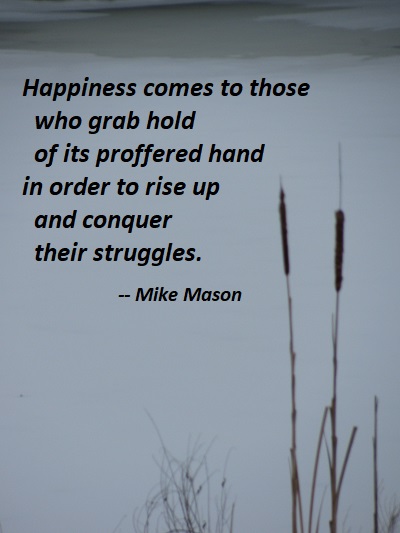
But you object: “I can’t be happy, because I’m sick,” or “I can’t be happy because my husband left me,” or “I can’t be happy, because I’m sad.” Don’t you understand? Happiness is the very weapon you need to surmount all these conditions. Happiness doesn’t come to those who sit around waiting until life gets better. Happiness comes to those who grab hold of its proffered hand in order to rise up and conquer their struggles.

— Mike Mason, Champagne for the Soul, p. 130

Photo: South Riding, Virginia, February 22, 2015

Unenforceable Rules

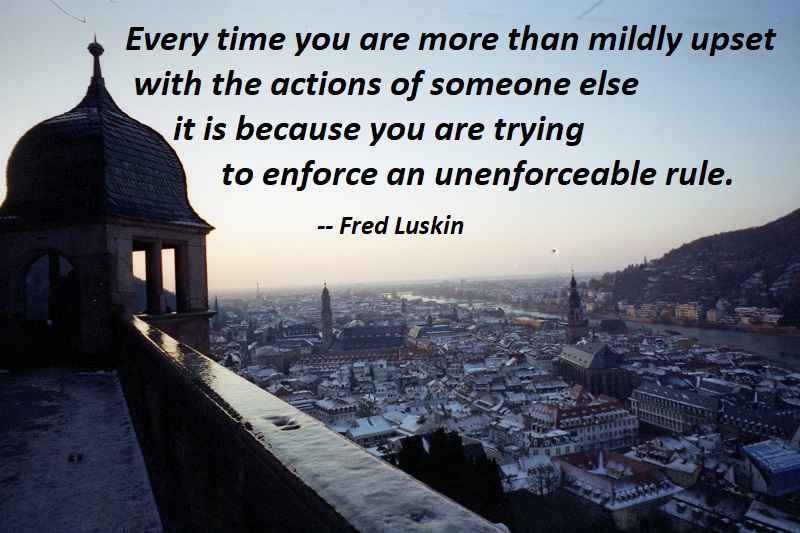
The good news is that challenging unenforceable rules is a simple process. Unenforceable rules make their presence known. You do not have to look far to find them. They do not hide under the rug. Every time you are more than mildly upset with the actions of someone else it is because you are trying to enforce an unenforceable rule. EVERY time you are more than mildly upset with your life it is because you are trying to enforce an unenforceable rule.

You will not stay angry or hurt unless an unenforceable rule of yours has been broken. You can be sure an unenforceable rule is operating when you feel angry, bitter, depressed, alienated, or hopeless. I am not saying there will be no sadness or frustration without unenforceable rules. I am not suggesting having feelings is wrong. What I am saying is that underneath your most painful feelings are rules you are helplessly trying to enforce. If you worked on challenging your rules when you start feeling upset, then your bad feelings won’t last and won’t be as severe.

— Fred Luskin, Forgive for Good, p. 128

Photo: Heidelberg, Germany, December 1996

The Choice of Empathy

Empathy is a choice. And it’s a vulnerable choice, because if I were to choose to connect with you through empathy, I would have to connect with something in myself that knows that feeling. In the face of a difficult conversation, when we see that someone’s hurt or in pain, it’s our instinct as human beings to try to make things better. We want to fix, we want to give advice. But empathy isn’t about fixing, it’s the brave choice to be with someone in their darkness — not to race to turn on the light so we feel better.

If I share something with you that’s difficult for me, I’d rather you say, “I don’t even know what to say right now, I’m just so glad you told me.” Because in truth, a response can rarely make something better. Connection is what heals.

If struggle is being down in a hole, empathy is not jumping into the hole with someone who is struggling and taking on their emotions, or owning their struggle as yours to fix. If their issues become yours, now you have two people stuck in a hole. Not helpful. Boundaries are important here. We have to know where we end and others begin if we really want to show up with empathy.

— Brené Brown, Dare to Lead, p. 142

Photo: South Riding, Virginia, January 15, 2019

Liberation Time

And yet, there is a resurrection that comes with loss. People can no longer see in us the person they saw before, true. But that is one of the gifts of loss. Loss frees us to begin again, to be seen differently, to tap into something inside of ourselves that even we were never really sure was there. But, whether we knew it or not, did badly want.

We can now — perhaps must now — be ourselves but in some very different ways. We don’t have to go on making a success of the family business. Or even being Mrs. Anybody. Or being called upon so often for the same things in life that we never get to show the world that we can do other things, as well. No doubt about it: Loss is liberation time.

Then we must begin even to know ourselves differently — as more than the mother or the son, the doorman or the doctor or the groundskeeper or the mail carrier. Now we have to dig deep inside us to find out what other parts of ourselves are waiting to be discovered.

— Joan Chittister, Between the Dark and the Daylight, p. 103-104

Photo: South Riding, Virginia, January 12, 2019

Praise and Blame

We all clamor for praise and recoil at blame. They are oddly and equally seductive. They pull us away from our center, and yet we strangely have grown dependent on blame and praise. Instead, we have to find our way to notice and return. Notice the positive sheen of praise and still refuse to cling to it. Choose to move quickly back to the center. Let the pang of this blame wash over you, abide in it, and then return immediately to your center. We want the “bliss of blamelessness,” as the Buddha would say, and yet find ourselves attaching to the praise of the crowd or the surly comment of the disgruntled. We try and gently catch ourselves when we’re about to let resentment harden into blame and let the illusion of praise define who we are.

— Gregory Boyle, Barking to the Choir, p. 104

Photo:  South Riding, Virginia, October 24, 2018


Moving Forward with Playfulness

As you are willing to move forward, your playfulness is a way of moving beyond any kind of contraction. Play creates flow. Be willing to share anything that needs to be shared, but be playful about that sharing. See how much you can play today, and how much you can get yourself into the flow. Play is the little sister of creativity, so treat it well. It will release old feelings of hurt and revenge if you allow it to do so.

— Chuck Spezzano, If It Hurts, It Isn’t Love, p. 393-394

Photo: Lake Ontario, July 1990

Taking Responsibility for Our Own Feelings

I want to make clear that taking responsibility for how you feel does not mean that what happened is your fault. You did not cause your parents to hurt you or your lover to cheat on you. You did not cause the car to hit you or the illness to strike you. You did not cause your boss to be grouchy nor did you cause the weather to stink on your vacation. While you did not cause these things to happen, you are responsible for how you think, behave, and feel since those experiences occurred. It is your life, and they are your reactions and emotions to manage.

Taking responsibility means first and foremost that even though we are hurt, we continue to make the effort to appreciate the good in our life. When we understand that pain is a normal part of life, we make the effort to keep our hurts in perspective. I challenge the common tendency to feel that our experience of hurt is more real than our ability to feel good. I challenge the tendency to assert that painful experiences are somehow deeper than rapture over the beauty of a sunset or the love we feel for our children.

Many of us are renting more space to rehashing our grievances than focusing on gratitude, love, or appreciation of nature. My central message here is when you bring more positive experiences into your life, your hurts will diminish in importance. In fact, this is the first step to taking responsibility for how you feel and beginning to forgive. If I rent out more and more space in my mind to appreciating my children or the loveliness of a rainy day, there is as a result less space and time for dwelling on the hurts.

— Dr. Fred Luskin, Forgive for Good, p. 111-112

Photo: South Riding, Virginia, March 21, 2018