Saving the World

You can save the world in a very simple way. Value everyone you see, connect your most humane values to theirs, and then let the principles of modeling, mimicry, emotional display, contagion, and reciprocity do their stuff. You don’t even have to make eye contact; it will work if you only do it in your head. Just regard everyone you see as a person of value. This creates a very subtle, mostly unconscious approach motivation, to which most people are likely to respond in kind, with subtle positive regard of the people they subsequently pass on the street. Many of the people you value on the street will take that unconscious, low-grade valuing state with them. They’re more likely to be nicer to their children and more pleasant to the people they see at work. And so will you.

Value every driver you see, even those who behave badly, and you’ll do a great deal to protect the safety of each child and adult with whom you share the road.

This new torrent of transmitting value along the Web of Emotion need not change your overt behavior at all. It will require next to no investment of time and energy. In fact, it will generate energy and give a sense of purpose to your time that might otherwise be empty or wasted. It will help you appreciate a fact that we easily ignore in our rushed and highly structured society; each person you pass on the street is as valuable as anyone in the world.

— Steven Stosny, Soar Above, p. 207-208

[Photo: Keukenhof, Holland, April 17, 2004]
Commitment to Joy

Yes, He does want His children to live in joy, and there’s a way to do it if we’ll trust Him.

The way begins with commitment. To become a Christian in the first place, one decides to follow Jesus no matter what. Why not make a similar commitment in regard to joy — to rejoice in the Lord always, no matter what? Isn’t it only a lack of faith that keeps us from this?

In conversations I’ve given up on trying to argue people out of their unhappiness. The more one reasons with them, the more their eyes glaze over. Theologically most Christians will probably agree that the Bible teaches and offers a life of joy, yet deep down they’re not convinced. They’re especially not convinced that such a life is possible for them, or for any ordinary person, right now. Neither seeing nor believing in the joy set before them, they’re resigned to unhappiness, and so that’s what they get.

Resignation is a form of commitment. In effect these skeptics are committed to their own unhappiness. Some may not admit they’re unhappy, yet neither can they claim to be deeply happy. They’ve stopped short of abundant joy, the achieving of which requires a determination to leave none of joy’s stones unturned. Happy times may come to anyone haphazardly, but if happiness is to be part of the character, one must resolutely take hold of it. One must choose joy, and keep on choosing it under all conditions, until gradually it becomes a habit, a self-sustaining reality. Lives change not through having some colossal experience but rather by making small, hard, daily choices.

In the same way that a commitment to love erodes selfishness, a commitment to joy provides a place to stand against all worldly vicissitudes. Do you want to live in fear, always wondering if some calamity will ruin your life? Then remain committed to the notion that it’s impossible to rejoice in all circumstances. But if you want to be free, commit to joy come what may. In view of all that can happen to foil happiness, resolve deep within, “Nothing will stop me. I’m fixing my eyes on Jesus, and I’m not letting anything interrupt my joy in Him.”

— Mike Mason, Champagne for the Soul, p. 55-56.

Theology of Happiness

I’m convinced that the main obstacle to happiness is lack of faith. People are unhappy because they don’t believe in happiness. They believe in same-old-same-old. To undertake my experiment in joy, I had to change beliefs. From a stick-in-the-mud theology of sadness I had to switch to a theology of happiness.

For years I believed it was a good thing to be sad. Sadness was compassionate, pragmatic, often the most realistic response to life’s complexities. What a surprise to discover that a lingering, low-grade melancholy was actually my last line of defense against the love of God. Moodiness was how I got back at God for everything that had ever gone wrong in my life. Atheists get back at God by not believing in Him, but that option was closed to me. I couldn’t help believing in God; the evidence was too compelling. I knew the world was filled with wonders, that life was precious beyond words, that I was surrounded by signs and messages of the power and love of my Creator. In view of all this, how could I justify clinging to my self-centered moodiness?

The answer was simple: Believe in sadness. Believe that a certain degree of melancholy is inevitable in this world. Believe that joy is brief and unsustainable, the rare exception rather than the rule. A capricious blessing, not a commandment.

Are you unhappy today? Ask yourself what you believe. What is your excuse for believing you cannot live this day in joy? No one can be happy without believing that happiness is good, right, appropriate, and allowed. If we believe joy is in short supply and must be carefully rationed, we will not rejoice. The lavish abundance of God’s kingdom isn’t obvious to the naked eye; it can be enjoyed only by those who believe, with a faith intense enough to lead to action.

— Mike Mason, Champagne for the Soul, p. 53-54.

Let Go of Judgment

We know that when we are having a bad time, we are in judgment. Any time we are not enjoying ourselves and experiencing the beauty within and around us, we are also in judgment. When we have lost our sense of wonder, we are judging something or someone. By our judgment, we are robbing ourselves of a really good, creative time, but we always have a choice. We can choose to have enjoyment. our willingness to let go of judgment allows us to experience the beauty, wonder, and joy in life.

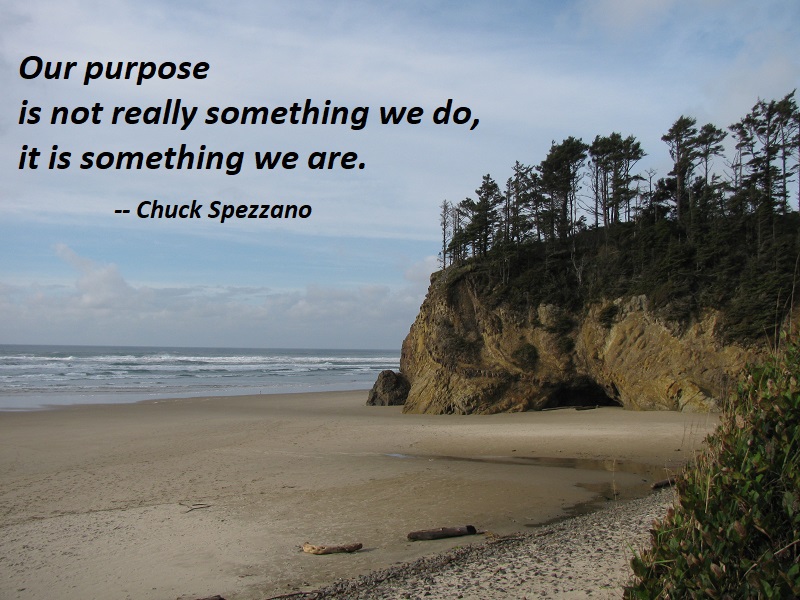
— Chuck Spezzano, If It Hurts, It Isn’t Love, p. 281