The Fine Art of Finding Ourselves

Failure gives us the chance to experiment with life, to play with it a bit, to move in different directions until we find, as we learned from Cinderella as children, the shoe that fits. Because what doesn’t fit will irritate us all our life. We will live in the unnecessary pain that comes from forcing ourselves into something that not only embarrasses us but cramps our hearts and damps our spirits.

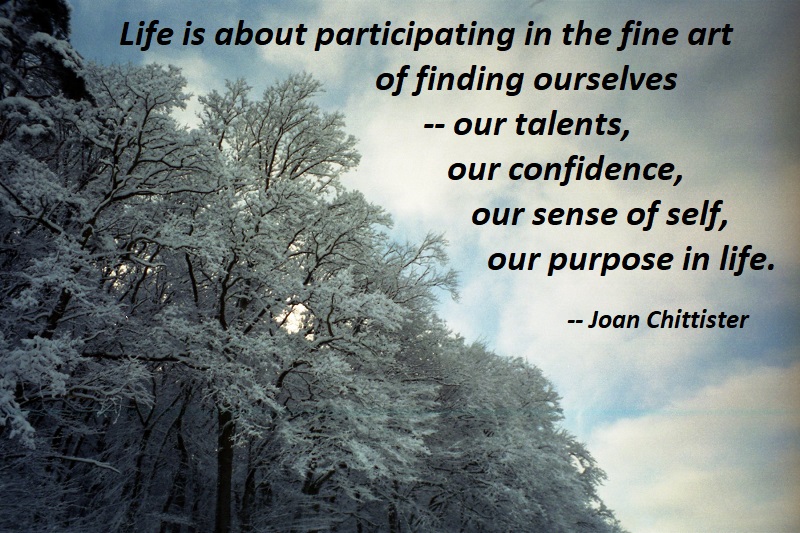
Life is about participating in the fine art of finding ourselves — our talents, our confidence, our sense of self, our purpose in life. The world waits for each of us to give back to the best of our ability what we have been given for its sake. The only way to know what that is depends on learning to follow our hearts until our hearts and our abilities are one, until what we love and what we do well are one and the same thing.

— Joan Chittister, Between the Dark and the Daylight, p. 64

Photo: Gundersweiler, Germany, December 1999

Designed for Joy

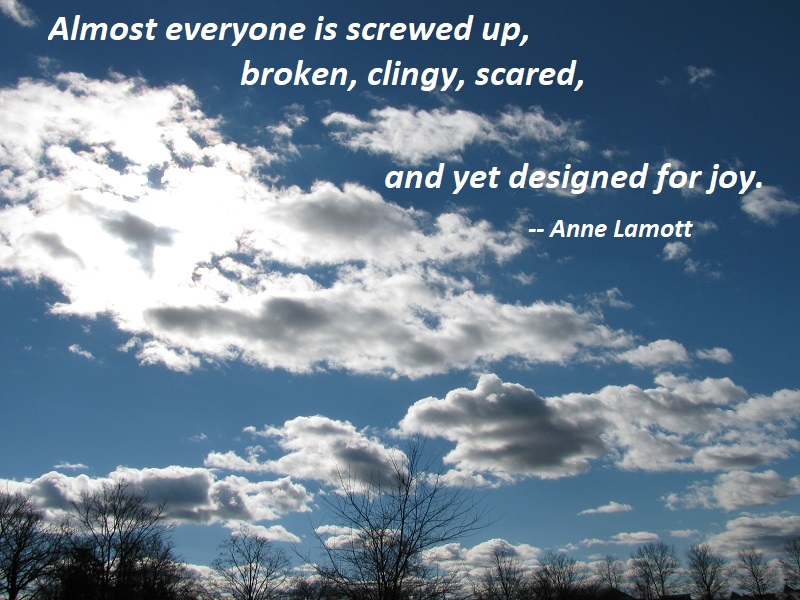
Almost everyone is screwed up, broken, clingy, scared, and yet designed for joy. Even (or especially) people who seem to have it more or less together are more like the rest of us than you would believe. I try not to compare my insides to their outsides, because this makes me much worse than I already am, and if I get to know them, they turn out to have plenty of irritability and shadow of their own. Besides, those few people who aren’t a mess are probably good for about twenty minutes of dinner conversation.

— Anne Lamott, Almost Everything, p. 55

Photo: South Riding, Virginia, December 22, 2018

The Narrow Gate

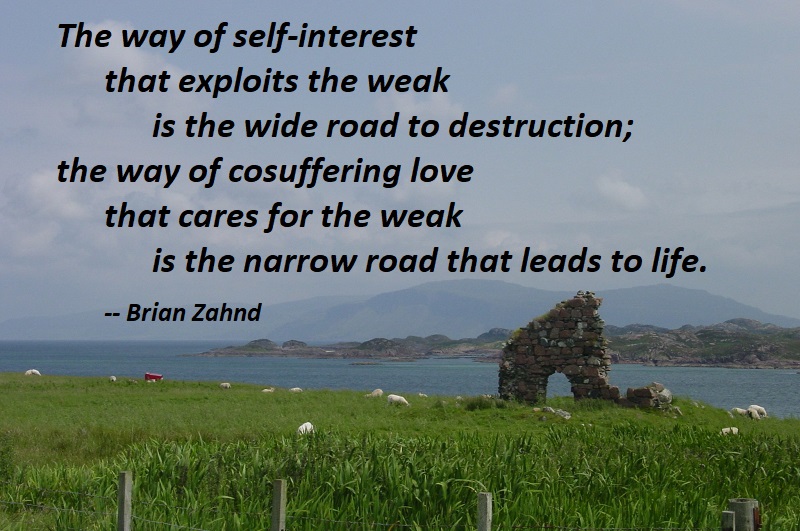
What Jesus certainly does not say is that the sheep and goats are divided on the basis of who has and who has not said a sinner’s prayer! Unfortunately, a cobbled-together misreading of Paul has been used to either ignore or evade what Jesus taught about the priority of loving our neighbors as ourselves being the criterion for judgment. Jesus taught that the Golden Rule is the narrow gate that leads to life. The narrow gate is not a sinner’s prayer but a life of love and mercy. The way of self-interest that exploits the weak is the wide road to destruction; the way of cosuffering love that cares for the weak is the narrow road that leads to life.

— Brian Zahnd, Sinners in the Hands of a Loving God, p. 129

Photo: Isle of Iona, Scotland, July 13, 2003.

Awe

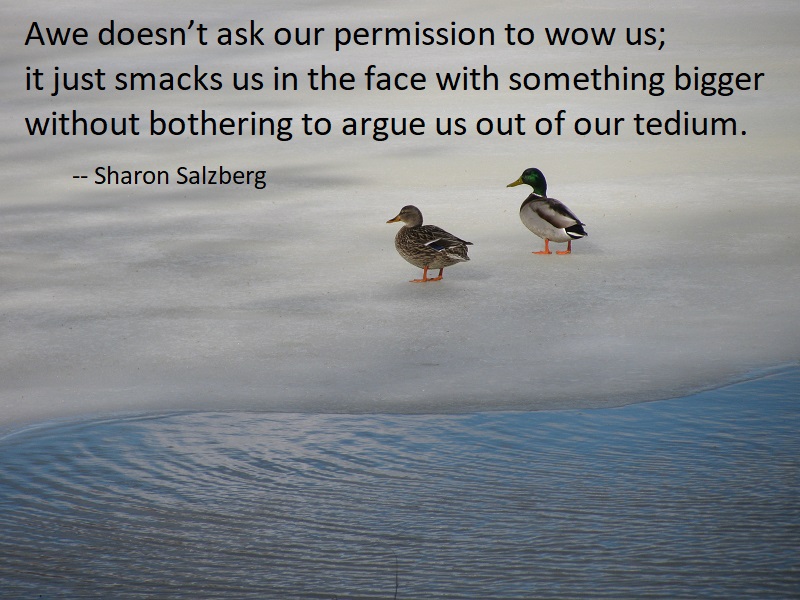
Awe doesn’t ask our permission to wow us; it just smacks us in the face with something bigger without bothering to argue us out of our tedium. Awe can come in a single glance, a beautiful sound, a heartfelt gesture. Think of how we can slog along in our little tunnel of daily life, back and forth, and then one day pass a lilac bush in bloom. The fragrance catches us first and then the beauty of the full blossoms. In pausing to appreciate it, we receive a reminder of the spectacular. Much like that, awe can bring this invigorating sense of novelty into everyday relationships that might otherwise feel stale or dull.

— Sharon Salzberg, Real Love, p. 282

Photo: South Riding, Virginia, January 29, 2016

Life Here and Now

In the New Testament, however, salvation is about much more than just getting our soul into heaven when we die, and evangelism is about much more than getting our name on the right side of the divine ledger. Salvation is about getting heaven, the realm of God’s saving presence, into all the different aspects of our life here and now. The early Christians did not understand their mission in life to be to simply get people to assent to certain religious beliefs so that they would have a good afterlife waiting for them. They believed that Jesus is the world’s true ruler, and so their mission was to live in that truth and announce it to the world. The first Christians believed that through his resurrection and ascension, Jesus was exalted as King over all, and so the way we enable God’s kingdom to come on earth as it is in heaven is by following Jesus here and now.

— Heath Bradley, Flames of Love, p. 137-138

Photo: South Riding, Virginia, December 17, 2018

Priorities

It’s not easy to establish priorities in life. Most of life is spent needing to do everything at once. And that’s impossible. At least it is impossible to do them all at the same level of artistry all the time. There are simply some things worth doing that at some times are worth doing poorly. Sometimes the soufflé doesn’t come out as raised as we would like it, but it is food on the table and that is all that matters for now.

The ability to deal with failure, with doing some things well enough without having to do them compulsively, is a great gift.

— Joan Chittister, Between the Dark and the Daylight, p. 58

Photo: Burg Rheinfels, Germany, April 2003

Holding Space

As therapists and caregivers explain, to “hold space” for someone is to simply sit with them in their pain, without judgment or solutions, and remain present and attentive no matter the outcome. The Psalms are, in a sense, God’s way of holding space for us. They invite us to rejoice, wrestle, cry, complain, offer thanks, and shout obscenities before our Maker without self-consciousness and without fear. Life is full of the sort of joys and sorrows that don’t resolve neatly in a major key. God knows that. The Bible knows that. Why don’t we?

— Rachel Held Evans, Inspired, p. 110-111

Photo: South Riding, Virginia, December 4, 2018

Out of Our Own Way

Love allows us to get out of our own way. It allows us to transcend this fear and these calcified ways of reacting. Love allows us to receive freely. Love raises us above the worries and cares and creates the responsiveness that brings contact and joy.

Today, go out there and love. Get out of your own way. Love everyone you meet, and let the love that wants to come to you from God through others reach you.

— Chuck Spezzano, If It Hurts, It Isn’t Love, p. 381

Photo: South Riding, Virginia, November 30, 2018

Gifts of Failure

No, life is not about winning. It is about trying, about participating, about striving, about becoming the best we can be, not the best by someone else’s measure. That’s what failure does for us. It teaches us about ourselves: our energy level, our endurance level, what we’re naturally good at and what we’re not, what we like and what we don’t, what it means to do something just for the fun of it. Failure doesn’t mean that we cannot compete; it doesn’t mean not to give everything we have to doing what we do. It does mean that just because we play we don’t have to win. The playing is the thing.

Most of all, it gives us the permission to go through life without public certification. Failure enables us to take risks as we grow until we find where we really fit, where we can not only succeed, but also enjoy the challenges of life as well.

No, winning is not everything. But we will never really know that until we lose a few and discover that the world does not end when we lose. Now it is just a matter of trying again somewhere else, perhaps. Now we’re free to be unnoticed. We’re free to do what we like best, what is needed most, what will bring us to the most we can be: the most happy, the most competent, the most satisfied with who we are and what we do. That means, of course, that we have to make choices about what we want to do and why we want to do it.

— Joan Chittister, Between the Dark and the Daylight, p. 57-58

Photo: South Riding, Virginia, October 29, 2018