Unrelenting and Restorative
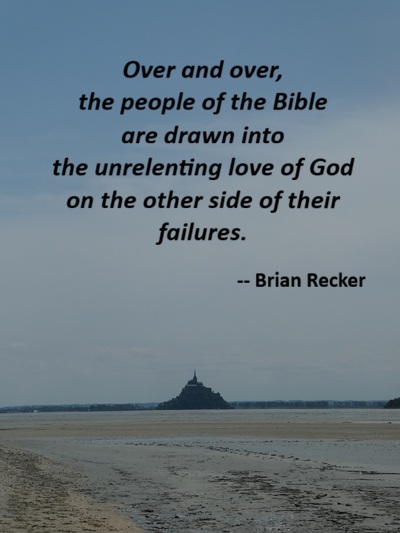
Unlike the doctrine of hell, which is never clearly spelled out in the Bible, the unrelenting, restorative love of God – which does not count our sins against us but instead works all things together for good in order not only to redeem people from every tribe, tongue, and nation but also to liberate all of creation – is spelled out in the Bible time and time again. It is arguably the unifying theme of the whole book. Over and over, the people of the Bible are drawn into the unrelenting love of God on the other side of their failures.

— Brian Recker, Hell Bent, p. 106

Photo: Mont Saint-Michel, seen from across the bay, June 20, 2026

For Everybody

Something must break us out of the reward-punishment frame. It is too small and too self-serving. It makes the God of the ever-evolving and expanding universe seem equally small and petty, and it has already shown itself to create far too many small, petty, largely competitive, and happily vengeful humans. Yet, in spite of it all, the universe remains one giant self-revelation of the fabulous nature of God, not a small stage where one slice of the human species can show itself to be a winner or a loser.

Somehow, the loving people I have met all across the world seem to know that if it is love at all, it has to be love for everybody. As soon as you even begin to parcel it out, you are not in the great field of love.

— Richard Rohr, The Tears of Things, p.159

Photo: Étretat, France, June 23, 2026

All of Us Are Freely Forgiven.

It takes one to forgive and two to reconcile. Although God freely forgives all of us without condition, we can choose to enter fully into the equation in order for reconciliation with God to happen. And this reconciliation takes place as we turn back to God. God lifts us up into the life of God and we participate joyfully in the new life we have in Christ. We can interpret the cross of Jesus as at-one-ment that deconstructs notions of a violent God bent on retributive justice. We see that the justice of God is love and that love forgives, transforms, and seeks to create new and harmonious relationships. Through the forgiveness of God, a way is opened up for the transformation of all humanity (of creation, to be exact). Through the cross of Jesus, we are forgiven without condition, accepted as we are. Through repentance we are reconciled with God and transformed into those who live in the power of divine love.

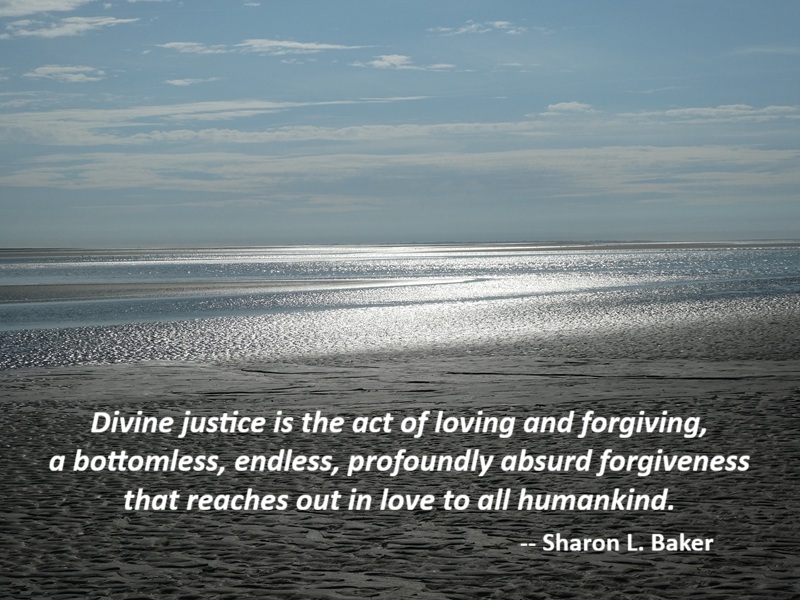
Divine justice, therefore, is the act of loving and forgiving, a bottomless, endless, profoundly absurd forgiveness that reaches out in love to all humankind. Our response-ability is to receive it, to enter into the forgiveness of God, reconciled and restored. If, that is, we have eyes to see and ears to hear.

— Sharon L. Baker, Executing God, p. 161

Photo: The Bay of Mont Saint-Michel, France, June 20, 2026

The Very Heart of God

But this story of ultimate reconciliation is not just a stack of Bible verses. It is a key theme of the whole Bible, and it is essential to how we relate to God. We connect to God and love God because God first loves us. God is not a punisher; God is a healer. We fail, but God’s steadfast love “endures forever” – Psalms 136 repeats this truth twenty-six times! The redundant message doesn’t make for the most subtle poetry, but some truths need to be drilled into thick skulls. Despite the way that Christian history shows how we are experts at missing the point, those who know God best have always known that at the very heart of God is unfailing love.

— Brian Recker, Hell Bent, p. 104-105

Photo: Mont Saint-Michel, June 17, 2026

The Good News

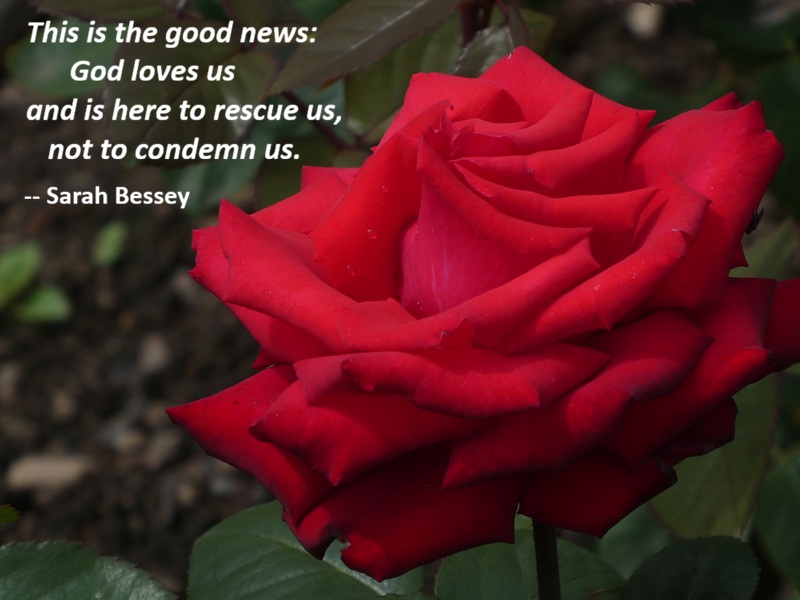
In story after story, Jesus reveals all the ways we’ve misunderstood and misrepresented God. This is the good news: God loves us and is here to rescue us, not to condemn us. Cast away the old visions of bearded Zeus, of paternalistic punishers, of Bible verses as weapons, of faraway fear coming home to roost, of switches and beatings described as love. Such things aren’t love. They never were.

The love of God isn’t a far-off destination we are striving to arrive at. Nor is it a prize that will be given to us only if we earn it. It’s not for the winners or the ones with answered prayers. It’s not just for the ones clutching their pearls over you. It’s not just for one denomination or church or religion. Now, we are all loved now.

— Sarah Bessey, Field Notes for the Wilderness, p. 62.

Photo: Zweibrücken Rose Garden, Germany, June 18, 2024.

Everybody Is Invited.

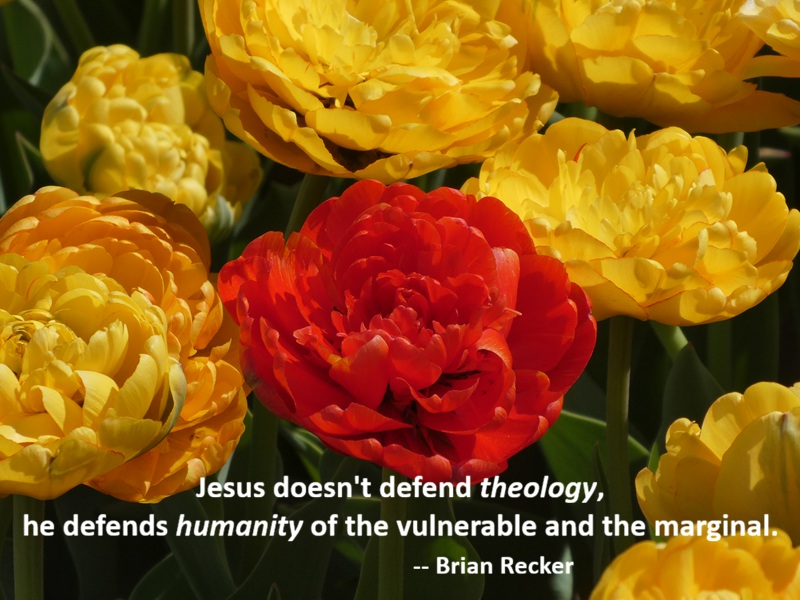
Salvation is not about choosing the right theological beliefs to avoid hell. It’s about recognizing the goodness and divinity in the despised “other” and joining in on the party God is throwing, where everybody is invited. Jesus never tells people they need to change their doctrine or convert to another religion in order to be saved from hell. Jesus doesn’t defend theology, he defends humanity of the vulnerable and the marginal. Jesus doesn’t explain the one correct statement of faith to his disciples; he meets real human needs, while calling out religious leaders for the hypocrisy of caring more about dogma than justice and mercy.

Hell is not a good Christian doctrine because it makes it impossible to show up in relationships with others like Jesus did. The spirituality of hell excludes and others people; Jesus includes the “other” and shows us that we are all more similar than we thought. We are connected, whether we are aware of it or not. Refusing to see this – that is hell. The true hell is exclusion and denying our shared belovedness. It is living in the delusion of superiority and separation. It is refusing to join the banquet where everyone is invited.

— Brian Recker, Hell Bent, p. 58-59

Photo: Tulips, Burnside Farms, Nokesville, Virginia, April 7, 2026

Whoever

By using the word “whoever,” Jesus expands the borders of who’s in and who’s out, scrambling their notions of who gets to receive the grace of God and how they get to receive it. By opening eternal life to “whoever eats of this bread,” Jesus begins to deconstruct that old bureaucratic system of circles and opens up eternal life to . . . well . . . whoever! It isn’t about blood or lineage or culture or tradition. It has nothing at all to do with any of the circles the people of God had previously drawn. Perhaps the disciples were scandalized because they wondered, “Could it be just anybody who eats the bread?” Maybe they even worried, “Could it be . . . everybody?”

Exclusion is easy. Walking around thinking that we are the special ones, that we are justified simply by virtue of who we are or what we believe, some identity or another, is comforting. Cutting more and more people out of that circle isn’t a problem as long as we stay nestled safely inside of it.

Expanding the circle, however, is a “hard teaching.” Expand it too far and we start to wonder if there’s anything special about us at all.

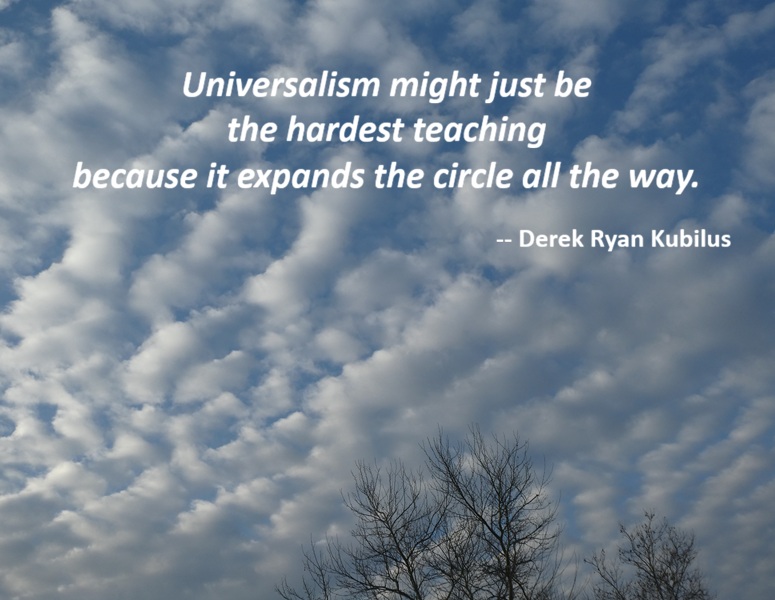
By that measure, universalism might just be the hardest teaching because it expands the circle all the way.

— Derek Ryan Kubilus, Holy Hell, p. 126

Photo: South Riding, Virginia, March 21, 2026

Relentless Love

Jesus has no doubt about the salvific efficacy of the cross. Ultimately it will drag all people to himself. Does this imply that salvation is forced upon us through overpowering coercion? No, I don’t think so. Saving grace can always be resisted by a rebellious will. Rather, I think this has to do with the utter relentlessness of the divine love seen in Christ upon the cross. The gravity of grace is always pulling upon us. At any given mment we can resist the love of God, but, as Psalm 136 says so relentlessly – twenty-six consecutive times – “His steadfast love endures forever.”

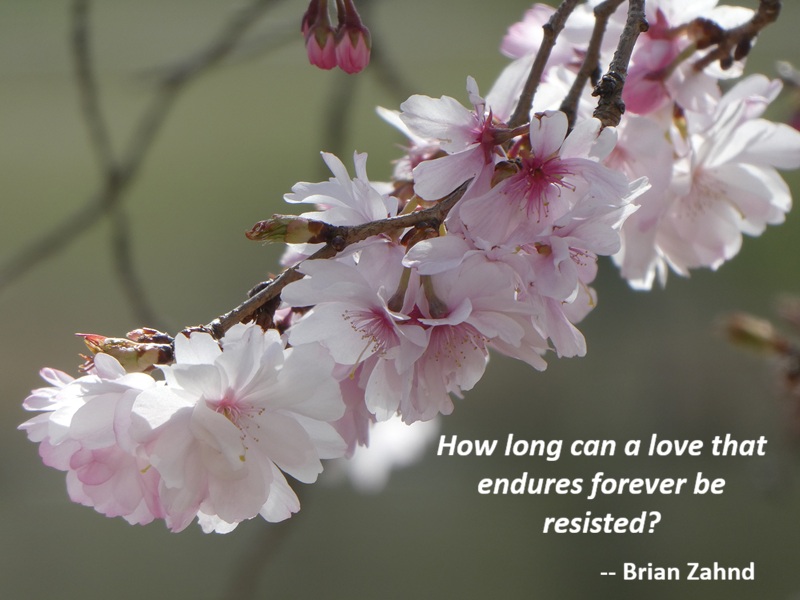
From the cross of Christ there emanates a tractor beam of steadfast love that pulls upon all people. At any given moment any given person can resist it, but how long can a love that endures forever be resisted?

— Brian Zahnd, Wood Between the Worlds, p. 91

Photo: Cherry blossoms, South Riding, Virginia, March 28, 2025