Too often I have heard people’s pain met with a Christia consolation which essentially communicates that the person in pain should learn to cling to hope, to trust in God. More often than not, I’ve found this unhelpful, and at worst a form of spiritual abuse that uses language of hope to manipulate the hurting into a feigned happiness.
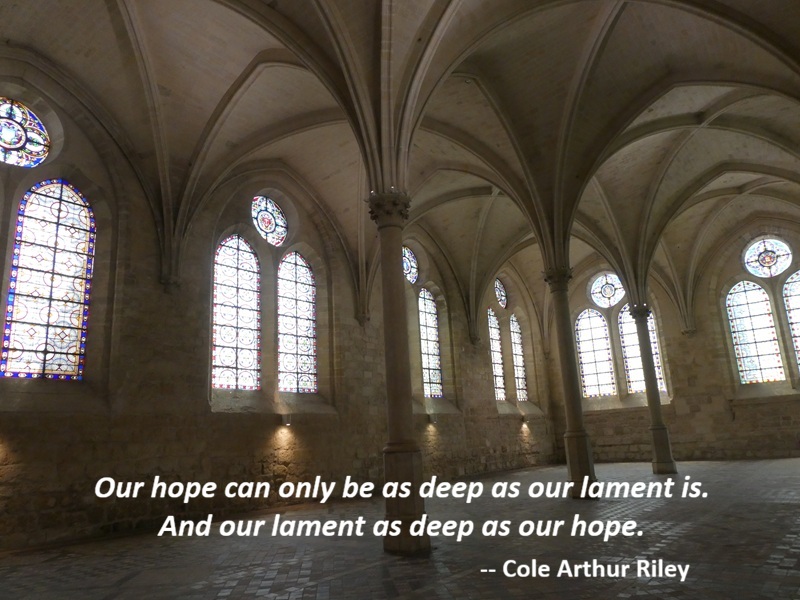
This is also a foundational misrendering of lament. Lament is not anti-hope. It’s not even a stepping-stone to hope. Lament itself is a form of hope. It’s an innate awareness that what is should not be. As if something is written on our hearts that tells us exactly what we are meant for, and whenever confronted with something contrary to this, we experience a crumbling. And in the rubble, we say, God, you promised. We ask, Why? And how could we experience such a devastation if we were not on some mysterious plane, hoping for something different. Our hope can only be as deep as our lament is. And our lament as deep as our hope.
— Cole Arthur Riley, This Here Flesh, p. 101
Photo: Abbaye de Royaumont, France, June 24, 2026