May God’s Stitches Hold

People say we are unworthy of salvation. I disagree. Perhaps we are very much worth saving. It seems to me that God is making miracles to free us from the shame that haunts us. Maybe the same hand that made garments for a trembling Adam and Eve is doing everything he can that we might come a little closer. I pray his stitches hold.

— Cole Arthur Riley, This Here Flesh, p. 15

Photo: South Riding, Virginia, January 17, 2026.

Sheep and Goats

Also, notice that the sheep to the right of the shepherd are considered praiseworthy precisely because they do not think of the world in a dualistic way. They are sheep not because they were born as sheep but because they have chosen to respond to their neighbors in a very specific way. What grants them their identity as sheep i that they are precisely the kind of people who do not split the world up into sheep and goats….

The sheep respond to need and otherness with hospitality and love. They are sheep precisely because they are capable of recognizing a common humanity in their neighbors and having empathy for those who might be different from them or marginalized by society. They choose to cross the boundaries and break through the walls that might otherwise divide people – even the walls of a prison cell. Their “sheepyness” is defined by their refusal to accept the divisions of social or immigration status, health, wealth, or even (most ironically) the consequences of punitive justice.

Notice that the King does not say, “I was innocent and you came to prison to visit me.” He does not seem to care about the particular guilt or innocence of the one who is incarcerated. He simply identifies himself with whoever might be in prison, saying, “I was in prison and you visited me.” As the last detail mentioned in a series, the fact that sheep go to visit prisoners carries the most emphasis in the text. Caring for those who are imprisoned actually epitomizes what it means to be a sheep. Yet, some will argue that we are to understand this passage to be saying that God imprisons souls in a torture dungeon and withdraws God’s presence from them for all eternity! Are we to believe that God is praising the sheep for their enduring presence with those who are in prison, and at the same time, God withdraws God’s own eternal presence from those whom God sends to prison? If that were true, then Christianity would simply be a terrible religion worthy of our rejection, because the Christian God would be the biggest hypocrite of all.

— Derek Ryan Kubilus, Holy Hell, p. 98-99

Photo: Gray winter sky, South Riding, Virginia, December 31, 2025

Metamorphosis

I am still learning this new life, and in many ways it still feels strange to me. I’ve begun filling the space that loss created around me. I can color the space around me however I want — finally — because now there is room. What I’m discovering is as surprising to me as the caterpillar’s transformation: life on the other side of loss is not only livable but may be better, richer, more meaningful. I am more of myself for having gone through this strange and painful transformation, like entering the darkness and coming out with wings.

— Maggie Smith, Keep Moving, p. 173

Photo: Sunrise over lake, South Riding, Virginia, December 17, 2025

Prayer Takes Time

I wonder if God needs us to persevere in prayer simply because most of what we pray for will take a long time to realize. We pray for healing for ourselves and those we love, knowing that in most cases the process is slow. We pray for peace within our families or in the human family, and we know that peace isn’t readily attained and often comes at a dreadfully high price. We pray for justice, knowing that it is always hard-won and takes generations to accomplish.

— Mariann Edgar Budde, How We Learn to Be Brave, p. 176

Photo: Snow on frozen lake, January 1, 2026

Invited to Joy

Jesus invites us to joy. The holiness to which we are called is to know joy in its fullness. We let ourselves be drawn to the Tender One whose face is unbridled joy. We are beckoned to this locus of joy, not a reckoning with the error of our ways but God saying, unabashedly smiling, “Get over here.”

— Gregory Boyle, Forgive Everyone Everything, p. 18

Photo: Cardinal, South Riding, Virginia, December 31, 2026

The Incarnation

A God who not only understands but experiences hunger, thirst, weariness, joy, sadness, physical pain, growth, interpersonal relationships, intimacy, betrayal, offense, occasions for celebration, grief, and the full gamut of the human experience is a great deal different from a God who is content to sit on high while looking down low.

In the incarnation, we are confronted with a bizarre proposition. The God that existed before the beginning of time chose to walk among the people as one of their own. What was once thought of as imperceptible became a tangible reality that people could see with their own eyes. Converse with. Even touch. The incarnation suggests that God is indeed living. And, for some of us, all of this is a little difficult to square with a God who exists outside the boundaries of time and space.

— Trey Ferguson, Theologizin’ Bigger, p. 158

Photo: South Riding, Virginia, January 20, 2024

Forgiveness, not Punishment

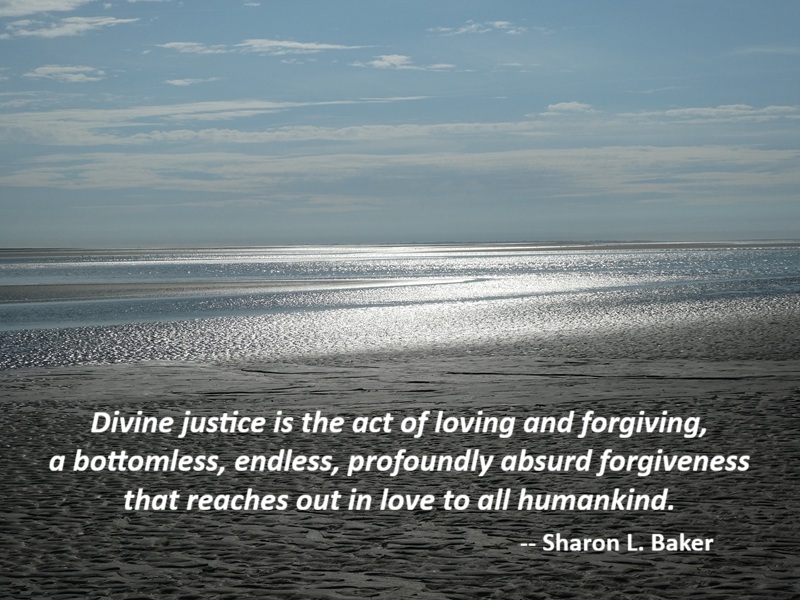
Actually, we might say that sin condemned and punished through retribution is sin condemned without hope for redemption. But sin exposed through righteousness, with the intent to restore the sinner to God, is grounded in the hope of salvation. So instead of saying that God inflicted the pain of the cross on Jesus as a penalty for our sin, we can say that the horrific nature of the cross exposed and condemned the gravity of our sin. After all, human beings are the ones who put Jesus to death, not God.

And remember, Jesus never said anything about coming to receive punishment for sin, but he said quite a bit about forgiving it. The righteousness of God in Jesus transcended the retributive aspects of the law and brought about our forgiveness – think about Jesus’ prayer for our forgiveness from the cross. In this manner, Jesus gave us his life and revealed to us the law of love that restores us to God and to each other. The Bible tells us that no greater love exists than this (John 15:13).

— Sharon L. Baker, Executing God, p. 134

Photo: Sunset at Blackwater Canyon, WV, April 23, 2025

Unshakably Good

I told the crowd that two unwavering principles held at Homeboy Industries were the following: 1) Everyone is unshakably good (no exceptions) and 2) We belong to each other (no exceptions). Then I posited: “Now, do I think all our vexing and complex social dilemmas would disappear if we embraced these two notions?” I paused, then continued, “Yes, I do.” And the entire audience exploded in laughter. I was startled. When the laughter subsided, I repeated quietly: “Yes, I do.”

These two ideas allow us to roll up our sleeves so that we can actually make progress. So that we can love without measure and without regret. So that we can cultivate a new way of seeing. We finally understand that the answer to every question is, indeed, compassion.

— Gregory Boyle, Cherished Belonging, p. 2.

Photo: South Riding, Virginia, December 27, 2025.

God Did Not Make Us to Hate Us.

God did not make us to hate us.

God did not dream up the color yellow and craft the scientific art of making butter from milk and whimsically birth cumulus clouds just to . . . disdain a little girl who misunderstood the cosmic structure.

God did not count the hairs on our heads or the stars that would hang in the sky over billions of years just to resentfully accept desperate people begging to be spared from brutal torment.

I know this because maybe heaven isn’t a pit stop between Raleigh and LA, but heaven is all around us. Breaking in and barreling down walls and peeping up like dandelions in the asphalt. God would not be so creative and wily and beautiful all at the same time if God’s desire was punishment.

— Lizzie McManus-Dail, God Didn’t Make Us to Hate Us, p. xi

Photo: South Riding, Virginia, December 14, 2025