Review of Swirl by Swirl, by Joyce Sidman, pictures by Beth Krommes
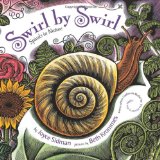
Swirl by Swirl

Spirals in Nature

by Joyce Sidman
pictures by Beth Krommes

Houghton Mifflin Books for Children, 2011. 36 pages.

This is a gentle and soothing picture book that rewards reading and examining again and again. The text is unrhymed poetry, with only a few lines on a page, and very large print.

You could read this book to very young children with a short attention span, but it will also work with older children, who can notice new details on each page.

The beautiful pictures were created by Beth Krommes, Caldecott medalist for The House in the Night. She uses the same scratchboard technique here, with more colors. The technique works well for showing spirals, since the lines are distinct and clear.

Here’s the first page. It says:

“A spiral is a snuggling shape.
It fits neatly in small places.
Coiled tight, warm and safe, it waits . . .”

We’ve got a snow scene, but most of the picture is taken up with what’s underground. We see several animals curled up in their nests for the winter, and small print labels them: a bull snake, harvest mouse, eastern chipmunk, and woodchuck. All the animals are resting in a coiled shape.

The next page shows those same animals emerging into a springtime landscape, but the sharp reader will still spot some spirals.

The book goes on, gently and soothingly, showing seashells, ferns, ram’s horns, coiled tails and trunks, spiderwebs, and even gets much bigger in waves, whirlpools, and tornadoes. The climax takes us all the way out to galaxies, and then back to the cozy winter landscape again.

There are even two pages at the back that give some of the science (and math!) behind spirals.

This was one of the books we discussed at the Bill Morris Seminar in January, and my fellow attendees made me appreciate it all the more. It’s the sort of book into which you can delve much deeper than initially meets the eye, a book you and your children will want to look at and read again and again.

Buy from Amazon.com

Find this review on Sonderbooks at: www.sonderbooks.com/Childrens_Nonfiction/swirl_by_swirl.html

Disclosure: I am an Amazon Affiliate, and will earn a small percentage if you order a book on Amazon after clicking through from my site.

Source: This review is based on a library book from the Fairfax County Public Library.

Disclaimer: I am a professional librarian, but I write the posts for my website and blogs entirely on my own time. The views expressed are solely my own, and in no way represent the official views of my employer or of any committee or group of which I am part.
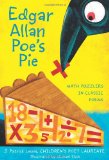
Review of Edgar Allan Poe’s Pie, by J. Patrick Lewis

Edgar Allan Poe’s Pie

Math Puzzlers in Classic Poems

by J. Patrick Lewis
illustrated by Michael Slack

Harcourt Children’s Books, 2012. 37 pages.

I feel a tiny bit sheepish by how much fun I find in this book. J. Patrick Lewis, Children’s Poet Laureate, has parodied 14 classic poems that children may well be familiar with and has inserted… a math problem.

These problems are not particularly tricky. Though I suppose that depends on the child’s age. (There is some multiplication and division, so this is more for upper elementary grades.) At times it’s not totally clear exactly what they want you to figure out (though that is given in the upside-down answers on the next page). But the parodies are definitely playful.

Could there possibly be a better way to get a kid to do word problems for fun and without fear?

The poems, after the title, list the poem they are inspired by.

Here’s the end of “Edgar Allan Poe’s Apple Pie,” the one inspired by “The Raven”:

I ignored the frightful stranger
Knocking, knocking . . . I, sleepwalking,
Pitter-pattered toward the pantry,
Took a knife from the kitchen drawer,
And screamed aloud, “How many cuts
Give me ten pieces?” through the door,
The stranger bellowed, “Never four!”

Another favorite for me is the one that plays off a poem I love, “Us Two,” by A. A. Milne. Here’s the beginning:

Wherever I am, there’s always Boo.
Boo in the flowers with me.
The size of our garden is eight by two.
“How much wire for the fence,” says Boo,
“If it wraps all around as it ought to do?
Let’s guess together,” says Boo to me.
“Let’s guess together,” says Boo.

With some, like “Robert Frost’s Boxer Shorts,” he goes for silly. “Langston Hughes’s Train Trip” uses some trickier math. “Edward Lear’s Elephant with Hot Dog” is just a limerick.

That should give you an idea of what’s going on here. Some quite silly fun. With math!

Buy from Amazon.com

Find this review on Sonderbooks at: www.sonderbooks.com/Childrens_Nonfiction/edgar_allan_poes_pie.html

Disclosure: I am an Amazon Affiliate, and will earn a small percentage if you order a book on Amazon after clicking through from my site.

Source: This review is based on a library book from the Fairfax County Public Library.


Review of Guyku, by Bob Raczka

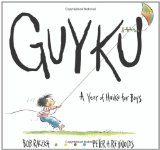
Guyku

A Year of Haiku for Boys

by Bob Raczka
illustrated by Peter H. Reynolds

Houghton Books for Children, Boston, 2010. 48 pages.
Starred Review

At the end of this book, Bob Raczka explains why he wrote Guyku, a collection of haiku for boys.

“Now that I’m a grownup (sort of), I realize that haiku is a wonderful form of poetry for guys like us. Why? Because haiku is an observation of nature, and nature is a place where guys love to be….

“One more thing about haiku: they’re written in the present tense. In other words, whatever happens in a haiku, it’s happening right now. From my experience, guys are always interested in what’s happening right now.

“In case you were wondering, every haiku in this book is about something I did as a boy. Or something I’ve seen my own boys do. It’s the kind of stuff I — along with amazing and inspiring illustrator Peter H. Reynolds — wanted to share with guys like you.”

The poems are wonderful, with a section for each of the four seasons. The illustrations beautifully capture the playful, adventurous spirit expressed in the haiku. I’ll give an example from each season, but please remember that the illustrations make them all the more wonderful!

Spring:

“In a rushing stream,
we turn rocks into a dam.
Hours flow by us.”

Summer:

“Pine tree invites me
to climb him up to the sky.
How can I refuse?”

Fall:

“Hey, who turned off all
the crickets? I’m not ready
for summer to end.”

Winter:

“Winter must be here.
Every time I open my
mouth, a cloud comes out.”

Check this book out and share it with a guy in your life!

Buy from Amazon.com

Find this review on Sonderbooks at: www.sonderbooks.com/Childrens_Nonfiction/guyku.html

Disclosure: I am an Amazon Affiliate, and will earn a small percentage if you order a book on Amazon after clicking through from my site.

Source: This review is based on a library book from the Fairfax County Public Library.

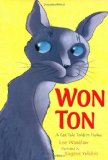
Review of Won Ton, by Lee Wardlaw

Won Ton

A Cat Tale Told in Haiku

by Lee Wardlaw
illustrated by Eugene Yelchin

Henry Holt and Company, New York, 2011. 34 pages.
Starred Review

This book works both as a collection of short, accessible poems and as an entertaining picture book. The author’s note at the beginning informs us that technically the poems inside are senryu, not haiku. But the syllable format is the same, and I think it was a good choice to use “Haiku” in the title, since that is a term most school children are familiar with.

This book takes us from a cat in a pet store waiting to be bought to a cat in a home with his very own beloved boy. The illustrations show a true cat nature, and so do the poems.

Here are a few I particularly like:

Yawn. String-on-a-stick.
Fine. I’ll come out and chase it
to make you happy.

Scrat-ching-post? Haven’t
heard of it. Besides, the couch
is so much closer.

Letmeoutletme
outletmeoutletmeout.
Wait — let me back in!

Your tummy, soft as
warm dough. I knead and knead, then
bake it with a nap.

Definitely charming. Reading this to a small child will prompt them to look at a cat with new eyes. Reading it to an older child may get them writing haiku of their own.

Buy from Amazon.com

Find this review on Sonderbooks at: www.sonderbooks.com/Childrens_Nonfiction/won_ton.html

Disclosure: I am an Amazon Affiliate, and will earn a small percentage if you order a book on Amazon after clicking through from my site.

Source: This review is based on a library book from the Fairfax County Public Library.

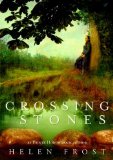
Review of Crossing Stones, by Helen Frost

Crossing Stones

by Helen Frost

Frances Foster Books (Farrar, Straus and Giroux), New York, 2009. 184 pages.

Crossing Stones is a novel in verse about two families who live across a creek from each other during World War I. The book is masterfully and beautifully written. Unfortunately, I’m not a big fan of verse novels. Just hearing the thoughts of the characters from the start, it’s harder for me to picture the characters and the setting. Still, once I got going, I found this to be a powerful and moving story.

Both the families that live across the creek have a brother and a sister. Frank and Emma live on one side, and Ollie and Muriel live on the other. Frank loves Muriel, and Ollie loves Emma, but when World War I starts, Frank goes off to war, and Ollie soon follows, even though he’s only sixteen.

Muriel’s not a fan of the war, like her Aunt Vera, a suffragette. But not being happy about the war is considered unpatriotic, and women are told their place is in the home.

This book includes war, the flu epidemic, the battle for women’s rights, and the day-to-day struggles of farm chores that must go on even when the men and boys have gone to war.

I should have heeded the advice of our local Kidlit Book Club leader and read the “Notes on the Form” at the back of the book first. Helen Frost did something innovative and symbolic. She writes the poems in the voices of Muriel, Emma, and Ollie. Muriel’s poems are written in free style, in the shape of a rushing creek “flowing over the stones as it pushes against its banks” just as Muriel is pushing against the constraints of her society and time.

Emma’s and Ollie’s poems are written to make the shapes of stones. The author explains:

“I ‘painted’ them to look round and smooth, each with a slightly different shape, like real stones. They are ‘cupped-hand sonnets,’ fourteen-line poems in which the first line rhymes with the last line, the second line rhymes with the second-to-last, and so on, so that the seventh and eight lines rhyme with each other at the poem’s center. In Ollie’s poems the rhymes are the beginning words of each line, and in Emma’s poems they are the end words.”

The rhymes are so unforced, I didn’t notice them at all until I read the note at the back. I was impressed when I looked back and found the rhymes, but wish I had noticed from the beginning. Helen Frost also tells us:

“To give the sense of stepping from one stone to the next, I have used the middle rhyme of one sonnet as the outside rhyme of the next. You will see that the seventh and eight lines of each of Emma’s poems rhyme with the first and last lines of Ollie’s next poem, and the seventh and eighth lines of Ollie’s poems rhyme with the first and last lines of Emma’s next poem. If you have trouble finding these rhymes, remember to look on the left side of Ollie’s poems, and on the right side of Emma’s.”

So besides writing a moving story of World War I, Helen Frost has also pulled off an impressive technical achievement.

Buy from Amazon.com

Find this review on Sonderbooks at: www.sonderbooks.com/Teens/crossing_stones.html

Disclosure: I am an Amazon Affiliate, and will earn a small percentage if you order a book on Amazon after clicking through from my site.

Source: This review is based on a library book from the Fairfax County Public Library.

Review of My People, by Langston Hughes, photographs by Charles R. Smith Jr.

My People

by Langston Hughes
Photographs by Charles R. Smith Jr.

Ginee Seo Books (Atheneum Books for Young Readers), New York, 2009. 36 pages.
2010 Coretta Scott King Illustrator Award
Starred Review

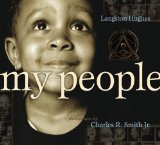
My People is a beautiful, glorious, gorgeous book. I can’t adequately speak in its praise. It’s also, I believe, the first time a photographer has won the Coretta Scott King Illustrator Award — but the award is completely deserved, as the images used are stunning and so wonderfully accompany the poem.

The text is the Langston Hughes poem, “My People,” which talks about how beautiful his people are. “The night is beautiful, so the faces of my people…”

Charles R. Smith Jr. uses incredible close-up pictures of African-Americans to illustrate each phrase. The faces are truly beautiful, radiant and glowing. I think my favorite pictures are the ones that illustrate the phrase “are the souls,” with children dancing, completely unself-conscious. But all the people featured — elders, adults, children and babies — are photographed in a way that makes us see the wonder of their joy and humanity. Truly beautiful.

You simply have to see this book to understand how wonderful it is.

Buy from Amazon.com

Find this review on Sonderbooks at: www.sonderbooks.com/Childrens_Nonfiction/my_people.html

Disclosure: I am an Amazon Affiliate, and will earn a small percentage if you order a book on Amazon after clicking through from my site.

Source: This review is based on a library book from the Fairfax County Public Library.

Review of I Heard God Talking to Me, by Elizabeth Spires

i_heard_god_talking_to_meI Heard God Talking to Me

William Edmondson and His Stone Carvings

by Elizabeth Spires

Frances Foster Books (Farrar, Straus and Giroux), New York, 2009. 56 pages.

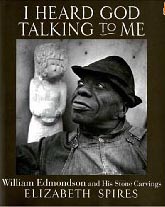
Here’s a book that is as distinctive as its subject. It’s a biography of folk sculptor William Edmondson, but the story of his life is told in a series of poems. The poems are based on photographs taken during his life (He died in 1951.) of his sculptures and of himself and of his yard.

The poems are mostly in the voice of the object in the sculpture. Like the sculptures, they are quirky and distinctive and amusing.

A few pages of prose at the end give a summary of William Edmondson’s life and fill in some of the details.

Altogether, the photos and poems in this book add up to a compelling portrait of a man who believed he was doing the work of God.

I’m inclined to agree with him.

Buy from Amazon.com

Find this review on Sonderbooks at: www.sonderbooks.com/Childrens_Nonfiction/i_heard_god_talking_to_me.html

Disclosure: I am an Amazon Affiliate, and will earn a small percentage if you order a book on Amazon after clicking through from my site.

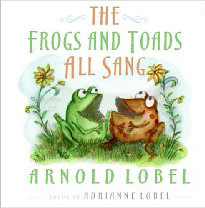
Review of The Frogs and Toads All Sang, by Arnold Lobel

frogs_and_toads_all_sangThe Frogs and Toads All Sang

by Arnold Lobel

color by Adrianne Lobel

HarperCollins, 2009. 29 pages.

This book is based on a discovered treasure — a little handmade book that Arnold Lobel had given to Crosby Bonsall as a Christmas gift long ago. The book was black and white, so for this delightful picture book version, his own daughter filled in the drawings with color.

The frogs and toads in this book were created before The famous and beloved Frog and Toad. The book consists of ten short, sweet, and silly poems, each including frogs, toads, or polliwogs.

There’s nothing profound or tremendously significant here. But somehow, the poems beg to be read aloud. And when you finish reading the book, I am quite sure you will be smiling.

Very nice. And a lovely discovered legacy from a much-beloved author.

Buy from Amazon.com

Find this review on Sonderbooks at: www.sonderbooks.com/Picture_Books/frogs_and_toads_all_sang.html

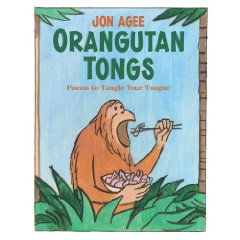
Review of Orangutan Tongs, by Jon Agee

orangutan_tongs.jpg

Orangutan Tongs

Poems to Tangle Your Tongue

by Jon Agee

Disney/Hyperion Books, 2009.  48 pages.

Starred review.
Sonderbooks Stand-out 2010: #2 Picture Books

This book is entirely too much fun.  I brought it home and read it to my teenage son, and, as I suspected, he couldn’t resist trying it himself.  For Dr. Seuss’s birthday, we recently had a tweetle beetle binge from Fox in Socks, so it was fun to read to each other and laugh from a new book where I didn’t have the advantage of about forty years of practice.

Orangutan Tongs (Can you resist saying that title aloud?) is a book of tongue twister poems, with illustrations.  They are all quite silly and good for fun and laughter.

My son claimed that he had not been practicing, but I found it highly suspicious that when I came home from work the next day, he was suddenly able to recite the Peggy Babcock poem:

Peggy Babcock at work.  Peggy Babcock at play.

Peggy Babcock tomorrow.  Peggy Babcock today.

Peggy Babcock, repeated, is tricky to say:

Peggy Babcock, Peggy Babcock, Peggy Babcock, ole!

Buy from Amazon.com

Review of Why War Is Never a Good Idea, by Alice Walker

why_war_is_never_a_good_idea.jpg 

Why War Is Never a Good Idea

by Alice Walker, illustrations by Stefano Vitale

HarperCollins, 2007.  32 pages.

Starred Review

Though War has eyes

Of its own

& can see oil

&

Gas

& mahogany trees

& every shining thing

Under

The earth

When it comes

To nursing

Mothers

It is blind;

Milk, especially

Human,

It cannot

See.

Though War is Old

It has not

Become wise

It will not hesitate

To destroy

Things that

Do not

Belong to it

Things very

Much older

Than itself.

Here is a haunting and poetic, artistic and beautiful book. 

The language is simple.  The author talks of things that War cannot understand, but that it can destroy.

The artwork is haunting, memorable and symbolic.  On one page, the words are: Picture frogs beside a pond holding their annual pre-rainy-season convention.  They do not see War. Huge tires of a camouflaged vehicle about to squash them flat.  The illustrations show a close-up painting of frogs on the left, with a photo of a rusty wheel on the right side, wadding up pages of peaceful villagers falling underneath it.

The portrayal is not graphic, but symbolic, making it all the more striking.

Don’t read this book to your child if you want to make apologies for War, if you want to explain about necessary evils. 

However, if you think you can use some convincing, or want to express an unambiguous idea to a child, this book makes a powerful and persuasive case for why War is never a good idea.  The language is simple enough for a child, yet something that will linger in the mind of an adult.

http://www.harpercollinschildrens.com/

Buy from Amazon.com

Find this review on the main site at:

www.sonderbooks.com/Childrens_Nonfiction/why_war_is_never_a_good_idea.html