Review of Wildspeak, words by Sangma Francis, pictures by Lexi Vangsnes
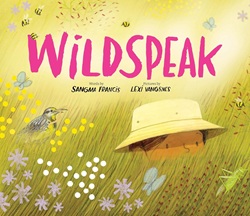
Wildspeak

words by Sangma Francis
pictures by Lexi Vangsnes

Sourcebooks Jabberwocky, 2026. 36 pages.
Review written August 13, 2026, from a library book.
Starred Review

Wildspeak is a wondrous and wonder-filled picture book about creativity and exploring the natural world.

We see a mother and two girls heading off on a nature walk. All three have brown skin, and a dog is happily bounding along with them.

In the wide, wide world with its wide, wide skies,
there are wild, wild words waiting to be spoken.

First, the book highlights some imaginative words that describe nature, like “dragonflies,” and “waterweeds.” But then they begin making up words of their own, like “Sunglitter,” to describe the scatter of light off water. And then they make a game of it:

“What’s the word for the shininess of pebbles underneath?” Cora asks.

It’s time for Wildspeak! On the next spread, they shout the words, “Stonelight,” “Bottomshimmer,” “Rockglisten,” and “Goblingems.”

And so the book continues. I’m not sure where they find so many different spaces for their nature walk – meadows, beach, mountain, forest – but in each space they highlight some existing wild words, and then make up new ones of their own.

For example, when a wave goes out and leaves sea stones drying in the sun, the girls call it, “Beachcrackle,” “Foamdry,” “Poolfizz,” and “Stonebreath.”

At the end of the day, they write their new words in their nature journal.

The end papers are fun, showing that nature journal, and including a taped-in glossary of some of the existing wildspeak words encountered earlier in the book.

This book is more for young elementary school kids than preschoolers – kids that can write down their new words. But preschoolers can get in on the imagination and wonder.

asangmafrancis.com
lexivangsnes.com
sourcebooks.com

Buy from Amazon.com

Find this review on Sonderbooks at: www.sonderbooks.com/Picture_Books/wildspeak.html

Disclosure: I am an Amazon Affiliate, and will earn a small percentage if you order a book on Amazon after clicking through from my site.

Disclaimer: I am a professional librarian, but the views expressed are solely my own, and in no way represent the official views of my employer or of any committee or group of which I am part.

Subscribe for more reviews and talk about books.

Join the conversation: What did you think of this book?
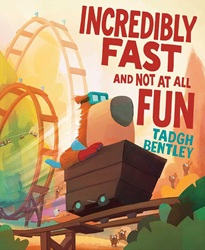
Review of Incredibly Fast and Not at All Fun, by Tadgh Bentley

Incredibly Fast and Not at All Fun

by Tadgh Bentley

Atheneum Books for Young Readers, 2026. 44 pages.
Review written August 17, 2026, from a library book.
Starred Review

I love roller coasters, so the cover of this book made me laugh out loud.

Here’s the set-up, that takes up the first few spreads:

Many summers ago
the world’s first roller coaster
was invented almost entirely by mistake.

All Bear wanted was a quick
and easy way to get from
the stillness of home . . .

to the calm of his beehives.
One that avoided the hustle and bustle
of the chattering woods below.

Bear called his invention the Honey Runner.
It was a bit steep.

The corners took some
getting used to.
And it was way too fast.

But he needed the speed to get up the slopes.

During all of these, we see a beautiful autumn forest with roller coaster tracks popping up between a vertical pillar where bear lives and a place on the forest floor with his hives. The start of the track is a vertical drop from bear’s house. There’s another hill and a bend before the track ends.

To Bear’s great surprise, his neighbors – from squirrels to moose, want to try out his invention. And even though they scream with terror, they want to do it again! What’s going on?

Bear tries signs:

It is incredibly
FAST
not at all
COMFORTABLE
and definitely not
FUN

But that doesn’t work at all.

He tries making rules against screaming or riding at night. That also doesn’t work.

Then he tries making the ride even scarier, with loops and twists, but that only brings bigger throngs.

I don’t know if this will delight the hearts of people who, like Bear, don’t understand the appeal of roller coasters – but it delighted me. (I have a theory that if you are exposed to roller coasters when you are in junior high, when your good sense is outweighed by your desire to try new things that your friends are doing – you will love roller coasters forever. I was at that crucial age when I first went upside down in a roller coaster and decided that nothing could scare me after that.)

Bear finally gives up and leaves his invention to the forest creatures who keep swarming it – and finds a new location for his home and hives that have a waterfall between them.

Bear’s cluelessness in not understanding the love other folks have for fast rides is shown rather than told – and it’s a delight! Check this one out to see for yourself and your kids.

TadghBentley.com

Buy from Amazon.com

Find this review on Sonderbooks at: www.sonderbooks.com/Picture_Books/incredibly_fast_and_not_at_all_fun.html

Disclosure: I am an Amazon Affiliate, and will earn a small percentage if you order a book on Amazon after clicking through from my site.

Disclaimer: I am a professional librarian, but the views expressed are solely my own, and in no way represent the official views of my employer or of any committee or group of which I am part.

Subscribe for more reviews and talk about books.

Join the conversation: What did you think of this book?
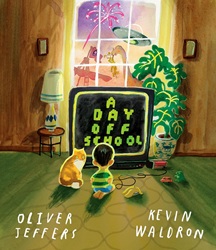
Review of A Day Off School, by Oliver Jeffers and Kevin Waldron

A Day Off School

by Oliver Jeffers and Kevin Waldron

Philomel, 2026. 44 pages.
Review written August 12, 2026, from a library book.
Starred Review

Herbie has the sniffles. He gets a day off school! Before his dad even checks on him, he eats breakfast in a sofa fort, plays Space Blasters, races his cars, draws a giant dinosaur, practices his yo-yo tricks, bounces a ball, and watches some cartoons. [Of course there are pictures to go with all of these activities.]

After lunch, everything seems boring. [I love the bored slump to his body in the pictures of his attempts at fun.]

Then… he starts thinking about school…

What if something really good happened there today?

Like an extra playtime?
Or a dog loose in the corridor?

From there, his imagination takes off. (And the pictures for this part are glorious.) So much so, that when his sister gets home, he wonders if that’s a space helmet hidden in her backpack from the rides the aliens gave the kids on their spaceship.

The next day, he gets to go back to school. It’s really boring.

Or is it?

As usual with Oliver Jeffers, the wild imagination presented in a matter-of-fact way strikes the perfect note. (Stuck is still one of my all-time favorite picture books.)

oliverjeffers.com
penguinrandomhouse.com

Buy from Amazon.com

Find this review on Sonderbooks at: www.sonderbooks.com/Picture_Books/day_off_school.html

Disclosure: I am an Amazon Affiliate, and will earn a small percentage if you order a book on Amazon after clicking through from my site.

Disclaimer: I am a professional librarian, but the views expressed are solely my own, and in no way represent the official views of my employer or of any committee or group of which I am part.

Subscribe for more reviews and talk about books.

Join the conversation: What did you think of this book?
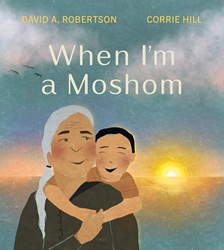
Review of When I’m a Moshom, by David A. Robertson and Corrie Hill

When I’m a Moshom

written by David A. Robertson
illustrated by Corrie Hill

Tundra, 2026. 36 pages.
Review written July 9, 2026, from a library book.
Starred Review

This beautiful, soothing, and inspiring book will leave you with a warm and happy feeling. It’s from the creators of On the Trapline, written after the death of the author’s father. Told from the perspective of his young son, it’s a wonderful homage to the boy’s Moshom (grandfather).

Each section is headlined by a word in Swampy Cree with the English translation in parentheses. [And I apologize – I put the Swampy Cree words with the correctly accented letters into this post, but my blog didn’t recognize those characters and when I came back to it, they’re replaced with question marks. Instead of getting it wrong, I will simply list what they mean in English.] Some examples are “teacher,” “love,” and “your home.” Then the text starts with these lines:

When I’m a moshom,
A long, long time from now, . . .

And we get gentle descriptions of the things the moshom will do with his grandchildren… “Because that’s what Moshom used to always do.”

When I’m a moshom,
A long, long time from now,
I will go to all my grandchildren’s activities,
Just like Moshom did.

Those activities will include dancing, swimming, gymnastics, playing hockey.

Because moshoms bring the best luck,
Especially when they watch their grandchildren play.

The child’s Moshom taught them things, like words in the Cree language. He did things with them. He told them stories. He showed them his community.

My favorite section is probably the one headed by the word for Love:

When I’m a moshom,
A long, long time from now,
I will tell my grandchildren I love them,
Just like Moshom did.

I’ll say I love you when I visit them,
And they’ll jump into my arms and knock the wind out of me.

I’ll say I love you when they visit me,
And I’ll swing them around in a great, big circle.

I’ll say I love you when they call,
And they’ll hug their phone tight to their chests.

When ever they say, “Moshom, I love you,”
I’ll say “kisâkâhitin.” I love you, too.

Because that’s what Moshom used to always do.

An incredibly touching book for talking with a child about their grandparents. What things will your child do when they are a grandparent?

darobertson.ca
corriehill.com

Buy from Amazon.com

Find this review on Sonderbooks at: www.sonderbooks.com/Picture_Books/when_im_a_moshom.html

Disclosure: I am an Amazon Affiliate, and will earn a small percentage if you order a book on Amazon after clicking through from my site.

Disclaimer: I am a professional librarian, but the views expressed are solely my own, and in no way represent the official views of my employer or of any committee or group of which I am part.

Subscribe for more reviews and talk about books.

Join the conversation: What did you think of this book?
Review of Zebra and Yak: The Backwards Alphabet Book, by Paul Friedrich

Zebra and Yak

The Backwards Alphabet Book

by Paul Friedrich

G. P. Putnam’s Sons, 2025. 48 pages.
Review written May 4, 2026, from a library book.
Starred Review

This picture book is the kind of clever idea that makes you surprised you haven’t seen it before.

The book begins, “Are you ready to start the alphabet? Let’s go!” When you turn the page, you see “Z is for Zebra.”

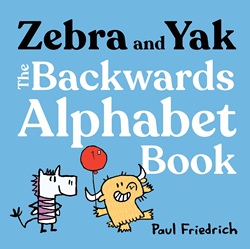
There’s a cartoon picture of Zebra on a lounge chair. He throws what I think is a table and a glass (might be a phone), and a speech bubble says “What?” On the opposite page are four comic book panels of Zebra asking why he didn’t hear the cue of X for Xylophone.

The book continues with the narrator’s words in very serious type, and the rest in comic book format with hand-drawn speech bubbles. After Zebra explains how things should go, the narrator says:

Apple wasn’t around.
We’re starting with Z instead.

Zebra’s response: “This is ridiculous! We need to find Apple!”

On the next page, Yak, too, isn’t ready, because he hasn’t seen the x-ray machine.

The two of them wander through the alphabet backwards, with plenty more silly situations. At the start of the alphabet, they’re wondering what took so long.

When they finally get to Apple, he’s very upset that he thought this was happening next week, so he went on vacation. An Alligator deals with him.

So this is one of those silly books that benefit from looking at something old in a new way. It will be better for kids who already firmly know their alphabet – I’d hate to really mess up any future library pages being able to shelve books. (They should also be old enough to be okay with a sentient apple getting eaten.)

I found the book when I saw Zebra and Yak are featured next in a Backwards Counting Book. That doesn’t feel as unusual, but I’m guessing it will still be silly.

paulfriedrich.com

Buy from Amazon.com

Find this review on Sonderbooks at: www.sonderbooks.com/Picture_Books/zebra_and_yak.html

Disclosure: I am an Amazon Affiliate, and will earn a small percentage if you order a book on Amazon after clicking through from my site.

Disclaimer: I am a professional librarian, but the views expressed are solely my own, and in no way represent the official views of my employer or of any committee or group of which I am part.

Subscribe for more reviews and talk about books.

Join the conversation: What did you think of this book?
Miriam and Her Dancing Shoes, by Sandy Eisenberg Sasso, illustrated by Joani Rothenberg

Miriam and Her Dancing Shoes

by Sandy Eisenberg Sasso
illustrated by Joani Rothenberg

Apples & Honey Press, 2025. 40 pages.
Review written April 28, 2026, from a library book.
Starred Review

Miriam and Her Dancing Shoes is a delightful expansion on the Bible story of the parting of the Red Sea.

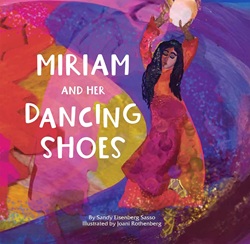
The paintings that go with the book have rich, beautiful colors. The people are leaving Egypt, but still complaining.

“ENOUGH COMPLAINING!”
Moses held up his hands.

“TAKE ONLY WHAT YOU CAN AND HURRY!”
There was no time to argue,
no time for bread to rise.
The people carried bowls of
sticky dough on their shoulders.

But not Miriam!
She carried a timbrel
and her dancing shoes.

I love Moses’s response:

“Give me strength,”
sighed Moses.
“We are running for our lives,
not planning a party!”

But as the people are going through the Sea of Reeds after Moses parts it, they are afraid and begin complaining again. Moses is so far ahead, they can’t even see him. And of course Pharaoh’s army is behind.

So Miriam shouts for them to follow her.

FOLLOW MY DANCING SHOES.

And when they slip and slide and get stuck in the mud, she tells them to lift up their feet like they are dancing. She plays her timbrel, and they walk to the rhythm.

Moses looked back
and was amazed.

The people were following
Miriam’s dancing shoes and
the music of her timbrel.

They were not complaining.
They were not grumbling.
They were singing.
They were dancing!

Miriam assures him this is the song of freedom, the sound of hope.

And this whole wonderful story is told with glorious paintings. I’m now thinking of this old story in a completely different way.

There are nine pages of back matter at the end of this picture book. I had a hard time deciding whether to put the book in nonfiction with some other Bible stories or with the picture books. I ultimately decided on picture books because the story it tells is so wonderful, and I think it will find more readers.

The back matter includes a wonderful song, written and performed by David Sasso, which you can find at www.davidsasso.com/freedom-walks-in-dancing-shoes. It’s based on the book and uses paintings from the book, and listening to it added to my delight with the whole project.

There are also a couple of craft projects in the back, including “Make a Freedom Tambourine,” and then notes about the story of the Exodus and the history of traditions that have grown up around Miriam, the sister of Moses.

You don’t have to be Jewish or Christian to love this story.

rabbisandysasso.com
applesandhoneypress.com

Buy from Amazon.com

Find this review on Sonderbooks at: www.sonderbooks.com/Picture_Books/miriam_and_her_dancing_shoes.html

Disclosure: I am an Amazon Affiliate, and will earn a small percentage if you order a book on Amazon after clicking through from my site.

Disclaimer: I am a professional librarian, but the views expressed are solely my own, and in no way represent the official views of my employer or of any committee or group of which I am part.

Subscribe for more reviews and talk about books.

Join the conversation: What did you think of this book?
Review of We the People Is All the People, written by Howard W. Reeves, illustrated by Duncan Tonatiuh

We the People Is All the People

written by Howard W. Reeves
illustrated by Duncan Tonatiuh

Abrams Books for Young Readers, 2026. 36 pages.
Review written June 4, 2026, from a library book.
Starred Review

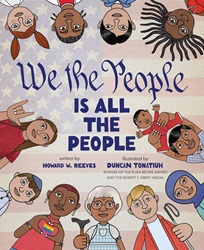
The concept of this picture book is simple and beautiful. The first page after the title page lists the Preamble to the United States Constitution, of course beginning with “We the People.” The rest of the book shows the wonderful multi-faceted diversity of the people of the United States.

Here’s how it begins:

“We the people” is all the people.

People
next door,
down the street,
and across the country,
in cities,
towns,
and farms.

People
living in houses,
apartments,
and in shelters,

who worship in churches,
mosques,
and temples.

People
who were here,
who arrived later,
who still come today.

And so it continues. Of course the pictures add great resonance – showing us a wide variety of people who fit each description.

A later section includes:

People
who look different ways,
love different ways,
and communicate different ways.

People
on assembly lines,
bread lines,
and protest lines.

And the last couple spreads:

Her. Him. Them.
You. Me. Us.

“We the people” is ALL the people.

There’s an author’s note at the back where he does acknowledge that the Constitution was originally written not for all the people, but for landowning white men. But I like his conclusion:

Some injustices have been corrected, such as emancipating the enslaved and giving women the vote, while others we are still working on.

Although things are better today, and there are more people included in “we the people” than when the preamble was written, for every step forward there is often a step backward, and there are still so many people left out. We still have much more work to do to include all the “we” in “we the people” as we strive to create a more perfect union.

This simple and beautiful picture book helps me believe that we can raise up the next generation to help make it so. Reading this book is a perfect way to celebrate America’s 250th birthday.

DuncanTonatiuh.com
abramsbooks.com

Buy from Amazon.com

Find this review on Sonderbooks at: www.sonderbooks.com/Picture_Books/we_the_people_is_all_the_people.html

Disclosure: I am an Amazon Affiliate, and will earn a small percentage if you order a book on Amazon after clicking through from my site.

Disclaimer: I am a professional librarian, but the views expressed are solely my own, and in no way represent the official views of my employer or of any committee or group of which I am part.

Subscribe for more reviews and talk about books.

Join the conversation: What did you think of this book?
Review of Charts for Babies, by Michelle Rial

Charts for Babies

by Michelle Rial

Abrams Appleseed, 2026. 36 pages.
Review written June 2, 2026, from a library book.
Starred Review

This book makes my mathematical heart happy! Mind you, I’m the mom who, frustrated when grading third-semester calculus papers, taught my small children the chain rule of calculus. (Just the pattern, not anything about the concepts behind it.)

This book, too, gives small children some patterns – and maybe they’ll notice some concepts. But that’s kind of not the point.

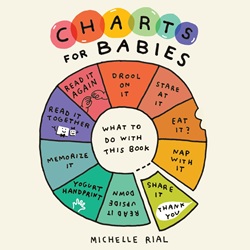
It’s all light and happy with pages in rainbow colors and rhyming text. And we see things in charts. Here are a couple of examples of the text in spreads:

This is wide.
This is narrow.
This is a line.
This is an arrow.

And of course that’s accompanied by an appropriate chart. Here’s another:

This is a block.
This is a stack.
This is a duck.
The duck says, “Quack Quack!”

The charts are all pretty much that simple, with some excuses to give hugs at the end.

And then on the final end papers, we get a key to the types of charts used – in a chart: Venn diagram, column chart, dumbbell chart, area chart, scatter plot, bubble chart, matrix, pie chart, bar chart, sound wave chart, timeline, decision tree, line chart, concentric diagram, spiral graph, and key. That last box is wonderfully self-referential.

So you see – they will learn something! It’s all clever and fun. What is a chart, after all, but a visual representation of something, a way to understand it at a glance? I always love a read-aloud that parents will enjoy, too, and this one is 100% fun!

michellerial.com

Buy from Amazon.com

Find this review on Sonderbooks at: www.sonderbooks.com/Picture_Books/charts_for_babies.html

Disclosure: I am an Amazon Affiliate, and will earn a small percentage if you order a book on Amazon after clicking through from my site.

Disclaimer: I am a professional librarian, but the views expressed are solely my own, and in no way represent the official views of my employer or of any committee or group of which I am part.

Subscribe for more reviews and talk about books.

Join the conversation: What did you think of this book?
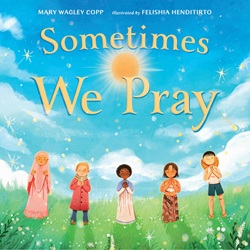
Review of Sometimes We Pray, by Mary Wagley Copp, illustrated by Felishia Henditirto

Sometimes We Pray

by Mary Wagley Copp
illustrated by Felishia Henditirto

Charlesbridge, 2026. 36 pages.
Review written April 20, 2026, from a library book.
Starred Review

Here is a simple and inclusive book about how all kinds of people from all over the world in all kinds of situations and all kinds of ways all pray.

The book is simple – it doesn’t talk about who or what different groups pray to. Instead, it talks about what we have in common – we pray. And it does show the variety of ways that happens.

I love the story at the back of why the author wrote the book:

One day, in the middle of an ELL (English language learners) class, two of my Syrian students stood up with their prayer rugs, went to a corner of the room, and knelt in prayer. Another student, a former pastor from Burundi, suggested that we sit silently as they prayed. The class obliged. A student from Haiti made a sign of the cross and others bowed their heads, as we sat in silence. When the class resumed, a lengthy conversation ensued – as best we could with the variety of languages we spoke – of what prayer meant to each of us. The curiosity of the students, coming from vastly different cultures, was heartening. In making space for, listening to, and hearing different perspectives, we found connection and discovered many shared values. Sometimes We Pray is inspired by that class. It is an offering to initiate similar explorations. During my research, many people shared their perspectives and practices, and I am grateful for their generous and open spirit.

The main text of the book stays simple, suitable to read to a child:

Sometimes we kneel.
Sometimes we bend and bow.
Or lie flat.

We might pray with each step. [Here there’s a picture of Buddhist monks walking in a labyrinth.]
strumming each string,
inspecting each incredible leg, [Here there’s a picture of a child looking at a praying mantis.]
or maybe…
marveling at a star.

The book goes on to talk about positions of prayer, what we do with our hands, times we pray, ways we pray, places we pray.

I like the part at the end that does include praying in difficult times:

Sometimes we wonder if prayer works.
Someone we love gets sick…
and doesn’t get better.

Someone is hungry or
doesn’t have a home.
The rain doesn’t stop or
never
comes.

But we keep praying, wherever we are.

We might be praying the same prayer,
sowing the same seeds, or…
marveling at the same star.

The beautifully painted pictures accompany a few lines on each spread. They portray people of many different cultures and religions, from many different parts of the world – and viscerally show us how much we are all alike in this way.

This isn’t a book I’d use to introduce a child to prayer. As a Christian, I’d use the tried-and-true “Prayer is talking to God.” But once a child has seen how their own family prays, this book is a glorious way to point out that others may do it differently, but so many others of us here on earth do pray.

marywagleycopp.com
felishiahenditirto.com

Buy from Amazon.com

Find this review on Sonderbooks at: www.sonderbooks.com/Picture_Books/sometimes_we_pray.html

Disclosure: I am an Amazon Affiliate, and will earn a small percentage if you order a book on Amazon after clicking through from my site.

Disclaimer: I am a professional librarian, but the views expressed are solely my own, and in no way represent the official views of my employer or of any committee or group of which I am part.

Subscribe for more reviews and talk about books.

Join the conversation: What did you think of this book?
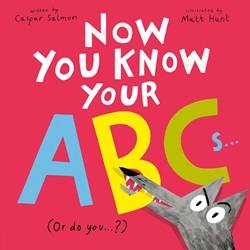
Review of Now You Know Your ABCs… (Or Do You…?) written by Caspar Salmon, illustrated by Matt Hunt

Now You Know Your ABCs…

(Or Do You…?)

written by Caspar Salmon
illustrated by Matt Hunt

Nosy Crow, 2026. 32 pages.
Review written April 20, 2026, from a library book.
Starred Review

Hooray! The creators of the amazing How to Count to One (And don’t even THINK about other numbers) have created another interactive and utterly silly parody of a basic concept book – this time taking on the alphabet.

The book begins simply enough with A is for Apple, B is for Ball, and C is for Castle. But when the narrator starts in and tries to do D is for Dog – the “dog” turns out to be a wolf – a Dangerous, Dangerous wolf!

So what are you to do but cry out EEEEEEEEEEK in fear and run all the way to France?

The nearest French person is no help, because they do not speak your language, so you Go and seek shelter inside a tree house.

The adventure that follows gets zanier and zanier as you try to outwit the wolf and get back home – all the way through the alphabet.

It all adds up to an extremely silly book that begs to be read aloud, preferably with a group that indeed already knows their ABCs so they will appreciate the surprising ways each next letter is brought into the story.

matthuntillustration.com
nosycrow.us

Buy from Amazon.com

Find this review on Sonderbooks at: www.sonderbooks.com/Picture_Books/now_you_know_your_abcs.html

Disclosure: I am an Amazon Affiliate, and will earn a small percentage if you order a book on Amazon after clicking through from my site.

Disclaimer: I am a professional librarian, but the views expressed are solely my own, and in no way represent the official views of my employer or of any committee or group of which I am part.

Subscribe for more reviews and talk about books.

Join the conversation: What did you think of this book?