Review of I Hardly Knew Me, by Nia Chiaramonte
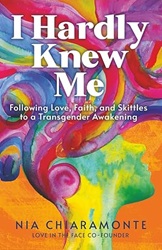
I Hardly Knew Me

Following Love, Faith, and Skittles to a Transgender Awakening

by Nia Chiaramonte

Lake Drive Books, 2025. 212 pages.
Review written January 27, 2026, from my own copy, purchased via Amazon.com
Starred Review

I Hardly Knew Me tells the coming-out journey of a Christian transgender woman. She tells her story with warmth and humor.

This isn’t a theological treatise defending her decision to come out, but it is a story explaining and showing how much her life is better, how much more authentically she presents herself, how much deeper her relationships, because she did come out.

We also see how difficult that path was. Her parents refused to acknowledge her as female, and she tells us the way different people responded, often in hurtful ways.

The book is presented as one person’s story, and it’s a story with heart.

I do think a strength of the book is giving insights on what is the most helpful way to respond when someone comes out to you.

Once I got to a point where I needed to come out to everyone, and I started coming out to more people who were emotionally unsafe, one thing was very clear to me: they didn’t know they were emotionally unsafe. Because felt safety is in the eye of the beholder – in this case, me. I told a couple of family members that they didn’t make me feel safe emotionally, and where I was able to, I told them why. It typically didn’t go over well. They thought they were creating a safe environment from their perspective.

The problem is that felt emotional safety has a very hard time existing in the presence of judgmental behavior, which you see when people start talking about religious or cultural or social rules instead of just listening. It’s judgment of someone for a life that is perceived as wrong, living a life as a trans woman in my case, and it is judgment of someone’s being. That creates an environment where emotional safety cannot exist. Thinking I know what’s best and having a judgmental attitude toward someone decimates any hope of emotional safety as it demolishes trust.

People I have come out to who have responded well and created safety for me have responded by first listening, then trusting. They trust in who I am and they trust that I know myself better than they know me. They create expanding spaces for us to find ourselves together. People who have hurt me emotionally haven’t trusted me and my own story, and in fact have projected their own insecurities about their story onto me, further destroying the possibility of building a safe space where both of us can be ourselves.

I also appreciated her insights on healthy and unhealthy boundaries:

For those who refuse to respect my boundaries, such as calling me by my actual name, they’ve in turn accused me of not respecting their boundaries. I say I can only be in a relationship if they respect and honor me by using my name and pronouns; they say they can only be in a relationship if they’re able to call me by whatever name and pronouns they choose.

This gets tricky because while these two things sound the same, there are major differences. My boundary says, “This is who I am in relationship to you, and I get to define me in that relationship. I will determine how I exist and behave in the world, and this is what I need from you.” The boundary from the one refusing to use my name says, “This is who you are in relationship to me; I get to define you and how you exist and behave in the world, and this is what I need you to be for me.” The unhealthy boundary essentially says, “My belief about you is more important than your belief about yourself, and I get to define your story so it fits with mine.” Whereas the healthy boundary says, “My belief about me and your belief about you are both important, and we each get to define our own stories.”

So you’ve got a warm coming-out story, insights into what it feels like to be transgender in today’s society, wisdom about how you can relate to transgender people in your own life – and a story that will give you a hankering for freeze-dried Skittles. (Well, it did me – I’d eaten them just before I read this book.)

Oh, and Skittles? She makes a good point: Freeze-dried Skittles and regular Skittles are both wonderful in their own way. But if you have one, expecting it to be the other, you’re going to be disappointed.

loveintheface.com
lakedrivebooks.com

Buy from Amazon.com

Find this review on Sonderbooks at: www.sonderbooks.com/Nonfiction/i_hardly_knew_me.html

Disclosure: I am an Amazon Affiliate, and will earn a small percentage if you order a book on Amazon after clicking through from my site.

Disclaimer: I am a professional librarian, but the views expressed are solely my own, and in no way represent the official views of my employer or of any committee or group of which I am part.

Subscribe for more reviews and talk about books.

Join the conversation: What did you think of this book?

Review of Who Is Government? edited by Michael Lewis

Who Is Government?

The Untold Story of Public Service

edited by Michael Lewis
read by the authors

Books on Tape, 2025. 6 hours, 43 minutes.
Review written February 19, 2026, from a library eaudiobook.
Starred Review

I listened to this audiobook because the book was on President Obama’s Summer 2025 Reading List. Listening to the audiobook was especially nice because the author of each essay read their own work, and W. Kamau Bell included audio interviews from his research.

This book is about public servants – about people who work for the federal government and the amazing work they do. I live in northern Virginia and many of my friends do awesome work for the government – so I was not surprised. It’s also true that several of my friends had to leave their jobs after Trump devastated the federal work force, so I did find myself wondering how many of the amazing people featured in this book are still employed, doing good for the country and the world.

The premise of the book is to find outstanding federal employees and highlight the good work they do, unbeknownst to most of the country. Michael Lewis asked some great writers to participate, and besides two essays from him, this book includes pieces from Casey Cep, Dave Eggers, John Lanchester, Geraldine Brooks, Sarah Vowell, and W. Kamau Bell.

Some examples of the stories I found super interesting (well, they were all really interesting) were the guy who saved tens of thousands of lives by changing mining regulations and putting an end to roof collapses in coal mines, and the IRS agent who brought down an international human trafficking ring (Can we put him on the Epstein case?), brought a drug lord to justice, and much more. One chapter wasn’t about any one person, but was about the Consumer Price Index – and the tremendous amount of work that goes into it and how important it is. Of course as a librarian, I was especially interested in the chapter that highlighted a worker at the National Archives.

This book can maybe help us recover from the devastation in our government post-Trump? It presents an uplifting vision of government that does good work, that takes care of important work that doesn’t make anyone a profit but touches lives in vitally important ways. This is what – and who – government is supposed to be.

If you live in the United States, I highly recommend this book to be informed about amazing things your government is doing – but also to hear some fascinating stories of good people doing good work.

michaellewiswrites.com

Buy from Amazon.com

Find this review on Sonderbooks at: www.sonderbooks.com/Nonfiction/who_is_government.html

Disclosure: I am an Amazon Affiliate, and will earn a small percentage if you order a book on Amazon after clicking through from my site.

Disclaimer: I am a professional librarian, but the views expressed are solely my own, and in no way represent the official views of my employer or of any committee or group of which I am part.

Subscribe for more reviews and talk about books.

Join the conversation: What did you think of this book?
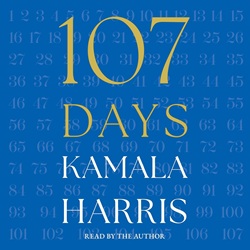
Review of 107 Days, by Kamala Harris

107 Days

by Kamala Harris
read by the Author

Simon & Schuster Audio, 2025. 9 hours, 58 minutes.
Review written January 27, 2026, from a library eaudiobook.
Starred Review

This audiobook made me wistful, nostalgic, and deeply sad for what might have been, but by the end filled me with hope and determination.

The content of the book is simple to describe: Kamala Harris tells about her 107 days running for president, from the day Joe Biden called to tell her he was dropping out to the night she got the news she had lost the election.

It renewed all my wishes that she had won. She cares about people and about trying to make government work for people. In her description of her days and her thoughts and emotions, she feels like a real person – a real person who is trying to do her best with what she has.

I think I relate to Kamala because she’s only a few months younger than me. (And Tim Walz only a few months older.) She’s also a likable person – down-to-earth and genuinely trying to use government power to defend those who need help and to bring fairness to our system.

I’ve seen criticism of this book that she didn’t take responsibility for the loss. But I think she did her best with the time she had. She does admit to some mistakes, and she points out mistakes by others (perhaps more than she should have, but it feels fair). This book shows how she gave it her best shot.

I still find myself wishing she’d had a little more investigation happen to irregularities in swing states’ voting machines, but she was determined to reinstate a peaceful transfer of power and not deepen the nation’s mistrust in voting results. And that was a powerful and hard thing she did. She said that only three other vice presidents have had to certify their own defeat – and Hubert Humphrey refused and had the president of the Senate do it in his place.

And she does hold out hope at the end. This was written before ICE moved so many troops into Minneapolis, so she focuses on the midterms and reminds us that the people still have power. May that be so. And may we as the people of these United States remember that we are the foundation of this government and make our voices known.

kamalaharris.com

Buy from Amazon.com

Find this review on Sonderbooks at: www.sonderbooks.com/Nonfiction/107_days.html

Disclosure: I am an Amazon Affiliate, and will earn a small percentage if you order a book on Amazon after clicking through from my site.

Disclaimer: I am a professional librarian, but the views expressed are solely my own, and in no way represent the official views of my employer or of any committee or group of which I am part.

Subscribe for more reviews and talk about books.

Join the conversation: What did you think of this book?
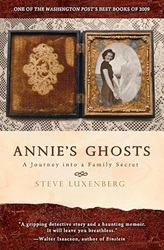
Review of Annie’s Ghosts, by Steve Luxenberg

Annie’s Ghosts

A Journey Into a Family Secret

by Steve Luxenberg

Hyperion, 2009. 401 pages.
Review written October 6, 2025, from a library book.
Starred Review

It’s a fun story how I happened to read this book: I met the author!

Back in April, I gave myself a retreat at Blackwater Falls Lodge in Blackwater State Falls, West Virginia. The lodge has a large common room, with an abundance of big, round tables. Someone had started a jigsaw puzzle on one of them – a trap for me! I started working on the puzzle after dinner, before carrying out my plan of reading and writing in my room, and got hooked. Other people came to join me – among them was a nice couple. The puzzle was of a giant library, and it came out that I was a librarian – and this gentleman was a writer! His wife was a retired school librarian. He was also an associate editor for the Washington Post. Well, it was nice doing the puzzle with them – and then they invited me to play a game of Upwords with them. And instead of a “productive” evening reading and writing, I had a lovely social evening playing Upwords with this obviously highly intelligent journalist and his wife.

When I got home, I checked out his books, then decided to read the older one first. It’s taken me a long time – mostly one or two chapters per week (because I read lighter stuff at bedtime, which is my main reading time). I did not find myself forgetting what went before when I picked it up each week – it’s memorable reading – and I finally finished off the last five or six chapters in one sitting last weekend. This is by no means light reading, but it’s absorbing, and it’s super interesting.

So now let me tell you about the book this nice man wrote. It’s the story of discovering his mother had a disabled sister she kept a complete secret after she married. He first heard a rumor of it when his mother was hospitalized, and then confirmation after her death. So then began the process of researching this aunt, Annie, whom he hadn’t known about.

At first, he assumed she lived away from the family most of her life, but Annie wasn’t moved to a state institution until she was twenty-one years old. She was born with one leg shorter than the other, that wouldn’t grow properly, and had possible mental retardation and mental illness. Annie spent the rest of her life – decades – in the institution, yet his mother had told everyone she was an only child.

So this is the story of Steve Luxenberg digging up the truth. And finding out why his mother kept this secret. It gives a window into mental health care in the 1940s and how much it has changed. We even learn about the experiences of his mother’s cousin, who was the only one of her immediate family to survive a massacre in a Ukrainian village during the Holocaust.

The secret seems simple on the surface – a disabled sister who’d been put into an institution. But the story ends up being sprawling, as Steve Luxenberg works to understand his mother’s motivation in keeping the secret. This involves attitudes at the time toward mental and physical disabilities, treatment options at the time, and even politics at the time as it involved state institutions. Then there was the bureaucratic paperwork to even have access to the records, if they existed, and the effort of tracking down people who’d known his mother as a child – when her sister lived with the family – and afterward. How many of them knew of the secret? Unfortunately, many of them had already passed. He got more information piece by piece, and the book is something of a detective story, as well as a broad work of history – mixed with journalism and memoir.

The whole thing was fascinating reading, but my favorite part came in a vignette toward the end. He begins most chapters with his own memories with his mother, and this one was about playing her favorite board game with her – Upwords. That made me smile. Made me feel like I had a tiny piece of the experience of this book. And Steve Luxenberg and his wife still play Upwords.

steveluxenberg.com

Buy from Amazon.com

Find this review on Sonderbooks at: www.sonderbooks.com/Nonfiction/annies_ghosts.html

Disclosure: I am an Amazon Affiliate, and will earn a small percentage if you order a book on Amazon after clicking through from my site.

Disclaimer: I am a professional librarian, but the views expressed are solely my own, and in no way represent the official views of my employer or of any committee or group of which I am part.

Subscribe for more reviews and talk about books.

Join the conversation: What did you think of this book?
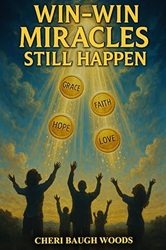
Review of Win-Win Miracles Still Happen, by Cheri Baugh Woods

Win-Win Miracles Still Happen

by Cheri Baugh Woods

Front Line Book Publishing, 2025. 264 pages.
Review written August 6, 2025, from my own copy, ordered via Amazon.com
Starred Review

Full disclosure first: I consider the author Cheri Woods a friend, via her brother Kevin, who I talked with most weeks at church for years. I was in the group that Kevin asked to pray for Cheri when her life was in danger with leukemia, I picked out verses for Kevin to send to her when she was going through treatment, and later when my niece had leukemia at 3 years old and again at 7 years old, Cheri in turn prayed for her.

So I know how miraculous Cheri’s story is, and I ordered a copy the same day I heard it had been published. And yes, I’m biased, and knew I would enjoy the book.

I’ll be honest – this book is not traditionally published, and although Cheri thanks an editor in the Acknowledgements, the presentation is not as polished as what I’m used to as a librarian. There are occasional mistakes such as quotation marks out of place and some repetitive spots. However, I’m glad that I knew I would want to read Cheri’s full story and overlooked those things – because as soon as I picked it up, I was riveted. Getting a Christian memoir traditionally published is incredibly difficult, so I’m selfishly glad that Cheri didn’t wait for that to happen so I could read her book now.

And I didn’t really know the earlier part of her story – that her first husband turned out to be a bigamist, and her second husband passed away when she was 32 years old. From seeing her journey with cancer, I was not surprised to see her faith shine through in her entire story, as God brought her through all of those hard things.

Here’s how Cheri explains the title in her Introduction:

I am here to declare that my cornerstone remains intact. Through all my circumstances and experiences, I learned to rely on the strength, power, and mercy that God so generously gives each of us through our faith.

I began living a Win-Win life, which meant that no matter what came my way, even if that meant my death, I WIN!

If God chose to keep me here on the earth, I win, because it shows me He still has need of me. My purpose for living is not over, and he has more for me to do for the glory of His kingdom.

If God chose to take me home, I WIN again because to be absent from the body is to be present with the LORD. That is the ultimate win.

My hope is that my life’s events may be an encouragement and an inspiration for you to keep going as you encounter your own struggles and difficulties. I pray that as you read, you will grab hold and tap into God’s energy, his forever-loving lifeline, and begin to live your own Win-Win life.

Reading this book is like hearing from an encouraging friend with strong faith. Her story is amazing – I wouldn’t believe it if someone tried to put it into a novel – and it’s lovely to see how God’s hand has been on her life all along.

Cheri had to retire early from her career as a teacher and school administrator when she got a bone marrow transplant and a new immune system. So let me encourage you to purchase her book – the money will go to someone who can use it and deserves it. It’s not every day that you “meet” someone who’s been through incredible difficulties who has such a sunshiny spirit of God’s love. This book will not only keep you reading, it will bless and inspire you.

Buy from Amazon.com

Find this review on Sonderbooks at: www.sonderbooks.com/Nonfiction/win_win_miracles_still_happen.html

Disclosure: I am an Amazon Affiliate, and will earn a small percentage if you order a book on Amazon after clicking through from my site.

Disclaimer: I am a professional librarian, but the views expressed are solely my own, and in no way represent the official views of my employer or of any committee or group of which I am part.

Subscribe for more reviews and talk about books.

Join the conversation: What did you think of this book?
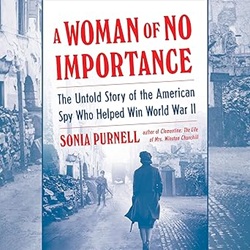
Review of A Woman of No Importance, by Sonia Purnell

A Woman of No Importance

The Untold Story of the American Spy Who Helped Win World War II

by Sonia Purnell
read by Juliet Stevenson

Books on Tape, 2019. 13 hours, 54 minutes.
Review written July 8, 2025, from a library eaudiobook.
Starred Review

I wish I remembered what prompted me to put this amazing nonfiction audiobook on hold, because it was a great tip. I don’t do a great job of reading big thick nonfiction tomes, but as an audiobook, it kept my interest all the way.

The author researched one of the most important spies of World War II, Virginia Hall. Yes, she was American, from Baltimore – but most of the time she did her spying for the British Special Operations Executive (SOE) before the United States even entered the war.

Not only did Virginia Hall face obstacles and being underestimated and dismissed because she was a woman – she was also disabled, an amputee with a wooden leg. Those things kept her from getting to go far in the U.S. diplomatic corps, so when World War II started, she found work with the SOE.

She was in “free” France under the Vichy government for most of the war, building more and more networks in the Resistance, sending more and more information to the Allies, and helping the cause more and more. She was the sort who wouldn’t let them send her back to safety, even when it became apparent the Germans were figuring out who was causing them so much trouble.

All along the way, she faced frustrations because her assessments and requests weren’t given the weight due her experience – because she was a woman. But still, her expertise and skills made her incredibly effective and helpful for the Allied cause.

The story is riveting – especially the bulk of it where she is working in war-time France. It’s truly amazing how much she accomplished right under the noses of her enemies. This book helped me understand that her many years of service and the wide variety of ways she helped the Allied cause.

soniapurnell.com

Buy from Amazon.com

Find this review on Sonderbooks at: www.sonderbooks.com/Nonfiction/woman_of_no_importance.html

Disclosure: I am an Amazon Affiliate, and will earn a small percentage if you order a book on Amazon after clicking through from my site.

Disclaimer: I am a professional librarian, but the views expressed are solely my own, and in no way represent the official views of my employer or of any committee or group of which I am part.

What did you think of this book?

Review of Desegregation in Northern Virginia Libraries, by Chris Barbuschak and Suzanne S. LaPierre

Desegregation in Northern Virginia Libraries

by Chris Barbuschak and Suzanne S. LaPierre

History Press, 2023. 206 pages.
Review written April 30, 2025, from my own copy, signed by the authors.
Starred Review

First, I owe my friends, authors Chris and Suzanne, a big apology. I attended their book launch in 2023 and got a signed copy – but I didn’t get it read until 2025. My excuse was that I was on the Morris Award committee in 2023, reading only debut young adult books – but that’s not a very good excuse in 2025! On top of that, Suzanne is the very most faithful advocate for my reviews, always liking my review posts on Facebook. So anyway, let me tell you about their wonderful book!

Yes, of course I’m biased. Chris and Suzanne both work in the Virginia Room at the City of Fairfax Regional Library branch of Fairfax County Public Library, where I worked as Youth Services Manager before I got my current position as Youth Materials Selector. I often got to spend an hour or two at the Virginia Room desk as needed – and came to appreciate their expertise and skills as researchers.

This book shows meticulous research, uncovering the history of segregation in Northern Virginia libraries, both explicit and implicit, and the brave Black activists who made desegregation happen even when a Supreme Court ruling wasn’t enough.

The book happened because one of the Fairfax County Library Board trustees, Dr. Sujatha Hamptom, challenged the established answer that FCPL had been open to everyone since its founding in 1939. Chris and Suzanne were asked to dig deeper and did the deep research in local archives that led to this book. I loved the way in their book launch they told stories of the individuals who stood up for everyone’s right to read – with legal challenges, sit-ins, and the like.

The book looks at six different Northern Virginia library systems, at notable cases elsewhere in Virginia, and at service in Washington, D. C. Even though Virginia passed a law in 1946 that libraries had to provide service to all residents – most jurisdictions still tried to meet that with separate services. And each jurisdiction had to fight for their rights in their own neighborhoods. And even when libraries were officially desegregated, there was still some time before Black people felt welcome enough to visit formerly white-only facilities.

The beautiful part of this book is how many different individuals took steps to make a difference in their own communities – and how in the long run, they succeeded, despite some individual setbacks. That’s a heartening message to read about today, when the idea that folks should be free to read what they want is being newly threatened. It’s good to read about the ordinary people who were heroes in the past by standing up for their own rights to library access.

historypress.com

Buy from Amazon.com

Find this review on Sonderbooks at: www.sonderbooks.com/Nonfiction/desegregation_in_northern_virginia_libraries.html

Disclosure: I am an Amazon Affiliate, and will earn a small percentage if you order a book on Amazon after clicking through from my site.

Disclaimer: I am a professional librarian, but the views expressed are solely my own, and in no way represent the official views of my employer or of any committee or group of which I am part.

What did you think of this book?
Review of That Librarian, by Amanda Jones

That Librarian

The Fight Against Book Banning in America

by Amanda Jones

Bloomsbury, 2024. 269 pages.
Review written February 22, 2025, from my own copy, purchased via Amazon.com
Starred Review

That Librarian is Amanda Jones’ own story about speaking up against censorship in a meeting of her local public library board – and then relentlessly being hounded and harassed online afterward. She is a middle school librarian herself, and has won multiple awards for her work. And that fueled the flame of defamation, slander, and even death threats – the bullies said that because she’s against book bans, that makes her a purveyor of pornography to children.

I’d like to think that this is a problem mainly in red states. And, yes, the county where I work as a librarian consistently votes blue. But in view of things that have happened in the first month of the new administration, I have to take seriously this paragraph from page 5 of Project 2025:

Pornography, manifested today in the omnipresent propagation of transgender ideology and sexualization of children, for instance, is not a political Gordian knot inextricably binding up disparate claims about free speech, property rights, sexual
liberation, and child welfare. It has no claim to First Amendment protection. Its purveyors are child predators and misogynistic exploiters of women. Their product is as addictive as any illicit drug and as psychologically destructive as any crime. Pornography should be outlawed. The people who produce and distribute it should be imprisoned. Educators and public librarians who purvey it should be classed as registered sex offenders. And telecommunications and technology firms that facilitate its spread should be shuttered.

No, I don’t believe in giving pornography to children, and neither does Amanda Jones. But they’re defining pornography as any book that acknowledges that transgender people exist. Anything that portrays same-sex couples as having loving relationships. And if you allow those books – books that resonate with citizens in our communities, books about the loving families that reside there, books that help the marginalized feel seen – the bullies label you as a sex offender – which is what they did to Amanda Jones.

Her original speech at the library board meeting didn’t mention any specific books, nor were any mentioned by the library board – but because she spoke up against book banning, she was accused of being a danger to children and wanting to put books about sex into the hands of children. This about someone who has devoted her life to serving children.

Amanda made the difficult choice to sue the main instigators for defamation. The initial case was dismissed on the grounds that she’s a “public figure,” which seems silly, since she spoke in that meeting as a parent and as a member of the community. And I just looked up on google, and after two appeals, the Louisiana Supreme Court vacated the lower court’s decision, so her case will go forward. She’s not even suing them for damages. All she’s asking for is $1 and an apology – because you don’t get to make up lies about someone and try to destroy their life.

So all that is good news, and this book gives visibility to the more and more pervasive problem of people trying to restrict their public library’s collections to only books that they think are okay. Yes, there are books in the public library that I wouldn’t give to my own children when they were young. But that doesn’t mean I should keep your children from reading them. Here’s how Amanda Jones puts it:

Freedom and parental rights are a rallying cry, but the same people who say this are trying to take away the rights of young adult readers, their parents, and others. The people who say they are for small government are pushing governmental control over what we the people have access to, and not just children. We should ALL want the freedom to read what we want to read and have access to reading materials from a variety of viewpoints. Protecting our libraries is exactly how we do that. The attack on librarians and libraries is shameful and something everyone should fear. Once they destroy our libraries and schools, what will be next? Where will it end? We must continue to speak up. That’s all we can really do. We must stand up for what is right and good, regardless of what is said about us. The book banners, the people who attacked me for daring to disagree with them, wanted to silence me. I didn’t let them. I did the opposite. For the past year, I have agreed to almost every interview requested of me to help spread the word across the nation about what is happening in our libraries and to librarians. It has been exhausting, but necessary. I will continue to speak out when asked. We have to not just for the sake of libraries but for real freedom. Everyone who can needs to speak out on behalfof those who cannot. People who are rational need to take a stand against the irrational. We must do so with grace and truth, never stooping to the tactics the pro-censors use. We are the real patriots.

I do highly recommend this book to everyone to help understand those who are attacking public libraries and our first amendment rights. There’s a chapter at the end about what you can do in your own community to support your own libraries.

Thank you, Amanda Jones, for speaking up for the freedom to read!

No one on the right side of history has ever been on the side of censorship and hiding books.

bloomsbury.com

Buy from Amazon.com

Find this review on Sonderbooks at: www.sonderbooks.com/Nonfiction/that_librarian.html

Disclosure: I am an Amazon Affiliate, and will earn a small percentage if you order a book on Amazon after clicking through from my site.

Disclaimer: I am a professional librarian, but the views expressed are solely my own, and in no way represent the official views of my employer or of any committee or group of which I am part.

What did you think of this book?

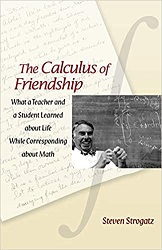
Review of The Calculus of Friendship, by Steven Strogatz

The Calculus of Friendship

What a Teacher and a Student Learned about Life While Corresponding about Math

by Steven Strogatz

Princeton University Press, 2009. 166 pages.
Review written September 9, 2021, from a book ordered via Amazon.com
Starred Review

This book is the story of the correspondence the author – a professor of Mathematics at Cornell University – carried on with his high school calculus teacher for over thirty years.

Here’s how he introduces the book:

For the past thirty years I’ve been corresponding with my high school calculus teacher, Mr. Don Joffray. During that time, he went from the prime of his career to retirement, competed in whitewater kayak at the international level, and lost a son. I matured from teenage math geek to Ivy League professor, suffered the sudden death of a parent, and blundered into a marriage destined to fail.

What’s remarkable is not that any of this took place – such ups and downs are to be expected in three decades of life – but rather that so little of it is discussed in the letters. Instead, our correspondence, and our friendship itself, is based almost entirely on a shared love of calculus.

It never occurred to me how peculiar this is until Carole (I’m happily remarried now) teased me about it. “You’ve been writing to him for thirty years? You must know everything about each other.” Not really, I said. We just write about math problems. “That is such a guy thing,” she said, shaking her head.

This Prologue is more honest than the subtitle. This is a book about awesome insights into and about calculus – clever, insightful, and challenging problems – and the beauty of math. It doesn’t say a whole lot about life lessons – and yet their friendship and personalities do shine through.

And there’s some lovely mathematics here, well-explained – at least I think so. I am sad to say that in many places, the math went over my head. I’m a former math major with a master’s degree in math who taught college math for ten years – but I didn’t remember things about infinite series and infinite integrals and other things discussed here. And I’m a little appalled with myself that I didn’t have the desire to go look up what I didn’t understand.

I am, however, wishing that this book existed when I was a young hot-shot calculus student. It would have showed me that math is not a finite subject and that even lofty math professors still find plenty of ideas to play with, going far beyond textbooks.

And yes, there are some lovely insights about the friendship between a teacher and his student. The correspondence began when Steven Strogatz started sending interesting math problems to his former teacher and then explained them. He shares an insight at the back of the book about what his teacher gave him:

He let me teach him.

Before I had any students, he was my student.

Somehow, he knew that’s what I needed most. And he let me, and encouraged me, and helped me. Like all great teachers do.

Hmmm. I do know of a young math major who just started at Virginia Tech. I think he’d be among the ideal audience for this book – reading about how, for those who love it, math never runs out of fascinating beauty.

Oh, and full disclosure: I was disposed to like this book because the author found my mathematical knitting posts and talked about them on Twitter. So now I’m happy to promote his book – both things are about the beauty of math.

stevenstrogatz.com
press.princeton.edu

Buy from Amazon.com

Find this review on Sonderbooks at: www.sonderbooks.com/Nonfiction/calculus_of_friendship.html

Disclosure: I am an Amazon Affiliate, and will earn a small percentage if you order a book on Amazon after clicking through from my site.

Disclaimer: I am a professional librarian, but I maintain my website and blogs on my own time. The views expressed are solely my own, and in no way represent the official views of my employer or of any committee or group of which I am part.

What did you think of this book?

Review of In the Garden of Beasts, by Erik Larson

In the Garden of Beasts

Love, Terror, and an American Family in Hitler’s Berlin

by Erik Larson
read by Stephen Hoye

Random House Audio, 2011. 12 hours, 53 minutes.
Review written January 8, 2025, from a library eaudiobook.
Starred Review

I’m not sure where I noticed the suggestion, but I do know that somewhere I saw the suggestion that I read this book about the rise of Hitler in order to gain insights about the rise of Donald Trump. Even though the book is 14 years old, there was still a wait for the audio. Now that I’ve read the book in that context, let’s just say that I was not reassured.

This is the story of William Dodd, the American ambassador to Nazi Germany in 1933 through 1937, just after Hitler became chancellor to Germany. Dodd was an academic, not the usual wealthy donor to get an ambassadorship, but newly-elected FDR was having trouble finding someone willing to go. Dodd brought along both his adult children, and the book gives extra attention to his daughter Martha, who had affairs with a wide assortment of men, including the first head of the Gestapo and a Russian Communist.

The chilling part of this book is how so many people simply didn’t take Hitler seriously. They believed him when he’d earnestly lie to their faces and claim he would put a stop to any harassment the people might do to American citizens or Jews. When I think about World War II, I think about the years after America entered the war, and had no idea how early Dachau was built, and that international visitors toured it, saw the prisoners in “protective custody” and said they were well-treated.

Of course, it was mostly unsettling. At first Dodd and his family didn’t believe the Jews were actually being mistreated, except for isolated incidents. And nobody really thought Hitler’s regime would last long. And Hitler improved unemployment! And inflation! And he found people to blame. Roused up national pride. While the main concern from America’s president was that Germany would repay its debts to American banks. (I always forget how soon after World War I Hitler rose to power. Not even fifteen years later.)

The author doesn’t take a grand overarching view of history. He shows us what it was like for one family, transplanted from America to Berlin. He heavily uses descriptions from their writings and keeps their viewpoint – which is all the more poignant, knowing what we know now.

I hated the way they shut their eyes to the threat from Hitler – as I continue to shut my eyes to the parallels I saw. Humans don’t want to believe that bad things are coming. I am still very much hoping this book is simply a fascinating in-depth look at the history of the lead-up to a madman taking power in one country and causing the upheaval of the world. May any parallels simply be products of wild imagination.

Buy from Amazon.com

Find this review on Sonderbooks at: www.sonderbooks.com/Nonfiction/in_the_garden_of_beasts.html

Disclosure: I am an Amazon Affiliate, and will earn a small percentage if you order a book on Amazon after clicking through from my site.

Disclaimer: I am a professional librarian, but the views expressed are solely my own, and in no way represent the official views of my employer or of any committee or group of which I am part.

What did you think of this book?