Review of The Tears of Things, by Richard Rohr

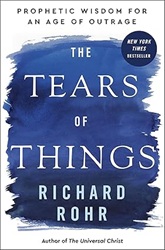
The Tears of Things

Prophetic Wisdom for an Age of Outrage

by Richard Rohr

Convergent Books, 2025. 173 pages.
Review written July 5, 2025, from my own copy, purchased via amazon.com
Starred Review

Richard Rohr has done it again! His latest book helps me see the prophets with new eyes – and see how the themes speak to us today.

Since prophets are looking at injustice and suffering, of course they’re applicable today, and give Richard Rohr gives us insights for approaching those things. I like the way he points out a pattern of growth in the prophets:

My favorite thing about the prophetic books of the Bible is that they show a whole series of people in evolution of their understanding of God. Like most of us, the prophets started not only with judgmentalism and anger but also with a superiority complex of placing themselves above others. Then, in various ways, that outlook falls apart over the course of their writings. They move from that anger and judgmentalism to a reordered awareness in which they become more like God: more patient like God, more forgiving like God, more loving like God.

I love that he points out that God’s abundant love and compassion is found over and over again in the Old Testament, and yes, even in the prophets.

The title of the book comes from a quotation from Virgil, which he expands on in the first chapter:

Prophets and mystics recognize what most of us do not – that all things have tears and all things deserve tears. They know that grief and sadness are doorways to understanding life in a non-egocentric way. Tears come from both awe and empathy, and they generate even deeper awe and deeper empathy in us. The sympathy that wells up when we weep can be life-changing, too, drawing us out of ourselves and into communion with those around us. This is continuously exemplified in the writings that we have received from the Hebrew prophets.

So the prophets begin by looking at what’s wrong with the world. They don’t flinch from the truth of the world. But Rohr emphasizes that they don’t stop there.

By following the prophets’ full journey from anger to sadness and beyond, we can mature in belief, as they had to do themselves. All the prophets started with anger, or even rage, at all the right things: injustice, oppression, deceit, misuse of money, power, even religion itself. But with only a couple exceptions (Nahum and Obadiah, who remained angry), they did not stop there. They were not just reformers; they were also mystics who were captivated by the wholeness and beauty at the heart of reality at the same time as they were confronting injustice. I hope to make those distinctions clear in this book. We miss the point when we confuse prophets with mere liberal humanists.

That gives you an idea of where the author is going with this book. He claims that for a mature prophet, it’s all about God’s unconditional love – and the journey to get us there presents ideas I’d never considered before.

My church went through this book, using it as a springboard for three meetings of “holy conversations.” We didn’t really study the book, but it got us talking to one another in fascinating ways.

I recently finished going through Richard Rohr’s book The Universal Christ with my small group, and we all agree that his books are not light reading, but they’re full of good things. This book is the same. He is a mystic, and his books are filled with mysticism, and my rational mind can’t always keep up. But I do know that I like the way he gets me looking at the world. And I love his affirmations of God’s love – even though the world is full of tears.

cac.org
convergentbooks.com

Buy from Amazon.com

Find this review on Sonderbooks at: www.sonderbooks.com/Nonfiction/tears_of_things.html

Disclosure: I am an Amazon Affiliate, and will earn a small percentage if you order a book on Amazon after clicking through from my site.

Disclaimer: I am a professional librarian, but the views expressed are solely my own, and in no way represent the official views of my employer or of any committee or group of which I am part.

What did you think of this book?
Review of Worth Fighting For, by John Pavlovitz

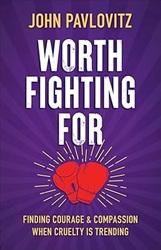
Worth Fighting For

Finding Courage and Compassion When Cruelty Is Trending

by John Pavlovitz

Westminster John Knox Press, 2024. 154 pages.
Review written June 10, 2025, from my own copy, purchased via Amazon.com
Starred Review

I think of John Pavlovitz as someone who comes across as angry. However, even though this book features a picture of boxing gloves, it’s ultimately a book about making compassion our primary characteristic as Christians. And he indeed makes a strong case that this is worth fighting for.

The sections in this book are short, so it made an easy morning read to read one section. I found myself talking about what I’d read with other Christians, especially this passage:

What we believe about faith and God and the afterlife is not as fixed as we often like to think. It is rather an ever-shifting point in space and time. Very likely, you believe quite differently than you did ten years ago in both subtle and substantial ways, and ten years from now the same will almost certainly be true. In this way I like to think of theology as a place – as the specific location where you are right at this moment.

This is important as you interact with others, because it helps you recognize your limitations and potential. You cannot make someone be where you are. It’s not your job or your right to forcibly pull someone to your faith perspective, to make them see as you see or agree to the givens you’ve established in your mind. Your responsibility is to openly describe the view from where you stand and hope that something in that is helpful or encouraging or challenging to people. I never feel I need to convince someone to believe what I believe, only to let them know where I am and ask them to meet me there in relationship.

I love that perspective, because I hadn’t stopped to think about it, but, yes, my beliefs are quite different than they were ten years ago, in many ways. I think sometimes we feel like we’ve seen the light and been set straight in one particular area – so we want to set everyone else straight, too. But why would someone else have to follow the same path as me? John Pavlovitz comes at faith with a deep respect for each person’s journey with God – even of those who berate him.

Yes, John Pavlovitz often comes across as angry, but that seems to be coming from a place of compassion, for those who try to exclude others from the table.

He doesn’t pretend that it’s easy to be inclusive and welcoming. But compassion is worth fighting for.

Love is still the greatest weapon we have in the face of fear. It is still the antidote to all that afflicts us. No, opposing hatred isn’t hateful. Opposing hatred is how we embody love.

And he’s absolutely right that hatred and exclusion are becoming more and more common in our society. In the chapter “The Future We Want,” he includes a section on “The America Worth Fighting For” and encourages us to help make a future America that stands against white supremacy and defends the vulnerable. He encourages us all to use our own abilities to do what we can to make a better future.

Affirm life, speak truth, defend the vulnerable, call out injustices – and gladly brave the criticisms and the wounds you sustain in doing it, knowing that they are a small price to pay for the nation that could be if you speak – or the one that will be if you do not.

So that gives you an idea of what you’ll find in this book – encouragement to stand up and be more compassionate. Here’s another passage I marked:

Compassion is what defines the community we feel called into.

In this shared desire to care for one another and for this planet, we who are a disparate assembly find an affinity that transcends the other boxes. It is the bigger table we are building, the expansive community we are forming.

And this is the side we choose regardless of the other boxes: the side of empathy and equality and benevolence and diversity. These don’t come with a prerequisite doctrinal statement or political affiliation, nor with any condition regarding race or orientation or pigmentation. No group has a market cornered on such selflessness and decency.

The powerful thread knitting together this new chosen family in these days is humanity that gives a damn about other humanity. This is the place where like-hearted people can all find belonging and live fully and heal wounds and fix broken things.

And this compassionate coalition of those who give a damn is what will save the world.

johnpavlovitz.com

Buy from Amazon.com

Find this review on Sonderbooks at: www.sonderbooks.com/Nonfiction/worth_fighting_for.html

Disclosure: I am an Amazon Affiliate, and will earn a small percentage if you order a book on Amazon after clicking through from my site.

Disclaimer: I am a professional librarian, but the views expressed are solely my own, and in no way represent the official views of my employer or of any committee or group of which I am part.

What did you think of this book?
Review of This Here Flesh, by Cole Arthur Riley

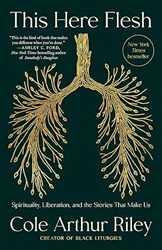
This Here Flesh

Spirituality, Liberation, and the Stories that Make Us

by Cole Arthur Riley

Convergent Books, 2022. 203 pages.
Review written May 13, 2025, from my own copy, ordered via amazon.com.
Starred Review

I feel at a bit of a loss to describe this book. I read it a chapter at a time as part of my devotional times, and noted lots of passages to post on my Sonderquotes blog, and finished each chapter inspired and uplifted. But I’m not sure I can adequately describe what you’ll find here.

I like to call this kind of book “Musings,” and these are Christian musings mixed with family stories and questions and thoughts about life.

Let me copy sections from her Preface, in hope this will give you the flavor of this contemplative book. I’m just going to show you a few pieces – but I hope it will pull you in to read the entire book.

My spirituality has always been given to contemplation, even before anyone articulated for me exactly what “the contemplative” was. I was not raised in an overtly religious home; my spiritual formation now comes to me in memories – not creeds or doctrine, but the air we breathed, stories, myth, and a kind of attentiveness. From a young age, my siblings and I were allowed to travel deep into our interior worlds to become aware of ourselves, our loves, our beliefs. And still, my father demanded an unflinching awareness of our exterior worlds. Where is home from here? What was the waitress’s name? Where do we look when we’re walking? If a single phrase could be considered the mantra of our family, it would be Pay attention….

I used to think that Christian contemplation was reserved for white men who leave copies of C. S. Lewis’s letters strewn about and know a great deal about coffee and beard oils. If this is you, there is room for you here. But I am interested in reclaiming a contemplation that is not exclusive to whiteness, intellectualism, ableism, or mere hobby. And as a Black woman, I am disinterested in any call to spirituality that divorces my mind from my body, voice, or people. To suggest a form of faith that tells me to sit down alone and be quiet? It does not rest easy on the bones. It is a shadow of true contemplative life, and it would do violence to my Black-woman soul….

And as we pay attention, we make a home out of paradox, not just in what we believe but also in the very act of living itself. Stillness that we would move. Silence that we would speak. I believe this to be a spirituality our world – overtaken with dislocation, noise, and unrest – so desperately needs….

This is a book of contemplative storytelling. The pages you hold are where the stories that have formed me across generations meet our common practice of beholding the divine. Feel now, they are wet with tears. Look how they glisten like my skin in sun, and they bear the grooves of many scars. As you cradle these pages, it is my sincere hope that they might serve as conduits for mystery, liberation, and the very face of God.

Yes, that’s what you’ll find here – contemplative storytelling. Cole Arthur Riley tells stories of her family and weaves them through with contemplation – and it all shines with light.

colearthurriley.com
convergentbooks.com

Buy from Amazon.com

Find this review on Sonderbooks at: www.sonderbooks.com/Nonfiction/this_here_flesh.html

Disclosure: I am an Amazon Affiliate, and will earn a small percentage if you order a book on Amazon after clicking through from my site.

Disclaimer: I am a professional librarian, but the views expressed are solely my own, and in no way represent the official views of my employer or of any committee or group of which I am part.

What did you think of this book?
Review of How We Learn to Be Brave, by Mariann Edgar Budde

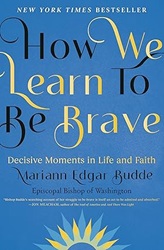
How We Learn to Be Brave

Decisive Moments in Life and Faith

by Mariann Edgar Budde

Avery (Penguin Random House), 2023. 201 pages.
Review written April 7, 2025, from my own copy, ordered via Amazon.com.
Starred Review

Mariann Edgar Budde is the Episcopal Bishop of Washington who asked Trump to his face in an inaugural service to have mercy on people. When I was commenting on that, one of my friends asked if I’d read her book – written after she spoke out about Trump’s photo op in front of her church during the Black Lives Matter protests. So I ordered a copy right away.

In the Introduction, she talks about a moment during the BLM protests when she was inspired by the words of Reverend Dr. William J. Barber II, cochair of the Poor People’s Campaign.

As he spoke, the weight I had been carrying all week fell off my shoulders, and in that moment, I knew my place in the larger struggle for justice. I heard myself say to God and to the universe, “I want to be among the coalition of the faithful. I want to be among those working for the change we need now.” That’s the decision with which I need to align my life every day. It wasn’t a new thought for me, but I felt it in a new way. It won’t always burn in my heart the way it did that week, but I don’t want to forget it. Like everyone else, I need grace, courage, and perseverance to be true to my decisive moment after the passion fades.

The theme of the book is decisive moments, and how we can make brave choices during decisive moments.

The chapters take us through “Deciding to Go,” “Deciding to Stay,” Deciding to Start,” “Accepting What You Do Not Choose,” “Stepping Up to the Plate,” “The Inevitable Letdown,” and “The Hidden Virtue of Perseverance.” So you see, we get all aspects of bravery beyond any big public decisions, and I like the way it builds to day-to-day work of keeping on. She illustrates the book with her own journey that eventually took her to Washington, D. C.

Some of our decisive moments require action; others, acceptance. Some are dramatic and there for all the world to see; others are internal, known only to the self and to God. Ultimately, what I want to communicate in these pages is that heroic possibilities lie within each of us; that the inexplicable, unmerited experience of God’s power working through us is real; and that we matter in the realization of all that is good and noble and true. We can learn to be brave.

And of course this book is all the more applicable during a second Trump term. May we as Christians rise to the moment.

Here’s how she ends the book:

My prayer is that, by grace, we all will be emboldened to lean into the wisdom, strength, power, and grace that come to us, whenever we find ourselves at a decisive moment. May you and I dare to believe that we are where we are meant to be when that moment comes, doing the work that is ours to do, fully present to our lives. For it is in this work that we learn to be brave.

mariannbudde.com
penguinrandomhouse.com

Buy from Amazon.com

Find this review on Sonderbooks at: www.sonderbooks.com/Nonfiction/how_we_learn_to_be_brave.html

Disclosure: I am an Amazon Affiliate, and will earn a small percentage if you order a book on Amazon after clicking through from my site.

Disclaimer: I am a professional librarian, but the views expressed are solely my own, and in no way represent the official views of my employer or of any committee or group of which I am part.

What did you think of this book?

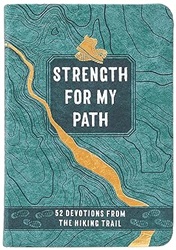
Review of Strength for My Path, by Maureen E. Wise

Strength for My Path

52 Devotions from the Hiking Trail

by Maureen E. Wise

BroadStreet, 2024. 176 pages.
Review written March 24, 2025, from my own copy, purchased via Amazon.com.
Starred Review

Full disclosure: Maureen Wise introduced herself to me online after finding my Sondermusings Substack and Sonderjourneys blog, saying we seem to have a lot of views in common. I love finding kindred spirits online! Then she offered to introduce me to her agent – and her agent enthusiastically read the full manuscript of my Psalms book and told me she enjoyed reading it but couldn’t represent me because it was too similar to a book by one of her existing clients, and it wouldn’t be fair to her. But anyway, I’m always interested in books by kindred spirits – so I’d already ordered myself a copy of this book, and yes, was predisposed to like it. But liking it is not at all a stretch.

It’s a book of devotions – so it’s an encouraging way to start your morning – and they all relate to hiking in some way. For example, “The Washed-Out Path” is about how Jesus is with us when our life feels in need of repair. “An Unexpected Storm on the Trail” encourages you to think about God’s perspective when your plans go awry. “What God Sees in Canal Paths” talks about how old abandoned canal paths have been turned into hiking trails – and God recognizes that we are valuable and worthy of care and protection. “Not Only the Destination But Also the Journey” has a rather obvious life application beyond enjoying your hike not just for the panoramic vista at the end.

Every devotion takes up two small pages, followed by a page with a prayer and a “Nature Connection” – Background facts about the topic of the day – and super interesting wide-ranging tidbits are included here.

I have to also give a shout-out to the book’s design. It’s got a soft and flexible suede-like cover, a ribbon bookmark attached, and a small trim size that makes you want to tuck it in a backpack and bring it on a hiking journey. I am a hiking dabbler – I love hiking, but prefer day trips so short that I can carry everything I need in my pockets. I do look for short hikes when I go on vacation, and this book got me wanting to hit the trail.

And of course the highlight is the devotions. I enjoyed this daily reminder to connect with nature – and to connect what I see in nature with God. To give you a taste, here’s a bit from the first devotion, “Jesus Valued Time in Nature”:

Follow Jesus’ lead and pray in wild places too. We don’t have to meet God only in set-aside places such as churches, Bible study meetings, Sunday school, and prayer rooms. While these places and times are sacred and important, we can connect with God anywhere. He is everywhere, after all. By intentionally choosing outdoor spaces to pray and be with God, we can also connect with creation and reflect on faith topics in a different way. Away from distractions and our human-made structures, immersed in the beauty of creation, we can find a deeper intimacy with the Creator.

And this book made me want to go out and do just that.

maureenwisebooks.com

Buy from Amazon.com

Find this review on Sonderbooks at: www.sonderbooks.com/Nonfiction/strength_for_my_path.html

Disclosure: I am an Amazon Affiliate, and will earn a small percentage if you order a book on Amazon after clicking through from my site.

Disclaimer: I am a professional librarian, but the views expressed are solely my own, and in no way represent the official views of my employer or of any committee or group of which I am part.

What did you think of this book?

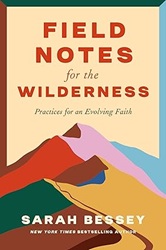
Review of Field Notes for the Wilderness, by Sarah Bessey

Field Notes for the Wilderness

Practices for an Evolving Faith

by Sarah Bessey

Convergent Books, 2024. 235 pages.
Review written February 11, 2025, from my own copy, purchased via Amazon.com
Starred Review

Field Notes for the Wilderness is for people whose faith is evolving. Perhaps you’ve grown up, like me, with certainty – faithful church attendance in evangelical churches, memorizing Scripture, singing in the choir, attending small group Bible studies. But something disrupts what you always knew as true.

[For me, it was a long process. I thought I could still attend my same church when I came to believe that the Bible teaches God will save everyone. Then I started believing that maybe LGBTQ people aren’t sinning… and my daughter came out as transgender (I’m still so very glad it was in that order). It wasn’t until my church decided to officially change their constitution to declare that LGBTQ people were sinning (so they could keep from renting out their new building for gay marriages, I think) – and the extreme lack of openness to discussion about it – that I finally realized I should look for a different church. And I was blessed that the first church I tried ended up being affirming, had a fabulous choir to join, and ended up being far more open to my theological ideas. But not everyone’s story progresses so happily.]

Here’s a section from the Introduction about why Sarah Bessey prefers the term “evolving faith” to “deconstruction”:

To me, an evolving faith is never simply about “deconstruction.” It has proven to be about the questions, the curiosity, and the ongoing reckoning of a robust, honest faith. An evolving faith brings the new ideas and ancient paths together. It’s about rebuilding and reimagining a faith that works not only for ourselves but for the whole messy, wide, beautiful world. For me, this has proven to be deeply centered in the Good News of Jesus. An evolving faith is sacramental, ecumenical, embodied, generous, spirit-filled, truthful, and rooted in the unconditional, never-ending love of God. It isn’t a linear experience of one and done and dusted. An evolving faith is a resilient and stubborn form of faithfulness that is well acquainted with the presence of God in our loneliest places and deepest questions. And an evolving faith has room for all the paths you may navigate after our time together in these pages.

Anyone who gets to the end of their life with the exact same beliefs and opinions they had at the beginning is doing it wrong. Because if we don’t change and evolve over our lifetime, then I have to wonder if we’re paying attention to the invitation of the Holy Spirit that is your life. Lisa Sharon Harper says that pilgrimage is about transformation. An evolving faith is a form of pilgrimage, and so yes, you are being transformed.

So you don’t have to be going through a crisis to enjoy this book, but if you are, I think it may help. The chapters are, essentially, about living a life of faith and walking on when things don’t necessarily go as planned. I haven’t particularly felt like I’m going through the Wilderness lately – and I still resonated with this book, marking more than a dozen passages for future Sonderquotes posts.

She talks about the “wilderness” as a place away from certainty and rules and only one way to do things. But being in that place helped her walk with Jesus, who promises rest for the weary.

The God I met in the wilderness reawakened me, recovered me, restored me to the Gospel of Love. This is the Gospel as I learned it at the feet of Jesus, hanging on to the hem of his humble garment. The width, length, height, and depth of God’s love is not fearful or restrictive or small or dull. It is a wide-open, sharp love that sets us free. It is a love that never steals, kills, or destroys us – it came that we might have life, and life that is more abundant. It is this love that brings us rest, that lifts burdens, that restores souls, that opens hearts, and changes lives.

And here’s why she calls the book a “Field Guide”:

This isn’t much of a rule book – rules rarely belong in the wilderness – but more of a field guide, a companion of sorts. Even theologically, I won’t have a lot of answers here for you; there are many good guides on the particulars of what you’re grappling with – from how church should or shouldn’t look to how to raise your kids, from rearranging your thoughts on sex to finding a new path for faith. I encourage you to honor your search for specifics; what I’m offering you is mostly companionship, the hope to help you adapt and survive in your journey even if it differs from my own.

If any of this sounds good to you, I recommend giving this book a try. I read it over a couple of weeks, and each time I dipped into it, I came away encouraged and uplifted in my own journey. Because fundamentally she communicates a belief that God is good, and God loves you and is walking with you.

sarahbessey.com

Buy from Amazon.com

Find this review on Sonderbooks at: www.sonderbooks.com/Nonfiction/field_notes_for_the_wilderness.html

Disclosure: I am an Amazon Affiliate, and will earn a small percentage if you order a book on Amazon after clicking through from my site.

Disclaimer: I am a professional librarian, but the views expressed are solely my own, and in no way represent the official views of my employer or of any committee or group of which I am part.

What did you think of this book?

Review of Everything Belongs, by Richard Rohr

Everything Belongs

The Gift of Contemplative Prayer

by Richard Rohr

Crossroad, 2003. 186 pages.
Review written January 8, 2025, from my own copy, purchased via amazon.com
Starred Review

I always have trouble summing up Richard Rohr books. I’ve decided that’s because they’re written more for our heart than our head. Someone in my small group had suggested studying contemplative prayer with our next book. So when I saw this book existed, I bought myself a copy to preview it. Well, it isn’t a how-to guide to contemplative prayer, so I didn’t feel like it was exactly what we were looking for. This gives more of the why of contemplative prayer than the how.

And I’m more of a head person than a heart person! Though I would like to grow in that. So I’m not even sure how to pitch this book. It’s worth reading, and I marked out many quotations to post over on my Sonderquotes blog. Let me give a couple of them here, to give you the idea.

The following of Jesus is not a “salvation scheme” or a means of creating social order (which appears to be what most folks want religion for), as much as it is a vocation to share the fate of God for the life of the world. Jesus did not come to create a spiritual elite or an exclusionary system for people who “like” religion, but he invited people to “follow” him in bearing the mystery of human death and resurrection (an almost nonreligious task, but one that can be done only “through, with, and in” God.)

We should not be surprised or scandalized by the sinful and the tragic. Do what you can to be peace and to do justice, but never expect or demand perfection on this earth. It usually leads to a false moral outrage, a negative identity, intolerance, paranoia, and self-serving crusades against “the contaminating element,” instead of “becoming a new creation” ourselves (Gal. 6:15).

And here’s a part that shows where the title comes from:

Everything belongs; God uses everything. There are no dead-ends. There is no wasted energy. Everything is recycled. Sin history and salvation history are two sides of one coin. I believe with all my heart that the Gospel is all about the mystery of forgiveness. When you “get” forgiveness, you get it. We use the phrase “falling in love.” I think forgiveness is almost the same thing. It’s a mystery we fall into: the mystery is God. God forgives all things for being imperfect, broken, and poor. Not only Jesus but all the great people who pray that I have met in my life say the same thing. That’s the conclusion they come to. The people who know God well – the mystics, the hermits, those who risk everything to find God – always meet a lover, not a dictator. God is never found to be an abusive father or a tyrannical mother, but always a lover who is more than we dared hope for. How different than the “account manager” that most people seem to worship.

So I always recommend Richard Rohr. But pick up this book if you’re ready for some meditative writing that is not about thinking, but that will nevertheless challenge your thinking and will uplift your heart.

cac.org

Buy from Amazon.com

Find this review on Sonderbooks at: www.sonderbooks.com/Nonfiction/everything_belongs.html

Disclosure: I am an Amazon Affiliate, and will earn a small percentage if you order a book on Amazon after clicking through from my site.

Disclaimer: I am a professional librarian, but the views expressed are solely my own, and in no way represent the official views of my employer or of any committee or group of which I am part.

What did you think of this book?

Review of Christian Mystics, by Matthew Fox

Christian Mystics

365 Readings and Meditations

by Matthew Fox

New World Library, 2011. 406 pages.
Review written November 29, 2021, from a library book
Starred Review

I heard about this book from the Richard Rohr emails I get from his Center for Action and Contemplation. Those daily emails made me interested in Christian mysticism, and this book was a good way to go a little deeper.

The Introduction to this book explains how the author is trying to show Christians mystical writings from within our own tradition. Here’s a short bit from that:

Today there is a genuine effort around the world at “deep ecumenism,” or “interfaith,” the coming together of the spiritual wisdom traditions of the world. That is a positive development. But the Dalai Lama points out that the “number one obstacle to interfaith is a bad relationship with one’s own faith tradition.” It is pitiful how few Christian leaders and Christian teachers (including in seminaries) know their own mystical lineage. These days, as revelations come to light about darkness in the Catholic Church, it is all the more important to pay attention to that which is true and deep and beautiful in the work of our Christian ancestors. Through the ages even to today, Christian mystics and activists have stirred hearts and souls. It is valuable at a time of church reformation and even revolution to tap into this wellspring of truth and renewal. Reading and praying the wisdom in these passages moves me deeply to embrace my mystic/prophet ancestors. I hope it helps to awaken the same in the reader.

The format includes 365 short readings from 32 Christian mystics, who include Jesus and Paul. After each quotation, Matthew Fox has some thoughts and questions about it.

Although there are 365 readings, they are numbered not dated, so you can begin any time during a year. Because I was using a library book, I read two pages per day. It still took a long time to finish, but is an older book, so I could renew or re-check out for as long as I liked.

The dedication also gives you an idea of what you’ll find here:

I dedicate this book to the young. They deserve and require a healthier version of religion, one that celebrates the depths of mysticism, love of the earth and the body, and a fierce commitment to community, compassion, celebrative rituals, and justice-making. They deserve a religion that is both simpler and more open to wisdom from all the world’s spiritual traditions.

May the mystics and meditations in these pages assist us all in reawakening the depths of our faith traditions, whatever they may be. May we travel lighter but stronger into a future worthy of our nobility as a species and worthy of the beauty of this wounded planet.

matthewfox.org
newworldlibrary.com

Buy from Amazon.com

Find this review on Sonderbooks at: www.sonderbooks.com/Nonfiction/christian_mystics.html

Disclosure: I am an Amazon Affiliate, and will earn a small percentage if you order a book on Amazon after clicking through from my site.

Disclaimer: I am a professional librarian, but the views expressed are solely my own, and in no way represent the official views of my employer or of any committee or group of which I am part.

What did you think of this book?

Review of You Are the Beloved, by Henri J. M. Nouwen

You Are the Beloved
Daily Meditations for Spiritual Living

by Henri J. M. Nouwen
compiled and edited by Gabrielle Earnshaw

Convergent (Penguin Random House), 2017. 410 pages.
Review written January 6, 2022, from my own copy

You Are the Beloved is the book of daily readings that I used during my quiet times in 2021. They were selected from the writings of Henri Nouwen and are presented in bite-sized daily chunks.

The theme is well summed up by the title: You are the beloved. The meditations remind me that God loves me and help me think about how I should live my life in the light of that. They were a good way to start my days.

Paging through, here’s a passage I highlighted on January 14:

For most of my life I have struggled to find God, to know God, to love God. I have tried hard to follow the guidelines of the spiritual life – pray always, work for others, read the Scriptures – and to avoid the many temptations to dissipate myself. I have failed many times but always tried again, even when I was close to despair.

Now I wonder whether I have sufficiently realized that during all this time God has been trying to find me, to know me, and to love me. The question is not “How am I to find God?” but “How am I to let myself be found by him?” The question is not “How am I to know God?” but “How am I to let myself be known by God?” And, finally, the question is not “How am I to love God?” but “How am I to let myself be loved by God?” God is looking into the distance for me, trying to find me, and longing to bring me home.

This book always left me with something to think about. I do recommend it as a nice way to add inspiring meditations to your year.

henrinouwen.org

Buy from Amazon.com

Find this review on Sonderbooks at: www.sonderbooks.com/Nonfiction/you_are_the_beloved.html

Disclosure: I am an Amazon Affiliate, and will earn a small percentage if you order a book on Amazon after clicking through from my site.

Disclaimer: I am a professional librarian, but the views expressed are solely my own, and in no way represent the official views of my employer or of any committee or group of which I am part.

What did you think of this book?

Review of What’s Your Story? by Sarah Heath

What’s Your Story?

Seeing Your Life Through God’s Eyes

How Joseph’s Story Can Help You Tell Yours

by Sarah Heath

Abingdon Press, 2017. 128 pages.
Review written 11/11/22 from my own copy.

My church small group has been going through What’s Your Story this Fall, and it’s been great for group discussion.

The book is short — designed to cover only four weeks of meetings, with one bonus week at the end. We did a week at the beginning, but it worked well for us, because we meet on nights when our local school system is in session, and they had lots of Monday holidays this Fall — so the book is getting us exactly through Advent.

And it’s a good study for getting to know each other. The author mostly uses the framework from Joseph Campbell’s Hero’s Journey to look at your own life and Joseph’s life story in the Bible.

I thought that approach was just a little simplistic — but she does acknowledge the complexity of actual lives, and provides a good jumping-off place to talk about our own lives. Basically, the chapters cover the Call to Adventure or Inciting Incident (Joseph sold into slavery), then Plot Twists (Joseph thrown into prison), then Climactic Moments – or embracing your desire and identity (Joseph interpreting Pharaoh’s dreams and exalted as ruler over Egypt), and finally the aftermath and preparation for another journey. In the fifth “bonus” week, the author encourages study participants to tell their stories to each other.

Despite there only being four chapters, each chapter is rather long, and you could spend two weeks on each chapter. I felt like we were only beginning the discussion with one week. The book includes journal pages, with big questions or quotations written in calligraphy and room to write your responses. For example, I enjoyed the blank timeline where she asks the reader to diagram the positive and negative plot twists in your life and look for themes.

Now, I’ve already done a lot of thinking about my life when I wrote Project 52 — the year I was 52 years old, I blogged each week about one year of my life. I’m also sitting in a very good place on my timeline when it’s easy to see how God took all my negative plot twists and worked them out for good. So I didn’t desperately need to hear this idea of your life as a story you’re co-writing with God. But I hope that perspective made my discussion encouraging. And I did enjoy having a vehicle for discussing that fundamental idea.

Here’s a nice quotation that reflects the approach you’ll find in this book:

I think it is problematic when we make people neurotic about finding “the calling” on their lives instead of helping people look for themes and see how their passions create deep desires that can translate into many fields. What you desire matters! What makes you come alive? What would the world miss if you didn’t tell your story? These are all the questions we should be answering when we are cowriting our story with God. It’s about more than just “What do you want to do when you grow up?”

Buy from Amazon.com

This review is only on the blog.

Disclosure: I am an Amazon Affiliate, and will earn a small percentage if you order a book on Amazon after clicking through from my site.

Disclaimer: I am a professional librarian, but the views expressed are solely my own, and in no way represent the official views of my employer or of any committee or group of which I am part.

What did you think of this book?