Review of The Little Rabbit Who Liked to Say MOO, by Jonathan Allen

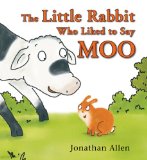
The Little Rabbit Who Liked to Say MOO

by Jonathan Allen

Boxer Books, 2008. 28 pages.
Starred Review

I was very surprised to realize I hadn’t reviewed this book yet. It’s been a favorite Storytime choice of mine ever since I found it in the New Books section in 2008. It’s absolutely perfect for toddlers and young preschoolers. They are generally quite good at animal sounds, and this throws in a nice twist.

Here’s how it begins:

“Little Rabbit sat in the farmer’s field.

“‘Moo,’ said Little Rabbit. ‘Moo.’

“‘Why are you saying moo?’ asked Calf. ‘You’re not a cow.’

“‘I like moo,’ said Little Rabbit, ‘and rabbits don’t have a big noise.’

“‘Can you make other noises?’ asked Calf.

“‘I like baa,’ said Little Rabbit.

“‘So do I,’ said Calf.”

You can guess how the book goes from there. The two cute little animals Baa together and a lamb comes to investigate… and so on. At the end, all the animals declare their favorite sounds, and Little Rabbit makes a surprising choice that will provide a laugh.

This is a happy book, with cute baby animals doing silly things and making the “wrong” sounds. Like I said, it’s a fantastic choice for Storytime, and would also be great for sharing with a little one who has mastered animal sounds and knows how the world works. They will especially enjoy the twist!

Buy from Amazon.com

Find this review on Sonderbooks at: www.sonderbooks.com/Picture_Books/little_rabbit_who_liked_to_say_moo.html

Disclosure: I am an Amazon Affiliate, and will earn a small percentage if you order a book on Amazon after clicking through from my site.

Source: This review is based on a library book from the Fairfax County Public Library.

Review of 999 Tadpoles, by Ken Kimura, illustrated by Yasunari Murakami

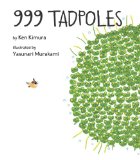
999 Tadpoles

by Ken Kimura
illustrated by Yasunari Murakami

NorthSouth, New York, 2011. First published in Japan in 2003. 44 pages.

I confess, I checked out this book because I thought it was a children’s book about numbers. It turned out to be a fun book about a whole bunch of baby frogs.

After 999 tadpoles were born in a little pond, a situation developed:

“The 999 tadpoles grew and grew and grew, until one day they grew into frogs. Now the pond was too small for them.
‘We can’t move!’ one called.
‘We can’t breathe!’ called another.
‘Don’t push!’ called a third.
‘We have a situation here,’ said Father.
‘We’ll have to move,’ said Mother.”

How Mother Frog and Father Frog get all their babies to another, bigger pond is a surprising and funny story. I love the matter-of-fact tone and the striking, simple pictures. I plan to use this book in a storytime soon.

Buy from Amazon.com

Find this review on Sonderbooks at: www.sonderbooks.com/Picture_Books/999_tadpoles.html

Disclosure: I am an Amazon Affiliate, and will earn a small percentage if you order a book on Amazon after clicking through from my site.

Source: This review is based on a library book from the Fairfax County Public Library.

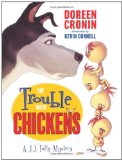
Review of The Trouble with Chickens, by Doreen Cronin

The Trouble with Chickens

A J. J. Tully Mystery

by Doreen Cronin
illustrated by Kevin Cornell

Balzer + Bray (HarperCollins), 2011. 119 pages.

It’s always good to find a beginning chapter book that’s funny, clever, and absorbing. The Trouble with Chickens has twenty-two short chapters, but there are plenty of pictures and lots of space between the lines. A child will feel he or she has accomplished something when they finish the book, but they will have fun while doing so, and it’s not too intimidating.

It always helps when the book is funny. This book is a hard-boiled detective story, but the detective is a search-and-rescue dog who’s been put out to pasture. A chicken wants his help.

Here’s how J. J. Tully puts it:

“I could track the six-day-old scent of a lost hiker and pull a fat guy out from under a pile of rubble, but I couldn’t get that crazy chicken out of my yard.”

Two of the chicken’s four chicks are missing, and it’s up to J. J. to track them down. Unfortunately, he must endure help from the two chicks who are still on the loose. And the crime ends up being much more nefarious than it appears at first.

Doreen Cronin is the author of the brilliant Click, Clack, Moo: Cows That Type, and its companions. Now she turns her hand to entertainment for children ready to read on their own. She’s still got that great sense of humor and gives us a look at human passions by displaying them in the bodies of animals. A lot of fun.

Buy from Amazon.com

Find this review on Sonderbooks at: www.sonderbooks.com/Childrens_Fiction/trouble_with_chickens.html

Disclosure: I am an Amazon Affiliate, and will earn a small percentage if you order a book on Amazon after clicking through from my site.

Source: This review is based on a library book from the Fairfax County Public Library.

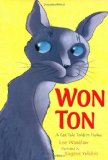
Review of Won Ton, by Lee Wardlaw

Won Ton

A Cat Tale Told in Haiku

by Lee Wardlaw
illustrated by Eugene Yelchin

Henry Holt and Company, New York, 2011. 34 pages.
Starred Review

This book works both as a collection of short, accessible poems and as an entertaining picture book. The author’s note at the beginning informs us that technically the poems inside are senryu, not haiku. But the syllable format is the same, and I think it was a good choice to use “Haiku” in the title, since that is a term most school children are familiar with.

This book takes us from a cat in a pet store waiting to be bought to a cat in a home with his very own beloved boy. The illustrations show a true cat nature, and so do the poems.

Here are a few I particularly like:

Yawn. String-on-a-stick.
Fine. I’ll come out and chase it
to make you happy.

Scrat-ching-post? Haven’t
heard of it. Besides, the couch
is so much closer.

Letmeoutletme
outletmeoutletmeout.
Wait — let me back in!

Your tummy, soft as
warm dough. I knead and knead, then
bake it with a nap.

Definitely charming. Reading this to a small child will prompt them to look at a cat with new eyes. Reading it to an older child may get them writing haiku of their own.

Buy from Amazon.com

Find this review on Sonderbooks at: www.sonderbooks.com/Childrens_Nonfiction/won_ton.html

Disclosure: I am an Amazon Affiliate, and will earn a small percentage if you order a book on Amazon after clicking through from my site.

Source: This review is based on a library book from the Fairfax County Public Library.

Review of Balancing Act, by Ellen Stoll Walsh

Balancing Act

by Ellen Stoll Walsh

Beach Lane Books (Simon & Schuster), New York, 2010. 32 pages.

Ellen Stoll Walsh is brilliant at explaining basic concepts to the very youngest readers. Her earlier book Mouse Paint is justifiably called “a modern classic,” demonstrating mice mixing colors in a simple, easily understandable way.

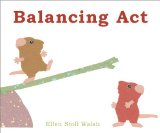
Balancing Act shows how balancing works in a way that even toddlers will be able to absorb. First, two mice balance on opposite ends of a stick. Then a lizard joins them, throwing off the balance — but when the lizard’s friend comes, balance is restored. Then comes a frog, and a friend.

When a big, heavy bird comes, it looks like their game is done — until all the other creatures get on the other side. That works great — until the stick breaks.

There are only a few words on each page, used in a way to captivate readers (“Uh-oh! A frog.”), so this book will work with the very youngest children, just beginning to understand that books tell a story.

Balance is a Math concept and a Science concept, but learning this concept is disguised in a lovely story with fun use of language that preschoolers will simply enjoy. A definite win!

Buy from Amazon.com

Find this review on Sonderbooks at: www.sonderbooks.com/Picture_Books/balancing_act.html

Disclosure: I am an Amazon Affiliate, and will earn a small percentage if you order a book on Amazon after clicking through from my site.

Source: This review is based on a library book from the Fairfax County Public Library.

Review of Quack and Count, by Keith Baker

Quack and Count

by Keith Baker

Harcourt Brace & Company, 1999. 28 pages.

Here’s a simple picture book that’s fun and easy to read, and lays a nice foundation for counting and addition.

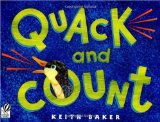
The story is simple. Lovely cut-paper artwork shows us seven ducklings. There are two rhyming lines on each set of pages, but the innovative part is that on each set of pages, we have different groupings.

On the page after we are initially introduced to the seven ducklings, it says,

“Slipping, sliding, having fun
7 ducklings, 6 plus 1.”

Six ducklings are grouped on the left-hand page, and one duckling has already slid down onto the right-hand page.

The next page is:

“7 ducklings, 5 plus 2
Playing games of peekaboo.”

Now you have five ducklings on the left and two on the right, all hiding in the long grass.

And so it continues.

This book is a beautiful way to give the idea of addition in a fun way, without overt teaching. They will see, without you even having to point it out, that 3 + 4 and 4 + 3 both equal seven. On each page, you can count the left, count the right, and count them all together, and your child will enjoy the experience even before he knows how to count himself.

This book gives an example of a beautiful and fun way to build a number sense into your little one. The short text means it would work well with very young children, and as they get older, you can let them count the ducklings themselves. The lovely artwork adds a level of enjoyment.

As a former math teacher, and a Mom who looked for excuses to teach my kids about numbers, and who has successfully reared two book-lovers and math-lovers, I simply had to highlight this delightful little book.

Buy from Amazon.com

Find this review on Sonderbooks at: www.sonderbooks.com/Picture_Books/quack_and_count.html

Disclosure: I am an Amazon Affiliate, and will earn a small percentage if you order a book on Amazon after clicking through from my site.

Source: This review is based on a library book from the Fairfax County Public Library.

Review of Is Your Buffalo Ready for Kindergarten? by Audrey Vernick

Is Your Buffalo Ready for Kindergarten?

by Audrey Vernick
illustrated by Daniel Jennewein

Balzer & Bray (HarperCollins), 2010. 32 pages.
Starred Review

And I thought every possible twist on starting Kindergarten had been covered! How wrong I was!

Here’s a delightful way for a kid-in-the-know to tell their Buffalo what’s needed to get ready for Kindergarten.

There are some great lines:

“Some people say kindergarten is no place for a buffalo.
How crazy is that?
Does your buffalo have a backpack?
Well, then. He’s definitely ready for kindergarten.”

“But your buffalo may sometimes get frustrated.
Like when someone takes his building blocks.
Or calls him Fluppalo.
Another buffalo might be tempted to nudge those kids.
But not your buffalo!
He’ll stop, take a deep breath,
and remember the Rules for Sharing and Caring.
That’s why kindergarten’s so great.
You learn to get along without using your horns.”

“Snack time!
Your buffalo is probably looking forward to sharing treats with a classmate. But he may be the only one who eats grass, then throws it up in his mouth and eats it again.
Remember: Everyone’s special in his or her own way.”

There you have it: A truly new perspective on getting ready for kindergarten and going over everything a kid (or a buffalo) will need to know. The pictures, of course, add to the fun. The buffalo is kind and lovable and looks perfect for hugging or cuddling up to during storytime.

Absolutely charming!

Buy from Amazon.com

Find this review on Sonderbooks at: www.sonderbooks.com/Picture_Books/buffalo.html

Disclosure: I am an Amazon Affiliate, and will earn a small percentage if you order a book on Amazon after clicking through from my site.

Source: This review is based on a library book from the Fairfax County Public Library.

Review of Art and Max, by David Wiesner

Art & Max

by David Wiesner

Clarion Books (Houghton Mifflin), Boston, 2010. 40 pages.
Starred Review

Three-time Caldecott Medal winner David Wiesner has another stunner here. Art & Max reminds me of The Three Pigs, because it’s also a meta-book, a book about how books are made. Or at least meta-art, art about art.

The story takes place in the desert with various desert reptiles. (I won’t attempt to specify which species.) Arthur is a big horny critter who is also an artist, and obviously very pleased with himself. When little Max comes along and wants to paint, he asks Art (Arthur) what he should paint.

When Art says, “You can paint me,” Max takes him literally. That’s when the fun begins.

Art ends up covered with paint. When the other critters try to fix him, he goes through several different manifestations — created in different art styles. Most catastrophic is when he’s a watercolor and drinks a glass of water — and then becomes a line drawing. Then when he walks away with Max holding his tail — he unravels completely.

Don’t worry, Max does recreate Art, in a whole new style.

I would like to share this with children. Probably old enough that they wouldn’t worry about being unravelled! Though I think kids will understand the playful spirit and that these things could only happen in a world where all the characters are made of paint in the first place.

This book has lots to talk about or just enjoy, and is captivating on many levels.

It wouldn’t have surprised me if this book had earned David Wiesner a fourth Caldecott Medal, since the art is so innovative and stunning. For me personally, the story didn’t have as much heart as his winners, but it’s still a playful and creative look at what you can do with art.

Buy from Amazon.com

Find this review on Sonderbooks at: www.sonderbooks.com/Picture_Books/art_and_max.html

Disclosure: I am an Amazon Affiliate, and will earn a small percentage if you order a book on Amazon after clicking through from my site.

Source: This review is based on a library book from the Fairfax County Public Library.

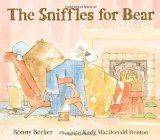
Review of A Bedtime for Bear

A Bedtime for Bear

by Bonny Becker
illustrated by Kady MacDonald Denton

Candlewick Press, 2010. 48 pages.
Starred Review
2010 Sonderbooks Stand-out: #3 Picture Books

I fell in love with Bear and Mouse in Bonny Becker and Kady MacDonald Denton’s first book about them, A Visitor for Bear. The book worked beautifully for reading aloud to a group of school aged kids up to 3rd grade at a summer childcare center — and equally well at preschool storytime. It was a whole lot of fun to read, with fun repetition that built suspense as well as a chance for the reader to indulge in drama. And all along, I’ve loved the expressive pictures that tell the story and subtext so brilliantly.

After they make friends in A Visitor for Bear, Mouse shows Bear how nice a birthday can be when you celebrate with a friend in A Birthday for Bear, which is in Easy Reader format. This third installment goes back to the format and almost the formula of the first — resulting in fun repetition that builds suspense, as well as a chance for the reader to indulge in drama.

Now Bear and Mouse are taking their friendship to another level: Bear is having a sleepover. However, everything has to be just so for Bear’s bedtime. Most of all, it had to be quiet — very, very quiet.

I love the way Bear has learned about friendship, but is still the same persnickety Bear underneath. He tries so hard to be polite at the noise Mouse makes at the beginning! You can see clearly on his face how hard this is for him:

Bristle, bristle, bristle. Bear heard a noise. It was Mouse, brushing his teeth.
“‘Ahem!’ Bear cleared his throat in a reminding sort of way.
“‘Most sorry,’ said Mouse.”

You can already guess what will happen, though what gets Mouse going was a surprise to me. I just love Bear’s big blow up, with the words printed huge across the page: “Will this torment never cease!” wailed Bear.

Honestly, it makes me want to run a Read-Aloud Bedtime Stories program just to get to read this book!

But that’s not the end. There’s a nice little twist when all is quiet and Mouse is asleep… but Bear hears something. Turns out it’s nice to have a friend when you hear scary noises at night.

I hope I’ve conveyed how much I love this book, but to truly appreciate its charm, you really need to get a copy and read it yourself — better yet, grab someone to read it aloud to, at bedtime. And like all great bedtime books, it ends with the characters fast asleep – and one of them is snoring.

Buy from Amazon.com

Find this review on Sonderbooks at: www.sonderbooks.com/Picture_Books/bedtime_for_bear.html

Disclosure: I am an Amazon Affiliate, and will earn a small percentage if you order a book on Amazon after clicking through from my site.

Source: This review is based on a library book from the Fairfax County Public Library.

Review of The Plot Chickens, by Mary Jane and Herm Auch

The Plot Chickens

by Mary Jane and Herm Auch

Holiday House, New York, 2009. 32 pages.

There are many books out there where writers try to tell children how to be a writer. Most fall a little flat as far as the story goes. But The Plot Chickens makes me laugh. Perhaps it’s my over-fondness for puns, but this is probably the book I’d reach for if I were trying to teach a class of elementary school students about being a writer.

Henrietta loves books and decides to write one herself. All the other hens are in on the process. I love the way they first jostle to be the main character, but then pull back when Henrietta gets to Rule Three: “Give your character a problem.”

The nice basic rules listed give lots of room for creativity. I like Henrietta’s story, The Perils of Maxine: It demonstrates that the rules do make a better book, and ends up as a story that a child could write.

But the authors are realistic about its chances of getting published. Henrietta sends it off and, “Many, many, many months later, the publisher sent a rejection letter.” Henrietta self-publishes the book.

My favorite pun is when the librarian tells her she should get a review, so Henrietta sends the book to The Corn Book Magazine. (Not that The Horn Book Magazine would review a self-published book with little merit, but I can believe that The Corn Book Magazine might.) The reviewer says “Henrietta lays an egg with her first book. We hope this is her last book. The Perils of Maxine shows why chickens shouldn’t EVER write.”

I like the way the book reveals the emotional turmoil of being a writer when Henrietta takes the reviewer’s words to heart. But the children at her local library story hour vote it the best book of the year. Sometimes critics can hate a book, but you can still reach children. (Okay, so what if the local children hate it, too? But this does make a fun story….)

This is a silly way to give children a glimpse of the writing process and the life of a writer.

Buy from Amazon.com

Find this review on Sonderbooks at: www.sonderbooks.com/Picture_Books/plot_chickens.html

Disclosure: I am an Amazon Affiliate, and will earn a small percentage if you order a book on Amazon after clicking through from my site.

Source: This review is based on a library book from the Fairfax County Public Library.