Review of The World Entire, by Elizabeth Brown, illustrated by Melissa Castrillón

The World Entire

A True Story of an Extraordinary World War II Rescue

by Elizabeth Brown
illustrated by Melissa Castrillón

Chronicle Books, 2025. 64 pages.
Review written November 17, 2025, from a library book.
Starred Review

The title of this book is taken from a quotation in the Talmud – “He who saves a single life, saves the world entire.” This book is a picture book biography of Aristides de Sousa Mendes, who saved the lives of approximately 10,000 refugees during World War II.

Aristides was a Portuguese diplomat who worked at a consulate in France. When refugees poured into Bordeaux fleeing the Nazis, he was ordered not to give any visas to enter Portugal. After talking with a rabbi and three days of soul-searching, Aristides instead began an assembly line granting visas to everyone.

After the Nazis came to Bordeaux, he went to Bayonne to help make more visas. He even helped refugees find a place to cross the border where those visas would be accepted.

And when he got back home to Portugal, he was arrested for defying orders.

This whole story is dramatized beautifully, with a long author’s note and timeline at the back, giving further details. This book celebrates a man who defied his own government to save people’s lives. He faced many consequences of his actions, but said, “I could not have acted otherwise, and I therefore accept all that has befallen me with love.”

elizabethbrownbooks.com
melissacastrillon.co.uk

Buy from Amazon.com

Find this review on Sonderbooks at: www.sonderbooks.com/Childrens_Nonfiction/world_entire.html

Disclosure: I am an Amazon Affiliate, and will earn a small percentage if you order a book on Amazon after clicking through from my site.

Disclaimer: I am a professional librarian, but the views expressed are solely my own, and in no way represent the official views of my employer or of any committee or group of which I am part.

Subscribe for more reviews and talk about books.

Join the conversation: What did you think of this book?
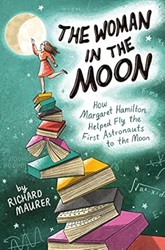
Review of The Woman in the Moon, by Richard Maurer

The Woman in the Moon

How Margaret Hamilton Helped Fly the First Astronauts to the Moon

by Richard Maurer

Roaring Brook Press, 2023. 254 pages.
Review written December 15, 2025, from a library book.
Starred Review

It’s always good to read about a female mathematician who excelled in her field. Margaret Hamilton studied math in the 1950s and learned computer programming while working with the meteorologist Edward Lorenz, who discovered the Butterfly Effect in meteorology. Margaret ran his computer simulations at MIT, and later moved to the lab that worked on the computer software that would go into space with the Apollo missions. Margaret, in fact, was the person who coined the term “software engineering” to reflect that writing the computer code was as much a feat of engineering as constructing the wiring – though in fact some of that code was wired into the physical computers.

This book takes us through Margaret’s life as she was consistently the only woman in her field. It goes into lots of interesting detail about the Apollo missions, all that they were up against, and how Margaret was responsible for making the software work. An abundance of relevant photos help keep the text moving, and the whole thing captures the sense of wonder that humans actually made it to the moon – with 1960s technology.

Historians believe a key reason that American astronauts got to the Moon first (Soviet space travelers never got there at all) was America’s lead in computer technology. There were computers at the launch center, computers at Mission Control, computers at the contractors, computers at the tracking stations, and of course the miniature AGC in the spacecraft. Among all these electronic brains, the only computer that never failed was the AGC. In thousands of hours of manned spaceflight, no software errors were known to have occurred. The achievement is unique in computer history. “Nobody can believe it to this day,” Margaret noted.

Margaret was the one in charge of the software for the AGC, the Apollo Guidance Computer, which was in the command modules in flight. This was a behind-the-scenes job, so it’s good to see this entire book about her, giving some much deserved recognition (besides the Presidential Medal of Freedom she got in 2016). Now kids and teens can learn about her accomplishments.

This book is geared to a middle school audience, but there’s nothing in it that would make high school students feel it’s too young for them, so I decided to post this review on my Teen Nonfiction page instead of my Children’s Nonfiction page, even though in the library we have it as a Juvenile Biography. It’s at a much higher level than the many picture book biographies I post on that page. aLearn about the woman who wrote the software that got humans to the moon.

Buy from Amazon.com

Find this review on Sonderbooks at: www.sonderbooks.com/Teen_Nonfiction/woman_in_the_moon.html

Disclosure: I am an Amazon Affiliate, and will earn a small percentage if you order a book on Amazon after clicking through from my site.

Disclaimer: I am a professional librarian, but the views expressed are solely my own, and in no way represent the official views of my employer or of any committee or group of which I am part.

Subscribe for more reviews and talk about books.

Join the conversation: What did you think of this book?
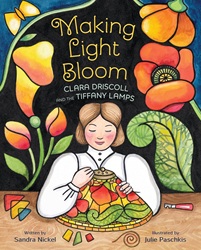
Review of Making Light Bloom, written by Sandra Nickel, illustrated by Julie Paschkis

Making Light Bloom

Clara Driscoll and the Tiffany Lamps

written by Sandra Nickel
illustrated by Julie Paschkis

Peachtree, 2025. 32 pages.
Review written November 18, 2025, from a library book.
Starred Review

This is another picture book biography that tells us about something a woman did that men got the credit for. (Pass Go and Collect $200, by Tanya Lee Stone, about the woman who invented the Monopoly game comes to mind, but I think I have reviewed others.)

In this case, the woman is Clara Driscoll. She grew up in the country loving gardens and flowers and art. As an adult, she moved to New York City to do more with her art. She got a job at the company of the glassmaker Louis C. Tiffany.

She joined a team of artists who selected and cut glass to create pictures and shapes in windows.

Clara showed great talent, so she was put in charge of a workshop staffed only by women.

She hired both experienced artists and untrained immigrants. And as she and her new Tiffany girls worked, Clara inspired them all by reading poetry about nature.

They continued to make glass for windows until Clara had a moment of inspiration.

Though her work kept her busy, Clara missed the house on the hill and its gardens.

One day she had an idea of how to bring their bright beauty to the city. She sent her sisters a letter and asked for yellow butterflies and wild primroses.

Once they arrived, Clara sketched them. But not as a window, with light coming from behind. As a lamp, with light coming from within.

She worked with the Tiffany girls to cut the pieces and with the craftsmen to form the glass into a lampshade. It took so much time and effort to make, one of the managers told Clara not to make any more.

But then, Louis saw what Clara had created and said it was “the most interesting lamp in the place.” He asked her to make another to display at the World’s Fair in Paris.

When the lamp won a bronze medal at the World’s Fair, she was asked to make more lamps and windows filled with gardens and landscapes and flowers. And Clara was put in charge of lamp-making.

“Tiffany lamps” became wildly popular and very valuable. Because Tiffany’s name was on them, no one knew that they were Clara’s design – until a bundle of her letters to her sisters and mother was discovered after both she and Louis Tiffany had died.

The art in this wonderful book is done in a style that matches the lamps Clara created, with dark outlines around simple shapes, as if made of glass themselves.

SandraNickel.com
JuliePaschkis.com
PeachtreeBooks.com

Buy from Amazon.com

Find this review on Sonderbooks at: www.sonderbooks.com/Childrens_Nonfiction/making_light_bloom.html

Disclosure: I am an Amazon Affiliate, and will earn a small percentage if you order a book on Amazon after clicking through from my site.

Disclaimer: I am a professional librarian, but the views expressed are solely my own, and in no way represent the official views of my employer or of any committee or group of which I am part.

Subscribe for more reviews and talk about books.

Join the conversation: What did you think of this book?
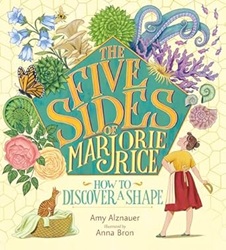
Review of The Five Sides of Marjorie Rice, by Amy Alznauer, illustrated by Anna Bron

The Five Sides of Marjorie Rice

How to Discover a Shape

by Amy Alznauer
illustrated by Anna Bron

Candlewick Press, 2025. 48 pages.
Review written October 3, 2025, from a book sent to me by the publisher.
Starred Review

Like another book I recently reviewed, Firefly Song, The Five Sides of Marjorie Rice is a picture book biography of a citizen scientist, a woman who made a notable discovery, even though she didn’t have formal training in that field. Marjorie Rice now has a special place in my heart, because in her case, the field was math.

The biography tells us how Marjorie Rice read an article in Scientific American by Martin Gardner and then got captivated with the idea of finding more five-sided convex shapes that tile a plane. And the stellar art by Anna Bron helps make it clear to the reader what this means.

We learn how she was inspired when a new tiling was discovered – to then search for new five-sided shapes of her own that would work. And she went on to find four of fifteen pentagon types that tile the plane. (Years later, other mathematicians found two more, and then another proved that there were no more.)

This amateur mathematician’s life is especially suited for a picture book biography because her work was so visual – and the artist did a great job of using pentagon tilings throughout the book. Back matter not only tells about the pentagon discoveries after Marjorie, they also give the reader great ideas for exploring shapes, tilings, and tessellations further.

I love that this is the story of a housewife with a curious and playful mind (if perhaps a somewhat obsessive one).

Oh look! I’m ready to post this review and looked up the author’s website. She has an MFA in Creative Writing and also teaches calculus and number theory. This makes me feel like she’s a kindred spirit with me, since I have Master’s degrees in Mathematics and in Library Science – not a typical combination. This explains her excellent picture book biographies of mathematicians. I’m going to keep watching for her books.

amyalz.com
candlewick.com

Buy from Amazon.com

Find this review on Sonderbooks at: www.sonderbooks.com/Childrens_Nonfiction/five_sides_of_marjorie_rice.html

Disclosure: I am an Amazon Affiliate, and will earn a small percentage if you order a book on Amazon after clicking through from my site.

Disclaimer: I am a professional librarian, but the views expressed are solely my own, and in no way represent the official views of my employer or of any committee or group of which I am part.

Subscribe for more reviews and talk about books.

Join the conversation: What did you think of this book?
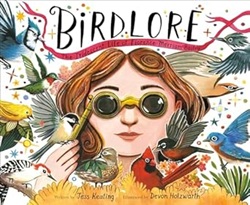
Review of Birdlore: The Iridescent Life of Florence Merriam Bailey, written by Jess Keating, illustrated by Devon Holzwarth

Birdlore

The Iridescent Life of Florence Merriam Bailey

written by Jess Keating
illustrated by Devon Holzwarth

Alfred A. Knopf, 2025. 40 pages.
Review written July 21, 2025, from a library book.
Starred Review

I love it when picture book biographies tell me about a person who lived a remarkable life and changed the world – but whom I’d never heard of before. This is one such book.

In 1889, Florence Merriam Bailey wrote the first field guide to American birds ever published. She talked about the wonders of birdwatching and popularized it for everyone.

This picture book tells her story with gorgeous art – as befitting a book about beautiful birds. (As a bonus, at the back, there’s a spread showing Florence’s favorite bird species and asking if you can find all these birds in the pages of the book.) It begins with her childhood in the countryside, when she would delight in finding them. When she got old enough to study birds as a scientist, she didn’t like the normal method at the time of examining dead birds and making them into specimens. So she would take notes on living birds in the outdoors.

When she went to university, Florence made friends with other women interested in birds and showed them her method of taking notes on birds in the wild. The women were scandalized together at the common fashion choice of the time – wearing dead birds on ladies’ hats.

It began a quest to share with people the wonder of birds in the wild – and helped pass the Lacey Act in 1900 that protected birds from illegal trade.

The way the story is told lifts your hearts with the birds and will add to your own appreciation. A lovely book about a woman who helped protect these lovely creatures.

jesskeating.com
devonholzwarth.com
rhcbooks.com

Buy from Amazon.com

Find this review on Sonderbooks at: www.sonderbooks.com/Childrens_Nonfiction/birdlore.html

Disclosure: I am an Amazon Affiliate, and will earn a small percentage if you order a book on Amazon after clicking through from my site.

Disclaimer: I am a professional librarian, but the views expressed are solely my own, and in no way represent the official views of my employer or of any committee or group of which I am part.

Subscribe for more reviews and talk about books.

Join the conversation: What did you think of this book?
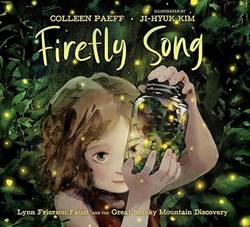
Review of Firefly Song, by Colleen Paeff, illustrated by Ji-Hyuk Kim

Firefly Song

Lynn Frierson Faust and the Great Smoky Mountain Discovery

by Colleen Paeff
illustrated by Ji-Hyuk Kim

Margaret K. McElderry Books, 2025. 40 pages.
Review written September 16, 2025, from a library book.
Starred Review

Firefly Song stands out among picture book biographies for several reasons, the first being that it’s got gorgeous art. I love the picture of the twilight forest dotted with fireflies and the picture of young Lynn Faust jumping into a Great Smoky Mountains swimming hole.

But it’s also wonderful because of the story it tells. Lynn Frierson Faust essentially trained herself as a scientist. As a child, she enjoyed the dazzling display of the synchronous fireflies at her family’s summer cabin.

When she tried to find out more about fireflies (because those were so wonderful), she discovered that scientists believed there were no synchronous fireflies in North America.

But how to let the scientists know they are wrong? She was met with plenty of skepticism.

It took her years of work and plenty of research to get other scientists to come and confirm what she’d realized all along – that a species of synchronous fireflies lives in the Great Smoky Mountains.

The fireflies of Elkmont and their light show are famous now. Each summer, thousands of visitors travel from clear across the world to witness the silent serenade of Photinus carolinus.

There’s nice back matter for those who are intrigued as I was and want to find out more.

colleenpaeff.com
hanuol.com

Buy from Amazon.com

Find this review on Sonderbooks at: www.sonderbooks.com/Childrens_Nonfiction/firefly_song.html

Disclosure: I am an Amazon Affiliate, and will earn a small percentage if you order a book on Amazon after clicking through from my site.

Disclaimer: I am a professional librarian, but the views expressed are solely my own, and in no way represent the official views of my employer or of any committee or group of which I am part.

Subscribe for more reviews and talk about books.

Join the conversation: What did you think of this book?
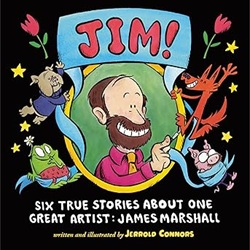
Review of Jim! Six True Stories about One Great Artist: James Marshall, by Jerrold Connors

Jim!

Six True Stories about One Great Artist: James Marshall

by Jerrold Connors

Dial Books for Young Readers, 2025. 72 pages.
Review written September 3, 2025, from a library book.
Starred Review

The perfect picture book biography exists, and I have just read it!

Jerrold Connors takes six stories that give us the essence of James Marshall’s life, and he relates them with words and art that perfectly mimic James Marshall’s style. The stories even have the punch of a George and Martha story!

I adore the George and Martha books, and this book borrows their format in a brilliant homage to their creator. The stories are numbered, as in George and Martha. They are: “The Book,” about creating Miss Nelson Is Missing with his friend Harry; “How Cute!” about how annoying it was to have his work called cute and his history as a classical musician; “Friendly Competition,” about his friends Maurice (Maurice wears a “Wild Thing” shirt.) and Arnold, who were also writers; “The Award” about how he would have liked to win an award but how his partner Billy reminded him that great art is about putting yourself in your work; “The School Visit” about his second-grade teacher who told him he’d never be an artist and served as the inspiration for Viola Swamp; and “The Hospital,” about how kids will remember him, because kids are really smart.

An Author’s Note ties it all together with more details about James Marshall’s life, but please be aware that my summary doesn’t begin to convey the charm of this book. Anyone who loves George and Martha (and who could possibly not?) will be absolutely delighted with this book.

jerroldconnors.com

Buy from Amazon.com

Find this review on Sonderbooks at: www.sonderbooks.com/Childrens_Nonfiction/jim.html

Disclosure: I am an Amazon Affiliate, and will earn a small percentage if you order a book on Amazon after clicking through from my site.

Disclaimer: I am a professional librarian, but the views expressed are solely my own, and in no way represent the official views of my employer or of any committee or group of which I am part.

Subscribe for more reviews and talk about books.

Join the conversation: What did you think of this book?
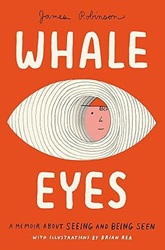
Review of Whale Eyes, by James Robinson

Whale Eyes

A Memoir About Seeing and Being Seen

by James Robinson
with illustrations by Brian Rea

Penguin Workshop, 2025. 298 pages.
Review written August 11, 2025, from a library book.
Starred Review

This book will literally change your perspective.

It’s not often that I have to order additional copies of a memoir published for kids because of so many holds, but that happened with Whale Eyes. What a creative and fascinating book! Written by a documentary filmmaker about his own childhood, Whale Eyes shows you what it’s like to have strabismus and exotropia – by playing with the format and illustrations in this book. You’ll be turning the book upside-down and even folding a page. (Do it gently if you’re using a library copy!) And you’ll begin to understand what it’s like to see things through Whale Eyes.

Most people’s brains fuse images from our two eyes. But James was born with eyes that don’t track together – so his brain compensates by alternating which eye he sees out of. And when his brain switches between eyes, that makes the image jump. Which makes reading extremely difficult. Or playing tee-ball – He tells the story of being the first kid the adults had ever seen strike out at tee-ball.

And when people see his misaligned eyes – they don’t know where to look. So they look away. Or they stare, trying to figure out what’s wrong with him. Neither one is good for connecting with people.

So this book is about helping people understand, and telling people where to look – at the eye that’s looking at them – so that we can make connections. He coined the term “Whale eyes” because we can only look at one of a whale’s eyes at a time – yet that doesn’t bother anyone.

There’s a point in the book where he asks the reader to take an intermission and watch a documentary about his condition that he made for the New York Times. I’d provide a link to that video – except watch it as an intermission, after you’ve been prepared, and I think it will hit all the harder.

He finishes up the book with some things he’s learned from making documentaries – things about making connections and catching people’s interests. He brings people together instead of pushing them apart.

This book is written for middle grade kids – but there is no age limit for liking and being fascinated by this book. I pushed a couple of my coworkers to check it out, and I hope this review will get it more readers. It will open your eyes to another way of looking at the world. Literally.

byjamesrobinson.com

Buy from Amazon.com

Find this review on Sonderbooks at: www.sonderbooks.com/Children_Nonfiction/whale_eyes.html

Disclosure: I am an Amazon Affiliate, and will earn a small percentage if you order a book on Amazon after clicking through from my site.

Disclaimer: I am a professional librarian, but the views expressed are solely my own, and in no way represent the official views of my employer or of any committee or group of which I am part.

Subscribe for more reviews and talk about books.

Join the conversation: What did you think of this book?
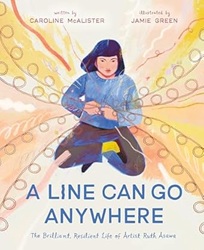
Review of A Line Can Go Anywhere, written by Caroline McAlister, illustrated by Jamie Green

A Line Can Go Anywhere

The Brilliant, Resilient Life of Artist Ruth Asawa

written by Caroline McAlister
illustrated by Jamie Green

Roaring Brook Press, 2025. 40 pages.
Review written June 6, 2025, from a library book.
Starred Review

I love the way my job at the library brings me into contact with beautiful picture book biographies of people I never would have known about otherwise. A Line Can Go Anywhere is about the American sculptor and artist Ruth Asawa. She is best known for her sculptures made from wire looped and intertwined into lovely shapes.

And author Caroline McAlister takes the idea of those long lines of wires turned into form and applies it to the artist’s life.

When Ruth was a child, there was an invisible line between her home life, where she spoke Japanese and had food and customs from Japan, and her school life in an American elementary school. Then Japan attacked Pearl Harbor – and her father was arrested, and Ruth and her mother and six siblings were imprisoned first at a racetrack, and then at a Relocation Center in Arkansas. But some skilled artists taught the children at the racetrack – and Ruth began sketching the lines around her.

She was allowed to leave to attend college to become an art teacher – but they refused to place her in a school. So she went on to a more open college in North Carolina, and learned to truly express herself in art.

I like this page that explains how she began her distinctive art from wires:

Then on a summer trip to Mexico, Ruth watched women carry eggs in woven wire baskets. She liked that the baskets were sturdy, strong, and practical, but also beautiful, patterned, and transparent. This was art made by ordinary people, used in their everyday lives. It didn’t hang on museum walls.

She thought back to the barbed wire that had kept her imprisoned at the Arkansas camp. Now as the world moved on from war, she found freedom in twisting wire into cells that divided and multiplied. A single strand of ordinary wire became a continuous piece with no beginning or end. She demonstrated that a line could go anywhere, be anything. A line could stretch into infinity.

The book goes on to talk about some public art she made and about how she continued to express herself. The back matter gives more details and includes of a photo of the artist with her wire art.

An interesting, informative, and inspirational story.

carolinemcalisterauthor.com
jamiegreenillustration.com

Buy from Amazon.com

Find this review on Sonderbooks at: www.sonderbooks.com/Childrens_Nonfiction/line_can_go_anywhere.html

Disclosure: I am an Amazon Affiliate, and will earn a small percentage if you order a book on Amazon after clicking through from my site.

Disclaimer: I am a professional librarian, but the views expressed are solely my own, and in no way represent the official views of my employer or of any committee or group of which I am part.

What did you think of this book?
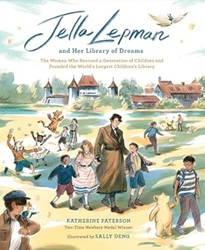
Review of Jella Lepman and Her Library of Dreams, by Katherine Paterson, illustrated by Sally Deng

Jella Lepman and Her Library of Dreams

The Woman Who Rescued a Generation of Children and Founded the World’s Largest Children’s Library

by Katherine Paterson
illustrated by Sally Deng

Handprint Books (Chronicle), 2025. 104 pages.
Review written June 9, 2025, from a library book.
Starred Review

This book has the large shape of an ordinary picture book biography, but there are more words on each page and many more pages, so this is suitable for older children than the usual picture book biography crowd, kids who can read more in-depth information. The book does have all the beauty and added interest of illustrations on every page.

I hadn’t heard of Jella Lepman before reading this book – but I had heard of the International Youth Library when I lived in Germany, and had long meant to go visit. I’m now all the more disappointed that I never did manage it – will have to visit Germany again to do so!

I’ve also heard of IBBY, the International Board of Books for Young People, which always has events at ALA Annual Conference – and was very happy to read a book about one of the founders.

So I knew about some of the things Jella Lepman established, but hearing her story helped me learn her wonderful motivation – helping children after war.

Jella was a German Jew who had fled Germany after Hitler rose to power. But she came back after the war, working for the U.S. Army. Her job was to be an “adviser on the cultural and educational needs of women and children” in the part of Germany under American occupation. She agonized about whether to accept the assignment.

Even if Jella could not help the adults, couldn’t she do something for suffering children? “I found it easy to believe that the children all to soon would fall into the wrong hands if no help came from the world outside,” she wrote. “Were not Germany’s children just as innocent as children all over the world, helpless victims of monstrous events?”

She had made up her mind. The fate of these children was too important. She would accept the military assignment.

After she arrived in Germany, I love the part where she decided to promote world peace through children’s books. She solicited books from countries across the world. It started with an International Exhibition of Children’s Books. The books were sent to the children of Germany as messengers of peace.

At first the show traveled around the country, but eventually Jella worked to give it a permanent home in the International Youth Library.

And that was only the beginning of her efforts toward peace through children’s books. To this librarian reading this, her story was uplifting and gratifying and beautiful.

katherinepaterson.com
chroniclekids.com

Buy from Amazon.com

Find this review on Sonderbooks at: www.sonderbooks.com/Childrens_Nonfiction/jella_lepman.html

Disclosure: I am an Amazon Affiliate, and will earn a small percentage if you order a book on Amazon after clicking through from my site.

Disclaimer: I am a professional librarian, but the views expressed are solely my own, and in no way represent the official views of my employer or of any committee or group of which I am part.

What did you think of this book?