Review of The Octopus Scientists, by Sy Montgomery

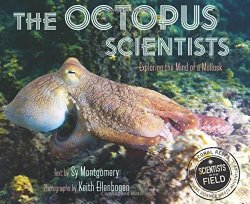
octopus_scientists_largeThe Octopus Scientists

Exploring the Mind of a Mollusk

Text by Sy Montgomery
Photographs by Keith Ellenbogen

Houghton Mifflin Harcourt, Boston, 2015. 72 pages.
Starred Review

The Octopus Scientists is part of the extraordinary Scientists in the Field series. As with The Tapir Scientist, Sy Montgomery puts herself in the story, telling us all about her two-week visit with a team of octopus scientists, what they were studying, and what they found.

In this case, the team of four scientists was searching for octopuses – to study where they live, what they eat, and even their personalities (bold or more cautious).
Among other interesting facts I learned, it turns out that octopuses is correct, not octopi.

Though many people still use this plural, octopus experts deem it incorrect because it mixes up two languages. Octopus is a Greek word meaning “eight-footed.” Adding i to the end of a singular noun is a Latin practice. The correct plural is octopuses, or octopods.

Most of this book addresses the biggest challenge: simply finding the octopuses, who are experts at hiding. But the team is very successful, and besides scientific results and information, because of this Keith Ellenbogen got an abundance of colorful, stunning photographs of octopuses and other sea creatures in the crystal clear water among the coral reefs.

I love the way the books in the Scientists in the Field series show what actual scientists do – including days of fruitless searching. It includes the difficulties they encounter and the mixed results as well as the triumphs and the new information gained.

Along the way, readers learn a plethora of facts about octopuses, and these facts are told as background in an engaging story, so they won’t quickly be forgotten.

This book may well inspire many future marine biologists. And the rest of us will marvel at the intelligence and beauty of the humble octopus. I had no idea they can change color more effectively than a chameleon, yet are colorblind themselves. Or that they can figure out how to open different kinds of latches. Or… This is definitely a book you should read yourself to find out more.

sciencemeetsadventure.com
hmhco.com

Buy from Amazon.com

Find this review on Sonderbooks at: www.sonderbooks.com/Childrens_Nonfiction/octopus_scientists.html

Disclosure: I am an Amazon Affiliate, and will earn a small percentage if you order a book on Amazon after clicking through from my site.

Source: This review is based on a library book from Fairfax County Public Library.

Disclaimer: I am a professional librarian, but I maintain my website and blogs on my own time. The views expressed are solely my own, and in no way represent the official views of my employer or of any committee or group of which I am part.

What did you think of this book?
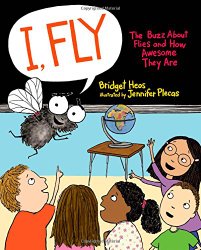
Review of I, Fly, by Bridget Heos, illustrated by Jennifer Plecas

i_fly_largeI, Fly

The Buzz About Flies and How Awesome They Are

by Bridget Heos
illustrated by Jennifer Plecas

Henry Holt and Company, New York, 2015. 44 pages.
Starred Review

This nonfiction for early elementary age kids hits just the right note.

A fly buzzes into a classroom and finds the kids studying — as usual — butterflies.

Well, guess who else metamorphoses, can fly, and is beautiful (at least according to my mother).

The fly goes on to explain:

Here’s how the story goes: My 500 brothers and sisters and I started out as eggs. Our mom tucked us into a warm, smelly bed of dog doo. When we hatched, we looked like short, greasy white worms. In other words, much cuter than caterpillars. Scientists called us larvae. Humans called us maggots. Our parents called us adorable.

He tells the kids all about the lifecycle of a fly and cool (or disgusting, depending on your viewpoint) facts about them as well.

My favorite bit is where a kid asks, “I heard that flies throw up on everything before they eat it. Is that true?”

No. We don’t throw up on everything. Only solid foods.

See, we don’t have any teeth, so we can’t chew. I had to throw up on this apple core to turn it into a liquid. That way I could sop it up with my spongy mouth.

But if something’s already a liquid, like the soup you’re having for lunch, I don’t throw up on it. I’ll slurp that right out of the bowl.

Of course, when the kids decide the fly is right and he should be studied, he finds he doesn’t actually want to be kept in a cage in the classroom. Then he tells them the facts about diseases flies carry so they’ll let him go.

Fortunately, readers of this book can learn all the facts the friendly fly has to tell them without making contact with its germs.

This one’s a natural for booktalking in the schools. Children will learn fly facts without even trying.

authorbridgetheos.com
jenniferplecas.com
mackids.com

Buy from Amazon.com

Find this review on Sonderbooks at: www.sonderbooks.com/Childrens_Nonfiction/i_fly.html

Disclosure: I am an Amazon Affiliate, and will earn a small percentage if you order a book on Amazon after clicking through from my site.

Source: This review is based on a library book from Fairfax County Public Library.

Disclaimer: I am a professional librarian, but I maintain my website and blogs on my own time. The views expressed are solely my own, and in no way represent the official views of my employer or of any committee or group of which I am part.

What did you think of this book?

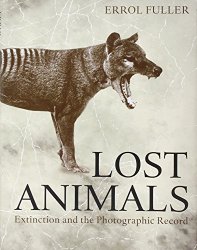
Review of Lost Animals, by Errol Fuller

lost_animals_largeLost Animals

Extinction and the Photographic Record

by Errol Fuller

Princeton University Press, 2013. 256 pages.

This is a fascinating book. The idea is simple: The author has compiled actual photographs of animals whose species are now extinct. There is information about each animal and details about when each one presumably died out.

In many ways, it’s a tragic book. Especially painful are pictures such as the one of a dead Yangtze River Dolphin taken with the hunter who shot it.

Mostly, the pictures are fascinating in themselves. As the author says in the Introduction:

It seems that a photograph of something lost or gone has a power all of its own, even though it may be tantalizingly inadequate.

nathist.press.princeton.edu

Buy from Amazon.com

Find this review on Sonderbooks at: www.sonderbooks.com/Nonfiction/lost_animals.html

Disclosure: I am an Amazon Affiliate, and will earn a small percentage if you order a book on Amazon after clicking through from my site.

Source: This review is based on a library book from Fairfax County Public Library.

Disclaimer: I am a professional librarian, but I maintain my website and blogs on my own time. The views expressed are solely my own, and in no way represent the official views of my employer or of any committee or group of which I am part.

What did you think of this book?

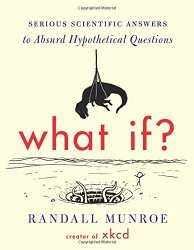
Review of What If? by Randall Munroe

what_if_largeWhat If?

Serious Scientific Answers to Absurd Hypothetical Questions

by Randall Munroe

Houghton Mifflin Harcourt, 2014. 303 pages.
Starred Review

Randall Munroe is the creator of xkcd.com. Fans of xkcd will have already read this book. So I should probably try to reach those who have not yet discovered the genius that is xkcd.

The Disclaimer at the front of the book says a lot:

Do not try any of this at home. The author of this book is an Internet cartoonist, not a health or safety expert. He likes it when things catch fire or explode, which means he does not have your best interests in mind. The publisher and the author disclaim responsibility for any adverse effects resulting, directly or indirectly, from information contained in this book.

I also want to say that this is the book that reinforces my belief in the Meyers-Briggs Personality Theory (See alittlebitofpersonality.com). As soon as I heard this book was coming out, I knew that I’d be buying one for both of my sons and my father for Christmas. After I’d done so, I realized that all of these men are INTP personality types. I noted as much on Facebook, and my older son commented that Randall Munroe is the quintessential INTP.

And what is the quintessential INTP? I think of that as someone who chases rabbit trails, who explores thoughts wherever they lead – someone, in fact, who gives serious scientific answers to absurd hypothetical questions. And enjoys doing so. And even writes a book about it.

Here are some of the absurd hypothetical questions this book answers:

What would happen if the Earth and all terrestrial objects suddenly stopped spinning, but the atmosphere retained its velocity?

If every person on Earth aimed a laser pointer at the Moon at the same time, would it change color?

What would happen if everyone on Earth stood as close to each other as they could and jumped, everyone landing on the ground at the same instant?

What would happen if you made a periodic table out of cube-shaped bricks, where each brick was made of the corresponding element?

If every human somehow simply disappeared from the face of the Earth, how long would it be before the last artificial light source would go out?

Is it possible to build a jetpack using downward-firing machine guns?

If everyone on the planet stayed away from each other for a couple of weeks, wouldn’t the common cold be wiped out?

Let’s assume there’s life on the nearest habitable exoplanet and that they have technology comparable to ours. If they looked at our star right now, what would they see?

What would happen if you tried to fly a normal Earth airplane above different solar system bodies?

If you call a random phone number and say “God bless you,” what are the chances that the person who answers just sneezed?

What is the farthest one human being has ever been from every other living person? Were they lonely?

What if a rainstorm dropped all of its water in a single giant drop?

The book consists of answers which take these questions at least mostly seriously, accompanied by Randall Munroe’s distinctive stick figure illustrations. He often goes off on tangents taking off from these ideas. For example, with the question about everyone on Earth standing close together and jumping, he points out that the real problem would not be with the jump, but with all those people trying to get back to their respective homes.

The survivors spread out across the face of the world and struggle to build a new civilization atop the pristine ruins of the old. Our species staggers on, but our population has been greatly reduced. Earth’s orbit is completely unaffected – it spins along exactly as it did before our species-wide jump.

But at least now we know.

I was also entertained by the selection of questions Randall Munroe called “Weird (and Worrying) questions from the What If? inbox” These he doesn’t answer, but I find it amusing as to which questions are weird even to Randall Munroe.

Here are a few examples of these “worrying” questions:

What sort of logistic anomalies would you encounter in trying to raise an army of apes?

What temperature would a chainsaw (or other cutting implement) need to be at to instantly cauterize any injuries inflicted with it?

How many nuclear missiles would have to be launched at the United States to turn it into a complete wasteland?

Those some examples of questions. Now let me give an example of his style of answers. Though without reproducing the stick figures, you definitely don’t get the full effect.

The answer to the question “What would happen if you tried to hit a baseball pitched at 90 percent the speed of light?” begins like this:

The answer turns out to be “a lot of things,” and they all happen very quickly, and it doesn’t end well for the batter (or the pitcher). I sat down with some physics books, a Nolan Ryan action figure, and a bunch of videotapes of nuclear tests and tried to sort it all out. What follows is my best guess at a nanosecond-by-nanosecond portrait.

Two pages later, with various instructive and dramatic illustrations, the answer ends like this:

Everything within roughly a mile of the park would be leveled, and a firestorm would engulf the surrounding city. The baseball diamond, now a sizable crater, would be centered a few hundred feet behind the former location of the backstop.

Major League Baseball Rule 6.08(b) suggests that in this situation, the batter would be considered “hit by pitch,” and would be eligible to advance to first base.

What are you waiting for? If you can resist reading this book after reading these tidbits (as hard as that is for me to understand), it is probably not the book for you.

xkcd.com
hmhco.com

Buy from Amazon.com

Find this review on Sonderbooks at: www.sonderbooks.com/Nonfiction/what_if.html

Disclosure: I am an Amazon Affiliate, and will earn a small percentage if you order a book on Amazon after clicking through from my site.

Source: This review is based on a library book from Fairfax County Public Library.

Disclaimer: I am a professional librarian, but I maintain my website and blogs on my own time. The views expressed are solely my own, and in no way represent the official views of my employer or of any committee or group of which I am part.

What did you think of this book?

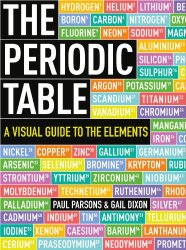
Review of The Periodic Table: A Visual Guide to the Elements, by Paul Parsons and Gail Dixon

periodic_table_largeThe Periodic Table

A Visual Guide to the Elements

by Paul Parsons & Gail Dixon

Quercus Editions, Ltd, 2014. First published in the United Kingdom in 2013. 240 pages.
Starred Review
2014 Sonderbooks Stand-out, #10 Nonfiction

One look at this beautiful book, and I had to read it. I had no idea I was interested in the chemical elements until I saw this book!

The book consists of a brief introduction, and then a one-page explanation (in a few cases more pages) of each of the first 100 elements in the periodic table, with a large photograph of something related to the element on the facing page. In most cases, it’s a picture of the element, but also includes things like a picture of the atomic bomb dropped over Nagasaki next to Plutonium, a krypton-gas discharge lamp next to Krypton, and a bone scan next to Technetium.

At the beginning of each element’s page, we see its place in the periodic table, its category, atomic number, atomic weight, color, phase, melting point, boiling point, crystal structure, and a diagram of its electrons.

I read this book slowly, an element per day – and found it consistently fascinating. I’m not sure how much of the information stuck, but something about the big beautiful pictures made it seem so much more alive than high school chemistry class (which I loved, but this was very different).

quercus.com

Buy from Amazon.com

Find this review on Sonderbooks at: www.sonderbooks.com/Nonfiction/periodic_table.html

Disclosure: I am an Amazon Affiliate, and will earn a small percentage if you order a book on Amazon after clicking through from my site.

Source: This review is based on a library book from Fairfax County Public Library.

Disclaimer: I am a professional librarian, but I maintain my website and blogs on my own time. The views expressed are solely my own, and in no way represent the official views of my employer or of any committee or group of which I am part.

Review of Trees Up Close, by Nancy Ross Hugo and Robert Llewellyn

trees_up_close_largeTrees Up Close

The Beauty of Bark, Leaves, Flowers, and Seeds

by Nancy Ross Hugo
photographs by Robert Llewellyn

Timber Press, Portland, 2014. 200 pages.
Starred Review
2014 Sonderbooks Stand-out, #4 Nonfiction

When I checked out this book, it looked familiar. Sure enough, the copyright page states, “This work incorporates portions of Seeing Trees copyright 2011 by Nancy Ross Hugo and Robert Llewellyn.” Back in 2011, I checked out Seeing Trees and liked the look of it so much, I bought myself a copy. Well, the book is extra large format and heavy and doesn’t fit nicely into my daily reading piles.

Seeing Trees, on the other hand, is paperback and a smaller seven-inch square. I ended up reading a chapter a day most days and being completely enchanted. I would like to take it outside with me and look much more closely at the trees in my neighborhood and by my lake. Though I will probably instead settle for looking at the trees which I can see out my window and learning what the things I see actually mean.

In fact, reading this book has gotten me taking far more pictures of bare branches in my walks by my lake. And now I’m noticing that each tree is different.

Normally, I’ve always thought that winter is not the time to notice trees. After all, they’re dormant then. What is there to see when a tree has no leaves?

Nancy Ross Hugo and Robert Llewellyn have now taught me otherwise. Here’s a bit from the chapter on “Buds & Leaf Scars”:

When most of us think of buds, we think of spring phenomena — and usually in association with garden flowers. But tree buds, which contain embryonic leaves, stems, and flowers, are usually formed the summer before they grow into the forms they take each spring, and winter is one of the best times to view them.

During the summer and fall, tree buds grow to a certain size then stop, or rest, for the winter. At that stage, these winter or resting buds, as they are called, remind us that life hasn’t fled the body of a leafless tree — it’s just in waiting, and the shapes of next year’s leaves and flowers are already programmed into its buds. Resting buds also provide one of the best ways to identify trees in winter, because their designs are unique to each species.

I found even the Introduction to the book inspiring:

Instead of traveling thousands of miles to see exceptional trees, as we had for our first collaboration, Bob and I decided to focus on the exceptional traits of ordinary, backyard trees. We did little traveling (unless you count walks around our own yards and neighborhoods), but we were no less impressed by what we saw. In fact, limiting the descriptions and illustrations of what we saw became harder than finding interesting tree traits to feature.

Our goal in creating this book was to share the beauty of what we discovered and to get other people outdoors searching for tree phenomena like the ones we observed, because what is startling in Bob’s photographs is infinitely more inspiring outdoors, where it can be appreciated in context and with all the senses. And it is in the process of discovering these phenomena in nature that the real joy of tree-watching resides. We want to convey that tree-viewing can be as exciting as bird-watching (perhaps even more exciting, if trees are your favorite wild beings) and that through intimate viewing, one’s sense of trees as living, breathing organisms, as opposed to inanimate objects, will be enhanced.

Above all, like most writers and photographers who value what they describe and illustrate, Bob and I hope this book will help make the world safer for trees. In my most romantic imaginings, I sometimes think that if I could just draw enough people’s attention to the beauty of red maple blossoms, the extraordinary engineering of gumballs, the intricacy of pine cones — all would be well in the tree world. That is a romantic notion. But sometimes romance can accomplish what rhetoric cannot. Look carefully at the hair, veins, pores, and other wildly vivifying tree characteristics captured in the photographs in this book, and you’ll never see a tree in the same way again.

Indeed, the authors have changed what I see when I walk among trees. And I’m thankful for it.

The meat of this book is the photographs — up close, stunning photographs of many different types of trees. There are five chapters — Leaves, Flowers & Cones, Fruit & Seeds, Buds & Leaf Scars, and Bark & Twigs. Each chapter has a short text that explains what you’re looking at for this part of a tree. Then many pages of photographs give you concrete examples of what this means, and show you the variation between different types of trees.

Since so much of reading this book is absorbing the stunning pictures, and since it comes in such a convenient size, it was easy to finish this book at the rate of a chapter a day. However, I will be thinking about the things I learned for the rest of my life, every time I go outside.

nancyrosshugo.com
robertllewellyn.com
timberpress.com

Buy from Amazon.com

Find this review on Sonderbooks at: www.sonderbooks.com/Nonfiction/trees_up_close.html

Disclosure: I am an Amazon Affiliate, and will earn a small percentage if you order a book on Amazon after clicking through from my site.

Source: This review is based on a library book from Fairfax County Public Library.

Disclaimer: I am a professional librarian, but I maintain my website and blogs on my own time. The views expressed are solely my own, and in no way represent the official views of my employer or of any committee or group of which I am part.

Review of Winter Bees and Other Poems of the Cold, by Joyce Sidman & Rick Allen

winter_bees_largeWinter Bees
& Other Poems of the Cold

by Joyce Sidman & Rick Allen

Houghton Mifflin Harcourt, Boston, 2014. 32 pages.
Starred Review
2014 Sonderbooks Stand-out: #3 Children’s Nonfiction

Winter Bees & Other Poems of the Cold is a magnificent collection of poetry, science, and art – all about creatures of winter.

The poems are lovely and evocative, the artwork is stunning, and the facts presented after each poem are surprising and interesting.

Usually, the poem gives the voice of the animal being featured, then a paragraph on the facing page gives more details. The creatures highlighted include tundra swans, garter snakes, moose, honeybees (in winter), beavers, wolves, ravens, voles, chickadees, snow fleas, and skunk cabbages.

As one example, here’s “Snake’s Lullaby,” featuring an illustration of a tangle of garter snakes, which we are told brumate together in a tangled mass underground.

Brother, sister, flick your tongue
and taste the flakes of autumn sun.

Use these last few hours of gold
to travel, travel toward the cold.

Before your coils grow stiff and dull,
your heartbeat slows to winter’s lull,

seek the sink of sheltered stones
that safely cradle sleeping bones.

Brother, sister, find the ways
back to the deep and tranquil bays,

and ‘round each other twist and fold
to weave a heavy cloak of cold.

This is a beautiful book which will draw the reader back again and again.

Do you have a child who likes facts about animals? This book is full of choice bits. You’ll learn about subnivean creatures. You’ll learn about springtails – tiny arthropods whose tails flip them up into the air. You’ll learn how honeybees keep the hive warm during the winter, and so many other interesting facts. And while your child is learning, the chances are good that they will be pulled into enjoyment of the accompanying poetry and artwork.

joycesidman.com
kenspeckleletterpress.com
hmhco.com

Buy from Amazon.com

Find this review on Sonderbooks at: www.sonderbooks.com/Childrens_Nonfiction/winter_bees.html

Disclosure: I am an Amazon Affiliate, and will earn a small percentage if you order a book on Amazon after clicking through from my site.

Source: This review is based on a library book from Fairfax County Public Library.

Disclaimer: I am a professional librarian, but I maintain my website and blogs on my own time. The views expressed are solely my own, and in no way represent the official views of my employer or of any committee or group of which I am part.

Review of Creature Features, by Steve Jenkins & Robin Page

creature_features_largeCreature Features

25 Animals Explain Why They Look the Way They Do

by Steve Jenkins & Robin Page

Houghton Mifflin Harcourt, Boston, 2014. 32 pages.

Steve Jenkins’ books are unfailingly fascinating. His cut-paper art is amazingly detailed and realistic.

This book is a simple introduction to the fascinating world of animals for younger readers. The pictures present 25 animals with something strange about the way their face looks. These animals explain why these looks help them survive, using simple language.

Here are a couple of examples:

Dear Egyptian vulture: Why no feathers on your face?

Are you sure you want to know? Really? Okay, I’ll tell you. I stick my face into the bodies of the dead animals I eat, and feathers would get pretty messy . . .

Dear star-nosed mole: What is that weird thing growing on your face?

Actually, that’s my nose. I live underground, and I use the tentacles on my snout to feel my way in the dark and find tasty worms and grubs to eat.

This book is a wonderful way to excite children’s curiosity about the natural world. It’s not often that a nonfiction book would work well for both preschool storytime and keeping the attention of school-age kids, but this one falls firmly in that category.

stevejenkinsbooks.com
hmhco.com

Buy from Amazon.com

Find this review on Sonderbooks at: www.sonderbooks.com/Childrens_Nonfiction/creature_features.html

Disclosure: I am an Amazon Affiliate, and will earn a small percentage if you order a book on Amazon after clicking through from my site.

Source: This review is based on a library book from Fairfax County Public Library.

Disclaimer: I am a professional librarian, but I maintain my website and blogs on my own time. The views expressed are solely my own, and in no way represent the official views of my employer or of any committee or group of which I am part.

Review of Ken Libbrecht’s Field Guide to Snowflakes

snowflakes_largeKen Libbrecht’s Field Guide to
Snowflakes

by Ken Libbrecht

Voyageur Press, 2006. 112 pages.
Starred Review

I finished reading this book exactly when the last snowfall of the winter happened in early 2014. So I wrote the review, and now I’m posting it in time for next winter’s snow. In fact, this would be a wonderfully appropriate Christmas gift for snow lovers everywhere.

We’ve all heard that no two snowflakes are exactly alike, and Ken Libbrecht asserts that, at least for all but the tiniest snowflakes, that is probably so. However, there are distinct types of snowflakes, which depend on the conditions under which they are formed.

This field guide first explains the general mechanics of snowflake formation. Then it gives detailed explanations of 35 different types of snowflake forms. There are beautiful example photos of each type, along with an explanation of how they are formed and under which conditions you’re likely to find them.

I thought this book was completely fascinating and beautiful, and it gave me a whole other reason to love snow. Best of all, at the back of the book, he explains how you can become a snowflake watcher – or photographer – too.

He has a wonderful website that will give you the idea of what’s in this book, snowcrystals.com. I think I am going to have to buy my own copy so I can keep it handy and take it out in the snow next winter.

snowcrystals.com
voyageurpress.com

Buy from Amazon.com

Find this review on Sonderbooks at: www.sonderbooks.com/Noniction/snowflakes.html

Disclosure: I am an Amazon Affiliate, and will earn a small percentage if you order a book on Amazon after clicking through from my site.

Source: This review is based on a library book from Fairfax County Public Library.

Disclaimer: I am a professional librarian, but I maintain my website and blogs on my own time. The views expressed are solely my own, and in no way represent the official views of my employer or of any committee or group of which I am part.

Review of Quiet, by Susan Cain

quiet_largeQuiet

The Power of Introverts in a World That Can’t Stop Talking

by Susan Cain

Crown Publishers, New York, 2012. 333 pages.
Starred Review

Back in 2012, when this book came out, I got to hear Susan Cain speak at ALA Midwinter Meeting. I also received a copy of the book, and the author signed it to me.

Her talk was fascinating, and I was excited to read someone speaking up for introverts. However, it did take me a frightfully long time to read the book. Essentially, that’s because I had my own copy, so it didn’t have a due date. And I’m always reading many nonfiction books at a time, and this one came to the top of the pile more slowly, because I didn’t have to turn it back in. However, this book is a keeper – I’m glad to have my own copy. In a world where extroversion is valued, it’s always good to be reminded that we introverts have our own strengths. The world needs both kinds of people.

In the Introduction, Susan Cain explains why this topic is important:

Our lives are shaped as profoundly by personality as by gender or race. And the single most important aspect of personality – the “north and south of temperament,” as one scientist puts it – is where we fall on the introvert-extrovert spectrum. Our place on this continuum influences our choice of friends and mates, and how we make conversation, resolve differences, and show love. It affects the careers we choose and whether or not we succeed at them. It governs how likely we are to exercise, commit adultery, function well without sleep, learn from our mistakes, place big bets in the stock market, delay gratification, be a good leader, and ask “what if.” It’s reflected in our brain pathways, neurotransmitters, and remote corners of our nervous systems. Today introversion and extroversion are two of the most exhaustively researched subjects in personality psychology, arousing the curiosity of hundreds of scientists.

These researchers have made exciting discoveries aided by the latest technology, but they’re part of a long and storied tradition. Poets and philosophers have been thinking about introverts and extroverts since the dawn of recorded time. Both personality types appear in the Bible and in the writings of Greek and Roman physicians, and some evolutionary psychologists say that the history of these types reaches back even farther than that: the animal kingdom also boasts “introverts” and “extroverts,” as we’ll see, from fruit flies to pumpkinseed fish to rhesus monkeys. As with other complementary pairings – masculinity and femininity, East and West, liberal and conservative – humanity would be unrecognizable, and vastly diminished, without both personality styles.

This book explores many aspects of introversion. She looks at the Extrovert Ideal in American society today, and provides scientific evidence that this ideal may be misguided. Often an introvert makes the better leader, for example, and learning isn’t necessarily better done in groups.

I particularly enjoyed the chapter “When Should You Act More Extroverted?” about finding that happy balance of acting extroverted, perhaps on a job, and having restorative times when you can return to your true self. I honestly think that my current state of living alone makes me all the more able, on my job, to happily help out strangers. She calls it a “restorative niche” when you carve out a time or place to have to yourself.

We would all be better off if, before accepting a new job, we evaluated the presence or absence of restorative niches as carefully as we consider the family leave policy or health insurance plans. Introverts should ask themselves: Will this job allow me to spend time on in-character activities like, for example, reading, strategizing, writing, and researching? Will I have a private workspace or be subject to the constant demands of an open office plan? If the job doesn’t give me enough restorative niches, will I have enough free time on evenings and weekends to grant them to myself?

Extroverts will want to look for restorative niches, too. Does the job involve talking, traveling, and meeting new people? Is the office space stimulating enough? If the job isn’t a perfect fit, are the hours flexible enough that I can blow off steam after work? Think through the job description carefully. One highly extroverted woman I interviewed was excited about a position as the “community organizer” for a parenting website, until she realized that she’d be sitting by herself behind a computer every day from nine to five.

Another valuable chapter is the one about parenting introverts. I had two introverted sons, and being an introvert myself, don’t think I gave them a hard time about it. (My younger son knew he could get me to take him to anything because I was so excited if he actually wanted to go to something outside of school!) But I have seen extroverted parents give their introverted children a hard time – for example, a family invited hordes of people to their introverted daughter’s fourth birthday party, and then talked to her sternly about how she needed to come out of her room. Susan Cain’s examples are much worse than that – a family that kept trying to get “help” for their apparently well-adjusted child because they thought he wasn’t outgoing enough.

Introverts will find valuable and interesting information in each chapter. Of course, it’s the extroverts who really need to read this book! Perhaps we can present them with facts from it to help relax the pressure for us to be like them.

Her concluding chapter has a good summary of tips:

Love is essential; gregariousness is optional. Cherish your nearest and dearest. Work with colleagues you like and respect. Scan new acquaintances for those who might fall into the former categories or whose company you enjoy for its own sake. And don’t worry about socializing with everyone else. Relationships make everyone happier, introverts included, but think quality over quantity.

The secret to life is to put yourself in the right lighting. For some it’s a Broadway spotlight; for others, a lamplit desk. Use your natural powers – of persistence, concentration, insight, and sensitivity – to do work you love and work that matters. Solve problems, make art, think deeply.

Figure out what you are meant to contribute to the world and make sure you contribute it. If this requires public speaking or networking or other activities that make you uncomfortable, do them anyway. But accept that they’re difficult, get the training you need to make them easier, and reward yourself when you’re done.

thepowerofintroverts.com
quietrev.com
crownpublishing.com

Buy from Amazon.com

Find this review on Sonderbooks at: www.sonderbooks.com/Nonfiction/quiet.html

Disclosure: I am an Amazon Affiliate, and will earn a small percentage if you order a book on Amazon after clicking through from my site.

Source: This review is based on my own copy, signed by the author.

Disclaimer: I am a professional librarian, but I maintain my website and blogs on my own time. The views expressed are solely my own, and in no way represent the official views of my employer or of any committee or group of which I am part.