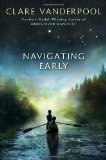
 Navigating Early
by Clare Vanderpool
Delacorte Press, 2013. 306 pages.
Let me say right up front that I don’t review books I don’t like. Navigating Early was a wonderful reading experience.
The book is set shortly after the end of World War II. Jack Baker and his Mom bore up when his Dad had to go to war. But then, at the end of the war, his Mom died in her sleep. Now Jack has been taken far from home in Kansas to boarding school in Maine. His whole world has changed.
Jack is a well-drawn character. The kids he meets at school aren’t intentionally mean; they seem like real kids. Jack often pretends to know about things like rowing that he knows nothing about; that seems realistic, too. Jack meets Early Auden, an autistic boy, before that word was really used. He simply comes across as strange. Early plays records of a different musician on different days of the week. He’s obsessed with the number pi. He’s a demanding coxswain and he knows how to rebuild a boat.
Then it’s fall break, and Jack’s Dad’s shore leave is postponed. Early had already invited him to go on a crazy quest to find the Great Bear of the Appalachian Trail. In a wave of disappointment and loneliness, Jack and Early set out on an epic adventure.
There were quite a few places where I had to stretch my belief a bit. I’ve read Born on a Blue Day, so I could accept that for some people, the digits of pi are like a landscape of colors and shapes. For Early, the digits of pi tell a story. That was a bit of a stretch, but I could believe it.
Then the story Early tells, from the digits of pi, mirrors what happens to the two boys on their quest. That’s a bit of a stretch, too, but I could suspend my disbelief.
The people they met on their quest all seemed pretty eccentric. Nobody asked why they were out in the wilderness on their own. Nobody insisted on taking them back to school. That was a bit of a stretch, but I could accept it.
Lots of different people in the story were dealing with some kind of grief. That was maybe a coincidence, but one that enhanced the story. In fact, the different shades of grief, experienced in the lives of the various characters, was a strength of the book.
What I absolutely could not believe? Well, Early’s obsessed with the number pi, right? Toward the beginning of the book, their math teacher tells them about a man named Professor Douglas Stanton:
He’s a mathematician at Cambridge who is on a quest of his own. He has spent much of his career studying this number and has a theory that, contrary to popular belief, pi is not a never-ending number. That yes, it is an amazing number that has over seven hundred digits currently known, and thousands more that haven’t been calculated yet. But he believes it will, in fact, end.
The fact is, pi was proven in 1761 to be irrational. That means it’s not a matter of “popular belief” that it doesn’t end. It doesn’t end, and mathematicians know it doesn’t end. They have proof. A serious mathematician would never entertain a theory like that with no possibility of it being correct.
It gets worse. At the culmination of the Fall Math Institute at the end of the book, Professor Stanton presents his “proof”:
Professor Douglas Stanton wrote out more than two hundred digits, which he explained, were the most recently calculated numbers of pi. He talked long and loud and wrote lots of symbols and equations on the chalkboard, highlighting the fact that there were no ones in the most recently calculated digits of pi. He explained that, based on this disappearance of the number one, he’d concluded that other numbers would also disappear and that pi would eventually end.
Early ends up refuting this so-called “proof” by showing that the calculations were wrong, and there actually should have been ones in the recently calculated digits.
Okay, this is wrong on many levels. I’ve been told that since pi is infinite, every conceivable sequence can be found among its digits if you go out far enough. There probably is a stretch of 200 digits somewhere that has no ones. And that would not prove anything! And a mathematician would know that it wouldn’t prove anything.
If Early finds an error in a published expansion of pi, great. But that wouldn’t disprove anything, either. The proof that pi is irrational (published in 1761) had nothing to do with its calculated decimal expansion.
Based on the Author’s Note at the end, the author knows that pi is irrational. I simply could not even come close to believing that a respected mathematician would seriously put forth a “proof” or even a conjecture that pi is a rational number. If this had been set in 1700, maybe. Or some alien, medieval-type world. In a historical novel set in 1945? No way.
I’m not sure if I think it’s good or bad that that particular plot point could be completely taken out of the book without any harm to the plot. (And I really don’t think that telling you what happens is a spoiler.)
I am afraid that once I noticed this, it’s bordering on a little obsession for me to point out that it’s incorrect. I suspect it bothers me, with a Master’s in Math, a lot more than it will bother most readers, particularly kids. But that bothers me, too. Mathematicians would never act as this Professor Stanton is portrayed acting, and I feel like it gives mathematicians a bad name. I don’t like kids getting the impression that pi’s irrationality is open to debate or that mathematicians aren’t absolutely certain about it. I would way rather she came up with something mathematicians actually might set out to prove, like the distribution of different digits in the expansion of pi. (How likely is it that a stretch of 200 digits has no ones? Now that’s an interesting question!)
Another question: How much do we hold writers of fiction to the facts? If her presentation of rowing terms were all wrong (I have absolutely no idea if they were or not; I assume they were correct.), would that be considered a flaw in the book? And would I accept the word of an expert who told me it was incorrect? I think this presentation of a mathematician claiming to “prove” pi is a rational number is completely unbelievable (Shall I say “irrational”?) in a book set in 1945. Will those without advanced mathematical training agree with me? Will they take my word for it? I can’t help but think of the much-decorated book The House of the Scorpion, by Nancy Farmer, which had a huge plot point turn on the completely impossible scenario of a clone having the same fingerprints as his “father.” There is absolutely no way that would happen. And how much does a flaw like that affect your opinion of a work of fiction?
Did I mention that the writing is lovely and the characters are well-drawn? Yes, I enjoyed this story. But I was annoyed every time it mentioned the idea that a mathematician thought pi would end. And now I find myself annoyingly obsessed with making sure that people know that WOULD. NOT. HAPPEN!
It’s a good book, though! And, please, tell me what you think. Did this bother you? I’d love to hear from non-mathematically-minded and mathematically-minded alike. Would it not have bothered you if I hadn’t pointed it out? Does it not bother you despite the fact that I pointed it out? I’m really curious if I’m the nutty one here!
Find this review on Sonderbooks at: www.sonderbooks.com/Childrens_Fiction/navigating_early.html
Disclosure: I am an Amazon Affiliate, and will earn a small percentage if you order a book on Amazon after clicking through from my site.
Source: This review is based on a library book from the Fairfax County Public Library.
Disclaimer: I am a professional librarian, but I write the posts for my website and blogs entirely on my own time. The views expressed are solely my own, and in no way represent the official views of my employer or of any committee or group of which I am part.
Please use the comments if you’ve read the book and want to discuss spoilers!
Yes, the business about pi being rational is bothering me a lot as I read the book. It’s not impossible for a mathematician to lose his mind and become convinced of a crank theory. But he would never get it accepted at a conference.
Yeah, obviously that ruined the book for me. I was kind of appalled that it got Printz Honor. It’s a decent story — but No.