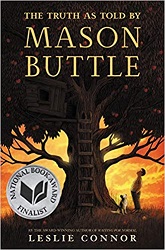
Review of The Truth as Told by Mason Buttle, by Leslie Connor

The Truth as Told by Mason Buttle

by Leslie Connor

Katherine Tegen Books (HarperCollins), 2018. 326 pages.
Starred Review
Review written February 4, 2018, from a book sent by the publisher.
2018 National Book Award Finalist
2019 Schneider Family Award Winner
2018 Sonderbooks Stand-out:
#1 Contemporary Children’s Fiction

Okay, I love this book, and I love Mason Buttle! I’m writing this at the beginning of my Newbery reading year. I may read many more books I love this year, and I may be the only person on the committee who loves this book – but I am so encouraged that such a wonderful book exists.

Mason Buttle is the biggest and tallest kid in seventh grade. And he has a disorder, so he sweats. A lot. And he has dyslexia, so he’s not very good at reading or writing.

As you may guess, a kid like that with a last name like “Buttle,” will get teased a lot, and bullied. But Mason takes it matter-of-factly.

His family’s gone through a lot lately. Mason’s grandpa died. Then his mother was killed in an accident, so only his grandma, Uncle Drum, and Mason are left. And then Mason’s best friend Benny died.

Benny died after he fell from their tree fort when the top rung of the ladder broke. The sheriff keeps wanting to talk with Mason about it. But he interrupts Mason, and it’s hard for Mason to get his words out. Mason has told the sheriff everything he knows.

But there’s a wonderful teacher at school named Mrs. Blinny. (Mrs. Blinny, too, is quirky and wonderfully described.) She’s got a new machine that Mason can talk into – and it will write down his words for him. Now at last, Mason can write his story.

Meanwhile, Mason makes a new friend, Calvin Chumsky. Calvin gets bullied, too. But the two together start a project together and become friends.

That’s only the bare bones of how the book begins. There’s a lot more going on – things with Mason’s family, things at school, the bully’s nice mother and the bully’s nice dog that Mason dog-sits, the family orchard that Uncle Drum has been selling off, and of course the mystery of what really happened when Benny died and why do so many people in town give Mason a sad-to-see-you look?

But Mason isn’t the type to feel sorry for himself. I challenge anyone to read this book and not just love this kid. Here he is in the very first chapter after he misspelled stopped as STOOPID in a spelling bee and someone put a t-shirt with the word STOOPID in his locker.

Matt Drinker loves when something like that happens. That’s why I’m guessing he put this STOOPID shirt inside my locker. He must have picked my lock to do it. Funny thing is I knew what the shirt said because of the two Os in the middle. I knew in two blinks.

Matt doesn’t know it but he did me a big favor. I always take two shirts to school. Unless I forget. I change just before lunch. This is because of how I sweat. It is a lot. Can’t stop it. Can’t hide it. I need to be dry at the lunch table. Otherwise I’m a total gross-out of a kid.

Well, today was a day that I forgot my extra shirt. So I’m wearing this one that says STOOPID on it. It’s big and it fits me. It’s clean and dry. I’m going to keep moving. Maybe nobody will see what it says.

And if they do, well, tell you what. Plenty worse has happened.

leslieconnor.com
harpercollinschildrens.com

Buy from Amazon.com

Find this review on Sonderbooks at: www.sonderbooks.com/Childrens_Fiction/mason_buttle.html

Disclosure: I am an Amazon Affiliate, and will earn a small percentage if you order a book on Amazon after clicking through from my site.

Disclaimer: I am a professional librarian, but I maintain my website and blogs on my own time. The views expressed are solely my own, and in no way represent the official views of my employer or of any committee or group of which I am part.

What did you think of this book?
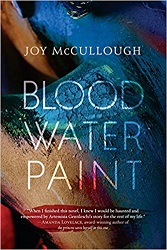
Review of Blood Water Paint, by Joy McCullough

Blood Water Paint

by Joy McCullough

Dutton Books, 2018. 304 pages.
Starred Review
Review written April 16, 2018, from a book sent by the publisher.
2019 Morris Award Finalist
2018 Sonderbooks Stand-out:
#1 General Teen Fiction

Wow. This book is amazing.

Now, the central event of the book is a rape – so I, personally, don’t think that’s “presentation for a child audience” [though that is only my personal opinion and I haven’t discussed it with anyone else on the Newbery committee]. But by the time I figured that out, there was absolutely no way I was going to stop reading.

This is a verse novel, which usually I don’t have a lot of patience with. But this verse spoke with a compelling voice that pulled me in immediately.

We have the perspective of Artemisia Gentileschi, who was seventeen years old in 1611 in Rome. Her mother died when she was twelve. She worked for her father, an artist, grinding pigments, preparing paint – and creating paintings for him, even though they bore his name.

In that world, women were used by men. Her mother had told her stories of the ancient heroines Susanna and Judith – they stood up to men and were vindicated, though it was not easy for them. Those stories, woven through the book, are the only parts that are not written in poetry. Yet they quickly make you feel what it must have been like for those ancient women – in a way that men who have never felt powerless cannot understand.

And then a young man hired to teach Artemisia perspective rapes her. And she tells the world what he did – but the resulting trial comes at great cost to Artemisia.

The powerless woman, used by men, stands up to the powerful, like Susanna and Judith before her. Though none of them spoke up without cost.

And the amazing part is that Artemisia is an actual woman, an artist, and her trial in 1611 actually happened.

Being verse, this book is not long. But its effect is long-lasting indeed.

They tell me I know
about perspective now.
Too well.
They say I’m standing
at the start of a long road,
looking out into the distance.
What do I see?

joymccullough.com
PenguinTeen.com

Buy from Amazon.com

Find this review on Sonderbooks at: www.sonderbooks.com/Teens/blood_water_paint.html

Disclosure: I am an Amazon Affiliate, and will earn a small percentage if you order a book on Amazon after clicking through from my site.

Source: This review is based on a library book from Fairfax County Public Library.

Disclaimer: I am a professional librarian, but I maintain my website and blogs on my own time. The views expressed are solely my own, and in no way represent the official views of my employer or of any committee or group of which I am part.

What did you think of this book?
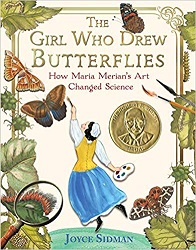
Review of The Girl Who Drew Butterflies, by Joyce Sidman

The Girl Who Drew Butterflies

How Maria Merian’s Art Changed Science

by Joyce Sidman

Houghton Mifflin Harcourt, 2018. 144 pages.
Starred Review
Review written March 7, 2018, from a book sent by the publisher.
2019 Sibert Medal Winner for best children’s nonfiction book of the year
2018 Sonderbooks Stand-out:
#1 Longer Children’s Nonfiction

This book has a prologue, with the heading, “The Girl in the Garden.” Quoting from it will tell you the background of Maria Merian’s life.

A girl kneels in her garden. It is 1660, and she has just turned thirteen: too old for a proper German girl to be crouching in the dirt, according to her mother. She is searching for something she discovered days ago in the chilly spring air. As she combs the emerald bushes, she looks for other telltale signs – eggs no bigger than pinpricks, or leaf edges scalloped by the jaws of an inching worm. . . .

But for years she has gathered flowers for her stepfather’s studio, carried them in, and arranged them for his still-life paintings. She has studied the creatures that ride on their petals: the soft green bodies of caterpillars, the shiny armor of beetles, the delicate wings of moths. She has looked at them closely, sketched and painted them. In learning the skills of an artist, she has learned to look and watch and wonder.

Imagine this girl, forbidden from training as either a scholar or a master artist because she is female. Aware that in nearby villages women have been hanged as witches for something as simple as showing too much interest in “evil vermin.”

Yet she is drawn to these small, mysterious lives. She does not believe the local lore: that “summer birds,” or butterflies, creep out from under the earth. She thinks there is a connection between butterflies, moths, caterpillars, and the rumpled brown cocoon before her, and she is determined to find it.

This is her story.

The biography that follows tells of a woman far ahead of her times. She was both an artist and a scientist. She was an artist because she assisted her father and her husband and learned from them – she wouldn’t have been able to study on her own merits. She was a scientist by virtue of her own patient observations. She learned which caterpillars transformed into which moths or butterflies and which cocoon or chrysalis went with each.

She made her observations known by painting them. She would paint creatures on the same plant where she found them, and she would paint a butterfly with its egg, caterpillar, pupa, and chrysalis in the same picture.

This book is lavishly illustrated with Maria Merian’s own paintings as well as photographs of caterpillars, moths, and butterflies. Quotations from Maria’s writings are included, set off in a box and printed in script. Every spread has something colorful to catch the eye.

The structure of Maria’s biography follows the life cycle of a butterfly, with chapter titles: “Egg,” “Hatching,” “First Instar,” “Second Instar,” “Third Instar,” “Fourth Instar,” “Molting,” “Pupa,” “Eclosing,” “Expanding,” “Flight,” and “Egg” again. Joyce Sidman has written a poem for each chapter, placed next to a photo of a caterpillar or butterfly at that stage.

Maria’s unique combination of observation plus art left a mark that affected scientists after her. After her death, Carl Linnaeus used her book to classify and name more than one hundred insects – names we still use today.

The exquisite paintings and detailed photographs make this a beautiful book worth browsing – even if it weren’t packed with facts about an important scientist, a woman far ahead of her time.

joycesidman.com
hmhco.com

Buy from Amazon.com

Find this review on Sonderbooks at: www.sonderbooks.com/Childrens_Nonfiction/girl_who_drew_butterflies.html

Disclosure: I am an Amazon Affiliate, and will earn a small percentage if you order a book on Amazon after clicking through from my site.

Source: This review is based on a book sent by the publisher.

Disclaimer: I am a professional librarian, but I maintain my website and blogs on my own time. The views expressed are solely my own, and in no way represent the official views of my employer or of any committee or group of which I am part.

What did you think of this book?
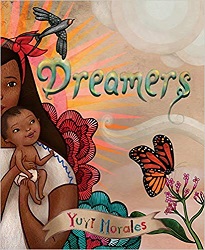
Review of Dreamers, by Yuyi Morales

Dreamers

by Yuyi Morales

Neal Porter Books (Holiday House), 2018. 40 pages.
Starred Review
Review written July 6, 2018, from an advance F & G.
2019 Pura Belpré Illustrator Award Winner
2018 Sonderbooks Stand-out:
#1 General Picture Books

Oh, this is such a gorgeous and timely book.

Mixing English and Spanish (without a glossary), Yuyi Morales tells her immigration story with glorious paintings and collages loaded with symbolism. A note at the back fills in the details.

She came to America with her baby, to get married. She felt bewildered and an outsider. She didn’t understand the language.

But almost the very center spread of the book is the place that changed both her and her child’s lives – the public library.

We see specific books on the shelves, but also wonders pouring out of the books she opens. All the rest of the spreads are about libraries and the wonders of books.

Thousands and thousands of steps
we took around this land,
until the day we found . . .

a place we had
never seen before.
Suspicious.
Improbable.

Unbelievable.
Surprising.

Unimaginable.

Where we didn’t need to speak,
we only needed to trust.
And we did!

Books became our language.
Books became our home.
Books became our lives.

We learned to read,
to speak,
to write,
and
to make
our voices heard.

The text alone doesn’t do this book justice. The joy of the mother and child as the world and imagination opens up is glorious to behold.

In the note, where she fills in details of her story, she explains that her child was not a Dreamer in the political way the word is used today, about undocumented immigrants brought to the United States as children.

Kelly and I were Dreamers in the sense that all immigrants, regardless of our status, are Dreamers: we enter a new country carried by hopes and dreams, and carrying our own special gifts, to build a better future. Dreamers and Dreamers of the world, migrantes soñadores.

Now I have told you my story. What’s yours?

She includes a list of books that inspired her at the back.

Oh, such a lovely book! And it doesn’t hurt that it’s a song of thanks to libraries.

HolidayHouse.com

Buy from Amazon.com

Find this review on Sonderbooks at: www.sonderbooks.com/Picture_Books/dreamers.html

Disclosure: I am an Amazon Affiliate, and will earn a small percentage if you order a book on Amazon after clicking through from my site.

Source: This review is based on a library book from Fairfax County Public Library.

Disclaimer: I am a professional librarian, but I maintain my website and blogs on my own time. The views expressed are solely my own, and in no way represent the official views of my employer or of any committee or group of which I am part.

What did you think of this book?
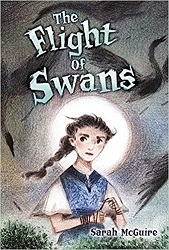
Review of The Flight of Swans, by Sarah McGuire

The Flight of Swans

by Sarah McGuire

Carolrhoda Books, 2018. 441 pages.
Starred Review
Review written August 30, 2018, from a book sent by the publisher
Mock Newbery winner at City of Fairfax Regional Library
2018 Sonderbooks Stand-out: #1 Children’s Fiction – Fantasy

Wow. Most of my readers know I love fairy tale retellings – this is a wonderful one, completely pulling me into the fantasy world, getting my very heart beating along with the protagonist, who tried to be silent for six years.

The fairy tale it’s retelling is the Grimm tale, “The Six Swans.” That was never my favorite fairy tale – but I think it’s interesting that my favorite fairy tale retelling for adults, Daughter of the Forest, is based on the same tale. This version is written for children, and doesn’t have quite as brutal things happen to the silent sister, but it’s equally powerful.

I reread the fairy tale after reading this book, and almost wish I hadn’t. The author retained the main elements – six older brothers turned into swans by the witch who enchanted and married the princess’s father, and she has to stay silent for six years, while knitting them shirts made out of nettles. But oh! The way she tells the story! I want to start reading it all over again. I’m actually a bit resentful that I need to keep reading other books. But the Newbery process being what it is – I know that I will read this book more times, and that’s a comfort to me.

Okay, I should tell about the book, not just rave about how good it is.

The book begins with Andaryn trying to fight her father’s enchantment:

The exile of the princes of Lacharra didn’t begin with swords or spells.

It began inside the castle kitchen with a quest for cloves.

It began with me.

Cooks mistrust anyone with empty hands, so I darted to the nearest table and snatched up a bowl of chopped leeks. Then I shouldered between scullery maids and undercooks as I moved toward the spice pantry.

Perhaps I was foolish. Maybe Father was just sick after being lost so many weeks in the forest. Maybe it was normal for a man newly married to hardly speak to the daughter he’d loved –

Then I remembered last night: Rees, the stable master, and the stable boy being beaten while Father looked on with empty eyes.

Something had happened to Father in the forest. He never would have allowed a beating for violating such a small edict, even if the woman he’d married had issued it.

Whatever she banned must be important – even if it was something as simple as cloves.

Andaryn secures some cloves and brings her father out of the enchantment – for a little while. But the Queen comes upon them together and quickly destroys Andaryn’s efforts. When Andaryn breaks the glamour her six older brothers feel for the Queen, her victory doesn’t last. The Queen locks them up, burning down the oldest brother’s castle with the brothers locked in the dungeon.

Andaryn bargains for their lives with her silence.

Finally, she spoke. “It would be a great sacrifice to release your brothers. I would expect something great in return: one year of silence for each of them. Not a word spoken,” she raised a finger, “and not a word written, either, for a word that’s written can be spoken. The moment you consent is the moment they are free.

Andaryn consents, and the Queen does set them free – but turns them into swans. They will take human form again only on the night of the full moon each month.

And so begins Andaryn’s journeys, in silence. It turns out it’s not enough to find a place to shelter, because the Queen sets otherworldly Huntsmen out after her.

The journeys aren’t as solitary as in the fairy tale, for her oldest brother’s wife accompanies Andaryn for some of the years. And there is a child to tend, as in the fairy tale – but the baby is her oldest brother’s son, the heir of the kingdom. And yes, the princess is discovered by the king of another country, but she still can’t speak.

Andaryn starts out as a 12-year-old determined princess. She ends the book as an 18-year-old young lady who has learned to be strong as steel through her suffering. A magnificent story.

lernerbooks.com

Buy from Amazon.com

Find this review on Sonderbooks at: www.sonderbooks.com/Childrens_Fiction/flight_of_swans.html

Disclosure: I am an Amazon Affiliate, and will earn a small percentage if you order a book on Amazon after clicking through from my site.

Source: This review is based on a library book from Fairfax County Public Library.

Disclaimer: I am a professional librarian, but I maintain my website and blogs on my own time. The views expressed are solely my own, and in no way represent the official views of my employer or of any committee or group of which I am part.

What did you think of this book?
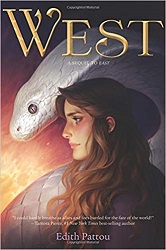
Review of West, by Edith Pattou

West

by Edith Pattou

Houghton Mifflin Harcourt, 2018. 514 pages.
Starred Review
Review written October 13, 2018, from a book sent by the publisher.
2018 Sonderbooks Stand-out: #1 Speculative Teen Fiction

I was so excited when I found out West was coming out! I still remember, approximately 15 years ago when I was working at Sembach Library and a shipment of new books came in that included East, by Edith Pattou and The Goose Girl, by Shannon Hale – two fairy tale retellings that ended up being my two favorite books of the year. I ordered my own personal copy of both of them, I liked them both so much. The Goose Girl has become the start of an entire series since then, but this is the very first follow-up to East.

Since this is my Newbery committee year, I didn’t get to reread East before reading West as I would have liked to do. But I remembered the basics, from the fairy tale “East of the Sun, West of the Moon.” Rose went off with a white bear to save her family, but used a candle to try to see his face and then had to travel east of the sun, west of the moon. In the end, she had to defeat the Troll Queen in order to save him. They were supposed to live happily ever after.

But in this book, we learn that the Troll Queen is not dead. And she’s ready to get revenge, not only on Rose and Charles, but on the entire human race.

Like the fairy tale it all began with, this book is something of a saga. Rose and Charles now have a baby boy and an adopted daughter. As the book begins, Rose was visiting her family in Trondheim while Charles was performing as a court musician in Stockholm. But word comes that there has been a shipwreck of the ship Charles was taking home. There’s something off about the report.

In this book, it’s very much a case of one thing leading to another. Rose ends up taking a journey every bit as taxing as the one that took her east of the sun, west of the moon. Again her quest requires ingenuity, perseverance, and resourcefulness.

But it also requires help from others. Once she finds Charles (that’s the first difficult part), he helps. But so do her brother Neddy and her friend Sib, and so does Estelle, the little girl they adopted, who is kidnapped by the Troll Queen along with their son and watches over him. It turns out she also needs help from the Fates themselves.

The journey takes Rose in every direction on the compass in her quest to save her beloved husband, then her son, and even all humankind.

The Troll Queen is a formidable opponent and frightening in her power and her hatred. But Rose has something stronger in the power of love.

This is another gripping adventure saga with all the resonance of a fairy tale.

edithpattou.com
hmhco.com

Buy from Amazon.com

Find this review on Sonderbooks at: www.sonderbooks.com/Teens/west.html

Disclosure: I am an Amazon Affiliate, and will earn a small percentage if you order a book on Amazon after clicking through from my site.

Source: This review is based on a library book from Fairfax County Public Library.

Disclaimer: I am a professional librarian, but I maintain my website and blogs on my own time. The views expressed are solely my own, and in no way represent the official views of my employer or of any committee or group of which I am part.

What did you think of this book?
2018 Sonderbooks Stand-outs

Announcing the 2018 Sonderbooks Stand-outs!

This year, I’ve got to explain myself. Most years I post my Stand-outs from all the books I read the previous year on January 1st. But this year, I was on the 2019 Newbery Committee, and could not say one word about eligible books online until after our announcement was made.

I did, however, make my list of stand-outs on January 1st. So this list was made before I had discussed any books with the committee or even reread very many — after which, I gained new appreciation for many of them and noticed new drawbacks in others. Thus, the opinions are mine and mine alone. And I was only one-fourteenth of the committee.

Also, please don’t think that you can figure out from this list which books I nominated or voted for when the committee met. I’m making absolutely no claim that these books are the most distinguished books of 2018. These are simply my personal favorites after a year of reading — the books that stood out in my mind after reading like never before, and the books that won a place in my heart, even though they might have some flaws that would keep them from being declared to have the most literary merit.

I’m posting more Stand-outs this year than ever before. That’s because I read more books than ever before! In fact, I made more categories than ever before, the better to honor more books. I’m of the Spread the Book Love Around persuasion, so I like to honor lots of books — but this is still only a small fraction of the books I read this year.

In fact, as usual, I’ll post my stats. In 2018, while serving on the Newbery committee, I read:

4 novels for adults (all on audiobook)
38 nonfiction books for adults (some on audiobook)
49 novels for teens
174 children’s novels
207 books of children’s nonfiction (many picture books among them)
595 fiction picture books
13 books reread

So you can see I’m actually being very choosy in naming all these Stand-outs!

And I highly recommend every single one of these books.

Here’s the list of 2018 Sonderbooks Stand-outs!

Of course, not all the books will be reviewed on the day I post this, since I also couldn’t post any reviews until after our announcement was made. My plan is to keep posting reviews of these books until I have them all posted — then start in on posting 2019 reviews, but fill in with 2018 reviews as needed. Since I have 314 reviews of 2018 books not yet posted (That was how I took notes on the first reading of books), I will not lack for reviews for a long time to come!

So if you want to read reviews of all these Stand-outs, just keep checking back for the next few weeks. I think you’ll find books you’ll enjoy very much!

2018 Sonderbooks Stand-outs and Newbery Notes

It’s time to post my 2018 Sonderbooks Stand-outs! *Here’s the link added later: 2018 Sonderbooks Stand-outs*

It’s time — but I’m not going to do it!

I’m on the 2019 John Newbery Medal Selection Committee — and I can’t say one word about eligible books until after our winner is announced on January 28, 2019.

I am compiling my list today, though — so you can be absolutely sure that the choices reflect my opinion only and not the opinion of anyone else on the committee.

The list will also just be a ranking of how much I, personally, enjoyed the book, and not a ranking of how I distinguished I think the book is. They are two different things. I will stress that again when I post the Stand-outs. I can say even now that the order of the Stand-outs does not reflect my nominations or my votes for the Newbery.

I also will break the children’s books into categories — for example contemporary fiction, historical fiction, and speculative fiction, so I don’t have to compare as many books with each other.

But they are about spreading the word about good books! I have read so many, many wonderful books that we will not be able to honor!

In fact, I’ve written 315 reviews of eligible books that I haven’t been able to post. I hope to get them posted, eventually, after the Newbery is announced. After all, this year, I’ve been able to catch up on posting reviews from 2016 and 2017 that I hadn’t gotten posted yet. Or at least I’ll be caught up after posting 18 more reviews.

But let me give the numbers for my 2018 calendar year of reading. I was reading for the Newbery, so not too many adult books. I did read:

4 novels for grown-ups (all on audiobook)
38 nonfiction books for adults or young adults
49 novels for teens
174 books of children’s fiction
207 books of children’s nonfiction (many of those picture books)
595 picture books
13 books reread

My Newbery totals have been somewhat different. I began reading in 2017. And I only counted eligible books — which means a lot of picture books in translation were left out. The Newbery totals so far, counting books I reread in with the total are:

904 books read, 592 of them being picture books, for a total of 102,390 pages read, with 22,168 of those pages coming from picture books.

Now that it is 2019, a few friends mistakenly asked me about things winding down — again, they are not winding down but still ramping up.

I have 24 days before our discussion begins on January 25. The room is reserved for us from 8 am in the morning to 10 pm at night on both Friday and Saturday. Much shorter on Sunday, only 8 am to 10 am. We’re going to call the winner on 6 am on Monday morning, January 28, and the announcement ceremony happens at 8 am.

Now I am only reading nominated books (so I can’t just read 96 more picture books to get my total to 1,000). What I very much want to do is reread all the nominated books and take detailed notes and plan out what I think the strengths and weaknesses are.

I can’t tell how many books are nominated — it’s all top secret — but I will confess that there are more than 24. So realistically, I will probably not be able to reread them all as carefully as I would like to. I’m going to have to prioritize.

A fun thing about this stage of the process is how much you notice about books the second or third time through. You really do notice the strengths and weaknesses with fresh eyes. You begin to see all the craft that went into writing the book.

Anyway, it has been a wonderful ride… and I’d better get back to it!

Review of How to Improve Your Marriage Without Talking About It, by Patricia Love and Steven Stosny

How to Improve Your Marriage Without Talking About It

Finding Love Beyond Words

by Patricia Love, EdD, and Steven Stosny, PhD

Broadway Books, 2007. 224 pages.
Starred Review
2007 Sonderbooks Standout: #1, Relationships

Okay, why am I reviewing a book about marriage today, when I’ve been divorced for 8 years, separated for 13 years, and with no prospects or evidence that I’ll ever marry again, besides being too busy reading for the Newbery committee to do any dating – or to have time for more than one book for adults at a time?

Well, I’m not sure I completely know the answer to that. It’s partly that it’s a Steven Stosny book. I’d recently reread some others, and they’re so full of wisdom. I’ve also spent a lot of time alone while doing so much reading – but since I don’t have time to date, maybe reading about marriage satisfies a little bit of that loneliness. I’m hoping I can learn some things while my emotions aren’t invested and busy triggering and blinding me – so maybe I won’t make the same mistakes the next time.

This book also has some super interesting things to think about, many ideas about men and women and how we respond and think differently. Everything they say about women rings true, so I suspect what they say about men is also true, and I’m still hoping I’ll absorb some of that.

Besides, the first time I read this book, when I still hoped against hope that my own marriage would be healed, I was taking grad school classes for my Master’s in Library Science, and didn’t have time to write or post a review. When I named it as a 2007 Sonderbooks Standout, I promised to write a review some day. So I’m finally keeping that promise for this book!

Besides, it’s an outstanding book! I read it too late to help my marriage, but I will always wonder if I’d read it sooner and tried some of these things, if something might have changed. As it is, if there’s anyone I can point to this book before it’s too late, that would be a wonderful outcome of writing this review, and nothing would make me happier.

The main premise of the book is similar to the book Love and Respect, by Emerson Eggerichs, which says that a man’s deepest need is respect and a woman’s deepest need is love. Or John Eldredge’s books, as in the book Captivating, that says women need to answer the question, “Am I lovely? Am I worthy of love?” and men need to answer the question, “Do I have what it takes?”

But Doctors Love and Stosny take a different approach. And those books I mentioned are from a Christian perspective and refer to the Bible to make their points. This is a secular book and refers to research, but I think it’s the flip side of the same ideas.

They say that a woman’s deepest vulnerability is fear, and a man’s deepest vulnerability is shame.

Most of the book is about how this falls out and how we can overcome it and use these vulnerabilities to connect rather than resent each other. But let me also talk about the promise in the title – these methods do not require lots of talking about it or building your “communication skills.”

They are not disconnected because they have poor communication; they have poor communication because they are disconnected.

The ideas for connecting are excellent – I wish I could try them out! But what’s helpful for me and can teach me even when I’m not in a relationship is better understanding a man’s perspective, better understanding what things I do that would trigger shame in my partner – despite my best intentions.

I was really surprised by the idea that a woman sharing unhappiness with her husband can make him feel like he’s failing to protect her or she doesn’t appreciate all she does.

Women build alliances with other women by doing what they learned in early childhood: exposing vulnerability. Marlene doesn’t have to mention to her girlfriends that she feels sad, unhappy, lonely, or isolated. They infer it from her body language or tone of voice, just as she can tell if something is wrong with them. As soon as one woman senses a friend in emotional need, they become more interested and emotionally invested in each other. But what do you think happens when Marlene tells Mark that she feels bad? (She has to tell him – his defense against feeling failure and inadequacy has blinded him to her emotional world by this time.) You guessed it – once she forces him to face her vulnerability, he feels inadequate as a protector. He responds with typical shame-avoidant behavior: impatience, distractedness, defensiveness, resentment, anger, criticism, or “advice” that sounds an awful lot like telling her what to do.

Here’s why talking doesn’t help:

One reason that talking about your relationship has not helped is that fear and shame keep you from hearing each other, regardless of how much “active listening” or “mirroring” you try to do. The prerequisite for listening is feeling safe, and you cannot feel safe when the threat of fear or shame hangs over your head. The threat is so dreadful that the limbic system, the part of your brain in charge of your safety, overrides any form of rational thinking. Almost everything you hear invokes fear or shame.

This is also why things sometimes change drastically when a couple gets married. Or why someone outside the marriage suddenly seems much more understanding. If a male friend talks about quitting his job and starting a business, I might admire him for his vision, for living out his principles. But if my husband does that? Oh, you can be sure my fears will get triggered! And if I express my concerns or start asking questions, “Have you thought about this….?” or offering suggestions or even criticism – You better believe I’ll be triggering his shame. [I can’t even begin to express what a comfort it was to me that when my then-husband retired from the military and was looking for a job, I was not in his life and was not in a place to give any input whatsoever. I could all too easily imagine how those conversations would have gone. This book explains why.]

This dynamic is explained in a chapter addressed to men. Again, I hadn’t realized how much a man’s identity is tied to making his wife happy – in a way that’s not as true when they are dating.

There was a time when your partner, before she was your partner, talked to you about various things that made her feel anxious or insecure. You most likely responded with a sense of protectiveness. You knew intuitively that she was upset. If she felt disregarded, you paid more attention to her. If she felt unimportant, you showed her that she was important to you. If she felt accused, you reassured her. If she felt guilty, you helped her feel better. If she felt devalued, you valued her more. If she felt rejected, you accepted her; if she felt powerless, you tried to empower her; if she felt inadequate, you helped her appreciate her competence; and if she felt unlovable, you loved her more. You did all this out of a natural desire to protect the person you loved.

You fell in love because you were able to connect, and you were able to connect because you felt protective. It started to go wrong when you began to see your impulse to take care of her, which made you feel great while dating, as costing too much time or money in a committed love relationship. You probably had good reasons for starting to feel that way, but as long as you feel that way, you will not find viable solutions to time and money problems. In other words, things will certainly get worse until you decide to be protective of your partner’s fear as you used to be; and in the long run, this will cost far less in time and money than a disconnected relationship and divorce.

Of course, this switch in how you reacted to her anxiety was confusing to her, to say the least. She was doing the same thing that used to invoke your protectiveness – worrying or expressing needs – but now she provoked your anger and resentment. It’s as if once you got married you expected that she would never again feel bad, or at least not show that she did. When she did show it, you interpreted her complaints as an indictment of your failure as a provider.

There’s a lot more about how things break down. Before rereading this, I would have said – no, I have actually said – that I don’t have much of a problem with fear.

But I came to see that I work so hard at managing my fear, I’m not even conscious of it. That’s what was going on when I’d give my husband career advice, or over-manage one of the many times we moved. That may be behind my tendency to plan way ahead, to over-pack for trips. I can so easily visualize every What-if scenario. And of course there’s physical fear. Women are trained from childhood not to go for a walk alone at night, for example. I am smaller than most adults, and there’s some fear that comes with that. I plan around it.

And of course the deepest fear is of not being loved, and ending my life alone and abandoned. When that fear’s triggered – well, is it any wonder your partner might feel like you don’t trust him as a lover? Once his shame is triggered, if he withdraws to feel better, my fear’s going to increase, and so on.

But the main thrust of this book is about overcoming those vulnerabilities, seeing your partner’s perspective, and being able to connect. Besides all the insights, there are some wonderful techniques that can build your connection to each other and remind you of your love for each other. Like I said, I really hope I get a chance some day to try these techniques out!

Here’s the last paragraph in the book:

The most profound moments between two people occur when their emotions resonate, soothing their different vulnerabilities and raising their hearts to simple enjoyment. When emotional connection goes deeper than talking, women overcome the stifling limitations of their anxieties, and men abandon destructive shame-avoiding behavior. The best protections from fear and shame are compassion, appreciation, and a sense of connection that is so deep, flexible, and resilient that it creates love beyond words.

I like that the title doesn’t say anything about fixing a bad marriage. This book offers a way to improve your marriage. Even good marriages can stand a little improvement! I hope some of my friends will try it out! And I will plan to reread it if I ever get married again. Until then, I’ve got some food for thought, and I’m mulling over what parts of my life are affected by fear I didn’t even realize I had.

Buy from Amazon.com

Find this review on Sonderbooks at: www.sonderbooks.com/Nonfiction/how_to_improve_your_marriage.html

Disclosure: I am an Amazon Affiliate, and will earn a small percentage if you order a book on Amazon after clicking through from my site.

Source: This review is based on a library book from Fairfax County Public Library.

Disclaimer: I am a professional librarian, but I maintain my website and blogs on my own time. The views expressed are solely my own, and in no way represent the official views of my employer or of any committee or group of which I am part.

What did you think of this book?
Review of Grand Canyon, by Jason Chin

Grand Canyon

by Jason Chin

A Neal Porter Book (Roaring Brook Press), 2017. 48 pages.
Starred Review
2017 Sonderbooks Stand-out, #4 Children’s Nonfiction

Here’s a stunningly illustrated and meticulously well-presented story of the ecology, geology and history of Grand Canyon.

First, the book explains that there are different ecological communities in different levels of the canyon. Then it also talks about the many different rock layers in the canyon.

Then we’re taken with a father and daughter on a hike through the different layers and different ecological communities. All around the borders, we’ll see drawings of different animals and plants that inhabit that layer.

But the most striking part about each layer is a cut-out window showing a fossil or rock found today – and when you turn the page, you see that thing in its habitat when the fossil was formed.

For example, the girl sees a fossil of a Trilobite in a rock today, then turning the page takes her back in time, under the sea, where Trilobites roamed the sea floor. Later the girl sees fossil footprints, and then in the past, she sees a lizard walking over windswept dunes and leaving those footprints.

It’s an interesting and imaginative way of presenting the material and is striking and easy to understand. There’s a fold-out spread with a panorama of Grand Canyon, and 8 pages of more details at the back of the book.

This is a fact-filled, gorgeously illustrated book that will reward multiple rereadings.

mackids.com

Buy from Amazon.com

Find this review on Sonderbooks at: www.sonderbooks.com/Childrens_Nonfiction/grand_canyon.html

Disclosure: I am an Amazon Affiliate, and will earn a small percentage if you order a book on Amazon after clicking through from my site.

Source: This review is based on a library book from Fairfax County Public Library.

Disclaimer: I am a professional librarian, but I maintain my website and blogs on my own time. The views expressed are solely my own, and in no way represent the official views of my employer or of any committee or group of which I am part.

What did you think of this book?