Review of Call the Midwife, by Jennifer Worth

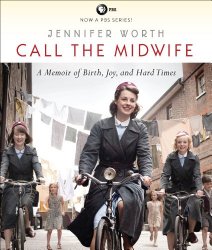
call_the_midwife_largeCall the Midwife

A Memoir of Birth, Joy, and Hard Times

by Jennifer Worth
read by Nicola Barber

HighBridge Audio, 2012. Book originally published in 2002. 12 hours on 11 CDs.
Starred Review
2014 Sonderbooks Stand-out, #9 Nonfiction

I’ve been watching the BBC series Call the Midwife on DVDs from the library. When I watched the special features after the second season, they mentioned how the producer had loved the book when she read it, and decided then and there to make it into a series. That was enough recommendation for me!

Indeed, I found the book just as charming as the television series. Mind you, they romanticized some things in the series. I was a little disappointed not to hear about any romance with Jimmy. And if Chummy has a romance with the police officer she ran down on the bike, it hasn’t happened yet. But in some ways, it’s more interesting, because it’s all true.

Jennifer Worth was a midwife in the East End of London in the 1950s. It was the beginning of the National Health Service, and in the past, pregnant women were dealt with by amateurs and charlatans, with a lot of deaths. As it is there’s plenty of poverty and eye-opening situations, and they make riveting listening.

There’s the family with 24 children, whose mother does not speak English. There’s the young immigrant girl from Ireland who got tricked into prostitution. And especially lovely are the nuns whom Jennifer works with. (I liked being able to picture them from the TV series. The reader did a great job with their different voices.)

Mind you, this is not family listening. The part where she describes the past of the young prostitute is particularly graphic. However, it also includes more about the restoration of Jennifer’s faith than the series does. The author clearly had a deep love for the people of the East End and communicates that love to the listener. I was happy to see that my library owns two more volumes on audio CD.

highbridgeaudio.com

Buy from Amazon.com

Find this review on Sonderbooks at: www.sonderbooks.com/Nonfiction/call_the_midwife.html

Disclosure: I am an Amazon Affiliate, and will earn a small percentage if you order a book on Amazon after clicking through from my site.

Source: This review is based on a library audiobook from Fairfax County Public Library.

Disclaimer: I am a professional librarian, but I maintain my website and blogs on my own time. The views expressed are solely my own, and in no way represent the official views of my employer or of any committee or group of which I am part.
Review of The Periodic Table: A Visual Guide to the Elements, by Paul Parsons and Gail Dixon

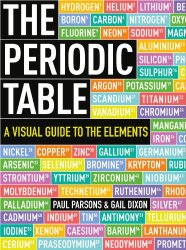
periodic_table_largeThe Periodic Table

A Visual Guide to the Elements

by Paul Parsons & Gail Dixon

Quercus Editions, Ltd, 2014. First published in the United Kingdom in 2013. 240 pages.
Starred Review
2014 Sonderbooks Stand-out, #10 Nonfiction

One look at this beautiful book, and I had to read it. I had no idea I was interested in the chemical elements until I saw this book!

The book consists of a brief introduction, and then a one-page explanation (in a few cases more pages) of each of the first 100 elements in the periodic table, with a large photograph of something related to the element on the facing page. In most cases, it’s a picture of the element, but also includes things like a picture of the atomic bomb dropped over Nagasaki next to Plutonium, a krypton-gas discharge lamp next to Krypton, and a bone scan next to Technetium.

At the beginning of each element’s page, we see its place in the periodic table, its category, atomic number, atomic weight, color, phase, melting point, boiling point, crystal structure, and a diagram of its electrons.

I read this book slowly, an element per day – and found it consistently fascinating. I’m not sure how much of the information stuck, but something about the big beautiful pictures made it seem so much more alive than high school chemistry class (which I loved, but this was very different).

quercus.com

Buy from Amazon.com

Find this review on Sonderbooks at: www.sonderbooks.com/Nonfiction/periodic_table.html

Disclosure: I am an Amazon Affiliate, and will earn a small percentage if you order a book on Amazon after clicking through from my site.

Source: This review is based on a library book from Fairfax County Public Library.

Disclaimer: I am a professional librarian, but I maintain my website and blogs on my own time. The views expressed are solely my own, and in no way represent the official views of my employer or of any committee or group of which I am part.

Review of Trees Up Close, by Nancy Ross Hugo and Robert Llewellyn

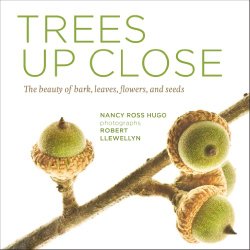
trees_up_close_largeTrees Up Close

The Beauty of Bark, Leaves, Flowers, and Seeds

by Nancy Ross Hugo
photographs by Robert Llewellyn

Timber Press, Portland, 2014. 200 pages.
Starred Review
2014 Sonderbooks Stand-out, #4 Nonfiction

When I checked out this book, it looked familiar. Sure enough, the copyright page states, “This work incorporates portions of Seeing Trees copyright 2011 by Nancy Ross Hugo and Robert Llewellyn.” Back in 2011, I checked out Seeing Trees and liked the look of it so much, I bought myself a copy. Well, the book is extra large format and heavy and doesn’t fit nicely into my daily reading piles.

Seeing Trees, on the other hand, is paperback and a smaller seven-inch square. I ended up reading a chapter a day most days and being completely enchanted. I would like to take it outside with me and look much more closely at the trees in my neighborhood and by my lake. Though I will probably instead settle for looking at the trees which I can see out my window and learning what the things I see actually mean.

In fact, reading this book has gotten me taking far more pictures of bare branches in my walks by my lake. And now I’m noticing that each tree is different.

Normally, I’ve always thought that winter is not the time to notice trees. After all, they’re dormant then. What is there to see when a tree has no leaves?

Nancy Ross Hugo and Robert Llewellyn have now taught me otherwise. Here’s a bit from the chapter on “Buds & Leaf Scars”:

When most of us think of buds, we think of spring phenomena — and usually in association with garden flowers. But tree buds, which contain embryonic leaves, stems, and flowers, are usually formed the summer before they grow into the forms they take each spring, and winter is one of the best times to view them.

During the summer and fall, tree buds grow to a certain size then stop, or rest, for the winter. At that stage, these winter or resting buds, as they are called, remind us that life hasn’t fled the body of a leafless tree — it’s just in waiting, and the shapes of next year’s leaves and flowers are already programmed into its buds. Resting buds also provide one of the best ways to identify trees in winter, because their designs are unique to each species.

I found even the Introduction to the book inspiring:

Instead of traveling thousands of miles to see exceptional trees, as we had for our first collaboration, Bob and I decided to focus on the exceptional traits of ordinary, backyard trees. We did little traveling (unless you count walks around our own yards and neighborhoods), but we were no less impressed by what we saw. In fact, limiting the descriptions and illustrations of what we saw became harder than finding interesting tree traits to feature.

Our goal in creating this book was to share the beauty of what we discovered and to get other people outdoors searching for tree phenomena like the ones we observed, because what is startling in Bob’s photographs is infinitely more inspiring outdoors, where it can be appreciated in context and with all the senses. And it is in the process of discovering these phenomena in nature that the real joy of tree-watching resides. We want to convey that tree-viewing can be as exciting as bird-watching (perhaps even more exciting, if trees are your favorite wild beings) and that through intimate viewing, one’s sense of trees as living, breathing organisms, as opposed to inanimate objects, will be enhanced.

Above all, like most writers and photographers who value what they describe and illustrate, Bob and I hope this book will help make the world safer for trees. In my most romantic imaginings, I sometimes think that if I could just draw enough people’s attention to the beauty of red maple blossoms, the extraordinary engineering of gumballs, the intricacy of pine cones — all would be well in the tree world. That is a romantic notion. But sometimes romance can accomplish what rhetoric cannot. Look carefully at the hair, veins, pores, and other wildly vivifying tree characteristics captured in the photographs in this book, and you’ll never see a tree in the same way again.

Indeed, the authors have changed what I see when I walk among trees. And I’m thankful for it.

The meat of this book is the photographs — up close, stunning photographs of many different types of trees. There are five chapters — Leaves, Flowers & Cones, Fruit & Seeds, Buds & Leaf Scars, and Bark & Twigs. Each chapter has a short text that explains what you’re looking at for this part of a tree. Then many pages of photographs give you concrete examples of what this means, and show you the variation between different types of trees.

Since so much of reading this book is absorbing the stunning pictures, and since it comes in such a convenient size, it was easy to finish this book at the rate of a chapter a day. However, I will be thinking about the things I learned for the rest of my life, every time I go outside.

nancyrosshugo.com
robertllewellyn.com
timberpress.com

Buy from Amazon.com

Find this review on Sonderbooks at: www.sonderbooks.com/Nonfiction/trees_up_close.html

Disclosure: I am an Amazon Affiliate, and will earn a small percentage if you order a book on Amazon after clicking through from my site.

Source: This review is based on a library book from Fairfax County Public Library.

Disclaimer: I am a professional librarian, but I maintain my website and blogs on my own time. The views expressed are solely my own, and in no way represent the official views of my employer or of any committee or group of which I am part.

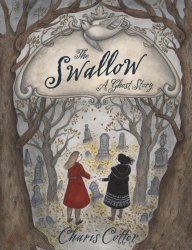
Review of The Swallow, by Charis Cotter

swallow_largeThe Swallow

A Ghost Story

by Charis Cotter

Tundra Books, 2014. 318 pages.
Starred Review
2014 Cybils Finalist, Speculative Fiction for Elementary and Middle Grades
2014 Sonderbooks Stand-out, #11 Children’s Fiction

I don’t think of myself as liking ghost stories, but this didn’t feel like a typical ghost story to me. This is a cozy friendship story and a girl-in-a-big-family-finding-a-friend story.

Sections in this book alternate between the voices of Polly and Rose. Their houses are next door to one another, and it turns out that their attics adjoin. The houses overlook the cemetery.

Rose has always been able to see ghosts, and she hates it. Polly has always wanted to see a ghost, and she isn’t sure that Rose isn’t one herself. She’s so pale and otherworldly.

Polly says:

I’ve always wanted to see a ghost. More than anything. I keep watch at my window for hours, I go for walks in the cemetery almost every day after school and I read all the ghost books I can find at the Parliament Street Library.

Rose says:

I never want to see a ghost again. I’m sick of it. Ladies all in white who follow me down the street, sad men in suits who sit at the back of the bus, children in nightgowns floating out hospital windows – I wish they would all disappear.

Rose hasn’t seen any ghosts, for some reason, since her hospital stay a few months ago. But then, when she hears Polly through the wall of her attic, she thinks they’re back. Polly, after hearing Rose’s voice, thinks she’s finally met a ghost.

Rose says,

I felt sick to my stomach. I was not used to invisible ghosts. And I certainly was not used to ghosts that talked so much. Especially out loud.

My heart sank. I hadn’t seen one ghost since I’d got home from the hospital, and I had really hoped they were gone forever. And now here was a ghost, right in my attic, in my own special nest. Where one came, the rest would follow, and I just knew I’d go stark raving mad if I couldn’t keep them away from me.

“Tell me,” said the ghost, “did you die a horrible death? Are you doomed to wander the ghostly regions between the land of the living and the life beyond?”

“Stop playing games,” I said. “You know I’m not a ghost. You’re the ghost, and you’re pretending to think I’m a ghost to drive me crazy. It isn’t going to work. Go away. All I want to do is sit in my attic and read my books and sing my songs in peace. Is that too much to ask?”

“Do ghosts read?” asked the ghost. “That’s very interesting. Do you have to turn the pages or can you sort of absorb the story by holding the book and pulling the words into your head?”

“I – am – not – a – ghost!” I said slowly and firmly. “Ghosts don’t read! They’re ethereal. They haunt people. They follow them down the street, they watch them when they’re doing their homework, they lurk behind gravestones, they hide in people’s attics –“

“For someone who says they’re not a ghost, you seem to know an awful lot about them,” said the ghost.

I opened my mouth but no words came out. This was the most infuriating ghost I had ever met.

I love the part – in the next chapter – where they figure out what’s actually going on. Rose had gotten frustrated and shouted out, “MY NAME IS ROSE MCPHERSON AND I LIVE AT 43 CEMETERY LANE AND I AM TWELVE YEARS OLD AND I AM NOT DEAD!”

She continues:

It felt good to lose my temper. I made a lot of noise, but the ghost didn’t seem at all put out.

“Wait. Where did you say you live?” she asked calmly.

“43 CEMETERY LANE!” I repeated.

Silence.

“Hit the wall again,” suggested the ghost.

THUMP.

“Umm . . . Ghost?” she said.

“My name is Rose!”

“Ummm . . . Rose?” she said.

“What?”

“I live at 41 Cemetery Lane. Next door.”

It took me a minute to figure it out. “You mean you’re in your own attic? On the other side of the wall?”

“Yes,” replied the ghost. “I guess you’re not a ghost after all.” She sounded disappointed.

“But why is it I can hear you so clearly?” I asked. “As if you were right here beside me?”

“I am right here beside you,” she said, starting to tap against the wall. “This wall must be really thin, not like the brick wall downstairs.”

“That must be it,” I said. A great feeling of relief swept over me and I spoke without thinking. “So you’re not a ghost either. You must be one of the dreadful Lacey children who live next door.”

“Who says we’re dreadful?” asked the girl.

Oops. “Um – my mother.”

“Oh,” said the girl. “Well – she’s right. We are.”

The girls agree to meet in the cemetery – and then find a grave with Rose’s name on it. Rose is convinced she’s not a ghost, but who is Winnifred Rose McPherson, who died at twelve years old, 40 years earlier?

The girls build a friendship. They research this other ghost. And then they find a way to go secretly into each other’s attics. But Rose’s home does have a ghost – and she’s angry, and doesn’t seem to want Polly to go into her attic.

This book is indeed a ghost story – but it’s also a friendship story, and a story that warmed my heart, despite the ghostly chill.

chariscotter.com
tundrabooks.com

Buy from Amazon.com

Find this review on Sonderbooks at: www.sonderbooks.com/Childrens_Fiction/swallow.html

Disclosure: I am an Amazon Affiliate, and will earn a small percentage if you order a book on Amazon after clicking through from my site.

Source: This review is based on a book sent to me by the publisher to evaluate for the Cybils Awards.

Disclaimer: I am a professional librarian, but I maintain my website and blogs on my own time. The views expressed are solely my own, and in no way represent the official views of my employer or of any committee or group of which I am part.

Please use the comments if you’ve read the book and want to discuss spoilers!

One More Stand-out

Today I was writing a review of one of our Cybils Finalists, The Swallow, by Charis Cotter. And I remembered how much I loved it, even though it was quite different from any other books on my list. And then I remembered that I’ve already added one stand-out to my list after the fact.

So I’m adding in a Stand-out. I’ll put it on the end of the list, but The Swallow truly is outstanding. I had hoped to post the review tonight, but will have to try for tomorrow….

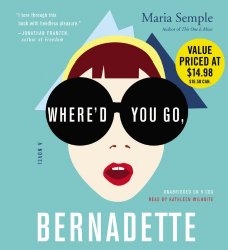
Review of Where’d You Go, Bernadette? by Maria Semple

whered_you_go_bernadette_largeWhere’d You Go Bernadette?

by Maria Semple
read by Kathleen Wilhoite

Hachette Audio, 2012. 8.5 hours on 9 compact discs.
Starred Review
2014 Sonderbooks Stand-out, #5 Fiction

Bee is trying to find her mother. Bernadette Fox has disappeared. Bee assembles various documents leading up to the disappearance to try to figure out what happened, and where her mother went.

Bernadette has been uptight for a long time, and has not been enjoying Seattle. What drove her over the edge? Was it the dispute with her neighbor over blackberry bushes? Was it stress about traveling to Antarctica to please their daughter and having to face the treacherous Drake Passage? Was the parents’ group at her daughter’s private school too much for her? Was it her husband’s long hours at Microsoft? Was it simply from trying to avoid interaction with people by using an internet assistant? Did she get wind of her husband’s plans to stage an intervention? Or is it nothing more than hatred of Idaho drivers?

The incidents happening around Bernadette were quirky enough to be humorous – at first. Toward the latter half, I began to think they were all simply too awful and couldn’t be overcome. A lot of little things had snowballed into big things, and let’s just say I was fully sympathetic with her for disappearing.

However, did she mean to disappear? Was she even still alive? And can Bee find her?

By the end of this book, I liked it tremendously. There were some fairly messy loose ends, but just enough to make the whole thing realistic. Bottom line, this book tells the story of a creative family who loves one another in extraordinary circumstances. And they found a realistic and hopeful, but extraordinary, way to get back from the edge of the cliff. The reader finishes with a belief that, one thing or another, they’re going to make it.

And getting there is quite a ride.

HachetteAudio.com

Buy from Amazon.com

Find this review on Sonderbooks at: www.sonderbooks.com/Fiction/whered_you_go_bernadette.html

Disclosure: I am an Amazon Affiliate, and will earn a small percentage if you order a book on Amazon after clicking through from my site.

Source: This review is based on a library audiobook from Fairfax County Public Library.

Disclaimer: I am a professional librarian, but I maintain my website and blogs on my own time. The views expressed are solely my own, and in no way represent the official views of my employer or of any committee or group of which I am part.

Please use the comments if you’ve read the book and want to discuss spoilers!

Review of Once Upon an Alphabet, by Oliver Jeffers

once_upon_an_alphabet_largeOnce Upon an Alphabet

Short Stories for All the Letters

by Oliver Jeffers

Philomel Books, 2014.
Starred Review

Oliver Jeffers’ books are quirky, offbeat, and, to certain people like me, utterly hilarious.

This is not a traditional alphabet book. As it says on the first page:

If words make up stories, and letters make up words, then stories are made of letters.

In this menagerie we have stories, made of words, made for all the letters.

The stories are all very short – with a title page, a two-page spread, and then a last page, all decorated with Oliver Jeffers’ loopy drawings, done large.

The stories possess that bizarre logic that makes me laugh. Many are tragic. Many seem pointless. And many show characters from a previous story. Taken together, they’ve got Oliver Jeffers’ unique charm.

I’ll include a couple of stories to give you the idea:

H

Half a House

Helen lived in half a house.
The other half had fallen into
the sea during a hurricane
a year and a half ago.

Being lazy, and not owning
a hammer, she hadn’t quite
got around to fixing it yet.
Which was fine . . .

. . . until the horrible day she
rolled out the wrong side of bed.

On this page we see Helen, open-mouthed, falling into the sea.

Another favorite, for which I’m afraid I can’t even begin to describe the drawings:

M

Made of Matter

Mary is made of matter.
So is her mother.
And her mother’s moose.

In fact, matter makes up everything
from magnets and maps to
mountains and mattresses.

Mary discovered all of this
the marvelous day she got sucked
through a microscope and
became the size of a molecule.

It’s a minor miracle that
they all made it back out
of the microscope at their
normal size again.

A few are done in rhyme:

R

Robots Don’t Like Rain Clouds

Robots don’t like rain clouds
So they steal them from the sky.

From everywhere and anywhere
That’s why it’s been so dry.

I’m sure you have been wondering,
What’s with all this dust?

Well, robots don’t like getting wet.
They don’t do well with rust.

I’ve already decided I want to booktalk this book next summer to the younger elementary school grades. I feel confident that just reading a few of the stories, and showing the large, dramatic pictures, will attract many readers, who will enjoy being in on the joke.

oliverjeffers.com

Buy from Amazon.com

Find this review on Sonderbooks at: www.sonderbooks.com/Picture_Books/once_upon_an_alphabet.html

Disclosure: I am an Amazon Affiliate, and will earn a small percentage if you order a book on Amazon after clicking through from my site.

Source: This review is based on a library book from Fairfax County Public Library.

Disclaimer: I am a professional librarian, but I maintain my website and blogs on my own time. The views expressed are solely my own, and in no way represent the official views of my employer or of any committee or group of which I am part.

Review of Brown Girl Dreaming, by Jacqueline Woodson

brown_girl_dreaming_largeBrown Girl Dreaming

by Jacqueline Woodson

Nancy Paulsen Books (Penguin), 2014. 337 pages.
Starred Review
2014 National Book Award winner for Young People’s Literature
2014 Sonderbooks Stand-out: #2, Children’s Nonfiction
2014 Cybils Finalist, Poetry

Brown Girl Dreaming is a memoir in verse. It’s lovely, and I hope children will find it in the nonfiction shelves of our library.

Jacqueline Woodson writes evocatively of her childhood, in Ohio, then South Carolina, then New York City. She wanted to be a writer even when she was a child, and catches that dream. She writes about being a Jehovah’s Witness, and about her family, about her best friend (who is still her best friend), and about how South Carolina and New York City were so different from each other.

I like the way each poem tells about a particular incident, but taken together they give a picture of her life. They are also told in different styles, focusing on different things – family, places, growing, writing.

There’s a series of haiku sprinkled throughout, all titled “how to listen.” Here is “how to listen #9”:

Under the back porch
there’s an alone place I go
writing all I’ve heard.

I’ll include some poems I enjoyed.

a girl named jack

Good enough name for me, my father said
the day I was born.
Don’t see why
she can’t have it, too.

But the women said no.
My mother first.
Then each aunt, pulling my pink blanket back
patting the crop of thick curls
tugging at my new toes
touching my cheeks.

We won’t have a girl named Jack, my mother said.

And my father’s sisters whispered,
A boy named Jack was bad enough.
But only so my mother could hear.
Name a girl Jack, my father said,
and she can’t help but grow up strong.
Raise her right,
my father said,
and she’ll make that name her own.
Name a girl Jack
and people will look at her twice,
my father said.

For no good reason but to ask if her parents
were crazy,
my mother said.

And back and forth it went until I was Jackie
and my father left the hospital mad.

My mother said to my aunts,
Hand me that pen, wrote
Jacqueline where it asked for a name.
Jacqueline, just in case someone thought to drop the ie.

Jacqueline, just in case
I grew up and wanted something a little bit longer
and further away from
Jack.

Here’s a story about her sister:

the reader

When we can’t find my sister, we know
she is under the kitchen table, a book in her hand,
a glass of milk and a small bowl of peanuts beside her.

We know we can call Odella’s name out loud,
slap the table hard with our hands,
dance around it singing
“She’ll Be Coming ‘Round the Mountain”
so many times the song makes us sick
and the circling makes us dizzy
and still
my sister will do nothing more
than slowly turn the page.

Later, there’s more about her sister:

gifted

Everyone knows my sister
is brilliant. The letters come home folded neatly
inside official-looking envelopes that my sister proudly
hands over to my mother.
Odella has achieved
Odella has excelled at
Odella has been recommended to
Odella’s outstanding performance in

She is gifted
we are told.
And I imagine presents surrounding her.

I am not gifted. When I read, the words twist
twirl across the page.
When they settle, it is too late.
The class has already moved on.

I want to catch words one day. I want to hold them
then blow gently,
watch them float
right out of my hands.

This one’s a nice family poem:

harvest time

When Daddy’s garden is ready
it is filled with words that make me laugh when I say them –
pole beans and tomatoes, okra and corn
sweet peas
and sugar snaps,
lettuce
and squash.

Who could have imagined

so much color that the ground disappears
and we are left
walking through an autumn’s worth
of crazy words
that beneath the magic
of my grandmother’s hands

become

side dishes.

And perhaps my favorite is about Jacqueline deciding she’s going to be a writer:

when i tell my family

When I tell my family
I want to be a writer, they smile and say,
We see you in the backyard with your writing.
They say,
We hear you making up all those stories.
And,
We used to write poems.
And,
It’s a good hobby, we see how quiet it keeps you.
They say,
But maybe you should be a teacher,
a lawyer,
do hair . . .

I’ll think about it, I say.

And maybe all of us know

this is just another one of my
stories.

The whole book gives a flavor of love and family and a girl listening to the world around her. Indeed, it’s the story of a brown girl dreaming.

jacquelinewoodson.com

Buy from Amazon.com

Find this review on Sonderbooks at: www.sonderbooks.com/Childrens_Nonfiction/brown_girl_dreaming.html

Disclosure: I am an Amazon Affiliate, and will earn a small percentage if you order a book on Amazon after clicking through from my site.

Source: This review is based on a library book from Fairfax County Public Library.

Disclaimer: I am a professional librarian, but I maintain my website and blogs on my own time. The views expressed are solely my own, and in no way represent the official views of my employer or of any committee or group of which I am part.

Please use the comments if you’ve read the book and want to discuss spoilers!

Review of The Castle Behind Thorns, by Merrie Haskell

castle_behind_thorns_largeThe Castle Behind Thorns

by Merrie Haskell

Katherine Tegen Books (HarperCollins), 2014. 327 pages.
Starred Review
2014 Cybils Finalist, Speculative Fiction for Elementary & Middle Grades
2014 Sonderbooks Stand-out, #2 Children’s Fiction

I loved this book. It begins with Sand (Alexandre) waking up in a fireplace. He has no memory of how he got there, or even of falling asleep.

In the room beyond, everything was broken.

Every single thing.

The mantel lay in two disjointed pieces on the cracked hearth. Mixed with the mantel’s splinters lay the shattered crest of a great family, their gilded phoenix and silvered swan once entwined, now separated and dismembered.

The enormous wooden tables throughout the room sagged and slumped like beasts fallen to the hunt. Every bench around the tables lay sideways and in pieces. Each cup and bowl was shattered or smashed. All the tablecloths and tapestries puddled in scraps on the floor or hung in tatters, and even the wood and kindling for the fireplace had been reduced to slivers….

Now he knew where he had awakened.

He was inside the Sundered Castle.

Every morning of his life, Sand had stepped out the front door of his house and ignored this broken castle across the valley. Everyone in the village ignored it. It was unreachable. Only the castle’s towers were visible above an enveloping thorny hedge, a raspberry bramble of astonishing proportion that had grown up around the ruin after the abandonment. Of course, no one picked raspberries from the hedge.

Sand explores the castle. Everything in it is broken. Even loaves of bread, books, and items of clothing are ripped in half.

Nothing was whole here, nothing at all. Not a spoon, not a toothpick, not a bed, not a door. No room had been exempted from the destructive force that had overtaken the castle.

Nothing in the castle has rotted, though, and it is oddly free of any signs of life – no animals, birds, or even mold.

Sand goes looking for the treasury, but instead finds the crypt, and a broken tomb.

The body that had once dwelled inside the fragmented tomb must have been ejected by the same force that had rent earth and stone throughout the castle. Scraps of a shroud littered the floor. It was strange, like some great outside force had tried to free the body. But to what end? To just let it lie in a heap on a dirt floor?

The body hunched in a haphazard pile of withered skin. Like one of the apples in the kitchen, Sand thought disjointedly, altogether horrified. His candlelight should have been steady in the still air below the earth, but it trembled with his shaking hand. Even the quivering light showed the details too well.

The corpse had been a girl. Her clothes were, perhaps, the only thing in the entire castle that were not ripped or town; they were fine fabrics, deep saffron velvets and russet silks that had not faded with age.

And the corpse was whole as well, though clearly the body’s bones were broken beneath its powdery, dried-out skin. The neck was tilted at an odd angle, and the arms and legs were bent horribly akimbo….

He shouldn’t leave her like that. He should put something to rights in this broken place, and she deserved it; she had been a person once. . . .

With his duty done, he fled up the stairs into the sunlight. He was ready to leave. He’d seen enough, maybe too much, and he wanted nothing more from this place. Its treasures could stay hidden. Its secrets could remain undiscovered. He had to get out. This place hadn’t suffered from some earthquake. Something else had happened here. Something that cut leather, ripped apples in half, and tore apart cast iron kettles. Something that broke bread and tossed bodies from tombs.

Naturally, Sand tries to get out. But the thorny hedge has a life of its own, and one thorn prick gives him a fever.

All that happens in just the first chapter.

As the book goes on, Sand figures out how to live in the castle. The old food can be salvaged, and he finds a way to get water from the well, even though the bucket is broken. He finds a stuffed falcon with a broken leg, splints the leg and begins carrying the falcon with him, to have a face to talk to.

In the smithy, even the anvil is in two pieces. But Sand is a smith by calling, having learned from his grandfather, and half an anvil is better than no anvil at all. He begins systematically mending things.

But his mending works better than it should. His unskilled efforts perfectly restore things. And then the falcon comes back to life. Readers will not be surprised at what else does.

But there’s still the problem of the curse on the castle. And the thorns have them trapped inside. I like the interaction as the two children slowly figure out how to break the curse. And figure out how to deal with the outside world if they do get out.

It’s also refreshing to have a boy in a book whose father wants to send him to the University – but he wants to be a blacksmith. I’ve heard the opposite story often. Sand is smart enough to go to the University, but his heart is in the craft of blacksmithing.

The author also beautifully works in a message about forgiveness. She’s not preachy, and it’s seamlessly and naturally built into the story, but I loved that part. I also loved that she didn’t present the idea that forgiveness can be achieved in an instant, but that just beginning to forgive has a magic of its own.

This is a fairy-tale-like story, but with nothing so simple as “true love’s kiss” to break the spell. The two main characters are middle-school-aged kids, and they go about the business of surviving and breaking the spell with kid-sized determination. They start out with some bickering, but learn to get along, bridge their differences, and become friends. This story completely charmed me.

merriehaskell.com
harpercollinschildrens.com

Buy from Amazon.com

Find this review on Sonderbooks at: www.sonderbooks.com/Childrens_Fiction/castle_behind_thorns.html

Disclosure: I am an Amazon Affiliate, and will earn a small percentage if you order a book on Amazon after clicking through from my site.

Source: This review is based on a library book from Fairfax County Public Library.

Disclaimer: I am a professional librarian, but I maintain my website and blogs on my own time. The views expressed are solely my own, and in no way represent the official views of my employer or of any committee or group of which I am part.

Please use the comments if you’ve read the book and want to discuss spoilers!

Oops! One more Stand-out!

It happened again! Because of some failures in record-keeping (and a couple of computer deaths this year), I inadvertently left a wonderful book off of my Stand-outs list. Fortunately, I haven’t chosen an arbitrary number for each list, so I will just add this book in. A few books will go down in rank, but they are still on the list.

The book is:

Once Upon an Alphabet, by Oliver Jeffers

I’m putting it at slot #5 in the Picture Books list.

I’ll correct the blog post below and eventually correct the main website page for the 2014 Sonderbooks Stand-outs.

One of these years, I won’t need to make any corrections!