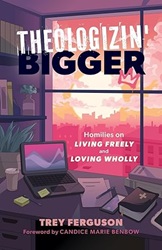
 Theologizin’ Bigger
Homilies on Living Freely and Loving Wholly
by Trey Ferguson
Lake Drive Books, 2024. 197 pages.
Review written March 5, 2024, from my own copy, purchased via Amazon.com
Starred Review
This book made my heart happy.
I’ve been following Pastor Trey on Twitter (@PastorTrey05) for some time now. He tweets about theology that I’d already found liberating, such as why the theory of Penal Substitutionary Atonement gives a harmful and unworthy view of God — along with joyful alternatives.
He starts off in the first chapter talking about how God is bigger than we can fathom. So sticking with what we know can be limiting. Here’s how Pastor Trey puts it:
But what if these constructs of knowing God are capable of preventing us from experiencing God? What if these things that we don’t know are invitations of the Almighty to catch glimpses beyond the blurry fragments and snapshots that we have compiled in this library we now recognize as the Bible? What if this limited, finite collection of writings is not even supposed to contain the fullness of the word of God? What might that demand of the thoughts we think about the Divine?
And then I love the title of the second chapter: “The Bible Ain’t No Car Manual.” Here’s the paragraph under that title:
The Bible is not a car manual. You not gon’ be able to search in the back for just any topic and find the chapter and verse to answer every question under the sun. Doing theology requires critical thinking skills.
So, yes, in his book Pastor Trey shows us how to do theology and learn about the living, dynamic love of God. The idea of theologizin’ bigger is to think big thoughts about our great big loving God.
The book takes us lots of places, including talking about the White Man’s Religion and the ways we use religion for harm. But the overall message is overwhelmingly positive, encouraging us to think big and think loving in our relationships with God and other people.
I love the last chapter, “The Rehumanization Project,” where he talks about using our God-given imaginations:
To be made in the image of God is to possess the power of imagination.
Imagination is an essential part of our humanity. It is our imagination that built cities and civilizations. Our imagination brought us countless genres of music. People have imagined timeless creations into reality through the culinary, visual, and dramatic arts. Literature born of our God-given imaginations has endured for millennia, across time, space, language, and culture. Imagination brought us the Flintstones and Super Soakers. It brought us more sports than we care to name. Nothing worthwhile came without someone first imagining it.
And that ties into our salvation like this:
Salvation is an act of reclamation and restoration. When Jesus saves us, he helps us reclaim the bits of humanity we’ve lost. Jesus gives us the ability to imagine good things and the power to realize them here and now. Community without exploitation. A sense of wealth that doesn’t demand scarcity. A love that doesn’t bleed us dry, but makes us whole. If only we imagine them, we can experience all these things. That’s what we were made to do. That’s what it means to be human.
If Jesus has the power to save, then we have the power to imagine again. We have the ability to theologize bigger. That is the image of God in us.
Reading a chapter a day of this book gave me a nice shot of inspiration and joy. I hope Pastor Trey will write many more books in the future.
Pastor Trey guarantees on his website that if you open up his book, you’ll find something worth talking about. That promise was fulfilled for this reader.
pastortrey05.com
lakedrivebooks.com
Find this review on Sonderbooks at: www.sonderbooks.com/Nonfiction/theologizin_bigger.html
Disclosure: I am an Amazon Affiliate, and will earn a small percentage if you order a book on Amazon after clicking through from my site.
Disclaimer: I am a professional librarian, but the views expressed are solely my own, and in no way represent the official views of my employer or of any committee or group of which I am part.
What did you think of this book?
Reading Trey Ferguson’s “Theologizin’ Bigger” motivated me to review another book I read some time ago, “Healing Haunted Histories,” by Elaine Enns and Chad Myers. Book authors, of course, are not necessarily alike; however, notable is their exactness in thought when writing from diverse backgrounds. Enns and Myers are “white” Canadians re-evaluating their religious heritage; Ferguson is a hip, urban, “black” American pastor from Florida. Enns and Myers are “cradle Mennonites” whereas Ferguson is a Mennonite convert.
Ferguson presents relatable personal homilies, social media jargon, truisms that sound like biblical proverbs, and slang whose meanings I had to look up. His book is a mixed bag of history, memoir, and religion in academic, humorous, poetic form. I am an African-American oldster of 70 years who has “been around the block” a few times, so, to me, nothing Ferguson says is new. What is new, however, and hopeful is Christianity’s seeming readiness for Trey Ferguson.
One hopeful sign is Enns’ and Myers’ book. What Ferguson preaches, Enns and Myers practice. Not that Ferguson is “behind the curve” but that Enns and Myers evidence what Ferguson envisions. Enns and Myers focus on the plight of Native Americans in Canada; Ferguson’s reference is African-Americans in the United States. The authors echo each other when recalling when they were not labeled “black” or “white.” Not for show does Ferguson entitle a chapter in his book, “We Gotta Have a Talk About Deconstruction.” Enns and Myers call it “Decolonization.”
The theologian who wrote the book’s introduction, Candace Marie Benbow, wrote, “Today’s deconstructionist movement aims to reclaim parts of our Christianity from the clutches of white supremacy….” She further writes, “to actually heal the wounds religious trauma cause….” Enns and Myers address victims and victimizers of this “trauma” and acknowledge a “moral injury” to perpetrators.
Our society is fashioned to punish the perpetrators, not thinking of regarding them as morally injured. Moreover, society focuses on punishing victimizers, not healing their victims. If one can imagine the kind of world Ferguson proposes, Enns and Myers show how that world could look in practice.
It may seem like an exaggeration to say that Trey Ferguson is a breath of fresh air in Christianity. Certainly, an observant sole can see that Christianity is as divided by gender and race as America was divided by slavery. Pastors like Trey Ferguson do not appear for no reason. What he writes is well worth reading.
Thanks for this! I’m going to have to look for the book you mention!