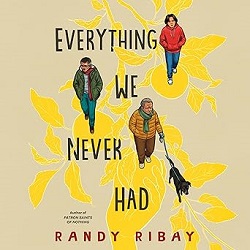
 Everything We Never Had
by Randy Ribay
read by Ramón de Ocampo, Jesse Inocalla, Manny Jacinto, and J. B. Tadena
Listening Library, 2024. 6 hours, 42 minutes.
Review written April 29, 2025, from a library eaudiobook.
2025 Asian/Pacific American Award for Young Adult Literature Winner
National Book Award Longlist
Everything We Never Had is a story of four generations of Filipino-American men. The first was Francisco, who came after World War II and tried to make money to send home to his family – but found instead prejudice, hatred, and low wages.
Francisco’s son Emil hated the way his father was never home, always traveling to organize the farm workers. He chose a different path and planned to go to college and make something of himself.
Emil’s son Chris wanted to play football and study history. But his father wanted him to focus on studies that would get him a good job some day.
And Chris’s son Enzo is dealing with anxiety. There’s talk of a pandemic, and his father asks him if he will give up his room so Lolo Emil can stay with them instead of in the retirement community. Enzo knows that Chris doesn’t like being with his father, and Emil doesn’t like being with them, but they can’t let him get sick and die.
I liked the way this book gives us insights into the things each generation had to deal with, including lots of history – and how it led to misunderstandings. The stories are interwoven a bit at a time, so I didn’t get the insights on most until after I’d already seen ways they weren’t a very good father. So this is an interesting exercise in learning to see from new perspectives.
Each man as a father tries to give his son everything he never had. Some are more successful than others. In the present-day pandemic, three generations need to learn to get along.
Find this review on Sonderbooks at: www.sonderbooks.com/Teens/everything_we_never_had.html
Disclosure: I am an Amazon Affiliate, and will earn a small percentage if you order a book on Amazon after clicking through from my site.
Disclaimer: I am a professional librarian, but the views expressed are solely my own, and in no way represent the official views of my employer or of any committee or group of which I am part.
What did you think of this book?