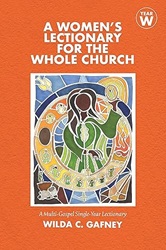
 A Women’s Lectionary for the Whole Church
Year W
A Multi-Gospel Single-Year Lectionary
by Wilda C. Gafney
Church Publishing Incorporated, 2021. 336 pages.
Review written February 17, 2026, from my own copy, purchased via Amazon.com
Starred Review
I heard about this book at my church’s women’s retreat last year from pastor Lauren Todd. So though technically the book begins with readings for the start of the Church Calendar in Advent, I started in the middle, and you can, too.
I didn’t grow up in a church tradition that uses lectionaries. They are a collection of Scripture readings to go with the church calendar. For each Sunday and for special feast days. Each day’s readings include an Old Testament passage, a passage from Psalms, a gospel reading, and a section from one of the Epistles.
In the Introduction, Wilda Gafney tells us the questions she posed:
What does it look like to tell the Good News through the stories of women who are often on the margins of scripture and often set up to represent bad news? How would a lectionary centering women’s stories, chosen with womanist and feminist commitments in mind, frame the presentation of the scriptures for proclamation and teaching? How is the story of God told when stories of women’s brutalization and marginalization are moved from the margins of canon and lectionary and held in the center in tension with stories of biblical heroines and heroes? More simply, what would it look like if women built a lectionary focusing on women’s stories?
Honestly, those were questions I’d never thought to ask. Reading this book showed me a fresh and eye-opening way to look at Scripture.
I especially loved her translations of Psalms, a book I’ve memorized in the New International Version – She uses female pronouns for God in all of them. I was surprised how powerful that felt. As she says at the front:
Exclusively masculine language constructs and reinforces the notion that men are the proper image of God and women are secondary and distant. Further, the simple reality that men and boys have always heard their gender identified with God cannot be overlooked as a source of power and authority and security in terms of their place in the divine economy. Many, if not most, women and girls have not heard themselves identified by their gender as and with the divine and for those who have had that experience, it has been profoundly moving, rare, and even sometimes profoundly disturbing.
She also has a list of names she uses for God in place of “Lord” – which is a “common male human slave holding title.” She reasons that she is following in the tradition of “the ancient biblical and rabbinical practice of substituting something that can be said for that which cannot.” The list at the back is lovely to browse through, and even use in prayer, with names like “The Ageless One,” “Author of Life,” “Generous One,” “Mother of Wisdom,” “Sheltering God,” and many others.
Each set of readings has text notes about her choices in translation and preaching prompts, which obviously I didn’t need, but gave me things to think about.
After reading this whole thing, I’m ready to go through it again another year. I would like to see an entire translation from her, at least of the Book of Psalms, but this way the readings are directed and thematic – and a true blessing.
Find this review on Sonderbooks at: www.sonderbooks.com/Nonfiction/womens_lectionary.html
Disclosure: I am an Amazon Affiliate, and will earn a small percentage if you order a book on Amazon after clicking through from my site.
Disclaimer: I am a professional librarian, but the views expressed are solely my own, and in no way represent the official views of my employer or of any committee or group of which I am part.
Subscribe for more reviews and talk about books.
Join the conversation: What did you think of this book?