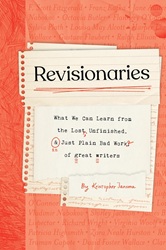
 Revisionaries
What We Can Learn from the Lost, Unfinished, & Just Plain Bad Work of Great Writers
by Kristopher Jansma
Quirk Books, 2024. 320 pages.
Review written from an Advance Reading Copy I picked up at work.
Starred Review
Revisionaries is both fascinating and inspiring. It’s fascinating because it tells you about the lives of many great writers and gives you a look at their unfinished work. It’s inspiring because it takes you behind the scenes and shows you how very fallible those geniuses were. In fact, they were human just like us.
The author based this book on his long obsession with unfinished manuscripts – and his blog “Unfinished Business.”
An unfinished manuscript becomes a parting gift and a glimpse at what might have been. The discoveries I’ve made in reading them have shaped the way I write and the way I teach writing ever since. I’ve reconsidered my entire idea of literary merit – genius is not something bestowed upon a select few through gifts or talents, but something built up, over much time and effort, by those resilient enough to never stop testing new ways of creating.
What I’ve found, time and time again, is that these works show that every genius is also merely human, and subject to the same stumbles, flaws, blocks, and total failures as any first-time writer. To read these incomplete novels and to understand the stories behind them is to expose creativity as something far more interesting and accessible, even if in doing so we must dismantle the very notion of genius.
Each of the twenty-one chapters covers a different writer. They have titles suggesting a failing of that writer: “Geniuses Write Bad Drafts” covers F. Scott Fitzgerald. “Geniuses Get Off to a Bad Start” is for Louisa May Alcott. “Geniuses Often Quit” covers Jane Austen. “Geniuses Bite Off More than They Can Chew” is about Ralph Ellison. And “Geniuses Still Have to Do the Dishes” is for Sylvia Plath.
The chapters themselves are informative and interesting and give you the inside scoop on the lives of great writers. But I especially loved the page or two at the end of each chapter called “Fail Like a Genius.” It gave you something from each writer’s life that you could apply to your own writing. He suggests that, like Kafka, you change your environment if you’re getting stuck; like Louisa May Alcott, imitate the writing of others to learn the craft; like Virginia Woolf, try writing a book just for fun alongside the book you’re “seriously” writing, and like Shirley Jackson, try writing about something you hate.
I read this book slowly, because each chapter was self-contained and gave me something to think about. Since my advance reading copy is paperback, it made a good book to bring on trips and read a chapter or so in the evening to wind down – and then I didn’t always remember to unpack it. But I did love reading it (and got more consistent when I reached the final third.) It gave me both wonderful stories about the lives of great writers and the encouragement that all those great writers were human like me.
When I finished the book, I got to thinking how encouraged I was when I learned that the first novel L. M. Montgomery wrote was not the first one she published, Anne of Green Gables. No, the first one she wrote was Kilmeny of the Orchard – a book which, honestly, isn’t nearly as good. It’s a fabulous first effort, but it’s not the masterpiece of what was actually her later work. Somehow it’s good to know that even L. M. Montgomery had to learn and grow as a writer.
And that’s the effect of this book. We learn the ways that each of these literary geniuses was fully flawed and human. And therefore maybe it’s worth it to keep making an effort to make our own mark.
Find this review on Sonderbooks at: www.sonderbooks.com/Nonfiction/revisionaries.html
Disclosure: I am an Amazon Affiliate, and will earn a small percentage if you order a book on Amazon after clicking through from my site.
Disclaimer: I am a professional librarian, but the views expressed are solely my own, and in no way represent the official views of my employer or of any committee or group of which I am part.
Subscribe for more reviews and talk about books.
Join the conversation: What did you think of this book?