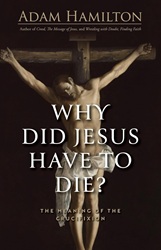
 Why Did Jesus Have to Die?
The Meaning of the Crucifixion
by Adam Hamilton
Abingdon Press, 2025. 121 pages.
Review written April 28, 2026, from my own copy, ordered via Amazon.com.
Starred Review
I’ve read several books about the meaning of the crucifixion, and especially offering alternatives to the penal substitutionary theory of the atonement. Some stand-outs include Did God Kill Jesus?, by Tony Jones; A More Christlike God, by Bradley Jersak; Creation and the Cross, by Elizabeth Johnson; and Lamb of the Free, by Andrew Rillera. My personal favorite by far is still Lamb of the Free, but I have to admit that it’s written with super academic language, pretty much directed at scholars and other Bible nerds. Its point is understanding the entire sacrificial system in Scripture, and a side effect of that understanding is showing that the penal substitutionary theory simply doesn’t fit.
However, much as I love Lamb of the Free, it’s pretty clear that this new book by Adam Hamilton is much less intimidating for your average Christian to pick up to better understand Christ’s death. It would work much better for going through with a small group, and it’s even in six chapters – pretty much asking to be a study during the season of Lent.
He is also not at all combative about atonement theories. He’s not looking to get you to reject one and choose another that you like better. He does cover penal substitution theory and the questions it brings up. Rather than outright rejecting it, he asks what can we learn from it?
This is his overall approach to all the theories, and I find it refreshing. Looking at the prologue to the Gospel of John, where Jesus is described as the Word, the Logos, he explains how that lens can change our view:
If we begin by seeing the Crucifixion and the atonement through the lens of John’s prologue, then we can recognize that Jesus’ death is not primarily a transaction, mechanism, or formula – it is not a divine quid pro quo where one thing automatically results in another (Jesus’ death procures our forgiveness, for instance). Instead, the Crucifixion is first and foremost a Word or message from God. This Word has the power to save, to deliver, to rescue, to redeem, to forgive, to heal, to inspire, and to love. It is intended to move us, to change us, to open our eyes and our hearts, to transform us, and to heal us and the world. We might call this the Logos theory of the atonement or simply refer to the Crucifixion as God’s Word.
When we understand this, our question changes from “How does the Crucifixion work?” to “What is God seeking to say to us through the Crucifixion?” Paul notes, “The message of the cross is foolishness to those who are being destroyed. But it is the power of God for those of us who are being saved” (I Corinthians 1:18, emphasis added). It is the message of the cross – God’s Word to us through the cross – that has the power to save. Each of the various metaphors used in the New Testament, and each of the different popular atonement theories in the church, are ways the disciples, and believers ever since, have heard God speaking through the cross. Each captures a different dimension of this Word. The focus is not understanding a mechanism, but rather hearing and accepting God’s Word of redemption, forgiveness, and love.
In the chapter on the penal substitution theory, he elaborates on this:
In moving away from seeing the Crucifixion as a formula or equation, but instead as God’s message to us, Christ’s death is not something God needed in order to forgive us, but something we needed in order to understand and accept that we are forgiven. In seeing the Crucifixion as God’s Word, we see God demonstrating the pain he himself experiences as a result of human sin but also the lengths to which he is willing to go to save us from it.
At this point, let me say that I don’t like the title of this book. I’ve heard this question myself – but always from people who have been taught that the penal substitution theory of the atonement is the very definition of the gospel – and that Jesus had to die in order for God to forgive us. Implied in the question is, “If Jesus didn’t have to die for God to forgive us, then why did he have to die?”
God forgave humans long before Jesus’ death! Read Psalm 103 if you don’t believe me. The Hebrew Bible is full of statements declaring God to be compassionate and gracious and forgiving sins. So I strongly believe that Jesus did not have to die in order for God to forgive us.
Adam Hamilton does take this up in the Postscript to the book, and says he considered calling it instead, Did Jesus Have to Die?. He shows many places where it is clear that Jesus could have turned away from the cross, and that he laid down his own life rather than having it taken from him.
Jesus didn’t have to die. While his death was a result of opposition and injustice he faced, it was more than that. He believed his death would accomplish God’s purposes, purposes we have described in the previous chapters and perhaps others. For these reasons Jesus chose to submit to a horrible death. He believed that through it, he would change the world. This is captured in the words he spoke shortly before his death. “‘When I am lifted up from the earth, I will draw everyone to me.’ (He said this to show how he was going to die)” (John 12:32-33).
So Adam Hamilton does discuss several theories of the atonement – including New Covenant, Redemption, Moral Influence, and Christus Victor. But it’s important to him to look at them as metaphors rather than mechanisms.
The New Testament authors used metaphors and analogies to describe the significance of Jesus’ death. These were drawn from Scripture as well as legal, economic, relational, and battlefield images, to name just a few. But at times we confuse the metaphors for mechanisms and, instead of hearing them as analogies helping to explain the meaning of the Crucifixion, we read them literally as though they describe processes and transactions and formulas for how the cross “works.” It is the nature of metaphors and analogies that they break down when pressed too far or taken too literally.
The beauty of this book is that Adam Hamilton doesn’t try to show us which is the “correct” theory of the atonement. Instead, he guides us to see beauty and meaning in each one.
As I’ve noted, the use of these various metaphors, ten of which I’ve included in this book, is more like poetry than physics, more like art than algebra. This is why I’ve suggested that when we read the New Testament’s various “atonement theories” we’re meant to ask not, How does Jesus’ crucifixion work? but instead, What does it mean? What is it God is trying to say to us?
Added October 23, 2026: I wrote the above review before I knew that Adam Hamilton is running for United States Senate in Kansas. I think it bodes well for a lawmaker to be able to find good out of multiple atonement theories. Where I figure out “which one I agree with” – he shows us beauty in each one. I think that’s a good thing for someone who wants to represent all the people of his state.
AdamHamilton.com
AbingdonPress.com
Find this review on Sonderbooks at: www.sonderbooks.com/Nonfiction/why_did_jesus_have_to_die.html
Disclosure: I am an Amazon Affiliate, and will earn a small percentage if you order a book on Amazon after clicking through from my site.
Disclaimer: I am a professional librarian, but the views expressed are solely my own, and in no way represent the official views of my employer or of any committee or group of which I am part.
Subscribe for more reviews and talk about books.
Join the conversation: What did you think of this book?