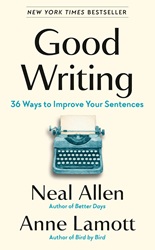
 Good Writing
36 Ways to Improve Your Sentences
by Neal Allen and Anne Lamott
Avery (Penguin Random House), 2026. 200 pages.
Review written August 18, 2026, from my own copy, purchased via Amazon.com.
Starred Review
I already loved Anne Lamott. Her vulnerable writing with self-deprecating humor and relatability won me over long ago. Now she’s written a book with her husband about how to write better, and preordering my own copy was a no-brainer.
Preorder? But this book has been out a few months. Yes, well, it’s the perfect book for reading a chapter a day (most days) and trying to absorb the wisdom. It’s also going to be a book I want to keep handy for when I’m revising my writing. I’m self-conscious about the rules I’m breaking in writing this review – but it’s not about squelching writing, it’s about making writing better, about improving sentences. (Anne does recommend pulling it out on the third draft of a book, which she calls the “dental draft” for in-depth cleaning.)
The set up of the book is 36 short chapters with writing rules from Neal’s years of experience as a journalist. And then in each chapter, Anne chimes in. She does some teasing and a little sniping, but the two writers’ love and respect for each other shines through and is a delight to read even if it wouldn’t help your own writing.
I like how Anne explains it in the Introduction:
My teaching has mostly been about the attitude of writing: gaining the confidence to get your stories told, to stop not writing, to tell the truthiest truth, make the plunge into empathy, and, mostly, to develop the habit of keeping your butt in the chair every day. Neal tends more toward encouraging people to write better sentences and paragraphs. Hence this book, and my own fixation with the best possible sentences I can write.
The rules you’ll find here are basic but universal: “Use Strong Verbs,” “Don’t Show Off,” “Trust Your Voice,” “Drop ‘Very’ and Other Crutch Words,” “Jettison [All Those] Tiny Words.”
Neal makes the case that you’ll find these rules helpful even if you don’t think of yourself as a writer:
These rules of good writing don’t exist only on the written page. They inform all types of communication, including everyday speech. We enjoy being entertained and persuaded in conversation, on film, through headphones, in private, and out in crowds. Instead of reading, people are listening – to books, yes, but also to experts on podcasts. As those experts script or improvise their words, they’re following many of the rules of rhetoric and persuasion that lifted Pericles two millennia ago and later, Shakespeare. Strong verbs keep the listener’s attention exactly the same way they keep the reader’s. I can’t prove it, but I tend to believe that the rules of persuasion and sentence-making will survive any changes in media, and may always assist us in refining the words we use to understand the human experience.
And I love Anne’s take on that:
Neal shared these thirty-six rules with me on our fourth or fifth date, and while their simplicity and brilliance were not the main reason I agreed to marry him a couple of years later, they didn’t hurt. His rules helped me become a better writer, and if you follow them, your writing will get better, too. Your work will get more economical, sharper, and more riveting. It is possible that it will become both more fun for us to read and more fun for you to write. Our hope is that you will be able to edit your work in a more focused and efficient way. Long, boring descriptions, out; generic verbs, out; endlessly inserted adjectives and adverbs, out out out. And clichés, feh! You can do better.
Writers, if you haven’t yet read Anne’s Bird by Bird, you absolutely need to do that! After that book gets you to write and to get your shitty first draft down on paper, this book will help you make that draft much less shitty.
And we’ll all be happier to read your writing.
Find this review on Sonderbooks at: www.sonderbooks.com/Nonfiction/good_writing.html
Disclosure: I am an Amazon Affiliate, and will earn a small percentage if you order a book on Amazon after clicking through from my site.
Disclaimer: I am a professional librarian, but the views expressed are solely my own, and in no way represent the official views of my employer or of any committee or group of which I am part.
Subscribe for more reviews and talk about books.
Join the conversation: What did you think of this book?