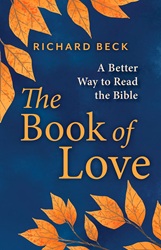
 The Book of Love
A Better Way to Read the Bible
by Richard Beck
Broadleaf Books, 2026. 270 pages.
Review written November 1, 2026, from my own copy, purchased via Amazon.com
Starred Review
By coincidence, I started reading this book shortly after reading Zach Lambert’s Better Ways to Read the Bible and shortly before starting Trey Ferguson’s new book, Love Is True Religion. All three wonderful books bring a little something different to the conversation, but all three are about reading the Bible through a lens of love. I highly recommend each one of them.
The Book of Love is the most academic of the three books, which isn’t a surprise because the author is a professor of psychology. I appreciated that approach as someone who’s already something of a Bible nerd.
I had begun the book before attending Wild Goose Festival in September, and I was excited to hear Richard Beck speak because of what I read. He did say that he wrote the book not so much to give people new interpretations in light of reading the Bible as a book of love – so much as opening minds to the idea that you can legitimately find new interpretations by reading the Bible this way. As a psychologist, he used the language of attachment theory and said we want people to have a secure attachment to God so they will feel safe to deconstruct. He said that before you show people there are choices, they need to know they’re safe to make the choices.
Here’s how he puts it in the first chapter of the book:
That everyone has a hermeneutic should be obvious. No one agrees even about “plain” and “literal” readings of the Bible. But this admission is terrifying. Stepping into this hermeneutical self-awareness, watching yourself interpret the Bible, is one of the most anxiety-inducing moments of our spiritual lives. When you admit that you have a hermeneutic, or at least become aware that there are multiple plausible ways of reading the Bible, an abyss opens under your feet. Solid ground dissolves into quicksand. You can feel yourself starting to sink.
The source of the terror is obvious: If I admit that I’m interpreting the Bible, how can I know that I’m right? We want the Bible to be clear and transparent so that it can provide us a firm foundation of truth. This is why biblical literalism is so alluring. A plain and literal reading of the Bible would allow us to escape the quicksand of interpretation. Since the Bible is clear – plain words on the page – there is no need for any interpretation. We can stand firmly upon these plain words and their literal, obvious teachings will provide clarity and truth. This is our naive hope.
But the minute we step into hermeneutical self-awareness, admitting that even “plain” and “literal” meanings of biblical texts involve some interpretive work, the firm foundation we thought we were standing on starts to crack. If interpretations abound, even among biblical literalists, how can I determine which of these competing interpretations is true? If the literal reading of the Bible is now up for grabs, who is going to call the balls and strikes for us?
But then he gently leads the reader to a suggestion that yes, we can admit we are using a hermeneutic and not crouch behind the word biblical to hide it. I agree with the author that the hermeneutic he shares in this book is biblical, but it’s refreshing that he admits it’s a hermeneutic. (Oh wait! Did I not define that word? It’s one I’m familiar with from my student days at Biola University. The author does define it early on: “By hermeneutics I mean your particular interpretive ‘take’ on the Bible, how you make sense of it, especially how you resolve conflicts between different readings of the Bible…. Your hermeneutic involves how you interpret the Bible to reach your felt sense of conviction that this particular reading is correct and true.”)
And the hermeneutic he presents in this book? It involves daring to trust that God loves us and then reading the Bible as a book of love.
As the book goes on, I appreciate that he tackles some passages that on the surface don’t feel like they show a God of love. And he shows how we can indeed read them that way without twisting our view of God.
But where the author won me over completely was when he described his evangelical upbringing – and that his entire outlook was changed by reading George MacDonald’s writing. George MacDonald was a nineteenth century Scottish preacher – and reading his writings changed my entire outlook, too! I still can’t read this paragraph without verbalizing a vehement “Yes!” a few times:
What I and many others have found so singular about George MacDonald was his fierce consistency in reading the whole of Scripture through the prism of a parent’s heart. MacDonald possessed a boldness, tragically rare among Christians, to reject any reading of the Bible that suggested God would be anything less than our most loving vision of parental love. More loving, in fact, than the most loving parent we could imagine. If you, as a loving parent, can’t imagine doing something to your child, then it is heretical to imagine God, whose love is infinitely greater than your own, doing such to his own children. Your love, insisted George MacDonald, cannot exceed the love of God. Here, then, is a hermeneutical rule in reading the Bible as a book of love: God’s love can never be less than your own. God’s love is always better, infinitely better.
And yes, there are objections to this view, as if it doesn’t consider justice or truth. But he points out (with George MacDonald) that a loving parent works to correct their child’s bad behavior – as the Prodigal Son’s father did, even if that means letting them eat with the pigs. But bad behavior doesn’t stop the parent from loving them.
This is how you read the Bible as a book of love. To be sure, there is a lot of work ahead of us. Many biblical stories and passages stand between us and the God who is infinitely more loving than we can imagine. But equipped with the hermeneutics of a parent’s heart we have what we need to start the journey. Yes, there are those who insist that God is less. Less good, loving, and kind. We will face those contentious issues. But at the end of the day, there are only two ways of reading the Bible. You can read the Bible to make the love of God feel more fragile or less. You can read Scripture to make the love of God feel more provisional, conditional, and tenuous, or more solid, unconditional, and dependable. In every debate, no matter the issue, this is the hermeneutical issue at stake. This is the fork in the road we always arrive at, over and over again.
So that lays out where he’s taking you in this book. He walks us through the Hebrew Scriptures, the Gospels, Acts, the Epistles, and Revelation – and shows us how they can be read as a book of love.
And, oh, I recommend reading this! Especially if you grew up with a fear that a wrong opinion would make you end up in hell. Like George MacDonald’s writings, this is a breath of fresh air – and I do believe that fresh air is the wind of the Holy Spirit. Here’s another paragraph from the introductory section:
When it comes to reading the Bible, this is the deep question you have to ask and answer before anything else: Is God for you? That is the central question you must discern. Otherwise, every time we enter into a discussion about Scripture, God’s love hangs in the balance. Before we crack the Bible open, we must face our anxious attachments. Without confidence in God’s unwavering love, all that remains is fear, terror, and insecurity. Yes, we debate many things when it comes to the Bible, but this is the issue behind all the issues. Do we trust that God, should we make a mistake, still loves us? As readers of Scripture, are we securely or anxiously attached? To read the Bible as a book of love, we have to trust that nothing can separate us from the love of God, not even our interpretive mistakes.
experimentaltheology.blogspot.com
Find this review on Sonderbooks at: www.sonderbooks.com/Nonfiction/book_of_love.html
Disclosure: I am an Amazon Affiliate, and will earn a small percentage if you order a book on Amazon after clicking through from my site.
Disclaimer: I am a professional librarian, but the views expressed are solely my own, and in no way represent the official views of my employer or of any committee or group of which I am part.
Subscribe for more reviews and talk about books.
Join the conversation: What did you think of this book?