Review of The Goblin Emperor, by Katherine Addison

goblin_emperor_largeThe Goblin Emperor

by Katherine Addison

Tor Fantasy, New York, 2014. 502 pages.

This is the sort of book that usually gets me telling people I don’t particularly like fantasy written for adults — so much detail in the world-building! So many strange names and strange cultural facts! So much strangeness in names and terminology!

However, unlike some others which I won’t name, Katherine Addison won me over completely with her story, despite the abundant detail. I found myself completely caring about the protagonist and even about his detailed choices — which at first I’d been impatient about.

Maia is the half-goblin fourth son of the elven emperor. His father is ashamed of him — he looks far too much like his goblin mother. He only met his father at his mother’s funeral, when Maia was 8 years old, and then was sent back into exile, accompanied only by a tutor who was also in exile and unhappy about that.

But then the emperor and his three oldest sons are all in an airship crash. Maia must come to the capital city immediately and take the throne.

This book is the story of an 18-year-old young man with no training for leadership being suddenly exalted to the position of emperor. He must learn how to rule and how to navigate the court and the halls of power. As well as wanting to stay alive.

Maia doesn’t even know how to dance or ride a horse. Can he get himself crowned, investigate his father’s death, choose an empress, rule the country — and stay alive while he’s doing it?

Despite my original prejudices, this ended up being an absorbing and engaging story.

katherineaddison.com
tor.com

Buy from Amazon.com

Find this review on Sonderbooks at: www.sonderbooks.com/Fiction/goblin_emperor.html

Disclosure: I am an Amazon Affiliate, and will earn a small percentage if you order a book on Amazon after clicking through from my site.

Source: This review is based on a book I got at ALA Annual Conference, signed by the author.

Disclaimer: I am a professional librarian, but I maintain my website and blogs on my own time. The views expressed are solely my own, and in no way represent the official views of my employer or of any committee or group of which I am part.

What did you think of this book?
Sonderling Sunday – Headlines!

It’s time for Sonderling Sunday! That time of the week when I play with language by looking at the German translation of children’s books. Sort of a Traveler’s Phrasebook for Very Silly People.

Sonderlinge3

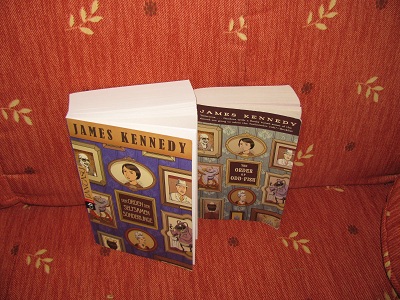
This week, I’m back to the book that inspired Sonderling Sunday, The Order of Odd-Fish, by James Kennedy, the most Sonder book of them all, Der Orden der seltsamen Sonderlinge.

This is my first week back after two and a half weeks of vacation on the west coast (which was great!), so once again I’ll have to keep it short. But there’s enough time for a little fun.

Last time I left off on page 234 in the English edition, Seite 295 auf Deutsch. I am in the middle of Chapter 18.

The first sentence I had to look up in German reveals no surprise I didn’t understand it:
Sir Alasdair übte oben auf seinem Urk-ack.
= “Sir Alasdair was practicing his urk-ack upstairs.”

“stopped hammering, drilling, and sawing” = aufhörten zu hämmern, zu bohren oder zu sägen

Don’t you want to know how to say this?
“the mellow tones of the urk-ack”
= die sanften Töne des Urk-ack

I still like long German words:
“pounded up and down”
= hinauf- und hinunterpolterten

“Inconvenience” = Ärgernis

This doesn’t sound like what it means:
“comfortable silence” = behagliches Schweigen

“often distracted” = häufig abgelenkt

“cot” = Pritsche

I’m not sure why this place-name was translated this way:
“Snoodsbottom” = Bilgental

“the important thing” = die Entscheidende

Here’s a good one!
“hopping mad” = fuchsteufelswild

“Girl Scout” = Pfadfinderin (“pathfinder girl”)

“brawl” = herumprügele

Another good phrase to know:
“That all sounds grand” = Das klingt alles ganz großartig

“bravely” = tapfer

“etiquette” = Verhaltensregeln (“behavior-rules”)

And I like how this sounds:
“Aunt Lily raised an eyebrow.”
= Tante Lily hob die Brauen.

And I have to list how the alliterative headlines were translated:

“ELDERLY ELDRITCH EXILES EXONERATED!
EXUBERANT EX-EXPATRIATES EXULT!”
= EXIL ENDLICH EXTERMINIERT!
VERGNÜGT VERBANNTE!

“MAGNANIMOUS MAYOR MAKES MERCIFUL MOTION
MANDATING MURDER MATTER MENDED!”
= BARMHERZIGER BÜRGERMEISTER BEENDET BANN
MORDVORWURF MAKULATUR

“STRIKE FORCE STEADFASTLY SCORNED SURRENDER TO
SILENT SISTERS, SUBSEQUENTLY SUFFERED SEVERE SANCTION,
SENTENCE SINCE SUSPENDED.”
= STREITMACHT VERHÖHNT STUMME SCHWESTERN
ANSCHLIESSEND ABER ABGEFAHRENER ÄRGER
SANKTIONEN SEITDEM SUSPENDIERT

(Not bad.)

That’s all I have time for tonight! But it’s good to be back! I am häufig abgelenkt, but die Entscheidende is to get back to it!

Review of The Scandalous Sisterhood of Prickwillow Place, by Julie Berry

scandalous_sisterhood_largeThe Scandalous Sisterhood of Prickwillow Place

by Julie Berry
read by Jayne Entwistle

Listening Library, 2014. 9.5 hours on 8 CDs.
Starred Review
2015 Odyssey Honor Audiobook

The Scandalous Sisterhood of Prickwillow Place are the students at a girls’ Victorian boarding school in Ely, England, St. Etheldreda’s School for Young Ladies.

Right at the start of the book, the girls’ awful headmistress suddenly dies, as does her odious brother. The girls don’t want to be sent home! Smooth Kitty forms a plan. They will carry on as if nothing has happened. Stout Alice is an aspiring actress, so she can impersonate Mrs. Plackett when visitors come to the door. Pocked Louise is a budding scientist, so she can determine if poison was used. Dour Eleanor can be in charge of burying the bodies in the vegetable garden, and Disgraceful Mary Jane can distract any men who come around. Dear Roberta and Dull Martha have parts to play as well.

There’s one problem: What will the murderer do if their plan didn’t work the first time? Will they be convinced Stout Alice is in fact Mrs. Plackett and try again to kill her?

This is a delightful book about girls caught in a difficult situation who come up with questionable ideas for dealing with it.

I enjoyed the atmosphere of Ely with the cathedral looming, as I have been there and that’s what I remember.

Naturally enough, it reminded me of Summer of the Gypsy Moths in that both books begin with girls burying a body and trying to convince others that nothing has happened. The Sisters of Prickwillow Place have the advantage of there being seven of them. Can they work together to be able to stay together?

This is a murder mystery with a Victorian atmosphere. I listened to the book, and the narrator is wonderful, using a distinct voice for each character, and all with an English accent which of course makes for delightful listening.

The trailer is wonderful and gives you the flavor of the book.

julieberrybooks.com
listeninglibrary.com

Buy from Amazon.com

Find this review on Sonderbooks at: www.sonderbooks.com/Childrens_Fiction/scandalous_sisterhood.html

Disclosure: I am an Amazon Affiliate, and will earn a small percentage if you order a book on Amazon after clicking through from my site.

Source: This review is based on a library audiobook from Fairfax County Public Library.

Disclaimer: I am a professional librarian, but I maintain my website and blogs on my own time. The views expressed are solely my own, and in no way represent the official views of my employer or of any committee or group of which I am part.

What did you think of this book?
Review of Billy’s Booger, by William Joyce

billys_booger_largeBilly’s Booger

A Memoir (Sorta)

by William Joyce and his younger self

Moonbot Books, Atheneum Books for Young Readers (Simon & Schuster), New York, 2015. 54 pages.
Starred Review

In this book, William Joyce explains for kids how he got his start writing picture books. He was in fourth grade, and he wrote a book for a school contest.

He worked hard on it. He exercised his imagination. The book he wrote and drew the pictures for is included in the center of this book.

What I love about it is that it reminds me of the stories my sons wrote when they were in about fourth grade. The smaller book is called Billy’s Booger and explains how Billy and his booger got bonked by a meteorite and gained super powers. The booger became a mathematical genius, and Billy could call on it at all times. The President of the United States asked advice from Billy and his Super-Booger!

Billy is tremendously disappointed when he doesn’t win any prize at all, not even honorable mention.

But the librarian puts all the kids’ books in the library — and Billy’s Booger gets checked out more than any other book.

And so began the adventures of a picture book author.

KIDS.SimonandSchuster.com

Buy from Amazon.com

Find this review on Sonderbooks at: www.sonderbooks.com/Picture_Books/billys_booger.html

Disclosure: I am an Amazon Affiliate, and will earn a small percentage if you order a book on Amazon after clicking through from my site.

Source: This review is based on a library book from Fairfax County Public Library.

Disclaimer: I am a professional librarian, but I maintain my website and blogs on my own time. The views expressed are solely my own, and in no way represent the official views of my employer or of any committee or group of which I am part.

What did you think of this book?
Review of Lost in NYC, by Nadja Spiegelman & Sergio Garcia Sanchez

lost_in_nyc_largeLost in NYC

A Subway Adventure

by Nadja Spiegelman & Sergio Garcia Sanchez

Toon Graphics, 2015. 49 pages.

Here’s a story that makes the most of the graphic novel format and throws in plenty of facts – even historic photographs – about New York City and the subway system.

Pablo’s first day of school in New York City happens to be the same day his class is going on a field trip, riding the subways, to the Empire State Building. Alicia helpfully offers to be his partner, but he is wary of making friends, since his family moves so often.

With Pablo’s inexperience, Alicia and he get separated from the class, and then Pablo gets separated from Alicia. However, Pablo knows where they’re going and asks for directions. Alicia uses her knowledge of the city to walk to the Empire State Building, and the class rides the subway. The graphic novel is perfect for showing how the three different groups take three different routes.

Along the way and in the back of the book, we get the history of the subway and facts about New York City.

And we’re told about another nice touch at the back. When the illustrator, Sergio Garcia Sanchez, was researching in preparation for drawing pictures of the subway stations, he took lots of pictures, and then noticed a policeman keeping a wary eye on him. So on almost every spread of the book, he included himself taking pictures and being followed by a cop. And of course once the reader finds that out, you go back to spot Sergio and the Cop in every crowded subway spread.

Even though this is a story about getting lost, I think the happy ending will help kids approach something potentially daunting – like riding a subway – without fear and with confidence.

toon-books.com

Buy from Amazon.com

Find this review on Sonderbooks at: www.sonderbooks.com/Childrens_Fiction/lost_in_nyc.html

Disclosure: I am an Amazon Affiliate, and will earn a small percentage if you order a book on Amazon after clicking through from my site.

Source: This review is based on a library book from Fairfax County Public Library.

Disclaimer: I am a professional librarian, but I maintain my website and blogs on my own time. The views expressed are solely my own, and in no way represent the official views of my employer or of any committee or group of which I am part.

What did you think of this book?
Review of Wearing God, by Lauren F. Winner

wearing_god_largeWearing God

Clothing, Laughter, Fire, and Other Overlooked Ways of Meeting God

by Lauren F. Winner

HarperOne, 2015. 284 pages.
Starred Review

This is a lovely book that challenged my thinking and opened my mind. I read it a little bit at a time, then finished the last few chapters during the 2015 48-Hour Book Challenge. In a way it was a shame to finish off the end quickly, since I liked the daily dose of thinking about God in new ways.

In this book, Lauren Winner looks at metaphors found in the Bible about God — but which the church doesn’t talk a lot about. Or at least the modern church. She did find writings from years past about each of the figures of speech.

She looks at God as clothing, God as scent, God as bread and vine, God as a laboring woman, God as one who laughs, and God as flame. All of these metaphors are found in Scripture, and all have something to offer us today.

I’ve been a church-goer all my life, and I enjoyed hearing things I hadn’t heard before. I enjoyed having a different light cast on my thinking about God.

Here are some of the author’s words in the introductory chapter:

The Bible has a great deal to say about this. Your church might primarily describe God as king, or light of the world, or ruler of all. In my church, we tend to call God Father, or speak of God as shepherd or great physician. When we are really going out on a limb, we pick up Matthew and Luke’s avian image and pray to God the mother hen tending her brood. Most churches do this — hew closely to two or three favored images of God, turning to them in prayer and song and sermons. Through repetition and association, these few images can become ever richer: there was once a time when I didn’t have many thoughts or feelings about God as great physician, but now I have prayed to that God with Carolanne, whose husband is pinned down by Parkinson’s, and Belle, who so much wants to keep this pregnancy, and Albert, who is dogged by depression, and because of those prayers, and the fears and hopes and miracles and disappointments they carry, God-as-physician seems a richer image than I first understood.

Yet the repetition of familiar images can have the opposite effect. The words become placeholders, and I can speak them so inattentively that I let them obscure the reality whose place they hold. I repeat them, I restrict my prayer to that small cupful of images, and I wind up insensible to them.

Unlike my church, with its four favored metaphors, the Bible offers hundreds of images of God — images the church has paid a great deal of attention to in earlier centuries, although many are largely overlooked now. Drunkard. Beekeeper. Homeless man. Tree. “Shepherd” and “light” are perfectly wonderful images, but in fixing on them — in fixing on any three or four primary metaphors for God — we have truncated our relationship with the divine, and we have cut ourselves off from the more voluble and variable witness of scriptures, which depict God as clothing. As fire. As comedian. Sleeper. Water. Dog.

Here is her invitation to the reader:

In this book, we will explore several overlooked biblical idioms for God. We will look at what the Bible itself suggests about these idioms, and what our daily lives have to say about them, and what various preachers and pray-ers and writers from earlier eras made of them. Your guide in this exploration is a bookworm who can happily get lost for a few days on a research trail, and I sometimes bring the words of anthropologists or historians or literary critics to bear on our ruminations. (Since the library of insights from those who have gone before us, and from contemporary scholars and preachers, is so rich, I have set additional gems at the bottoms of many pages. These quotations are there for stimulation and contemplation. Feel free to stop and linger over them, or skip them, or add your own musings.) Because I hope the book will help you sit down with God in a place the two of you have never visited before, each chapter concludes with a prayer. The final aim of this book is not to persuade you to stop thinking about God as your shepherd and start thinking about God as a cardigan sweater or One who weeps. The aim, rather, is to provoke your curiosity, and to inspire your imagination, and to invite you farther into your friendship with God.

If that invitation sounds even a tiny bit enticing, I highly recommend that you spend some time with this book.

laurenwinner.net
HarperCollins.com

Buy from Amazon.com

Find this review on Sonderbooks at: www.sonderbooks.com/Nonfiction/wearing_god.html

Disclosure: I am an Amazon Affiliate, and will earn a small percentage if you order a book on Amazon after clicking through from my site.

Source: This review is based on a library book from Fairfax County Public Library.

Disclaimer: I am a professional librarian, but I maintain my website and blogs on my own time. The views expressed are solely my own, and in no way represent the official views of my employer or of any committee or group of which I am part.

What did you think of this book?
Review of I, Fly, by Bridget Heos, illustrated by Jennifer Plecas

i_fly_largeI, Fly

The Buzz About Flies and How Awesome They Are

by Bridget Heos
illustrated by Jennifer Plecas

Henry Holt and Company, New York, 2015. 44 pages.
Starred Review

This nonfiction for early elementary age kids hits just the right note.

A fly buzzes into a classroom and finds the kids studying — as usual — butterflies.

Well, guess who else metamorphoses, can fly, and is beautiful (at least according to my mother).

The fly goes on to explain:

Here’s how the story goes: My 500 brothers and sisters and I started out as eggs. Our mom tucked us into a warm, smelly bed of dog doo. When we hatched, we looked like short, greasy white worms. In other words, much cuter than caterpillars. Scientists called us larvae. Humans called us maggots. Our parents called us adorable.

He tells the kids all about the lifecycle of a fly and cool (or disgusting, depending on your viewpoint) facts about them as well.

My favorite bit is where a kid asks, “I heard that flies throw up on everything before they eat it. Is that true?”

No. We don’t throw up on everything. Only solid foods.

See, we don’t have any teeth, so we can’t chew. I had to throw up on this apple core to turn it into a liquid. That way I could sop it up with my spongy mouth.

But if something’s already a liquid, like the soup you’re having for lunch, I don’t throw up on it. I’ll slurp that right out of the bowl.

Of course, when the kids decide the fly is right and he should be studied, he finds he doesn’t actually want to be kept in a cage in the classroom. Then he tells them the facts about diseases flies carry so they’ll let him go.

Fortunately, readers of this book can learn all the facts the friendly fly has to tell them without making contact with its germs.

This one’s a natural for booktalking in the schools. Children will learn fly facts without even trying.

authorbridgetheos.com
jenniferplecas.com
mackids.com

Buy from Amazon.com

Find this review on Sonderbooks at: www.sonderbooks.com/Childrens_Nonfiction/i_fly.html

Disclosure: I am an Amazon Affiliate, and will earn a small percentage if you order a book on Amazon after clicking through from my site.

Source: This review is based on a library book from Fairfax County Public Library.

Disclaimer: I am a professional librarian, but I maintain my website and blogs on my own time. The views expressed are solely my own, and in no way represent the official views of my employer or of any committee or group of which I am part.

What did you think of this book?
Review of Uprooted, by Naomi Novik

uprooted_largeUprooted

by Naomi Novik

Del Rey, New York, 2015. 438 pages.
Starred Review

Naomi Novik is the author of the brilliant books about Temeraire, a dragon who fought in the Napoleonic Wars in alternate-history England. This new book begins with a very different sort of dragon.

Our Dragon doesn’t eat the girls he takes, no matter what stories they tell outside our valley. We hear them sometimes, from travelers passing through. They talk as though we were doing human sacrifice, and he were a real dragon. Of course that’s not true: he may be a wizard and immortal, but he’s still a man, and our fathers would band together and kill him if he wanted to eat one of us every ten years. He protects us against the Wood, and we’re grateful, but not that grateful.

Agnieszka is born in the year of the girls who will be 17 the next time a girl is chosen to go serve the Dragon for ten years. But she’s not worried for herself. Everyone is sure that her best friend, beautiful Kasia, is going to be the one chosen.

But the Dragon looks at Agnieszka and makes a quick decision that no one expects. He suddenly takes her back to his tower without even a chance to say good-by. It turns out that Agnieszka has magic.

But not long after she’s been serving the Dragon, and having learned just a little bit — messengers come to the tower when the wizard is gone, saying that the Wood has taken Kasia.

The great Wood is sinister and evil. No one has ever escaped it. But Agnieszka will not and cannot stand by. And she sets in motion a series of confrontation with dark forces inhabiting the Wood and stretching all the way to the king’s court.

This is a wonderfully absorbing story and I read it all avidly with only a few breaks for air. I should mention that with Agnieszka being seventeen years old, the only reason I can see for this not to be a young adult novel is that there is one quite explicit sex scene as well as many gruesome deaths. (I mentioned that the Wood is evil?)

I enjoyed the way the magic is described and how Agnieszka’s magic is different from that of the Dragon, more in the tradition of Baba Jaga.

This is a wonderful story of a peasant girl discovering power and using it to defend the helpless and make things right.

naominovik.com
delreybooks.com

Buy from Amazon.com

Find this review on Sonderbooks at: www.sonderbooks.com/Fiction/uprooted.html

Disclosure: I am an Amazon Affiliate, and will earn a small percentage if you order a book on Amazon after clicking through from my site.

Source: This review is based on a library book from Fairfax County Public Library.

Disclaimer: I am a professional librarian, but I maintain my website and blogs on my own time. The views expressed are solely my own, and in no way represent the official views of my employer or of any committee or group of which I am part.

What did you think of this book?
ALA Annual Conference: 2015 Odyssey Award Program

2015 Odyssey Award Presentation

Odyssey Award for Excellence in Audiobook Production
For children or young adults published in the US
Chair: Dawn Rutherford
On the committee you develop “Odyssey ears” So tuned to production notes
463 audiobooks screened.
More than 340 hours of listening each.

Honor Books:

Tim Federle

Five, Six, Seven, Nate! by Tim Federle, narrated by Tim Federle
Tim Federle lived in the Bay Area when he was a child.
Our job as adults is to take our childhood weaknesses and turn them into strengths.
His weaknesses:
–Had a lisp.
–Had a sense of humor that got him sent to the principal’s office every day.
–Was a boy who loved musical theater
Becomes a platform instead of a demerit.

The Scandalous Sisterhood of Prickwillow Place, by Julie Berry, narrated by Jayne Entwistle
Jayne Entwistle

Jayne Entwistle

Books are like oxygen to a deep sea diver (from Flavia DeLuce)
In the theater, instant feedback. No immediate response with audiobooks.
Alone with the book — favorite place to be.
Proves the back and forth conversation, if not as immediate, is still alive.
As an only child, she was practically raised by books.
With this book, the book led her, rather than the other way around.
They had to pause it often because she was laughing too hard.
When she moved to LA, she cried out, “If only I could be paid to read.”

A Snicker of Magic, by Natalie Lloyd, narrated by Cassandra Morris
heard a clip

2015 Award

H.O.R.S.E., by Christopher Myers
Narrated by Dion Graham and Christopher Myers

HORSE

Dion and Christopher:
They read the whole book.
Christopher Myers:
One of the things authors get from ALA is to get outside the studio and get to see the people you’re talking to.
But this book was a conversation. They got to speak and listen both.
The Odyssey Award is about the skill of listening.
The Supreme Court decision was about listening.

Dion Graham: It is a conversation. What we do is about finding ways of listening to each other.

Let’s keep talking, and let’s keep listening!

ALA Annual Conference: Reading the Art in Caldecott Books

Reading the Art in Caldecott Award Books
What Makes a Picture Book Distinguished?

Gail Nordstrom
Coordinated Mock Newbery and Caldecott discussions
2002 Newbery committee, 2011 Caldecott committee
Heidi Hammond
School Librarian
Appointed to 2011 Caldecott committee

You must be a member of ALSC, and you must volunteer!
Wrote a book: Reading the Art in Caldecott Award Books: A Guide to the Illustrations

“Nothing happens accidentally in a picture book.” — K.T. Horning
The Adventures of Beekle, by Dan Santat
Notice: Dust jacket and book cover differ.
End papers have images — a variety of imaginary friends. Beekle’s purpose isn’t clear.
Color is important in Beekle. Full color in the imaginary world. Real world is dark and grim.
Playground is colored.
Beautifully balanced color in the tree.
Change of perspective. Detail, like tape on Beekle’s crown.
At the end, we learn Beekle’s purpose.

2014 Caldecott Medal: Locomotive
In this book, artistic expression as a whole.
Pen & Ink with water color — amazing detail.
Sense of speed. Tones give a sense of place and time.
There’s a second visual narrative in the illustrations.
Train has a diagonal line of energy. Great detail. Even bolts on the locomotive. Night scene. Coming right at you.
Font is used effectively.
Amazing end papers in this book.
Again dust jacket and boards have different images.

Elements of Art
Flora and the Flamingo: Color
Effective use of negative white space.
Line: Straight vertical line causes us to stop.
Molly Idle was an animator before illustrator — flaps add motion.
Diagonal line suggests movement.
Tree branches add balance
Color does evoke feeling and mood.
Creepy Carrots has a totally different feel.
Also minimal colors in One Cool Friend and use of white space.
Patterns used consistently.

This One Summer
Also minimal use of color. Indigo gives us a nostalgic feel.
Multiple images to suggest movement.
A variety of page and panel layouts.

Creative Spirits
Viva Frida — A new kind of art. Stop motion puppets, paint, photography, digital manipulation
Color is vibrant and intense.
Much texture
Begins with puppets and evolves into a dream world of acrylic paints.

The Right Word — collage and water color
Interesting shapes right from the start
Focus of each page is on a book cover
3D collage — lots of texture.
End papers goes from cluttered to ordered

The Noisy Paint Box
Expressionistic art — acrylic paint and paper collage.
Starts formal – art explodes with emotion later
Text becomes part of the illustrations

Dave the Potter
Light streams down on him.
Collage elements cut out of glossy photographs
Element of shape — roundness as he creates the bowl

Journey, by Aaron Becker
Different perspectives
Endpapers show different modes of transportation throughout the ages
Details of her room show her longing for travel

Me… Jane
Jane also makes a journey
Me… Jane is a circle story and first and last pictures reflect that.

Nana in the City
Vibrant colors
Spread before book begins lead to the city.
Grandma’s red accessories make her stand out.
Vignettes show action in quick sequence.
Page turn with boy marching right off the page.
They stand out from the crowd but blend in with the city.

Mr. Wuffles!
Water color and india ink
Layer upon layer to get the dimensionality of the cat.
Long thin panels with varying perspective
Mounted a camera to a broomstick to get a cat perspective
Color value change when we focus on the aliens. Different sense of space.
He worked with a linguist to develop a new language
Dust jacket and boards of books are totally different.

Sleep Like a Tiger.
Lots of pattern — acrylic paint on board, collage, digital manipulation.
Repeating motifs
Tiger is important
On moon, collage is the text of Tyger, by William Blake
Shape — rounded and comforting. Snail shape

Sam and Dave Dig a Hole
Shape is very important here, and negative/positive space
Colors change subtly as they dig.
Visual vertical motion where they fall.

This is Not My Hat
All hand-lettered
Horizontal format
In the sea, but grounded with the tops of plants.
The images tell a very different story than the narrative.
Clear movement across the page toward the page turn
Has the unusual movement “backwards”
Opposing narrative — completely different from the narrative

A Sick Day for Amos McGee
Blue end papers match blue of Amos’s house. Red letters match red of balloon. Horizontal line carries action through.
Flourish at end of each line, different each page.
Vertical lines cause us to pause.
Woodblock printing causes texture.
The animals aren’t humorous, but have dignity.
Text balances the image.
Amos is touching almost every animal in the story.

Now groups talk about picture books.