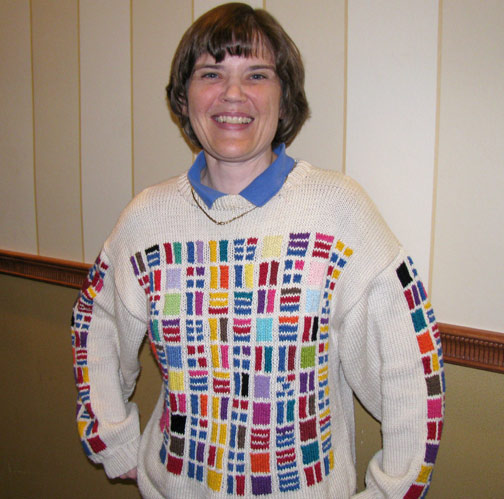
I wore my Prime Factorization Sweater to KidlitCon09, and it shows up in all my pictures, so I think it’s time for me to explain it.
This is the sweater that proves that I am a Certified Math Nut.
Okay, here’s how it works. You have to start in the bottom lefthand corner, because the mathematician in me couldn’t bear to start anywhere except where the origin would be on Cartesian coordinates. Naturally, the numbers go from left to right and from low to high.
I’ll post a picture of the front of the sweater:
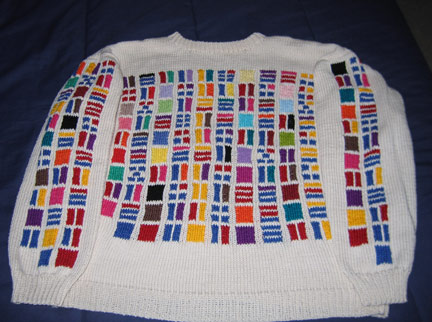
Okay, look at the bottom row. It looks like there is a blank space on the left. That represents 1, because 1 is the background color, because 1 is a factor of every number.
Next is a blue square, which represents 2.
Next is a red square, for 3.
Then comes 4. 4 = 2 x 2. So 4 is represented by two blue rectangles.
Then comes 5. 5 is prime, so 5 gets a new color, yellow.
Next is 6. 6 = 2 x 3. So 6 is represented by a blue rectangle and a red rectangle.
7 gets a new color, purple.
8 comes next. 8 = 2 x 2 x 2. So 8 is in a square with three blue rectangles.
Then comes 9. 9 = 3 x 3. Two red rectangles.
Last on the bottom row is 10. 10 = 2 x 5, so we have blue and yellow.
The second row starts with 11, which is given the color pink.
12 has three factors, since 12 = 2 x 2 x 3, so two blues and a red.
Get the idea? This sweater presents a chart giving the color-coded prime factorization of every number from 2 to 100.
The patterns are wonderful and fascinating. You’ll quickly notice that the yellows and the blues line up, because 5 and 2 are factors of 10. You also might notice that all perfect squares are symmetrical. Multiples of 11 go in a lovely pink diagonal across the sweater. There are hundreds more patterns. It would be a lovely visual aid for teaching number theory. Fun to quietly wear to Math competitions, too!
What’s more, you can use this as a quick conversion table to convert to Octal (Base 8), because on the back I did the same thing with rows of 8:
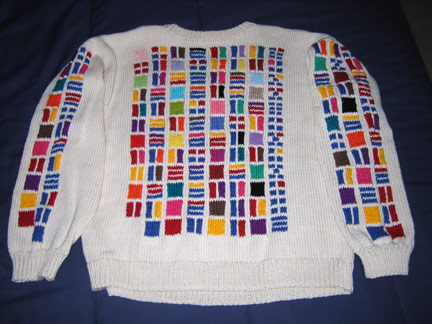
The fun thing about rows of 8 is that the patterns are all different! Notice how the last column is full of blue squares because every number there is a multiple of 8 and has at least three factors of 2. And now 9 (two reds) acts like 11, going diagonally up the sweater, as does 7 (purple) in the opposite direction.
On the sleeves, I did rows of 2 and rows of 3. The rows of 3 is the only one where the blues do not line up, because 2 and 3 are relatively prime.
Isn’t it just the coolest thing in the world?!!!
Okay, I warned you: This is the item that proves I am a Certified Math Nut. I can get hugely excited and animated talking about this sweater.
I have already done a library program called “Puzzles and Patterns” showing kids how they can make simple codes using the ideas from this sweater. There’s definitely a children’s book in there, but I haven’t gotten around to writing it yet. I definitely plan to some day!
One of the cool things about this sweater is that it works in any language and on any planet!!! You see, even if an alien race had only four fingers on each hand, they could look at the back of the sweater and all their numbers would work. For that matter, a number system with a base of 7 or some other strange base would still work, even though it might not be in neat rows for that base. The chart is entirely independent of the symbols used to represent a number, and based only on color.
So we had a family joke that if an alien ever came to our door, we’d run and get the sweater to prove that we are intelligent life.
I only hope the aliens are not color blind!
Of course I also like to tell the story that when I was knitting this sweater, I brought it along to visit my family and friends one Christmas. Most of my family are Math Geeks, too, so they were impressed. But one friend had a young son who listened to my explanation and responded, “That’s just weird!”
What can I say? He does have a point. Call me weird, but I still think it’s one of the coolest things in the world!
Edited to add: Here’s a link to my CafePress store, where you can order t-shirts using this idea, showing the color-coded prime factorization of the numbers from 2 to 100, with the number also printed below the color-coded square.
Also, here are all my entries about other prime factorization projects.
My posts on Mathematical Knitting and related topics are now gathered at Sonderknitting.
I love this! I’m planning a quilt for my grandson (age 11) who loves math; something like this would be perfect! Thank you.
Lovely! You can do the same thing with small pieces of color — should be easier than knitting it! 🙂 Yay!
Wow, what a wonderful sweater! I admire how you visualised this, your knowledge and dedication, and the way you give it a personal touch. And then you took the time to share it online, which is even more awesome! This is a work of art!
Wonderful! Leif in the comment above just sent it to me and I am fascinated! And you have a great sense of humor!
Thanks! 🙂
Hi! I love this!
Could you put this on a black silk tie? I’d really prefer silk, but if polyester is the only option I’ll make do.
I’m an instructional coach, and would LOVE to be able to wear this to my elementary and middle grades classes, plus math conferences.
Thank you!
Sorry — I know how to knit it, and I put the chart on a t-shirt at Cafepress: https://www.cafepress.com/sonderbooks I don’t know how to put it on a tie. Is there a company that does that? You’d want shorter rows, though — maybe rows of 5? Someone could probably knit a tie — but that would take a long time….
Now I’ve got a video series up with the library, called Mathematical Colors and Codes! Episode One explains the Prime Factorization Sweater and shows you how to color your own downloadable prime factorization chart. https://sonderbooks.com/blog/?p=37839
Great idea, amazing realization.
I love that knitpiece!
This is absolutely incredible. One of my math teachers shared the link and I was amazed. I knit and crochet, so I will probably keep this idea in mind for a fun future project.
It’s been SO much fun to knit mathematical stuff — coming up with the pattern is half the fun. Since then, I’ve done prime factorization blankets, which are a lot easier. See all my mathematical knitting on my Sonderknitting page.
I wasn’t confident in my abilities to do an adult sized one, so I did a baby one!
https://ibb.co/7NSc9TF9
Recipient is too young to understand the maths but is enjoying eating the sleeves 🙂
Thanks for the inspiration – will definitely do some more with this!
Oh, I love it so much! Hooray! Another Matheknitician! Once you get started…. Check out my gallery of mathematical knitting at Sonderknitting: https://sonderbooks.com/sonderknitting/