Conference Corner – KidLitCon 2012
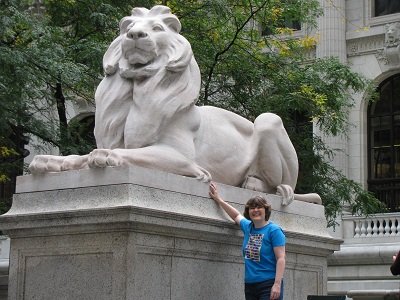
KidLitCon in New York City! At the New York Public Library! KidLitCon is a conference for bloggers who blog about children’s books. I went to KidLitCon09 close to home in DC, to KidLitCon11 in Seattle, and just had to go when it was so close by and free to boot.

I’m way behind on my Conference Corner posts. So, for fear I’ll never get to KidLitCon, I decided to post the same night I got back, when everything’s fresh. Instead of giving you all my notes, I’m just going to give you the high points. Here are the things I took home from KidLitCon12, in chronological order.

1. Publisher Previews are Dangerous.

I only was able to go to one preview, since I flew in to New York at noon, and that was probably a good thing. It was at the offices of HarperCollins going over books they’re publishing soon.

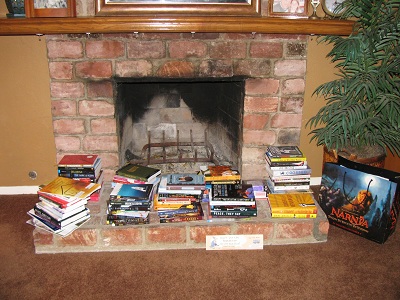
Why are previews dangerous? First, I had packed lightly. They gave us a full bag of advance reader copies, as well as three hardbound published books and a blank book. Did I tell them, no, I couldn’t possibly carry the bag home on the plane or fit it in my suitcase? No, I did not. Did I even tell them my neurologist said, since my vertebral artery dissection, that it’s not a good idea for me to walk around carrying more than 15 pounds? No, I did not.

Now, don’t worry, as I walked 20 blocks up 5th Avenue to our dinner (which I actually enjoyed. Definitely gave me the feel of New York City.), I found a FedEx and stuck the bag on their counter, and had them ship the whole bag home to me. But the other reason the preview was dangerous is after hearing them talk about the upcoming books, I want to read every single book! Was I hurting for ideas of books to read? No, I was not. Did I need to know about more books I’d like to read? No, I did not. Does that make me want to read them any less? No, it does not.

Now, later in the conference, I did end up with two more hardbound and two more paperback books. My suitcase ended up being hard to close, but I managed it. But to show how dangerous I find publisher previews, and how impossible I find it to resist free books — this morning I woke up from a dream where I was in a line to get advance reader copies of some adult books I didn’t even find very interesting, and which I knew I wouldn’t be able to fit in my suitcase, and when I knew it was Sunday and I wouldn’t be able to ship them — but I took them anyway! I was so relieved when I woke up! I had not taken more books than I could carry after all.

Yeah, I have a problem.

2. KidLit Bloggers are My People.

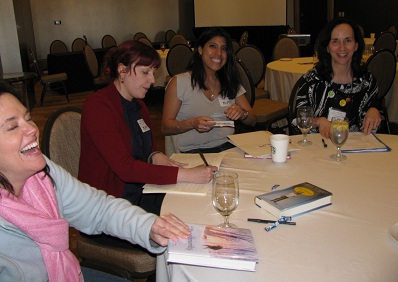
Okay, I knew this already. But it was a lovely to spend a weekend with other people who are a little nuts about children’s books. My resolution: Read more of their blogs! More regularly! These are my people, and it was wonderful to see the ones I already knew and meet some I hadn’t met before.

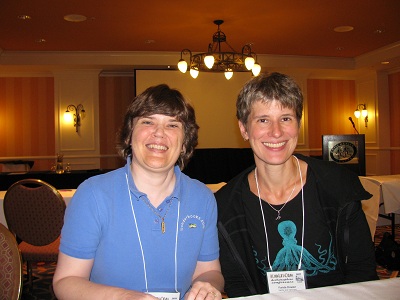
And I got to be roommates again with Lisa Song, who blogs at Reads for Keeps. She helped me navigate the subways, and having some quieter time with her between busy days was definitely a highlight of the conference.
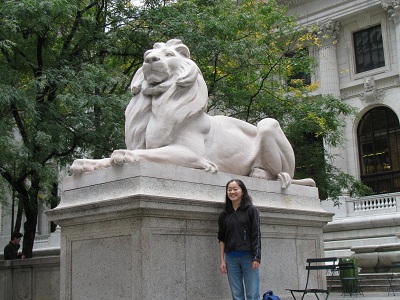
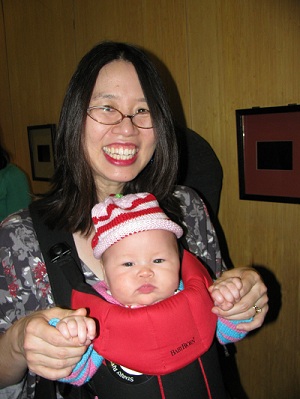
3. Grace Lin shines with niceness and has a Really Cute Baby.
4. Sushi tastes good.

Who would have thought?

5. You should be creating something you want to share with the world, not something to show how clever or talented you are.

This was from Grace Lin’s talk. Just an inspiring reminder why I blog: To share special books with other people.

6. Although they are My People, not all Children’s Book Lovers are introverts like me. The extroverted ones are really fun to be around, though.

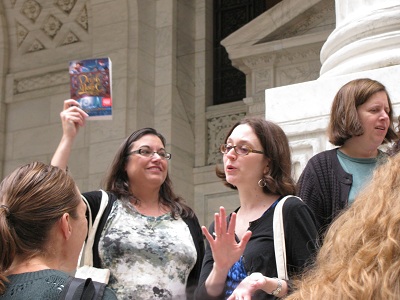
Here’s Pam Coughlan, Mother Reader, “auctioning” off ARCs from the Publisher Previews the day before. (I managed not to take any, I’m proud to say.) That’s Charlotte, middle grade science fiction and fantasy specialist, on the right. (Who is in the middle?)
7. Make your blog easy to share.

Resolution: Add more sharing buttons, besides the Tweet button. Must get around to this….

8. “If you talk like you’re alone in a room, you will be.” — Marsha Lerner
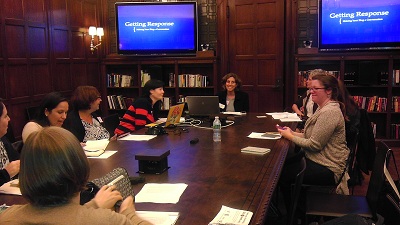
This point brought a small epiphany for me. Since I began Sonderbooks as an e-mail newsletter consisting of book reviews, I think of it as my thoughts I’m sharing with people. I’m talking like I did when I was the instructor lecturing the classroom.

9. Ask questions you want answers to.

All these last three points are from Marsha’s talk. And, mulling them over, I had an idea this morning. I think I am going to start using comments to discuss the books I review with other people who have read them. So I will put Spoilers in the comments. So far, I don’t get a lot of comments on book reviews. I mean, what do you say if you haven’t read the book? You can say, I’m looking forward to reading that. But wouldn’t it be nice to be able to talk about that annoying or brilliant thing at the end of the book and find out what other people think? I could use the comments for deeper discussion.

What do you think? I am honestly curious. Do you think spoilers in the comments is a good idea, if I put lots of warnings? My main blog doesn’t show comments, and on my website, you’d have to click over to the blog to see them, and I’d make sure to put warnings. Do you think it will work?

10. Winnie-the-Pooh!!!!! The Original!!!!
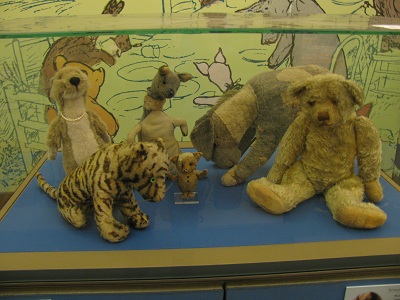
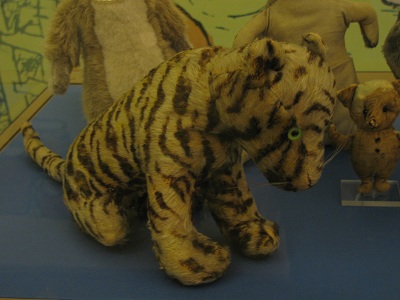
Okay, this was NOT something I took home with me, but this WAS a big huge enormous thrill. I got to see the original animals that Christopher Robin played with! Don’t they look so much like the Ernest Shepard illustrations? Especially Tigger:
And you can clearly see why Piglet is truly a Very Small Animal:
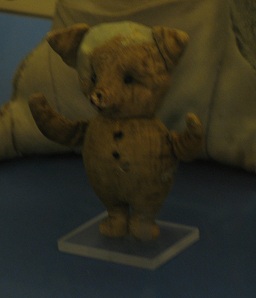
Eeyore actually looks patched, which easily explains the story of him losing his tail. All the animals, including dear Pooh, were clearly much loved.
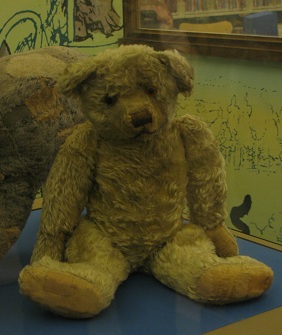
But wait. You may be asking, like me, “What is that OTHER stuffed animal doing in the case?” That, dear reader, is a Travesty. You see, not only was a sequel to Winnie-the-Pooh and The House of Pooh Corner “authorized,” a new character was created. A stuffed animal of this new character was created, and someone had the Very Bad Idea of putting the new stuffed animal in the case with the original toys with whom Christopher Robin once played. Here is a picture Leaving It Out:
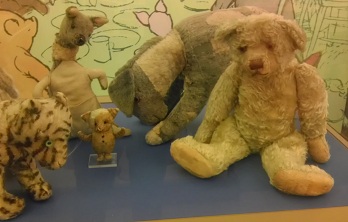
I took these pictures on my lunch break, and was so glad I’d made the pilgrimage. Wow.

11. Keep my inner fangirl in check. Maybe?

There was quite a lot of talk about the relationship between writers and bloggers. Do we get too nice because we don’t want to hurt the authors’ feelings? Is our professionalism hurt when we “know” the writer online or have met them in person?

I began writing Sonderbooks when I was working in a library, but was not yet a librarian. Now I’m a librarian, and I’ve been to the William Morris Seminar, and I closely follow the Heavy Medal blog — and I would so love to be on the Newbery committee some day. If I don’t want my reviews to be merely cheerleading, I should practice thinking critically. Yes, I feel I can continue with my policy of only reviewing books I like, but why do I like them? And, come on, it’s more professional if I try not to Squee too hard when I meet an author. Maybe less pictures with them? (And you’ll notice at least I posted Grace only with her baby.) Hmm. I’ll have to work on this one.

12. If you’re doing a PowerPoint presentation, make sure you are not scheduled after Brian Selznick.

This point is courtesy of Maureen Johnson; it seems very wise.
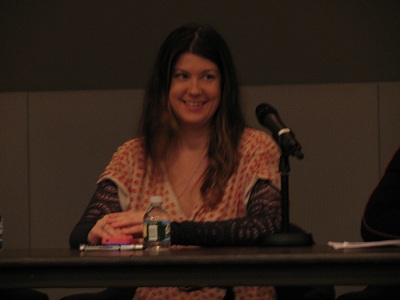
13. Always feel free to bring a friend.

Maureen roped her friend Robin Wasserman into sharing the keynote, and that added lots of fun to the talk.

14. Keep in mind every day why you’re doing what you’re doing.

Another one from Maureen Johnson.

15. Central Park is lovely.

Who knew?

I had a late afternoon flight, so I went into Central Park, and when I walked a little way in, I heard and saw an actual waterfall. So lovely.

I liked the juxtaposition of the trees with the skyscrapers.

Then later I came upon a large lake. Walking through Central Park was simply a lovely way to spend a couple hours after an inspiring weekend.

How about you, other KidLit Bloggers? What did you take away from KidLitCon?
Conference Corner — Morris Awards and YALSA Nonfiction Awards

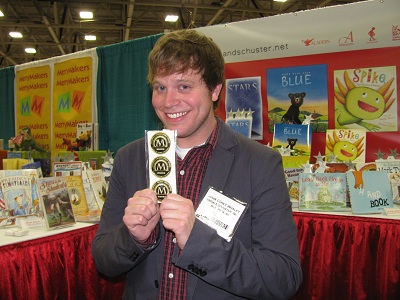
The final event of ALA Midwinter Meeting that I attended was the Morris Award and YALSA Nonfiction Award ceremony. I like the way those two awards announce a short list, so that the winners can be there for the ceremony. This year, it turned out that Morris Award Winner John Corey Whaley also won the Printz Award. He was a happy man. I spotted him in the exhibits after the award announcements.


Those are the Morris Award stickers for his book.

Of course, I had to get a picture with him, as did many other youth services librarians. We wanted him to know that to us, he’s a rock star.

At the Award ceremony, some of the authors spoke by video, but I took notes for the ones who spoke in person.

First was Guadalupe Garcia McCall, Morris Honor winning author of Under the Mesquite:
She got the news of winning the Honor while teaching, which was so appropriate, because she wrote the book while teaching.
She remembered being hungry for understanding. Books showed the world to her, empowered her.
She wrote, not to be published, but to be read.
She wrote this story for young people who can’t talk about this. They have great strength within them.
The most important destination of all: Young Readers’ Minds
ala means “wings” in Spanish. So appropriate!

Ruta Sepetys, Honor winner for Between Shades of Gray:
History has secrets.
Through stories, these people become human.

John Corey Whaley, Morris Award Winner for Where Things Come Back (He also learned on the same day that he won the Printz Award.):
Thursday was his birthday. He feels sorry for all his other birthdays.
“I get to be a writer. It means so much to say that.”
“My life is a constant state of shock.”
“There’s no other community I’d rather be part of than the People of YA.”
“…the cool kids who run into things because they’re walking while reading books.”
“I had given up hope that I could be a happy adult.”

Then were the YALSA Awards for Excellence in Nonfiction:

Karen Blumenthal, Honor Award for Bootleg:
One of the strengths of nonfiction: Real stories and real consequences.
“Nonfiction provides a context for a complicated world.”
“In real life, the girl doesn’t always end up with the sparkly vampire.”
The world isn’t black and white, but many shades of messy.
Those who passively observe get to live with the results.

Sue Macy, Honor Award for Wheels of Change
As a teen, her favorite books were This Fabulous Century. She imitated these books.
She takes a thematic approach to this era of history.
There was lots of serendipity in her search.

Steve Sheinkin, Award Winner for The Notorious Benedict Arnold
“Benedict Arnold made people nervous.”
This is a straight-ahead action-adventure rise and fall story.

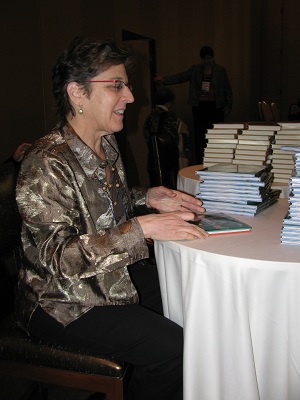
Afterward, we were given free copies of many of the books and got them signed. Here’s Sue Macy signing Wheels of Change:

This award ceremony isn’t nearly as fancy as the Newbery/Caldecott Banquet or as the Printz Reception, but I think with first-time authors winning the Morris Award, and nonfiction authors who don’t always get as much recognition, it’s guaranteed that the Morris and Nonfiction award ceremony will always be deeply heartfelt.

Conference Corner – ALA Midwinter Meeting – John Green

I’m attempting to post my notes from the many conferences I’ve gone to this year. I think I’m going to work backwards and forwards both. Last time, I posted notes from the last session I attended. Now I’m going to post notes from where I left off — John Green’s talk at ALA Midwinter Meeting

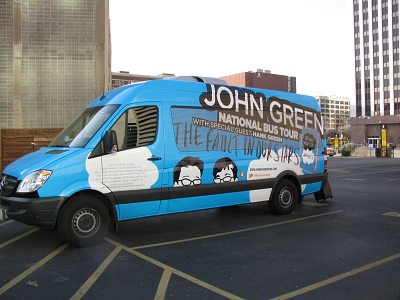
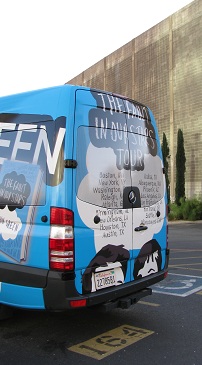
I spotted his van the next day when walking back to my hotel:

I walked in late to the talk, since I had been at a committee meeting. But here are my notes. It turns out that this works as a Librarians Help post as well. John Green is definitely a supporter of libraries and librarians.

While he was writing, he was still tweeting and using youtube and tumblr. He uses those because he likes them. After all, he likes talking about stuff that matters with people he finds interesting.

“There’s no such thing any more as a non-social-media internet.”

Social media has a lot of similarities with real life connections.

There’s so much location-based social media, that’s fantastic for librarians. “People are building real life connections in real life places.”

Librarians have been good at raising the quality of discourse for hundreds of years.

It’s difficult to build space for thoughtfulness.

Librarians should infiltrate digital communities and raise the quality of discourse.

“Reading builds strong and deep connections between people.”

They are building productive communities online. Some examples are kiva.org for Nerdfighters and dftba.com and wells in Haiti through water.org

Ultimately these are not opposite ideas: Reach out into the world and organize information to help people.

“The ultimate thing that librarians do is help people toward the answer to the overwhelming ultimate question of how to organize our lives.”

Then talking about teens: “Teens are having a lot of interesting things happen to them for the first time.”

His recommendations for reaching teens? Use Tumblr. Look for communities in your community that are active. Search the name of your community. Join the nerdfighters group in your area.

“Education exists for the benefit of the society, not the individual.”

Lead people to interesting places online.

Librarians Help! Conference Edition

It’s been more than a month since my last Librarians Help! post. During that time, I went to ALA Annual Conference. What did I learn there? More ways to help, of course!

Librarians:

— Help parents build early literacy skills in their little ones.
— Help older kids learn to read.
— Help show kids the fun side of reading.
— Provide a place to come in from the heat.
— Provide conversation about technology and privacy and ethical use of technology.
— Provide exposure to technology.
— Show how to use technology to promote learning.
— Help people trace genealogy.
— Help people find their next book to read.
— And, of course, promote great books by giving prestigious awards.

I’ve got notes from some of the people I helped before I went to California for the conference (and vacation with family and friends), so I’ll post a few of those.

— Lots and lots of requests for specific books or specific topics
— Got out some old photos of a local high school from the rare book room.
— Ordered microfilm from the Library of Virginia.
— Figured out the title of a book from a fragment on one copied page.
— Answered the question: What were the top three companies (by any criteria) in 1939?
— Helped someone copy a pdf file on the public computers.
— Helped someone load library books onto their Nook.
— Helped a customer format her resume.
— Answered question about salaries of congressional staff.
— Provided a definition of “cognitive dissonance” over the phone.

And here’s a link to an excellent article on Kentucky Teacher about the value of School Librarians: “Why You Need Your School Librarian.”

Have I convinced you yet? Librarians Help!

Conference Corner – 2012 Printz Program and Reception

2012 ALA Annual Conference is done, and I have lots of notes to share! Since I’m way behind on writing up my notes from Midwinter and from PLA, I decided to work backwards. When I finally get to notes I’ve already shared I’ll be done. The goal will be to post at least one Conference Corner post each week, but maybe I can do better. I’d like to catch up before KidLitCon in the Fall or maybe the Horn Book at Simmons symposium or maybe VLA Conference. (Now that my son will be in college, there are so many possibilities!)

The final event for me at ALA Annual Conference this year was the Printz Awards Reception. I always love the Printz speeches. I love it that everyone gives a speech, honor winners and the big honcho award winner. They always make sure to say nice things about libraries and librarians, so their words are treasured.

The night began, not surprisingly seeing who got the Honor award, with comedy. Daniel Handler and Maira Kalman gave a speech together thanking us for the Honor for Why We Broke Up.

Then Daniel Handler played the accordion and sang “Without Libraries We’d be Dum,” with special effects by Maira Kalman. This is worth experiencing!

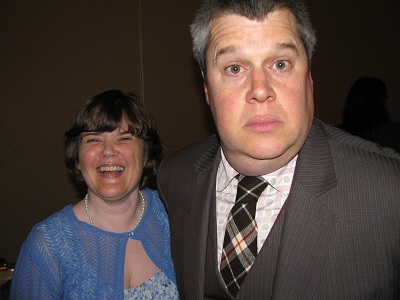
I got a picture with Daniel Handler at the reception. He seemed pleased that he got it to come out looking like someone had pasted him in. (Maybe I did?)

Next Honor winner was Christine Hinwood for The Returning. She told a great story of finding out she’d won an Honor. She had been without internet access and found out on a train. She said she broke all the rules of British train riding and danced down the aisle.

She said, “Teenagers are people, too.” She writes for people.

She also spoke up for the power of fantasy novels. “The fantasy books she read as a child are not childish.” “Fantasy allows exploring issues. . . without baggage.”

The Returning explores issues about war. How do combatants go back to family and a day job once the war is over? So many are affected by war for so long after the war is over.

Craig Silvey was the next speaker, honored for his book Jasper Jones.

I got a picture with him. He has an adorable Australian accent. He said that YALSA has been “absurdly kind to Australians” in their award choices. Many of us firmly believe it’s to get to hear their accents at the Printz Program.

(Oh look! I think that’s Christine Hinwood right behind me.)

Craig Silvey was quite ill when the Printz call came. He “let it ring out” twice, but finally answered this persistent caller. In his brain-addled state, his first thought was, “Oh my goodness. I’ve been honored by Prince.?” Fortunately, the committee gave him more information before he could follow up on this thought.

Like so many Printz Honorees, he talked about growing up in the library. I liked this line about reading fiction: “The truth, I found, was hidden in the lies.”

He talked about accidentally checking out A Clockwork Orange when he was ten years old. “I learned a very valuable lesson: Stories were powerful.”

Next up was Maggie Stiefvater, honored for the book I loved so much, The Scorpio Races.

Maggie Stiefvater also talked about the power of Fantasy. She began with a reading from Diana Wynne-Jones. 10-year-old Maggie thought the food described was wonderful. And yet it didn’t exist. It was imaginary.

For a truly great book, Maggie Stiefvater wants a book with another world inside it.

What makes us believe in a place? Diana Wynne-Jones showed the symptoms of a culture. It was the little things.

“Thisby is a big place made of tiny little sensations.”

Last of all was the acceptance speech from Printz Award Winner John Corey Whaley, still incredibly cute and still incredibly young.

He, also, had some great things to say about books, reading, teens, and libraries.

“You connect teens to worlds beyond their imaginations.”

John Corey Whaley found the story he was supposed to tell. “Listen closely when you open the book and you may hear the faintest sound of banjos.”

His book asks the question: “Is it possible to grow up in an impossible world?”

Talking about writing, he said, “Don’t we all want to make some dent in the side of the world?”

“Teens want the truth about everything, and they know exactly when they aren’t getting it.”

And he closed off with a rallying cry for libraries:

“Close our libraries, and you close our lives.”

“Tweet this: #SaveALibrary”

ALA Annual Conference 2012 Summary

ALA Annual Conference in Anaheim has finished up! I’m now sitting at my sister’s house, with vacation time for the rest of the week (Yay!), so I’m not sure how much I’ll post before I go home. Eventually, I’d like to give detailed notes for each event in my Conference Corner posts. But here, I’ll sum up the things I did.

It all began Friday. I made it to the Opening Session with Rebecca MacKinnon, a fascinating look at how we need to take a careful look at Internet Security and how it applies to human freedom and privacy, or lack thereof, around the world. I got a copy of her book, Consent of the Networked, and got it signed.

Then: The Exhibits. By waiting in line to get my book signed, I had missed the wild “Running of the Librarians” and some of the crazy book-grabbing frenzy that invades our minds at this time. As such, I was able to restrain myself to one suitcase full of books. (Yes, folks, I have a medical excuse. Get over it!)

Here’s a picture of my loot at the end of the conference, combined with my sister’s loot from a one-day exhibit pass. Hers is only one pile. I believe my total at the end was 68 books. (This is huge progress. I think at my first ALA, I came home with twice that many.)

On Saturday, I gave my sister (with whom I was staying) an exhibits day pass and a ticket to meet me at the Margaret A. Edwards Luncheon, but I went on ahead to visit the exhibits (more loot) and then hear a session on Putting Laughter in Literacy with Alan Sitomer and Raina Telgemeier. Alas! Sara Pennypacker, who was also to speak, was held up by a cancelled flight. Then came the Margaret Edwards Luncheon. I stood in line with Garth Nix! (squee!) And then, already having chosen seats at a table, Susan Patron sat down next to me, so we got to talk during the lunch! (squee! squee!) Pictures will definitely follow.

Saturday afternoon included very valuable sessions on Implementing Every Child Ready to Read 2 and then “Traveling the Spectrum: From Interstellar Adventures to Epic Fantasy, the influence of Science Fiction and Fantasy on the world today. This featured the stellar speakers Blake Charlton, Lois Bujold, and George R. R. Martin, so was excellent! Alas, had I but known, those who got a goodie bag of books by the authors had to stand in line for an hour ahead of time.

Afterward, I had the good luck to run into my co-worker from Fairfax County, so we had dinner together. I had an invitation to a publisher dessert at 9 pm, but I was way too tired by then, and went back to my sister’s house.

Sunday I did get there earlier, and caught the speaker Dan Ariely talking about interesting things he learned in researching his book: The Honest Truth About Dishonesty. Afterward, I got the book signed and hit the exhibits. For the 10:30 session, I got to hear my co-members of ALSC’s Children and Technology Committee speak on using apps in public and school libraries, and then got to have lunch with two of them afterward. After lunch, I attended an information-packed session on getting information out of the 1940 US Census. That information is going to be highly valuable to me when I sub in the Virginia Room. Then it was back to my sister’s to change for the Newbery Banquet.

The Newbery Banquet was, of course, a highlight of the whole conference experience. Chris Raschka spoke about art and memory. Jack Gantos had us roaring with laughter. And we were in a crowd of people who love children’s books.

The final day, for me at least, was Monday. This time I managed to get up early enough for the first session: The Digital Lives of Tweens and Teens. Interesting facts about the current group of 10- to 14-year-olds and how these facts impact the way we should serve them.

Then I was going to go to the session on crossover adult/YA books, but it was way too crowded, so I went to the ALSC awards, where the Siebert, the Batchelder, and the Geisel Awards were given, followed by an ALSC member meeting.

Finally, I hit the closing of the exhibits. It was probably a good thing that they had already wound down almost completely, though I was still able to get a copy of Siebert Honor book Witches signed by the author. Then the plan was to go back to my sister’s, but I had locked my keys in the trunk! (Urgh!)

However, after I called the rental car company and they told me it would cost $57, I went to get something to eat and saw my Triple A card. I was able to get it put on my AAA card instead of the rental car company. And, even better, the tow truck driver was so nice, he made me happy to have locked my key in the trunk because it gave me the opportunity to have my day brightened.

Back at my sister’s, I had enough time for a nap before the Printz Awards. All the Printz Award and Honor speakers were stellar, but Daniel Handler and Maira Kalman started it off with a rousing chorus of his song on the accordion, “Without Libraries We’d Be Dumb.” I was a little hurt today to discover he had not actually composed it as a Printz Honor speech, but I do have to share where I found the full text of his “speech” on YouTube. You must note, however, that the crowd at the Printz Award Reception was far, far more enthusiastic.

More details and notes will follow!

Conference Corner – ALA Midwinter Meeting – Susan Cain on Introverts

I’m continuing a weekly blog series, “Conference Corner,” where I share my notes from conferences. I’ve now finished the first big day of Midwinter Meeting, when I got to attend the Morris Seminar. Next up was the main conference. Midwinter Meeting is more about committee meetings than educational sessions, but there were still quite a few noteworthy sessions for which I will share my notes. First up was Susan Cain, author of the book Quiet: The Power of Introverts in a World That Can’t Stop Talking.

They also gave us a copy of the book afterward, and we got to have her sign it. Since I read nonfiction very slowly – theoretically so I can absorb it better, but practically speaking because I’m reading lots of nonfiction books at a time and rotating them – I have not yet finished the book. When I do finish, I will definitely review it here.

I have a feeling at a library conference there was perhaps an unusual proportion of introverts in the crowd. Susan Cain began her talk by discussing the main differences between extroverts and introverts. The primary difference is this: Where do you get your stimulation?

Introverts are more stimulated by lower levels of sound, light, or other outside sources. Social stimulation is the highest level of stimulation.

There are some profound advantages to being more easily stimulated.

She talked about some big contributions to society that have been made by introverts. But recently there’s a strong bias against introverts.

“When we view introversion as somewhere between a disappointment and a pathology, it’s a colossal waste.”

Many times, introverts try to pass as extroverts. This is a loss for us all at a social level.

Even in the animal kingdom, there are introverts and extroverts.

When introverted children are sitting quietly, they are paying more attention. They take in subtleties that others miss. Introverted kids know more than extroverts, even with same intelligence.

Introverts also take less risks. “Extroverts seize the day. Introverts make sure there’s a day left to seize.”

Most creative people tend to be introverts, because solitude is an important catalyst for creativity, and introverts are comfortable being alone.

Susan Cain’s Three Main Points:
1) Call for a world with more peace and quiet for everybody.
2) Call for a world in which we enjoy and celebrate introverted children.
3) We need to understand how much introverts and extroverts need each other.

We need to come together and truly delight in each other.

“Introverts are not antisocial, but differently social.”

Conference Corner – 2012 Morris Seminar – Panel Discussion and More

I’m awfully behind on posting notes from conferences. And there’s definitely added value if I share what I’ve learned. So – I’ve decided to attempt a weekly feature – Conference Corner – to share what I’ve learned at conferences. It will be awhile before I catch up, especially since I’m going to ALA Annual Conference next month, and I still haven’t finished talking about the Morris Seminar, ALA Midwinter Meeting, and PLA Biennial Conference.

One of the highlights of the Morris Seminar, a one-day seminar offered by ALSC to train people to be on book evaluation committees, was when we got into groups and practiced what we’d learned with books we’d read ahead of time. Here’s a picture of part of the group I was with. You can at least tell we were all having fun!

After lunch, we listened to a Panel Discussion featuring past committee chairs from some different ALSC Award committees: Martha Walker, from the Pura Belpre committee; Julie Roach, from the Geisel committee; Mary Burkey, from the Odyssey committee; Rita Auerbach, from the Caldecott committee; and Cyndi Richey, from the Newbery committee.

I took down some rather haphazard notes about the different committees. Below are some of the things they said.

Geisel: You’re evaluating text and pictures together. The illustrations need to work for someone just learning to read. One committee member adopted a classroom to try out the books.

Notable Committees: These are open committee meetings. Everyone’s equal when you walk through the door. You can learn about book evaluation by listening to these committees.

Audiobook evaluation: Assume the book is good. Now look at the narrator and the story. You’re evaluating production quality.

Here are some things to consider about the narrator of an audiobook:

Was the narrator authentic and genuine to time, character, etc?
Does meaning come through?
Is voice consistent?
Are accents correct?
“He said” “she said” should be dropped.
Don’t want a “fake voice.” You shouldn’t perceive that someone’s reading into a microphone.
Also think about the production quality. Don’t let a story you love blind you to the way it’s carried out.
Recommended book: Listening to Learn: Audiobooks Supporting Literacy, by Sharon Grover.

I took lots of notes about the Caldecott committee:

Rita Auerbach said she had less influence when she was the chair than when she was a regular committee member.

The function of the chair is to keep things going smoothly.

To be a good Caldecott committee member:

Participate in the discussion.
Read and respond on time.
Respect other members and couch concerns as questions.
Be willing to be cut off.
Don’t make up your mind in advance.
You can have an opinion, but at least be open to making your opinion change.

Picture books are difficult to discuss. Cultivate the vocabulary for talking about art.

Believe that artists, like authors, make decisions.

Think about the impact.

When discussing, don’t go through the book page by page. Use post-its to mark what you want to talk about.

Remember: There is room for interpretation.

“Most distinguished American picture book” does not necessarily have the most distinguished art.

How to prepare:
Read the books suggested in the manual, such as Picture This: How Pictures Work, by Molly Bang, and Show and Tell: Exploring the Fine Art of Children’s Book Illustration, by Dilys Evans

Your basic premise is that the illustrator has done everything deliberately. How does it impact the book?

What do you see? How does it make you feel?

You can consider text, design, and everything else that goes into the book.

Notes about the Newbery Committee:

Being on the committee builds mutual respect and trust between the members.

Look at the role models in your life and seek out opinions.

You will not remember what you read. Definitely take notes!

Best advice: Keep an open mind.

You’ll look at Suggestions and Nominations.

“Read while you eat. That’s called ‘reating.’”

This will be your most professionally satisfying experience because everyone’s read the same books.

To get prepared, attend a Notable Books discussion.

You can’t even have an appearance of a breach of confidentiality or conflict of interest.

Be on the lookout for other critical discussions. (This is why I’ve joined Capitol Choices.)

This is a literary award for literature for a child audience.

Recommended: Books by Lee Gutkind on creative nonfiction, From Cover to Cover, by K. T. Horning

It’s so important to listen! And listen without frowning.

Being in a committee will help you to use and hone your skills. You’ll use them for a lifetime.

Gearing Up for the Morris Seminar and ALA Midwinter Meeting

I’m so excited! Four years ago, the Association for Library Service to Children announced it would be starting the William Morris Seminar: A biennial invitational training in book evaluation skills, run by people who have selected past Newbery, Caldecott, Odyssey, Geisel, and other award winners.

I applied that time, but didn’t get accepted. I applied two years ago, but didn’t get accepted. I applied this time and did! So will I let a little thing like iffy health after a stroke stop me from attending? No, I will not!

But now it’s getting down to the wire. The seminar is this coming Friday, in Dallas, and as soon as it is over, ALA Midwinter Meeting begins. I have today off, but I will be working tomorrow and Wednesday. Wednesday night, I have to go to a “Senior Night” for parents at my son’s school. I believe they are mainly collecting money! But also some information will be given out, and I need to fill out some forms and drop off a toddler picture of my son. Then I leave on Thursday.

In the meantime, I also really need to get the FAFSA and CSS Profile paperwork done for my son’s financial aid applications. Because if I wait until after the seminar, the time will be too short. Better do it today, but I do find myself definitely procrastinating.

On a more fun note, I should go over again the books on our discussion list. I’ve read them all, but I should look at them afresh in terms of discussing their distinguished qualities. I think I will interrupt my reading plans to reread Okay for Now after I finish Death Comes to Pemberley and take notes for discussion.

Then there’s the matter of packing. I am sure I will have plenty of chances to pick up books to read once the conference starts on Friday. But what to read on the plane? What to read Thursday night? I may well have finished rereading Okay for Now by then. The next item on my 2012 Reading Plan is an Award Winner. I was going to read Please Ignore Vera Dietz, but I don’t like to bring hardcover library books on trips. So instead, I think I’ll go further down the list and read Everybody Sees the Ants, also by A. S. King, which is a 2011 Cybils Finalist, and which I have as a paperback ARC. After that, my plan says I read a prepublication ARC, so I think I will tuck in Drowned Cities, by Paolo Bacigalupi. Since I’m also bringing Okay for Now for the Morris Seminar, and since I will have plenty of opportunities to pick up new books, that will surely be plenty to bring. The big question is, can I really stop with those three? We shall see….

Of course another huge highlight of ALA Midwinter is the Youth Media Awards announcements on Monday morning. In the past, I’ve followed those on the internet, so it will be a thrill to be there in person, especially having discussed possibilities in detail at the Morris Seminar.

Another thing that makes me happy about ALA Midwinter is that I’ve already connected with some friends who will be there. I’ve only officially been a Librarian for four years, so I am very happy to already have some good friends in the library world. I’ve made them via Twitter, blogs, KidLitCon, our local DC KidLit book club, and other ALA events, and these are people who are also interested in great books for children. It feels very good to feel part of this world and have actual friends I’m excited to see and some to meet in person for the first time. Oh, and on top of that, my writing buddy is going to come for the weekend and share my hotel room. We met in Paris and she is a wonderful vivacious and encouraging person, and I’m so excited to get some time with her.

Of course, on top of all that, I’d really like to get my 2011 Stand-outs page posted! And all the reviews written for the books I chose. We shall see. This day off is already getting out of hand. And did I mention that on top of all of it, I’ve caught a cold? Oh, and I finally have an appointment with my neurologist — the day after I come back — to find out if I had another stroke some time in December. At least that way he won’t have the chance to tell me not to go!

Speaking of my neurologist, I was proactive and got a note from him to allow me to bring a rolling cart onto the exhibit floor. Since every single e-mail about the conference ends with the admonition: “No rolling carts are permitted on the exhibit floor!” I hope that this note will give me an exception. At ALA last summer, I knew my shoulder and neck seemed to be hurting extra from carrying a heavy bag of books, but I didn’t realize I’d had a vertebral artery dissection and was probably making it worse. Now I’m going to stick to my guns and insist on that cart.

I’ve already had two different dreams about ALA Midwinter! In one, I met Brian Selznick and was discussing why I think his book is fabulous as a whole, but I don’t think the text or illustrations on their own are distinguished enough to win (though I would be happy enough if I’m wrong). In the next, I was at an SCBWI Conference, happily picking up free books. I must be excited!

KidLitCon 2011

I spent last weekend in Seattle at KidLitCon and had a fabulous time!

KidLitCon is an annual gathering of bloggers who specialize in children’s books. I went when it was in Washington, DC in 09, and loved it. Last year, it was the same weekend as the Horn Book Colloquium at Simmons, and that was closer, so I went to Boston instead, and got to be a fangirl meeting Megan Whalen Turner. But this year, especially when I heard it would be in Seattle, I wanted to go to KidLitCon again.

What did I take away from KidLitCon?
1. Connection!

KidLitCon is the friendliest conference you could ever hope to attend. I figure it’s because almost no one who attends blogs for their job — they do this because they love it. So you’ve automatically got about a hundred people who love what you do. Definitely a bunch of kindred spirits!

This year, there was a special connection for me. You see, seven years ago, I posted a review of The Hollow Kingdom, by Clare Dunkle. Clare also lived in Germany at the time, and she got in touch with me, and we became friends. Clare was the one who put me in touch with Farida Dowler. Sure enough, our reading tastes made us friends and we became e-mail buddies. Later, when my marriage was falling apart, I needed friends to talk to about it who didn’t know my husband, so I could say all I needed to say without hurting his reputation. Farida provided a kind and helpful ear, and over the years I came to think of her as a dear friend.

So, at KidLitCon, I finally met her!

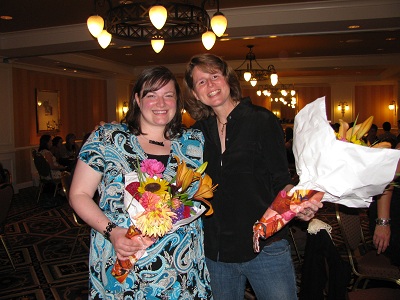
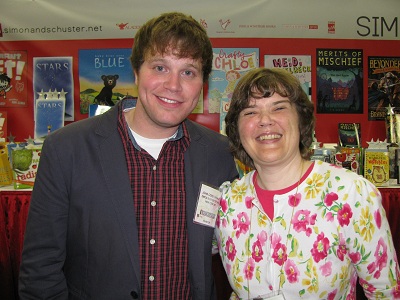
Here I am with my dear friend Farida, finally meeting in person! (And I was delighted when her round up of the conference also talked about how nice it was to meet!)

Some other lovely connection moments were meeting my roommate, Lisa Song of Reads for Keeps (we’d worked out the arrangements via e-mail, and she ended up being delightful); having a spontaneous dinner with Dorine White of The Write Path; and finishing off the conference with breakfast with Liz Burns, of A Chair, a Fireplace, and a Tea Cozy, whom I first met at KidLitCon09, and saw again at two ALA conferences. But that doesn’t mention all the many interactions with so many wonderful and friendly people. From start to finish, KidLitCon is the perfect place to meet people who love what you love and are happy to meet you, too.

Here’s a lovely group of people I had lunch with:

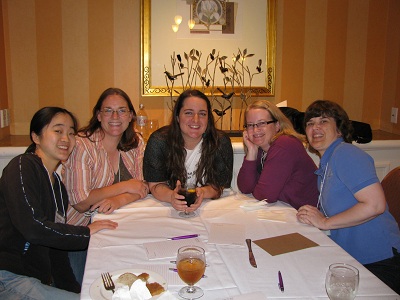
Above are Lisa Song, Melissa Fox, Maureen Kearney, Liz Burns, and me.

Let me repeat that the people I met at KidLitCon (including the ones I didn’t get pictures of) are fantastic people! Passionate about books and reading and literacy and libraries, and just a wonderful community to be part of.

What else did I get out of KidLitCon?

2. Encouragement!

A lot of the panels were about doing what I believe I’m already doing: Blogging about both old and new books; writing reviews that tell why I reacted a certain way to a book; trying to do good with my blog. These panels were inspirational, and gave me additional ideas to do what I do even better. They rekindled my excitement about being a book blogger.

Chris Singer of Book Dads reminded us that the books you choose to review can make a difference.

The panel with Maureen Kearney, Melissa Fox, and Jen Robinson encouraged that blogging a variety of types of books can keep your passion alive.

The panel on Critical Reviews, with Kelly Jensen, Abby Johnson, Julia Riley, and Janssen Brandshaw, gave us some nice tools of things to look at when analyzing why a book worked or didn’t work for you.

Richard Jesse Watson talked about using your blog to play, to express yourself. He said, “Isn’t blogging like yodeling into the abyss?” He also said that play is one of the most important ways to rejuvenate your voice. He left me inspired to have fun with blogging and try new things.

3. Fascinating Information!

Friday night, we met a whole bunch of Seattle-area authors, as they got to talk for 90 seconds about their latest book. Of course my to-be-read list just got longer.

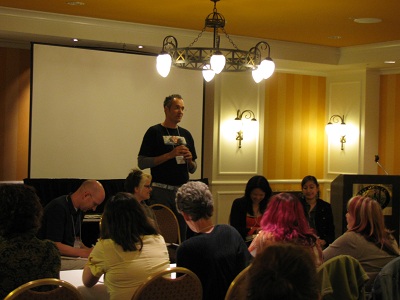
The Keynote Address by Scott Westerfeld on Saturday morning was wonderful. He talked about how he came up with the idea for the Leviathan series and how working with an illustrator changed how the story went. He talked about how technology changes our lives, but you can’t predict ahead of time how it will go. He showed some fan art and said that, thanks to fan art on the internet, we may be living in the age of the illustrated novel again. Another good quote: “In the west, we crazily think that illiteracy is related to pictures.”

In the panel “Moving Beyond Google Reader,” Jen Robinson gave some good instruction about how to set up a weekly or biweekly newsletter with your blog. Since that’s how Sonderbooks started, I definitely plan to follow her instructions to get back to that.

And the final panel, “Prejudice and Pride,” on Diversity, was simply amazing in all the good stuff that came out.

In the picture are Brent Hartinger, Sara Ryan, moderator Lee Wind, Justina Chen, and Sarah Stevenson.

Some quotables from that panel:

“What we are doing is art, not sociology.” — Brent Hartinger

“We’re writing a character, not an archetype.” — Lee Wind

“Do you have the right to write a character who isn’t you? YES!”

“This is a call for a plenitude of stories.” — Justina Chen

More than one author pointed out that the more stories there are about a group, the less tense people get. So the solution: Let more stories be told!

“You have tremendous power in what you choose to talk about.”

Also, we do need a certain distance from a topic, so sometimes people NOT in a particular group can tell a story better.

Remember: “People are not only one thing!”

So, that begins to tell you how wonderful KidLitCon was. I never would have gone if I’d realized I’d be recovering from a stroke, but I’m so glad I did! And it did not solve my problem of needing more sleep, and so getting way behind on blogging. However, it did remind me how much I love blogging and books and bloggers and book people. And it reminded me I’m doing it for fun, but I am also doing good while I’m at it.

Finally, big kudos to the organizers who put together a fabulous conference! Here are Jackie Parker of Interactive Reader and Colleen Mondor of Chasing Ray:

Thank you so much, ladies, for planning a weekend I will never forget!