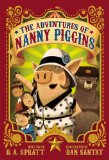
Review of The Adventures of Nanny Piggins, by R. A. Spratt

The Adventures of Nanny Piggins

by R. A. Spratt
illustrated by Dan Santat

Little, Brown and Company, New York, 2010. First published in Australia in 2009. 239 pages.
Starred Review

Move over Mary Poppins! Nanny Piggins is not a nanny who teaches her charges valuable lessons. In fact, the Disclaimer at the front warns you of things to come:

You are about to read a wonderful book. Nanny Piggins is the most amazing pig ever. It has been a privilege to write about her. But before you begin I must (because the publisher has forced me) give you one small warning. . .

Unless you are a pig, do not copy Nanny Piggins’s diet IN ANY WAY.

You see, pigs and humans have very different bodies. Pigs are a different shape (mainly because they eat so much). Plus, Nanny Piggins is an elite athlete so she has a freakishly fast metabolism that can burn a lot of calories.

So please, for the good of your own health, do not try to eat like Nanny Piggins. There is no doubt that chocolate, cake, cookies, tarts, chocolate milk, sticky cream buns, candy, ice cream, lollipops, sherbet lemons, and chocolate chip pancakes are all delicious, but that does not mean you should eat them seven or eight times a day.

Also, you really must eat vegetables, no matter what Nanny Piggins might say to the contrary, or you will get sick.

Yours sincerely,
R. A. Spratt, the author

P.S. The publisher also wants me to mention that you really should not try a lot of the things Nanny Piggins does either. For example, throwing heavy things off roofs. Firstly, because you might give yourself a hernia lugging it up there. But mainly, because if it landed on someone that would be terrible. So please do not copy Nanny Piggins’s behavior (unless you are under the close supervision of a responsible adult pig with advanced circus training).

Yes, Nanny Piggins is a pig. A pig who has left the circus, where she was a flying pig shot out of a cannon. Mr. Green hires her to watch his children because she only charges ten cents an hour. Yes, Nanny Piggins’s behavior is completely outrageous — and therefore tremendous fun to read about. Sensitive parents who aren’t sure their children would fully understand why they do not apply Nanny Piggins’s methods might find this book would make an excellent family read-aloud. (Then the parents can include wise instruction as to why such behavior is not advisable. They can also enjoy the fun along with their kids.)

Here’s an example that made me laugh, from when Mr. Green gives Nanny Piggins money to buy uniforms:

Happily, as it turned out, Nanny Piggins’s idea of a good investment was to buy four tickets to an amusement park. The children had the most wonderful day. They went on all sorts of terrifying rides. On some they were flung high into the air until they were convinced they were going to die. And on others they were spun around and around until they were utterly sick.

In fact, Michael was sick. Fortunately the ride was going at full speed at the time, and the vomit flew cleanly out of his mouth and into the face of the person behind him. So Nanny Piggins did not have to trouble herself with cleaning up his clothes.

“Well done, Michael,” Nanny Piggins complimented him. “With aim like that you could get a job at the circus.”

Here’s the way Chapter Four opens:

It was seven o’clock at night, and Nanny Piggins and the children were happily crouched on the floor of the cellar, holding a cockroach race, when they heard the distinctive harrumph sound of a throat being cleared behind them.

Now, one of the first things Nanny Piggins had taught the children was what to do if someone walks in on you when you are doing something bad. So the children did exactly as they had been trained — they stayed absolutely still and did not say a word, completely ignoring the four cockroaches as they scattered across the floor in front of them. Nanny Piggins made a mental note to recatch hers later because it was a big one with long legs and it would be a shame to let it run wild. Apart from making excellent racers, cockroaches can be tremendously handy for shocking hygenic people and clearing long lines at the deli.

As the author warns us repeatedly, Do not try this at home! But you can certainly enjoy reading about it at home. And if you won’t feed your kids junk food at every meal, where’s the harm in letting them fantasize about a nanny who does? This book is full of silly, over-the-top, good-hearted fun.

raspratt.com
dantat.com
lb-kids.com

Buy from Amazon.com

Find this review on Sonderbooks at: www.sonderbooks.com/Childrens_Fiction/nanny_piggins.html

Disclosure: I am an Amazon Affiliate, and will earn a small percentage if you order a book on Amazon after clicking through from my site.

Source: This review is based on a library book from the Fairfax County Public Library.

Disclaimer: I am a professional librarian, but I write the posts for my website and blogs entirely on my own time. The views expressed are solely my own, and in no way represent the official views of my employer or of any committee or group of which I am part.

Please use the comments if you’ve read the book and want to discuss spoilers!
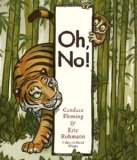
Review of Oh, No! by Candace Fleming and Eric Rohmann

Oh, No!

Words by Candace Fleming
Pictures by Eric Rohmann

Schwartz & Wade Books (Random House), New York, 2012. 36 pages.
Starred Review
2012 Sonderbooks Stand-out #9 Picture Books

This book charmed me from the moment I saw it. I simply had to read it aloud. The story can be sung to the tune of “Froggie Went a-Courtin’,” with a few adjustments. In place of “Uh-huh,” you’ve got a refrain of “Oh No!” in very appropriate spots at the end of each verse, and other fun sound effects earlier in the verses.

The story is simple: Several animals fall into a hole, and can’t get out, and it looks like Tiger will eat them. When each animal falls in, we have appropriate sound effects: “Ribbit-oops!” for frog; “Pippa-eek!” for mouse; “Soo-slooow!” for loris; “Grab on!” for sun bear (bending down a branch); and “Wheee-haaaa!” for monkey. When tiger comes to taunt them, anticipating his dinner, it’s “Slop-slurp!”

But someone bigger than Tiger comes along to help, the tables are turned, and no one gets eaten. Will the animals help Tiger out of the trap? “Oh, no!”

Caldecott winner Eric Rohmann has outdone himself with the beauty of these illustrations. The book has so many elements great for a storytime picture book: A catchy tune or rhythm (if you don’t want to sing it), fun sounds, repetitive and progressive story line with nice twists, animals they might not have known, and a turn-about story that will appeal to their sense of justice.

Now, there are some places where the exact tune has to be adjusted a bit. Personally, I found I was not capable of reading it straight, without putting it to the tune. Others may have better luck! But either way, this book begs to be read or sung aloud, and you will definitely want to share it with a child.

candacefleming.com
ericrohmann.com
randomhouse.com/kids

Buy from Amazon.com

Find this review on Sonderbooks at: www.sonderbooks.com/Picture_Books/oh_no.html

Disclosure: I am an Amazon Affiliate, and will earn a small percentage if you order a book on Amazon after clicking through from my site.

Source: This review is based on a library book from the Fairfax County Public Library.

Disclaimer: I am a professional librarian, but I write the posts for my website and blogs entirely on my own time. The views expressed are solely my own, and in no way represent the official views of my employer or of any committee or group of which I am part.

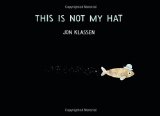
Review of This Is Not My Hat, by Jon Klassen

This Is Not My Hat

by Jon Klassen

Candlewick Press, 2012. 36 pages.
Starred Review
2012 Sonderbooks Stand-out: #4 Picture Books

What is it with Jon Klassen and stealing hats? This Is Not My Hat is remarkably similar to his last year’s book, I Want My Hat Back (which was also my #4 Picture Books Stand-out), while having completely different characters, a completely different setting, and even a very different hat! But as in the earlier book, justice is dramatic, swift and sure while at the same time off stage and mysterious, but highly satisfying. (Alas! Perhaps I’m more bloodthirsty than I realized.) And in both the occasion of said justice — stealing a hat — is a wonderful child-sized problem perfect for discussion.

Here are some ways the two books are similar:

1. A hat is stolen.
2. The victim of the hat theft is outraged and angry (as evidenced by their wide eyes).
3. The thief is much smaller than the one they stole from.
4. The thief is doing some lying, whether to others or merely to himself.
4. The illustrations are fabulous, with deadpan expressions and highly expressive eyes.
5. Both leave a delightful amount of room for children to draw their own conclusions, but I can let you in on a spoiler: The thief gets eaten. (That’s my story, and I’m sticking to it.)

In this one, the book begins with the thief fleeing the scene of the crime. He admits he stole the hat, but the big fish he stole it from was asleep and probably won’t wake up for a long time or even notice that it’s gone. As he says this, we see pictures of the big fish waking up and then noticing the hat is gone. The little fish has a plan — to go where the plants grow big and tall and close together where nobody will ever find him. Well, he does get there, with the big fish right behind. You definitely can’t see what happens inside those plants — but let’s just say it doesn’t look good for the little fish.

I love the page with the thief’s rationalization (What a way to discuss Rationalization with children!):

I know it’s wrong to steal a hat.
I know it does not belong to me.
But I am going to keep it.
It was too small for him anyway.
It fits me just right.

And you know what? He’s right! The hat does fit him just right, and is way too small with the big fish. But I still think this would make a great pairing with The Book of Bad Ideas! And what a fabulous way to discuss Right and Wrong with kids. Or, just to read a tremendously fun story, where drama and art and plot are all beautifully balanced with a delightful result. I guess there’s a little kid who enjoys justice inside all of us. Or at least a person who enjoys a good story.

candlewick.com

Buy from Amazon.com

Find this review on Sonderbooks at: www.sonderbooks.com/Picture_Books/this_is_not_my_hat.html

Disclosure: I am an Amazon Affiliate, and will earn a small percentage if you order a book on Amazon after clicking through from my site.

Source: This review is based on a library book from the Fairfax County Public Library.

Disclaimer: I am a professional librarian, but I write the posts for my website and blogs entirely on my own time. The views expressed are solely my own, and in no way represent the official views of my employer or of any committee or group of which I am part.

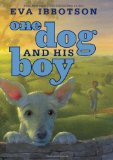
Review of One Dog and His Boy, by Eva Ibbotson

One Dog and His Boy

by Eva Ibbotson

Scholastic Press, New York, 282 pages.

This book could have been named, A Poor Little Rich Boy and his Adventures with Five Dogs, but the actual title does tell you about the central story of one boy finding the dog who’s right for him, and that dog finding the boy.

The book begins with the boy:

All Hal had ever wanted was a dog.

He had wanted one for his last birthday and for the birthday before, and for Christmas, and now that his birthday was coming around again he wanted one more desperately than ever. He had read about dogs and dreamed about dogs; he knew how to feed them and how to train them. But whenever he asked his mother for a dog she told him not to be silly.

“How could we have a dog? Think of the mess — hairs on the carpet and scratch marks on the door, and the smell. . . . Not to mention puddles on the floor,” said Albina Fenton, and shuddered.

And when Hal said that he would see to it that it didn’t smell and would take it out again and again so that it didn’t make puddles, she looked hurt.

“You have such a beautiful home,” she told her son, “I would have thought you would be grateful.”

This was true in a way. Hal’s parents were rich; they lived in a large modern house in the suburbs with carpets so thick that your feet sank right into them and silk curtains that swept to the floor. There were three new cars in the garage — one for Albina, one for her husband, and one for the maid to use when she took Hal to school — and five bathrooms with gold taps and power showers, and a sauna. In the kitchen every kind of gadget hummed and buzzed — squeezers and coffeemakers and extractors — and the patio was tiled with marble brought in specially from Italy.

But in the whole of the house there was nothing that was alive. Not the smallest beetle, not the frailest spider, not the shyest mouse — Albina Fenton and the maids who came and went saw to that. And in the garden there were no flowers — only raked gravel — because flowers mean earth and mess.

When Hal persists in asking for a dog, his father gets a bright idea. He will rent a dog from Easy Pets for the weekend. After all, “By the time the dog has to go back, Hal will be tired of him — you know how quickly children get bored with the things you give them. He only played with that indoor space projector we got him for Christmas for a couple of days and it cost the earth.”

Well, you can imagine how well it goes over when Albina has to bring the dog back. (Hal’s father was so conveniently scheduled to leave on another trip before Easy Pets opened.)

Hal ends up running away with his dog, heading to his grandparents, who live in the north of England. But he ends up traveling with a girl whose sister worked at Easy Pets and four other dogs who also were not where they belonged.

The story includes lots of coincidences, but it’s sweet and happy and funny. Spoiler alert: All the dogs end up where they should be, but the process is reminiscent of the great adventure in Dodie Smith’s The 101 Dalmatians.

Here’s a story of great love between a dog and a boy, and best of all, no dogs are harmed in this story! Here’s a dog story that doesn’t end in tears, but with lots of smiles. Okay, maybe it’s not the likeliest of stories, but it’s a fun read.

scholastic.com

Buy from Amazon.com

Find this review on Sonderbooks at: www.sonderbooks.com/Childrens_Fiction/one_dog_and_his_boy.html

Disclosure: I am an Amazon Affiliate, and will earn a small percentage if you order a book on Amazon after clicking through from my site.

Source: This review is based on an Advance Reader Copy I got at an ALA conference.

Disclaimer: I am a professional librarian, but I write the posts for my website and blogs entirely on my own time. The views expressed are solely my own, and in no way represent the official views of my employer or of any committee or group of which I am part.

Please use the comments if you’ve read the book and want to discuss spoilers!

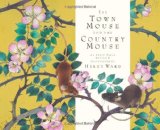
Review of The Town Mouse and the Country Mouse, retold and illustrated by Helen Ward

The Town Mouse and the Country Mouse

An Aesop Fable retold and illustrated by Helen Ward

Templar Books (Candlewick Press), 2012. Illustrations copyright 2011. 44 pages.
Starred Review

Here’s the familiar Aesop Fable, told with lavishly beautiful illustrations. There are also few enough words on each beautiful spread to make this a hit for storytime. (Why is it that sometimes the more beautiful the illustrations, the more words on a page? Not a problem here.)

I like the way Helen Ward contrasts the City Mouse’s words with pictures of the country. For example, the first page where the City Mouse is telling the Country Mouse about his home has these words:

“In the city, we don’t have mud,” he said.
“And we don’t have dangerous wild animals.”

The picture on that spread is of a baby fawn curled up asleep in the grass.

The next page says,

“In the city, we dine on rich, exotic foods in sumptuous surroundings.”

The picture that goes with those words is of the two mice in a beautiful orchard eating wild berries.

Helen Ward has the mice come to the city along with a Christmas tree and the feast is a Christmas celebration, so you can use this for Christmas, but there’s nothing about it in the text, so you can also use it any time of year.

The moral is not spelled out, but I think it will be easy even for the youngest listeners to understand and talk about.

This book is a feast for the eyes, along with a story that never grows old.

candlewick.com

Buy from Amazon.com

Find this review on Sonderbooks at: www.sonderbooks.com/Picture_Books/town_mouse_and_country_mouse.html

Disclosure: I am an Amazon Affiliate, and will earn a small percentage if you order a book on Amazon after clicking through from my site.

Source: This review is based on a library book from the Fairfax County Public Library.

Disclaimer: I am a professional librarian, but I write the posts for my website and blogs entirely on my own time. The views expressed are solely my own, and in no way represent the official views of my employer or of any committee or group of which I am part.

Review of Frog and Fly, by Jeff Mack

Frog and Fly

Six Slurpy Stories

by Jeff Mack

Philomel Books, 2012. 40 pages.

My friend has told me that her favorite picture books are those where someone gets eaten, and now I am alert for such books and always show them to her. But I have to admit that there were already several among my favorites before I ever met her. I’ve even started a board on Pinterest highlighting these bloodthirsty — but so funny — books.

With a title like Frog and Fly, that someone gets eaten should not come as a surprise. Though the title should actually be Frog and Flies. Let’s just say that this isn’t one of those stories-about-two-unlikely-friends books.

The cartoon illustrations are accompanied by simple sentences in word balloons, with plenty of repetition. For example, one story goes like this (except no explanation of who is speaking, with the words in speech bubbles telling that clearly):

Zip! The fly lands on a dog and says, “Good morning, Dog.”

The dog says, “Yuck! Shoo, Fly!”

Zip! The fly lands on a hog and says, “Good morning, Hog!”

The hog says, “Yuck! Shoo, Fly!”

Zip! The fly lands on the frog and says, “Good morning, Frog!”

SLURP!

“Yum! Good morning, Fly!”

All of the stories have that kind of simple kicker ending. And the final story? Well, let’s say that the Frog finally gets his comeuppance.

Beginning readers will thoroughly enjoy this book, and I have a feeling it will also go over great at storytime with preschool to early elementary age listeners.

jeffmack.com
penguin.com/youngreaders

Buy from Amazon.com

Find this review on Sonderbooks at: www.sonderbooks.com/Picture_Books/frog_and_fly.html

Disclosure: I am an Amazon Affiliate, and will earn a small percentage if you order a book on Amazon after clicking through from my site.

Source: This review is based on a library book from the Fairfax County Public Library.

Disclaimer: I am a professional librarian, but I write the posts for my website and blogs entirely on my own time. The views expressed are solely my own, and in no way represent the official views of my employer or of any committee or group of which I am part.

Review of The Three Ninja Pigs, by Corey Rosen Schwartz

The Three Ninja Pigs

by Corey Rosen Schwartz
illustrated by Dan Santat

Putnam, 2012. 40 pages.

There’s a whole subgenre out there of Three Little Pigs variants, and I’ve definitely got a soft spot for them. This one doesn’t attain the heights of The Three Little Wolves and the Big Bad Pig, or David Wiesner’s The Three Pigs, but it’s definitely fun.

I don’t think I even need to tell you what happens. We’ve got three ninja pigs. The one who trains the hardest (the girl! yay!) is the one who defeats the wolf. Along the way, Corey Rosen Schwartz gives us rhymes that make us laugh instead of cringe. (Well, if you don’t love puns, you may cringe, but the rhymes are excellent. And personally, I love the puns.) Dan Santat’s square-jawed pigs are the perfect tough porkers to take on the bullying wolf.

Here’s the sister pig training:

She balanced and blocked like an expert,
and practiced her lessons nonstop.
By the time she was through,
she could break boards in two
by performing a perfect pork chop!

Okay, there’s nothing profound here, and Sister Pig manages to scare away the wolf with her ninja moves. But it’s definitely a fun addition to the subgenre. And, hey, it’s got ninjas!

Buy from Amazon.com

Find this review on Sonderbooks at: www.sonderbooks.com/Picture_Books/three_ninja_pigs.html

Disclosure: I am an Amazon Affiliate, and will earn a small percentage if you order a book on Amazon after clicking through from my site.

Source: This review is based on a library book from the Fairfax County Public Library.

Disclaimer: I am a professional librarian, but I write the posts for my website and blogs entirely on my own time. The views expressed are solely my own, and in no way represent the official views of my employer or of any committee or group of which I am part.

Review of Oh No, George! by Chris Haughton

Oh No, George!

by Chris Haughton

Candlewick Press, 2012. 32 pages.
Starred Review

This book is along the lines of No, David!, by David Shannon, but this time the naughty “child” is a dog. In many ways, I think that will help children take lessons from the book all the more, and get practice putting themselves in the perspective of someone very different from themselves on the outside, but not so different on the inside.

The pictures are simple shapes, rather like a child would draw them, with bright orange backgrounds on alternate page spreads, mostly where the words say, “Oh no, George!”

The opening pages have these words:

Harry is going out.
“Will you be good, George?”
asks Harry.
“Yes,” says George.
“I’ll be very good.”

I hope I’ll be good,
George thinks.

George sees something in the kitchen.
It’s cake!
I said I’d be good,
George thinks,
but I LOVE cake.

What will George do?

That’s the cue for a page turn, a bright orange background, a picture of George taking an enormous mouthful of cake, and the words, “Oh no, George!”

And so it goes. George is tempted to play with Cat and dig in dirt, things he LOVES to do. Before each succumbing, the audience is asked “What will George do?”

Then Harry comes back. He confronts George with his terrible mess.

I said I’d be good,
George thinks.
I hoped I’d be good,
but I wasn’t.

A tear is coming out of George’s eye, and the text reads, “What will George do?”

It turns out that George apologizes and gives Harry his favorite toy. Harry and George go for a nice walk.

On the walk, George is once again tempted by a cake, lovely dirt, and a cat. But hooray! George goes right past!

The book ends like this:

Something smells very interesting.
What can it be?

It’s a trash can. There’s nothing George likes more than digging in trash.

What will George do?

George?

You can see there are so many interesting things that can be discussed about this book! And it tells a fun story at the same time. This is sure to be a hit in storytime or on a parent’s lap.

candlewick.com

Buy from Amazon.com

Find this review on Sonderbooks at: www.sonderbooks.com/Picture_Books/oh_no_george.html

Disclosure: I am an Amazon Affiliate, and will earn a small percentage if you order a book on Amazon after clicking through from my site.

Source: This review is based on a library book from the Fairfax County Public Library.

Disclaimer: I am a professional librarian, but I write the posts for my website and blogs entirely on my own time. The views expressed are solely my own, and in no way represent the official views of my employer or of any committee or group of which I am part.

Writing Reviews, Posting Reviews

I have a problem. It’s a good problem. I am way behind on reviews I have written but haven’t posted. Right now there are 97 of them.

Partly, this problem came from the solution to an earlier problem: I was way behind on books I’d read but hadn’t reviewed. I decided to solve that problem by spending 30 minutes per day writing reviews. Some time ago, I’d tried and succeeded — for an entire year — to write 30 minutes a day on my book. For now, I’m putting my book-writing on hold. I went to the William Morris Seminar in January to learn about ALSC’s Book Evaluation Committees. It’s seen as conflict of interest to have a book being published when you are evaluating books for a committee (like the Newbery), so I decided I haven’t gotten published in all this time, why not wait a little longer and see if I can get on a committee first? Surely I can write in the meantime — just not try to find a publisher. Well, I decided that, and then got more and more lazy about my 30 minutes per day goal. When I saw how behind I was on books to be reviewed, I decided to let myself spend that time on review writing. And I’ve caught up!

Or, I’ve sort of caught up. There’s a problem. If I write one review per day but don’t post one review per day, I will never catch up. The fact is, I need to be much, much more choosy about which books I review. Right now I’ve got four books sitting here that I liked very much and want to recommend, but I think I will discipline myself and not review them.

Or, how about this: I’ll give a mini-review here and now, but won’t make a full-on page with links on my main site.

Here are four excellent books. First two picture books.

Rabbit’s Snow Dance, as told by James and Joseph Bruchac, illustrated by Jeff Newman, tells a folk tale about how rabbit got his short tail. The book would make a wonderful read-aloud, with chants like “I will make it snow, AZIKANAPO!” and a longer chant in a circle that begs for the listeners to act out. Rabbit has a nice comeuppance at the end, or, well, comedownance, and that’s how he loses his long tail. Joseph and James Bruchac are storytellers, and this story definitely wants to be told.

Sleep Like a Tiger, by Mary Logue, illustrated by Pamela Zagarenski, is one I got fresh appreciation for when I heard people talk about it at Capitol Choices. This is a deceptively simple bedtime story. A little girl is not sleepy at bedtime, and her parents tell her she doesn’t have to go to sleep, but she does have to put on her pajamas… and so on. Along the way, they talk about how different animals sleep. The pictures show the animals, like a tiger, in their habitat, while in alternate spreads the little girl settles into her bed with her stuffed animals and toys. In the end, she settles down like the animals do. This is a cozy and lovely bedtime book.

Then, two books of children’s nonfiction, both about birds:

Alex the Parrot: No Ordinary Bird, by Stephanie Spinner, illustrated by Meilo So, is another picture book, but tells a true story. It includes short chapters, but there is no table of contents and this is definitely suitable for younger kids. The story is about an African Grey Parrot and his owner, Irene Pepperberg. She used Alex to show that parrots possess true intelligence. The book talks about Alex’s progress and how he was tested and matched three-year-old children.

Moonbird: A Year on the Wind with the Great Survivor B95, by Phillip Hoose, is much longer. It covers science, nature, the environment and what you can do to help. Moonbird tells the story of a rufa red knot banded with the number B95 in the year 1995 who has been spotted since. These birds are some of the greatest distance travelers on earth, and B95 is the oldest known such bird. The book goes into detail about what physiological changes and athletic feats go into his journey. The author interviewed many scientists all interested in helping the red knots and other shorebirds continue to survive.

So there you have it — Four more excellent books. Some day, I will catch up…. Meanwhile, keep reading!

Review of Penny and Her Doll, by Kevin Henkes

Penny and Her Doll

by Kevin Henkes

Greenwillow Books, 2012. 32 pages.
Starred Review

I love that Kevin Henkes is writing beginning readers, and I love that he’s brought out another book about Penny. The only thing I don’t like? Now that two are both published in 2012, they can’t both win the Geisel Award.

When I heard Kevin Henkes speak at ALA Midwinter Meeting, he said that the Penny books were designed to be a progression, and indeed Penny and Her Doll has three chapters, where Penny and Her Song had only two. It’s a slightly — very slightly — more complicated story and one that comes around back to the beginning.

Penny is out in the garden with her mother as the book opens. Her mother is weeding, and Penny is smelling flowers.

“The roses are my favorites,” said Penny.
“I do not have a favorite weed,” said Mama.

While they are in the garden, the mailman comes with a package for Penny from Gram. It is a doll, and Penny loves the doll as soon as she sees it.

But the doll needs a name. Everyone in their family has a name, and the doll needs one. So Penny spends the rest of the book looking for a name for her new doll. Adults will not be the least surprised at the name Penny chooses, but children will be delighted to guess before Penny comes up with it.

It was the first book that made me completely fall in love with Penny, since I definitely have a soft spot for a little girl who sings around her house. But this one keeps that love going. And I love Penny’s parents, so understanding and helpful and supportive. They suggest, but they don’t solve Penny’s problems for her.

And I love the way Kevin Henkes supports beginning readers with his repetitive structure, which seems entirely natural and adds to the story. For example:

“What if I can’t think of a name?”
said Penny.

“You will,”
said Mama.

“You will,”
said Papa.

Penny tried and tried
to think of a name for her doll.

And I should add that the first time Mama and Papa each say “You will,” there’s a small picture of them next to their words. Simply every detail in this book builds toward a child’s success in reading.

I’m definitely looking forward to the third planned book about Penny, Penny and Her Marble.

KevinHenkes.com
harpercollinschildrens.com

Buy from Amazon.com

Find this review on Sonderbooks at: www.sonderbooks.com/Picture_Books/penny_and_her_doll.html

Disclosure: I am an Amazon Affiliate, and will earn a small percentage if you order a book on Amazon after clicking through from my site.

Source: This review is based on a library book from the Fairfax County Public Library.

Disclaimer: I am a professional librarian, but I write the posts for my website and blogs entirely on my own time. The views expressed are solely my own, and in no way represent the official views of my employer or of any committee or group of which I am part.