Review of Conversations with People Who Hate Me, by Dylan Marron
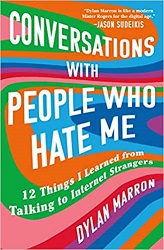
Conversations with People Who Hate Me

12 Things I Learned from Talking to Internet Strangers

by Dylan Marron

Atria Books, 2022. 257 pages.
Review written June 15, 2022, from a library book
Starred Review

I am so impressed with this book and so inspired by it.

As it happens, the morning before I picked this up, my pastor had preached about empathy. He said that when we interact with people we disagree with on the internet, we tend to look at them at a distance, through binoculars, focusing on our broad differences. But empathy comes close and sees people as individuals, in all their humanity and particularities.

The amazing thing Dylan Marron has done is achieved empathy even on the internet.

I was excited about this book because I enjoyed Dylan’s videos for Seriously.TV a few years ago. He’s a gay person of color, and made wonderful points from a progressive perspective, and I was onboard and cheering for his side of the debate.

But he, amazingly, brought things beyond debate to empathy. As you may guess, the videos that I liked so much had plenty of people who felt the opposite and told him so in no uncertain terms. But Dylan explains in this book that since the videos were posted on Facebook, he was able to look at the commenters’ Facebook pages and find out these were humans saying harsh things, not monsters.

And that started a project that became a podcast, “Conversations with People Who Hate Me.” He found detractors who said harsh things (though ruled out the death threats) and engaged them in conversation. Found out about who they were as people. It wasn’t about debate, but was about empathy, about seeing people with different opinions as humans worthy of respect.

Dylan tells that story in his book, and it’s a beautiful thing to watch. I’m not sure I could do it. Dylan does point out that he’s coming from a place of privilege, and some people are so abused, it’s too much emotional work to try to have empathy for their abusers. But I’m coming from a place of privilege, too, and I simply have a hard time looking past opinions I think are despicable. I easily forget that they are humans who hold those opinions for reasons. And Dylan Marron inspired me to try, showed me that it’s not impossible, and has given me an amazing example of human kindness.

He didn’t necessarily change minds with these conversations. And that wasn’t the point. But he did achieve the goal of the participants in the conversations seeing each other as fellow humans, and not as enemies.

The book does outline lessons he learned and things he noticed along the way. There are many obstacles to finding empathy, and he didn’t always make it past those obstacles. But there’s so much beauty in the attempt.

It all goes back to what my pastor talked about — empathy. One of the lessons that Dylan learned is that empathy is not endorsement. He still disagrees with many of the people he interacted with. But he sees them and knows human details about them and thinks of them as friends. And that’s amazing to me — and I want to learn to do it myself.

In his last chapter, he discusses how “snowflakes” make a good metaphor for his guests, in all their unique individuality.

And just as snowflakes are breathtakingly beautiful up close, my guests are breathtakingly beautiful up close, too. From the moment they first say “Hello” I am able to appreciate them as individuals and it is at this close range — voice to voice — that it becomes clear that they aren’t my enemies at all, no matter how vehemently we may disagree. Hearing Josh’s laugh, or Frank’s accent, or learning the tiny detail that E was applying for jobs around the time of our call, allowed me to see them as human, and this opened the door for empathy. And as I walked through that door, my fear dissipated.

I highly recommend this book, partly for the reasons Dylan Marron writes in the final paragraph:

One conversation will not heal the world. Empathy alone will not cure what ails us. Inspiring words will not protect us from harm. But in an era when we feel increasingly isolated, when we speak to each other on platforms that divide us by rewarding competition over connection, conversation is a tiny, enormous, mundane, epic, boring, thrilling, simple, complex act of rebellion that builds a bridge where there wasn’t one before.

simonandschuster.com

Buy from Amazon.com

Find this review on Sonderbooks at www.sonderbooks.com/Nonfiction/conversations_with_people_who_hate_me.html

Disclosure: I am an Amazon Affiliate, and will earn a small percentage if you order a book on Amazon after clicking through from my site.

Disclaimer: I am a professional librarian, but the views expressed are solely my own, and in no way represent the official views of my employer or of any committee or group of which I am part.

What did you think of this book?
Review of Different Kinds of Fruit, by Kyle Lukoff

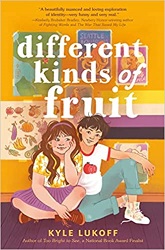
Different Kinds of Fruit

by Kyle Lukoff

Dial Books for Young Readers, 2022. 313 pages.
Review written June 10, 2022, from my own copy, sent by the publisher
Starred Review

Kyle Lukoff won the Stonewall Award and Newbery Honor with his last book, Too Bright to See. Different Kinds of Fruit is another book exploring issues about gender in the lives of kids, and it does it with a happy and engaging story.

Annabelle has gone to school at the Lab all her life, so when they get a new teacher and a new student on the first day of sixth grade, she knows it’s going to be a different year than what she expected.

The new kid is named Bailey and explains that they are nonbinary and use they/them pronouns. But when Annabelle tells her parents, she’s surprised by her father’s reaction. Making friends with Bailey opens up discussion in her family and she learns family secrets that had been hidden from her.

Meanwhile, the new teacher gets the class excited about the topics they can explore — until one parent reports them and the principal squelches their plans. Can the kids find a way to stand up for what they want to learn?

The story doesn’t feel like an issue book, even though issues, very timely ones, do come up. I like the portrayal of Annabelle’s growing friendship with Bailey and Annabelle’s questions about herself when she realizes she’s got a crush on Bailey.

The characters in this book are interesting people, with lots more depth than the way they might be categorized by gender or whom they’re attracted to.

For example, when Annabelle goes over to Bailey’s house, she’s interested in some posters on her walls.

I was curious about the plant poster, and walked over to examine it more closely. “What is this?” I asked. “A flowchart or something?”

“Oh! There’s a whole series of these. Each poster is about a different taxonomy. Taxonomy is, like, groups of things, and how they’re organized. This one is about different kinds of fruit.”

I peered at it. Cucumbers and pumpkins and eggplants and avocados, all connected by lines and arrows. “Uh, no it’s not?” I said. “I mean, yeah, those are fruit up there” — I pointed to the top, where there were apples and oranges and bananas — “but the rest of these are vegetables! And those helicopter seeds aren’t fruits either.”

Bailey grinned wickedly. “I have news for you, my binary friend!” They dropped teir voice like they were about to utter a revealing truth of the universe. “There is no. Such. Thing. As a vegetable.”

I squinted at the chart, and then at them, and then back at the chart. “Yes there is! What are carrots, then? I don’t see those here.”

“Carrots are roots.”

“Okay, kale?”

“Leaves.”

“Artichokes? I mean, they’re gross, but those are definitely vegetables.”

“Wrong on both counts! Artichokes are delicious and flowers.”

“Flowers??”

“Yup. Broccoli and cauliflower and figs are all flowers too. ‘Vegetable’ is a made-up category.”

That didn’t make any sense. “If vegetables are made up, then why aren’t fruits?”

“Because they’re not!” Bailey looked triumphant, like this was a hill they would gladly die on. “‘Fruit’ is a job. It describes the part of the plant that distributes the seeds. Apples and oranges are fruits because they have seeds. So are pumpkins and cucumbers! And tomatoes. And those helicopter seeds. And berries. As a matter of fact, everything I named is a type of berry.”

“But ‘vegetable’ isn’t a job?” I wracked my brain to come up with something that all vegetables had in common, but I couldn’t. Except that they’re good for you.

“Nope! Leaves are a job and roots are a job and flowers are a job. ‘Vegetable’ is something people made up to sell salad mix.'”

This story has so much heart and is so much fun. On top of that, it gets you thinking about different kinds of people and what they all have in common. A joyful story that explores gender roles and the fakeness of vegetables.

penguin.com/kids

Buy from Amazon.com

Find this review on Sonderbooks at www.sonderbooks.com/Childrens_Fiction/different_kinds_of_fruit.html

Disclosure: I am an Amazon Affiliate, and will earn a small percentage if you order a book on Amazon after clicking through from my site.

Disclaimer: I am a professional librarian, but the views expressed are solely my own, and in no way represent the official views of my employer or of any committee or group of which I am part.

What did you think of this book?
Review of Aristotle and Dante Discover the Secrets of the Universe, by Benjamin Alire Sáenz, read by Lin Manuel Miranda

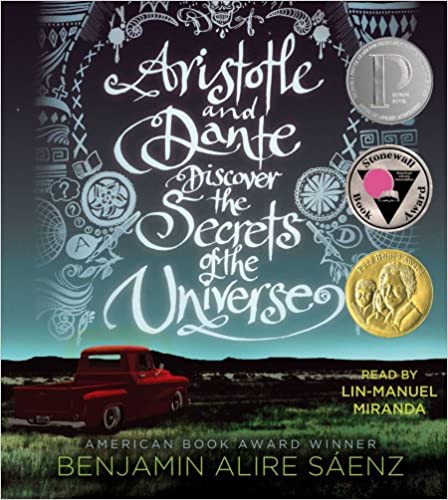
Aristotle and Dante Discover the Secrets of the Universe

by Benjamin Alire Sáenz
read by Lin Manuel Miranda

Simon & Schuster Audio, 2013. 7 hours and 29 minutes.
Review written February 12, 2022, from a library eaudiobook
Starred Review
2013 Pura Belpré Author Award Winner
2013 Stonewall Book Award Winner
2013 Lambda Literary Award Winner
2013 Printz Honor Book

I got to hear Benjamin Alire Sáenz give his Printz Honor acceptance speech in 2013, and that speech made me very much want to read this book. I finally got around to it after a sequel came out in 2021 – and the same day I finished listening to this, I began listening to the sequel. I am so glad to finally read this marvelous book.

It’s a friendship story about two Mexican American boys. They meet at the start of summer before their sophomore year of high school at different high schools in El Paso, Texas, and have a laugh over their similar names. Ari is the narrator of the book, a boy who spends a lot of time in his own head – which makes him a good narrator. Dante is an open-hearted boy full of philosophical questions and free with his emotions – the sort of boy who’d try to rescue a bird with a broken wing in the middle of the street.

But when Dante does that on a rainy day and a car comes around the bend, without thinking, Ari runs and pushes Dante out of the way – at the risk of his own life. There are some other crises in the book, and lots of thinking about life and what things mean. Ari has a brother twelve years older who is in prison, and his family never talks about that brother.

I knew from the Printz acceptance speech that this is also a book about coming out as gay and figuring out who you are. But that takes up most of the book, so I won’t say a lot about that – except it is heart-wrenching and feels true. The book is set in the late 1980s, and they’re up against harsh attitudes in the world around them, many of which are internalized.

Something I love about this book are the two sets of parents, both of whom are wonderfully drawn and love their sons with all their hearts. It’s refreshing to read a book about teens with loving and supportive parents. Ari’s dad is dealing with post-traumatic stress from his time in Viet Nam, but that makes him human and real, not irreparably scarred.

In fact, that’s what’s so wonderful about this book – all the characters feel true. Nobody’s perfect, and they’ve got flaws consistent with their strengths. I found myself wanting to hug these two boys.

And it’s narrated by Lin Manuel Miranda! He didn’t do a tremendous job distinguishing between the voices of the different characters, though I find I’m picking up on subtle differences a little more by the time I’ve started the second book. But in spite of that tiny quibble, I could listen to Lin Manuel Miranda read anything. When it’s a wonderful book he’s reading, it simply added to my love. Of the book!

benjaminsaenz.com/

Buy from Amazon.com

Find this review on Sonderbooks at: www.sonderbooks.com/Teens/aristotle_and_dante_discover_the_secrets_of_the_universe.html

Disclosure: I am an Amazon Affiliate, and will earn a small percentage if you order a book on Amazon after clicking through from my site.

Disclaimer: I am a professional librarian, but the views expressed are solely my own, and in no way represent the official views of my employer or of any committee or group of which I am part.

What did you think of this book?
Review of Blips on a Screen, by Kate Hannigan, illustrated by Zachariah OHora

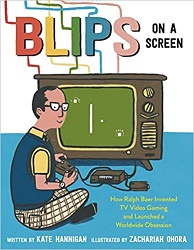
Blips on a Screen

How Ralph Baer Invented TV Video Gaming and Launched a Worldwide Obsession

written by Kate Hannigan
illustrated by Zachariah OHora

Alfred A. Knopf, 2022. 44 pages.
Review written June 8, 2022, from a library book.
Starred Review

Here’s a picture book biography of the guy who invented the first video game. I think of creating video games as something for people who are good with computers, but Ralph Baer came at it from the perspective of someone skilled in electronics and understanding how televisions work. And of course that makes sense, because video games came along before home computers.

Rolf Baer was born in Germany, but his family fled from Hitler and the Nazis in 1938 a few weeks before the border closed. In America, he changed his name to Ralph.

Ralph was always interested in inventing. He worked in radio repair and used his radio skills during World War II. From there, it was a natural next step to work on televisions. He worked for military electronics, but couldn’t get over the idea of figuring out how to play games on a TV.

The book tells about the process he went through, which included getting a patent, so his company was able to license his new invention when the boom took off. But before that happened, he got plenty of rejection for his idea. But after the Odyssey finally came out in 1972, it began a new obsession with video games.

The book makes the process understandable and accessible to kids. I always love Zachariah OHora’s illustrations, and his cartoons give a simplified picture of the essentials of this story.

This book tells about an inventor who created something important to kids and it also talks about the process of getting an invention produced — in a fascinating and informative picture book.

Buy from Amazon.com

Find this review on Sonderbooks at www.sonderbooks.com/Childrens_Nonfiction/blips_on_a_screen.html

Disclosure: I am an Amazon Affiliate, and will earn a small percentage if you order a book on Amazon after clicking through from my site.

Disclaimer: I am a professional librarian, but the views expressed are solely my own, and in no way represent the official views of my employer or of any committee or group of which I am part.

What did you think of this book?
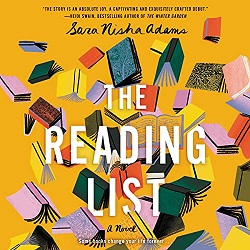
Review of The Reading List, by Sara Nisha Adams

The Reading List

by Sara Nisha Adams
read by Tara Divina, Sagar Arya, and Paul Panting

HarperAudio, 2021. 12 hours, 47 minutes.
Review written June 8, 2022, from a library eaudiobook
Starred Review

This book is about a handwritten reading list that several people find in different surprising places in Wembley, a suburb of London. And then how reading those books changes people’s lives.

The two central characters who get most of the book’s time are Aleisha, a 17-year-old who’s working at the library as a summer job, and Mukesh, an elderly Indian gentleman who lost his wife two years before. Aleisha has her own pressures as she and her older brother are trying to care for their mother, who keeps the house dark and rarely leaves her bed. Aleisha’s planning to head to university and study to be a lawyer when the summer is over.

The first time Mukesh comes to the library, he encounters Aleisha, who has no recommendations for him and is quite rude. But Aleisha feels guilty, so when she finds the Reading List, she decides to read the books and then pass them on to Mukesh. Both their lives are profoundly touched.

I love the way this book highlights how a good book can affect you so deeply. Books can give you insights into your own life and even help build relationships. Besides Mukesh and Aleisha, Mukesh also gains new ground with his granddaughter through books.

I’ve read and loved all but three of the books on the list. Here are the books:

To Kill a Mockingbird, by Harper Lee
Rebecca, by Daphne DuMaurier
The Kite Runner, by Kaled Hosseini
Pride and Prejudice, by Jane Austen
Little Women, by Louisa May Alcott
Beloved, by Toni Morrison
A Suitable Boy, by Vikram Seth

The book The Time Traveler’s Wife is also featured.

The three I haven’t read are The Kite Runner, Beloved, and A Suitable Boy. Now I want to go out and read those three if they’re anything as good as the others.

I did laugh that my favorite on the list – Pride and Prejudice – was the least favorite of the characters in the book. Oh well! At least it got included.

So it was all a wonderful story. I particularly loved the narrator who read Mukesh’s chapters. I felt like the character was talking with me and this kind elderly widower won my heart.

I did have some things that bothered me a lot about their portrayal of a library. Maybe things are different in the U.K., but I’m not really convinced they are.

First, a student working in the library for the summer is not called a librarian. A librarian is someone with a master’s degree in library science. Although a customer might mistakenly call such a person a librarian, the workers would not perpetuate that mistake.

Next, this poor hardly-occupied library needed library outsiders – Mukesh and Aleisha – to come up with an idea to “save” it – by having a program! A program where the community gets together. That’s all well and good and they had a very nice reason for it. But come on, is the author aware that most libraries have a full schedule of programs to engage their communities? It’s not actually a novel idea.

I did think it was interesting that while they talked about a few regulars, that particular library didn’t have any patrons experiencing homelessness. Maybe that’s not a problem in England? Of course, the library in the book was much, much less frequented than the one where I work. We get more than 800 customers on a typical day. I know there are libraries that don’t get so many, but the portrayal – in a book reminding us how reading can change lives – made me wince a little bit.

I also really wondered how the books on the list were chosen. It was interesting that there was only one children’s book – Little Women – and it’s a very old children’s book, set in 1860s America. But that of course got me thinking: If I were to make a list of my favorite books, books that had power to move people deeply and affect their lives and relationships, which books would I choose?

Buy from Amazon.com

Find this review on Sonderbooks at www.sonderbooks.com/Fiction/reading_list.html

Disclosure: I am an Amazon Affiliate, and will earn a small percentage if you order a book on Amazon after clicking through from my site.

Disclaimer: I am a professional librarian, but the views expressed are solely my own, and in no way represent the official views of my employer or of any committee or group of which I am part.

What did you think of this book?
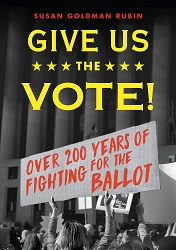
Review of Give Us the Vote! by Susan Goldman Rubin

Give Us the Vote!

Over 200 Years of Fighting for the Ballot

by Susan Goldman Rubin

Holiday House, 2020. 124 pages.
Review written April 8, 2020, from a library book

Give Us the Vote! opened my eyes about the history of voting in the United States. Sure, I knew that African Americans needed a Constitutional amendment before they could vote, as did women. What I hadn’t realized is that it’s still always been a battle to have free and fair elections.

I didn’t realize, for example, that we didn’t have a secret ballot until the early 1900s. Before that, people would buy and sell votes – and they could follow up depending on how the person voted. But even after that, it was still possible to bully people at the voting booth or try to exclude people from voting.

All the way through the 1850s, people voted with their voice. (Or I should say, men voted with their voice.)

The earliest method of voting was voicing one’s choice in public. A citizen would literally stand up and say who he was voting for or raise his hand. This made intimidation easy. Around Election Day, candidates plied voters with rum, wine, and beer to win their votes, or bribed them with food and money. Since only property owners could vote, candidates often bought “freeholds,” or temporary land rights, from large landowners. They gave these rights to landless men, and returned the deeds to the real owners after the election. Sometimes corrupt candidates would even pay voters not to vote so that they could win a majority.

This book covers the battle to gain the right to vote for many different groups, as well as the many different kinds of cheating that people have used successfully over the years our country has been a nation. One popular method is getting fake people to vote or the same people voting many times. But then another technique is stealing and destroying ballots and/or replacing them with fake ones. Getting the count correct is another whole area of danger. I didn’t realize that it wasn’t until the Civil War when soldiers wanted to vote that absentee ballots were allowed, and it was a big area of controversy, including new ways of committing voter fraud.

Gerrymandering is mentioned, with both old and recent examples from both parties. The author mentions a 2019 Supreme Court case that decided that this is an issue for elected branches of government to decide, not the federal courts.

This book is geared to teens, so it includes the movement to change the voting age from twenty-one to eighteen during the Vietnam War – and the current wish of some to bring it down to age sixteen.

Many people agree that high schoolers care about local and national problems and should be allowed to vote. Studies prove that teenagers can gather and process information, weighing pros and cons as well as most adults. Research conducted by FairVote shows that sixteen- and seventeen-year-olds are as informed and engaged in political issues as older voters. If they start voting in their teens, they are more likely to make voting a lifelong habit and increase voter turnout.

Books like this will help young people realize we can’t take for granted our rights to fair and free elections.

HolidayHouse.com

Buy from Amazon.com

Find this review on Sonderbooks at: www.sonderbooks.com/Teen_Nonfiction/give_us_the_vote.html

Disclosure: I am an Amazon Affiliate, and will earn a small percentage if you order a book on Amazon after clicking through from my site.

Disclaimer: I am a professional librarian, but the views expressed are solely my own, and in no way represent the official views of my employer or of any committee or group of which I am part.

What did you think of this book?
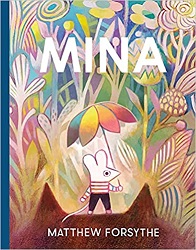
Review of Mina, by Matthew Forsythe

Mina

by Matthew Forsythe

Paula Wiseman Books (Simon & Schuster Books for Young Readers), 2022. 64 pages.
Review written May 20, 2022, from a library book
Starred Review

This picture book made me laugh out loud in several places.

Mina is a little mouse who loves to read. She’s always pictured with her head in a book or using art supplies. She lives with her father in a piece of wood in the forest.

On the first page, we’re introduced to her this way:

Mina lived in her own little world where nothing ever bothered her.

Except one thing.

We’re told that one thing is not her father, even though you’d think his ambitious projects would disturb her concentration. But no, we always see Mina lost in her book, doing her own thing.

However, Mina started to worry when her father brought home a big surprise. He says it’s a squirrel, since squirrels are bigger than mice and have long, bushy tails. But the reader can see what the mice don’t understand — the animal her father brought home is a cat.

Mina’s father keeps telling her not to worry. He knits a sweater for the squirrel. When the squirrel doesn’t eat and he thinks it might be lonely, he finds it two more friends.

How does this situation resolve? I’m not going to give it away, because it’s way too much fun to read yourself. I can confidently promise that you’re going to be surprised.

This is one I’ll be urging my coworkers to take a few minutes and read. Please do that yourself! I guarantee it will bring a smile.

Buy from Amazon.com

Find this review on Sonderbooks at: www.sonderbooks.com/Picture_Books/mina.html

Disclosure: I am an Amazon Affiliate, and will earn a small percentage if you order a book on Amazon after clicking through from my site.

Disclaimer: I am a professional librarian, but the views expressed are solely my own, and in no way represent the official views of my employer or of any committee or group of which I am part.

What did you think of this book?
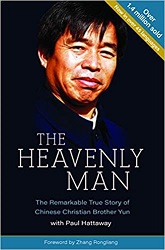
Review of The Heavenly Man, by Brother Yun with Paul Hattaway

The Heavenly Man

The Remarkable True Story of Chinese Christian Brother Yun

by Brother Yun
with Paul Hattaway

Kregel Publications, 2020. First published in the United Kingdom in 2002. 338 pages.
Review written May 28, 2022, from a library book
Starred Review

This book is the amazing true story of the life of Brother Yun, a pastor in the Chinese house church movement. The story of Brother Yun’s faith is full of miracles from start to finish. His family first accepted Christ when Yun was a child, after his mother received a vision and then his father was miraculously healed of cancer.

Brother Yun devoted his life to Christ when he was still young. One of the early miracles he experienced was when he prayed earnestly for a Bible, and one was then brought to him. The entire book testifies over and over to the great power of God.

After Brother Yun became a pastor, he was imprisoned in China three times. Each time, he was tortured horribly. At one point in prison, he followed the Holy Spirit’s guidance and miraculously went without food or water for 74 days.

And despite all the torture, all the difficulties, his passion for Jesus, commitment to tell about him, and determination not to betray his brothers and sisters all shine through. During his third time in prison, he experienced a miracle like Peter’s as the doors of the prison were standing open and he walked right past the guards to escape, with his broken legs cured as he walked away.

Brother Yun’s story is told in his own voice, with interludes from his wife, telling how things were for his family when he was imprisoned. Both attest to miracle after miracle and God’s faithful care.

After the escape from prison, Brother Yun miraculously made his way to the West. He still preaches to those who haven’t heard, especially as part of the “Back to Jerusalem” movement, which plans to send millions of missionaries from China.

I was amazed that Chinese Christians don’t want people in the West to pray that their persecution will stop. Here’s one place where Brother Yun talks about this:

Don’t pray for persecution to stop! We shouldn’t pray for a lighter load to carry, but a stronger back to endure! Then the world will see that God is with us, empowering us to live in a way that reflects his love and power.

This is true freedom!

This book is riveting reading. As a western Christian reading it, of course I’m struck by how different my life is from Brother Yun’s. It’s a story of God’s power and the Lord’s amazing faithfulness. And amazing stories of how God is changing lives today.

The one thing I didn’t like was that, because this was originally published in 2002, that’s when the story ends. I am completely sure that Brother Yun did not stop following God twenty years ago, and I would like to know what happened next.

asiaharvest.org

Buy from Amazon.com

Find this review on Sonderbooks at: www.sonderbooks.com/Nonfiction/heavenly_man.html

Disclosure: I am an Amazon Affiliate, and will earn a small percentage if you order a book on Amazon after clicking through from my site.

Disclaimer: I am a professional librarian, but the views expressed are solely my own, and in no way represent the official views of my employer or of any committee or group of which I am part.

What did you think of this book?
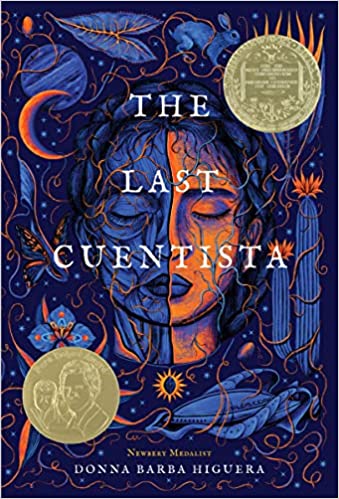
Review of The Last Cuentista, by Donna Barba Higuera

The Last Cuentista

by Donna Barba Higuera

Levine Querido, 2021. 320 pages.
Review written April 6, 2022, from my own copy, purchased via amazon.com
2022 Newbery Medal Winner

The Last Cuentista won the Newbery Medal. Everyone should read it. The writing is lyrical, lush, and gorgeous. It talks about the power of Story, greater than anything.

As the story begins, Petra and her family are getting ready to leave earth. She misses her grandmother Lita, who told her a story about Halley’s Comet as a fire snake with bad eyesight that accidentally hit its mother, earth, and destroyed it.

It feels wrong to be sneaking off Earth while so many are left behind. They don’t even inform my parents of our destination until the day before. Dad says Pleiades had been storing their ships in a massive underground facility at the old Denver airport — they weren’t supposed to leave Earth on their first official trip for another two years. The maiden test flights into nearby space a few months earlier had been successful, but because we’re now leaving so suddenly, this will be the first interstellar journey.

If a solar flare hadn’t shifted the comet off course a week earlier, we’d be watching Fire Snake harmlessly pass Earth in a few days like it had since the beginning of time.

Petra and her brother Javier are prepared to go into a stasis pod. They will sleep for three hundred and eighty years and wake up ready to go to a new planet, named Sagan, where another ship has already gone to terraform. Scientists like Petra’s parents will help set up life on the new settlement — and Petra and Javier have custom programming that will go into their brains while in stasis, so they will wake up scientific experts as well.

As they go into stasis, Petra learns that her desired elective — storytelling — was overridden by her parents. She doesn’t want to be a scientist. She wants to be a Cuentista like her grandmother.

Not everyone on the spaceship will be in stasis. The Monitors will spend their lives in space making sure that those in the pods are safe.

But something goes wrong from the very start when Petra is supposed to go to sleep. And when she wakes up, near the planet, she discovers the Collective has taken over. They expect her to answer to the name Zeta-1 and serve the Collective.

The story is compelling and beautifully written. But I had problems with it that I’ve had with other dystopian fiction. I couldn’t get around my questions of why? Why would the Collective want to ban memories of earth and ban stories? The explanation given was that earth was a place of war and they were starting over, but I didn’t buy it. I didn’t think people leaving their home planet would want to forget everything.

I also couldn’t really bring myself to believe in the magic technology that could reprogram brains — and somehow didn’t work on Petra. And Petra could make people remember despite that. So although I see the amazing craft in the book, I could never quite suspend my disbelief and really believe it would happen that way.

But it won the Newbery. So there are many people who didn’t have any problem with those things. Try it yourself! Read this beautiful story and then tell me what you think: Were you pulled into this tale of the last survivors of humankind?

levinequerido.com

Buy from Amazon.com

Find this review on Sonderbooks at: www.sonderbooks.com/Childrens_Fiction/last_cuentista.html

Disclosure: I am an Amazon Affiliate, and will earn a small percentage if you order a book on Amazon after clicking through from my site.

Disclaimer: I am a professional librarian, but the views expressed are solely my own, and in no way represent the official views of my employer or of any committee or group of which I am part.

What did you think of this book?
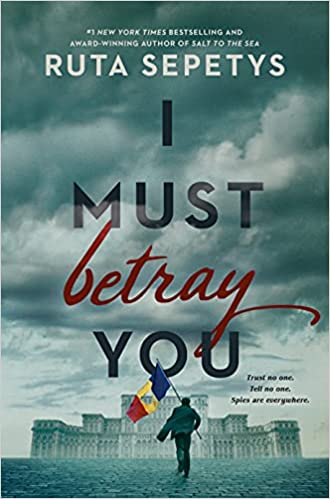
Review of I Must Betray You, by Ruta Sepetys

I Must Betray You

by Ruta Sepetys

Philomel Books, 2022. 319 pages.
Review written March 12, 2022, from a library book
Starred Review

This is another book that’s sobering to read during the war in Ukraine. I wish this was ancient history, but I remember well when it happened.

I Must Betray You is set in Romania in 1989, during the last days of the Ceausescu regime — but seventeen-year-old Cristian Florescu doesn’t know they are the last days. All Cristi has ever known is his family’s bleak apartment, waiting in lines for goods, having to speak softly for fear of being overheard, pictures of the Ceausescus overlooking everything, and knowing that anyone might be an informer.

But when Cristian is called into the principal’s office, he hadn’t been prepared that now he needs to be an informer. His mother cleans the house of an American diplomat. Cristian is to accompany her and befriend the diplomat’s teenage son and report back. The reward? One he can’t give up – medicine for his grandfather, who is dying of leukemia. But the leverage is that the agent who interviews him knows about a dollar bill he got from an American from selling a stamp. That is illegal, and they threaten prosecution — unless Cristian does what they want.

But once he starts as an informer, he doesn’t know who he can trust. And then, when the girl he’s had his eye on for ages actually shares a Coke with him — State Security finds out, and she accuses him of being an informer.

And that’s only the beginning. Through associating with the Americans to spy on them, Cristian finds out about protests in other Eastern European countries. Maybe Romania doesn’t have to be this way?

Several awful things happen in this book. The fight for freedom in Romania wasn’t easy. But this book tells the story from the perspective of a young person trapped by the regime, but who dares to dream of a better life.

I also appreciated the Epilogue, which showed that overthrowing the Ceausescu regime didn’t instantly resolve all problems. There are also historical photos at the back, taken in Romania in the 1980s.

rutasepetys.com

Buy from Amazon.com

Find this review on Sonderbooks at: www.sonderbooks.com/Teens/i_must_betray_you.html

Disclosure: I am an Amazon Affiliate, and will earn a small percentage if you order a book on Amazon after clicking through from my site.

Disclaimer: I am a professional librarian, but the views expressed are solely my own, and in no way represent the official views of my employer or of any committee or group of which I am part.

What did you think of this book?