Review of Spark, by Sarah Beth Durst

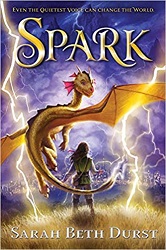
Spark

by Sarah Beth Durst

Clarion Books, 2019. 311 pages.
Starred Review

Here’s a fun fantasy about a quiet girl who tends to get overlooked. She’s one of the lucky few children who gets an egg of a storm beast to bond with and she expects to hatch a rain beast or sun beast like her father or older brother.

Everyone is surprised when her egg hatches the flashiest beast of all – a lightning beast!

Her family is convinced some sort of mistake happened. Mina knows that bonding with Pixit is not a mistake, but she still doesn’t feel adequate as the guardian of a lightning beast.

This book, like so many others, is about a 12-year-old going to school to learn magic, but this setting with dragon-like storm beasts is innovative and interesting. And there’s more. The storm beasts control the weather in their country of Alorria. But when Mina has an accident and lands outside the border, she learns that their control of the weather may have repercussions. But what can a 12-year-old girl do about that? Especially one who isn’t even sure she’s cut out to be the guardian of a lightning beast.

This is not a story about a quiet girl learning to be loud. It is the story of a quiet girl learning that being herself has power.

sarahbethdurst.com

Buy from Amazon.com

This review is only on the blog.

Disclosure: I am an Amazon Affiliate, and will earn a small percentage if you order a book on Amazon after clicking through from my site.

Disclaimer: I am a professional librarian, but I maintain my website and blogs on my own time. The views expressed are solely my own, and in no way represent the official views of my employer or of any committee or group of which I am part.

What did you think of this book?

Review of Marshmallow Clouds, by Ted Kooser and Connie Wanek, illustrated by Richard Jones

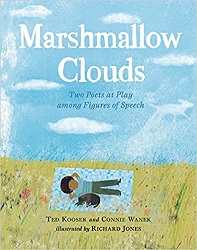
Marshmallow Clouds

Two Poets at Play among Figures of Speech

by Ted Kooser and Connie Wanek
illustrated by Richard Jones

Candlewick Press, 2022. 72 pages.
Review written May 13, 2022, from a library book
Starred Review

I don’t usually get too excited about poetry collections, but this one had me smiling at new ways of looking at things I’d never thought of before. I started wanting to read bits aloud to a coworker. Though I’d also have to show them the beautiful images accompanying the poems.

The poets are indeed playing with ideas. First, we meet a winter tree that looks like it’s clowning around on the top of a hill, up on one leg and juggling a pie. Then there’s a meteor shower like scratches a black cat playing with an enormous ball that glitters, a fireplace like a playpen for the fire, a book as a sandwich of words and ideas, and a harp like a great golden moth as a harpist smooths the veins in its wings. Or let me type out the whole poem “Thunderstorm”:

This one’s gotten up in the night
and, not wanting to wake us,
stumbles around, bumping the walls
of the long empty hallway leading away,
now and then lighting a match
and then, just as quickly, blowing it out.

I love the images in these poems. They’re creative and so imaginative. Here’s the first stanza of a poem called “July”:

One summer day I was boiled and salted
like a peanut. I was the meat
in a heat sandwich, the dog in a hot.
I was the crimson crayon
melting in a sunny car,
the color of firecrackers and flags
and Mars, where once water
cooled the red stones.

Here’s the first stanza of a poem called “Secret”:

It’s safe to tell a secret to the stars,
aliens all. They haven’t
a word of English,
which means they are reliable
in their silence.

That poem has more about stars and secrets and fire burning up the secrets and how good it is to let them go.

And I need to stop giving examples, because there are far too many good ones. At the back, poet Ted Kooser tells what they are trying to do with this book:

Each of us is born with a gift of imagination and, as if it were a favorite cat or dog, playing with your imagination can keep it healthy and happy. The poems in this book are about fooling around, about letting one’s imagination run free with whatever it comes upon. Our idea is to encourage you to run with your own imagination, to enjoy what you come up with.

The poems in this book, combined with the simple and meditative images, filled me with delight. They’re divided into sections for Fire, Water, Air, and Earth.

A lovely collection of poems that might surprise you — as it did me.

candlewick.com

Buy from Amazon.com

Find this review on Sonderbooks at: www.sonderbooks.com/Childrens_Nonfiction/marshmallow_clouds.html

Disclosure: I am an Amazon Affiliate, and will earn a small percentage if you order a book on Amazon after clicking through from my site.

Disclaimer: I am a professional librarian, but the views expressed are solely my own, and in no way represent the official views of my employer or of any committee or group of which I am part.

What did you think of this book?

Review of The Boy Who Invented the Popsicle, by Anne Renaud and Milan Pavlovic

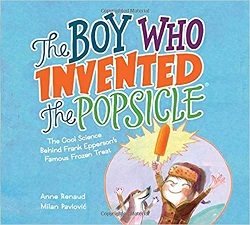
The Boy Who Invented the Popsicle

The Cool Science Behind Frank Epperson’s Famous Frozen Treat

by Anne Renaud and Milan Pavlovic

Kids Can Press, 2019. 40 pages.
Starred Review
Review written October 23, 2019, from a library book

This is a picture book biography of Frank Epperson, the inventor of the Popsicle, with a little bit more.

I’m always impressed when children’s nonfiction manages to surprise me. The big surprise in this book is that Frank Epperson invented the Popsicle before household freezers were common. And he first experimented with making them when he was eleven years old, living in San Francisco, during an unusual cold spell.

The book shows that he was an inventor at heart, making a two-handled handcar when he was a kid. He also experimented with making flavored soda water.

The book has experiments you can do at home to go with the text. One is making your own lemon-flavored soda water. (Hmm. Is using baking soda what gave soda its name? The book doesn’t say.)

His first frozen drink on a stick happened when he tried freezing one of these drinks. Later, as an adult, when he saw people eating chocolate-covered ice cream bars, he thought he’d experiment with making more of his frozen drinks on a stick.

But he needed to freeze them at a cooler temperature than water freezes because of the sugar and flavorings included – and an experiment helps the reader understand that. And he needed to freeze them quickly, because he didn’t want the flavorings and water to separate – another experiment helps the reader understand that.

He came out with his frozen treats – which he first called the Ep-sicle – in the early 1920s. This was long before homes were typically stocked with a refrigerator-freezer, so they were mostly sold in stores and at special events.

This book gives an interesting story of ingenuity, experimentation, and implementation. The experiments give it a little something beyond the typical picture book biography.

kidscanpress.com

Buy from Amazon.com

This review is only on the blog.

Disclosure: I am an Amazon Affiliate, and will earn a small percentage if you order a book on Amazon after clicking through from my site.

Disclaimer: I am a professional librarian, but I maintain my website and blogs on my own time. The views expressed are solely my own, and in no way represent the official views of my employer or of any committee or group of which I am part.

What did you think of this book?

Review of State of Terror, by Hillary Rodham Clinton and Louise Penny, read by Joan Allen

State of Terror

by Hillary Rodham Clinton
and Louise Penny
read by Joan Allen

Simon & Schuster Audio, 2021. 15 hours, 41 minutes on 13 CDs.
Review written May 27, 2022, from a library audiobook

Normally I would never check out a novel written by a celebrity, but the pairing with Louise Penny, a distinguished mystery writer, was enough to intrigue me. Surely a former Secretary of State can write very convincingly about plausible terrorist threats.

Actually, it’s a little too convincing. The story begins with a female secretary of state recently appointed by her political rival. The new president appointed Ellen Adams essentially to ruin her political power, and they don’t like each other very well. The narrator sounded a lot like Hillary Clinton, and the set-up got me wondering if Hillary Clinton and Barack Obama had disliked each other as much as the two characters do.

But the characters are in a very different situation. The previous president was “Eric Dunn,” and they go on about what an incompetent buffoon he was. There’s another scene that includes the president of Russia, I guy named Ivanov, who is portrayed as pure evil. Mind you, the secretary of state gets the better of both of them! How much is that wish fulfillment fantasy and how much is it just rational commentary on what the world could be like after our last president?

I didn’t think the writing was stellar, and the plot had things about it that I can nitpick and also that I did see coming, but it certainly held my interest and kept me awake on my commute.

Shortly after the book starts, a large bomb goes off in Europe, followed by another. And then they get evidence there will be a third bomb, and it’s going to happen on the same bus in Frankfurt where Ellen Adams’ reporter son has been following a lead.

But that’s only the beginning. Who is responsible for the bombs? And what are their plans now?

It was probably a little self-indulgent of the author to make it the female secretary of state who figures out the answers and deals with tyrants and saves the day. I mean, why not write a book where the hero reminds everyone of you?

I don’t think I’m giving anything away when I reveal that some of the villains are right-wing idealists in the United States, even in positions of power. They’re willing to work with Al Qaida and bring terror to American soil if it will put a liberal president out of power and start things fresh, back to “real” America.

This was published in October 2021, and would have been written well before that. I thought it was interesting that even in this scenario, the authors didn’t think of having the right-wing talking about election fraud. And they talked about the danger that the Taliban would take over Afghanistan when they had to pull out troops based on the deal made by “Eric Dunn.”

So it was all rather disturbing. And probably a touch too realistic.

I don’t think there’s any danger that people who are politically conservative will want to read this book. If you pretty much agree with Hillary Clinton’s assessment of Donald Trump, I mean “Eric Dunn,” then this book emphasizes how many bad results could still come to pass from his presidency.

But try to listen to it as a realistic thriller of what could have happened, but is not happening in real life.

simonandschuster.com

Buy from Amazon.com

Find this review on Sonderbooks at: www.sonderbooks.com/Fiction/state_of_terror.html

Disclosure: I am an Amazon Affiliate, and will earn a small percentage if you order a book on Amazon after clicking through from my site.

Disclaimer: I am a professional librarian, but the views expressed are solely my own, and in no way represent the official views of my employer or of any committee or group of which I am part.

What did you think of this book?

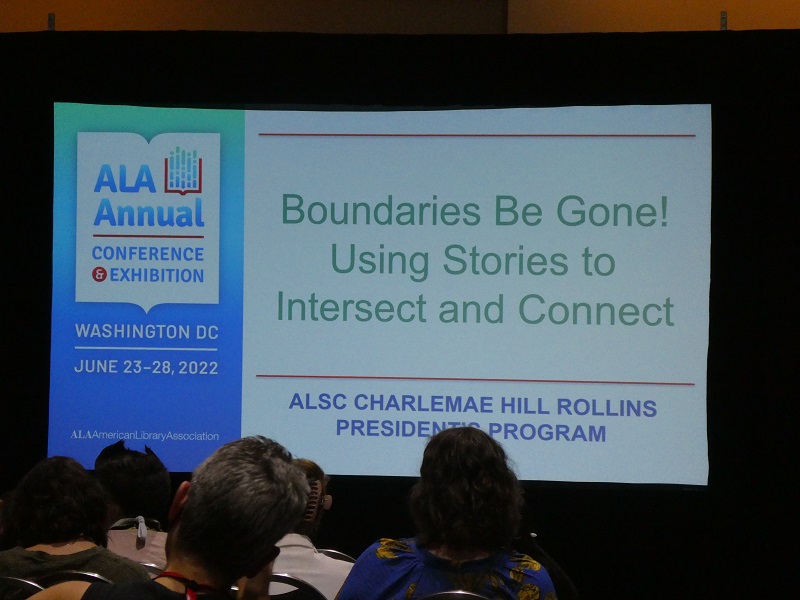
Boundaries Be Gone! Using Stories to Intersect and Connect – ALA Annual Conference Day Four

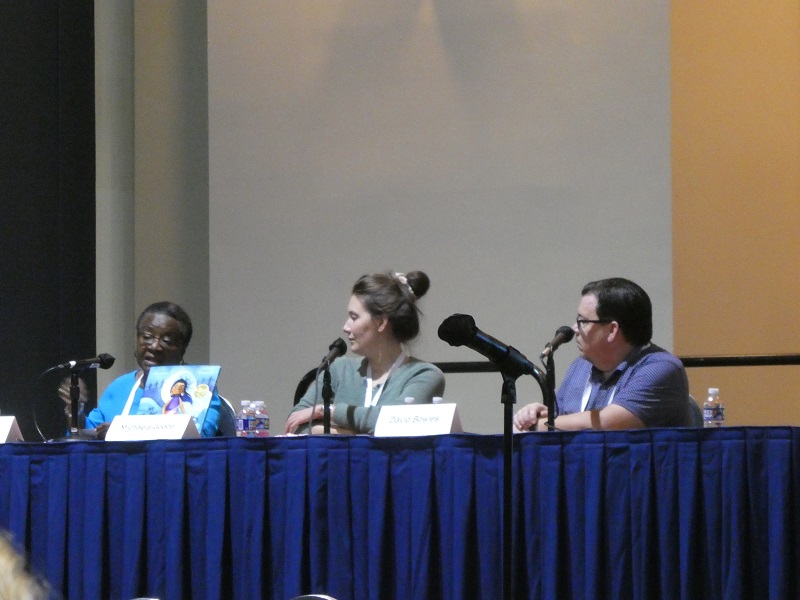
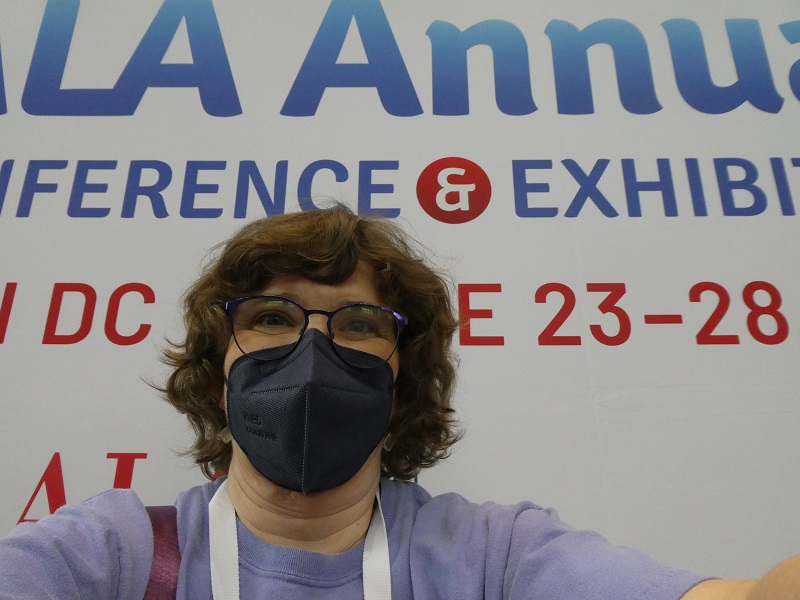
On Monday, June 27, 2022, the fourth day of ALA Annual Conference, I stumbled a little late into a program called “Boundaries Be Gone! Using Stories to Intersect and Connect.” I missed the first speaker, Dr. Cora Dunkley, but have some great notes from those who followed:

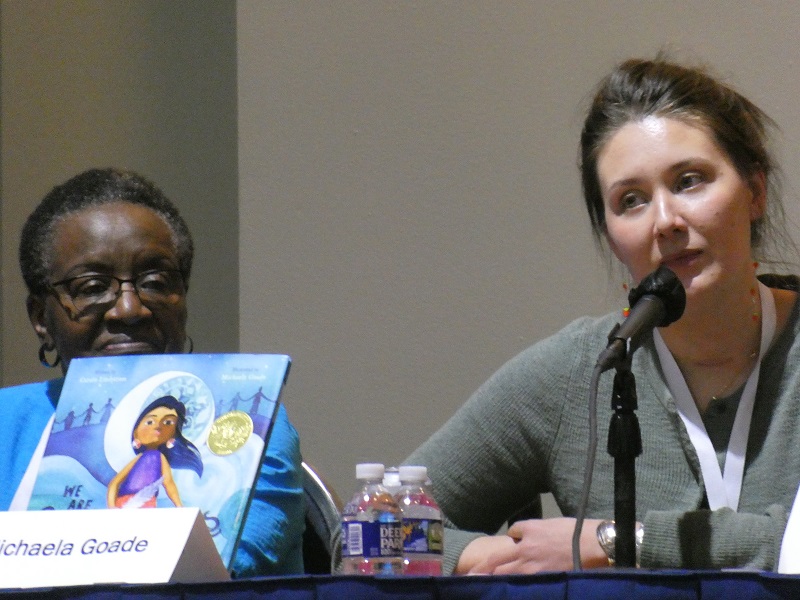
The first speaker I got to listen to was Michaela Goade, the Caldecott-winning illustrator of We Are Water Protectors.

She is indigenous and grew up in Juneau and Sitka.

She wants kids to feel seen and powerful. Indigenous roots are a superpower.

She grew up with shame. Storytelling is so important, and the books she had weren’t written by indigenous people. But the native kid lit community is growing! There are more tribe-specific books. We’re all working together toward greater awareness.

These different communities have their own unique histories and traditions. They’re trying to communicate the breadth. There’s no one way to be indigenous.

She’s part of an organization making Native books for Native peoples. Working with authors from different indigenous communities. They use the author as the anchor. They focus on emotion and universal calls to action.

Unfortunately, We Are Water Protectors will always be relevant.

We need non-indigenous folks to see and love on these books.

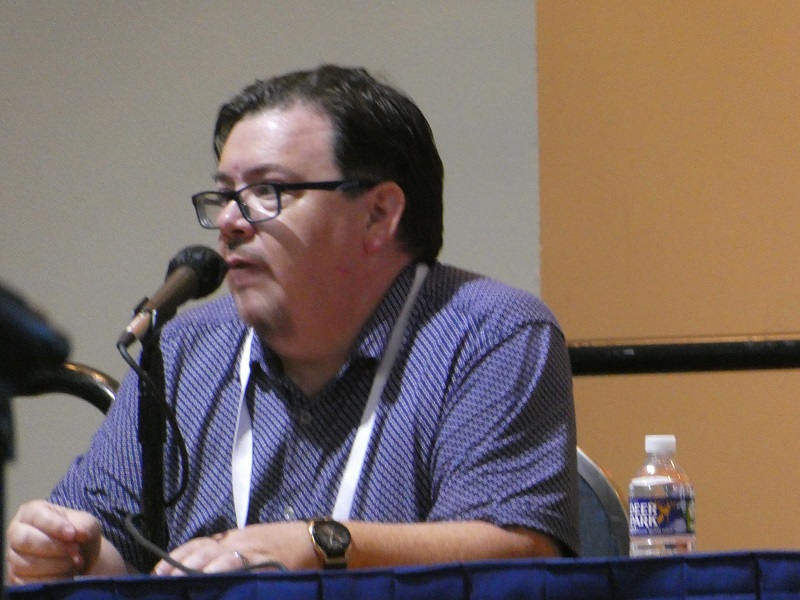
The next speaker was author David Bowles.

There’s a liminal space in borders. He grew up in a transnational place. Borders can be porous but important. You see yourself as someone defined by the boundary. Inside of you is this liminal space, a convergence of heritages.

Growing up bilingual emphasizes linguistic duality.

He’s from a family of storytellers. His grandmother was a cuentista who refueled the stories.

His mother took him to the library every day in Kindergarten and he saw that the language in books was different. He knew he wanted to do something with story. He’s both a cuentista and a writer.

Even growing up on the border, the books had nothing about Mexican heritage. He felt a calling and needed to be a teacher first, paying a debt to the community.

The system kept people in their place. He needed to breach the boundary between teacher and student. He didn’t want to be above them talking down to them.

How do our boundaries intersect? Boundaries are important, but not impermeable.

He began a journey digging into his roots, de-centering the European part.

Cross over boundaries in yourself and reach out in solidarity to others.

A central thread in his work is rooted in the experience of living on the border. He wants these books to broadcast to others that these stories matter and are beautiful. There’s so much overlap in humanity.

Banning books tries to make permeable boundaries into concrete walls. If you control what kids are exposed to, it’s easier to try to make everyone the same.

After the speakers were questions and answers. My favorite comment from that was when Michaela Goade said that being the first (Indigenous Caldecott Winner) feels great but not great. The tricky part is that then you’re expected to be an ambassador.

I went to a couple more sessions, including the Stonewall Awards celebration, wrapping up a wonderful time at ALA Annual Conference, in person again.

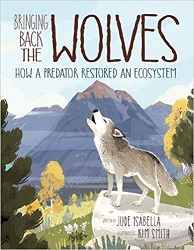
Review of Bringing Back the Wolves, by Jude Isabella, illustrated by Kim Smith

Bringing Back the Wolves

How a Predator Restored an Ecosystem

by Jude Isabella
illustrated by Kim Smith

Kids Can Press, 2020. 40 pages.
Review written August 22, 2020, from a library book

Bringing Back the Wolves is not flashy, but it’s simply presented nonfiction in a picture book format – and I learned a whole lot.

This book explains that all the wolves in Yellowstone National Park were gone by 1926. The government had offered a bounty on wolves and other predators in its quest to tame the west. But what nobody at the time realized was that would affect the entire ecosystem.

The book talks about the food web and food chains. But it shows that wolves affected the ecosystem far beyond ways you’d expect. Especially effective for me were spreads at the beginning and end of the book showing a valley in Yellowstone’s northern range in 1995 just before wolves were reintroduced, contrasted with a picture of that same valley twenty-five years later.

In between those spreads, it’s clearly laid out how much the wolves affected. First, it was the large herds of elk, which in 1995 were five times larger than in 1968. Fewer elk affected which plants and trees could survive and thrive. That affected animals in the middle of the food chain as well as bringing more birds and raptors to Yellowstone. Then, especially affecting the landscape, beavers came back, building dams and reviving the ecosystem on their part. Songbirds returning mean that the park even sounds different than it did in 1995. I’d no idea how much is affected, down to the insects in the soil.

Here’s how the author finishes this book, on the spread with the picture of the revitalized valley:

Twenty-five years after their reintroduction, about 500 wolves roam the greater Yellowstone ecosystem, staking their claim in the food web. Wolves have helped to balance the ecosystem just by being themselves, apex predators. But perhaps even more important, studying the wolves has exposed just how complex and interconnected the ecosystem is, revealing surprising links no one could have imagined.

kidscanpress.com

Buy from Amazon.com

This review is only on the blog.

Disclosure: I am an Amazon Affiliate, and will earn a small percentage if you order a book on Amazon after clicking through from my site.

Source: This review is based on a library book from Fairfax County Public Library.

Disclaimer: I am a professional librarian, but the views expressed are solely my own, and in no way represent the official views of my employer or of any committee or group of which I am part.

What did you think of this book?

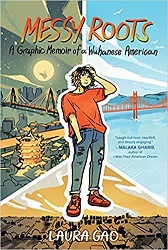
Review of Messy Roots, by Laura Gao

Messy Roots

A Graphic Memoir of a Wuhanese American

by Laura Gao

Balzer + Bray, 2022. 272 pages.
Review written July 24, 2022, from a library book

Here’s a graphic memoir immigrant story. It’s getting where I feel like I’ve read a lot of these — the life story of a kid who feels very different from their peers and ends up loving art. I’ve read others, but they always pack a punch. In the hands of an artist, a graphic novel (or memoir) is such a wonderful way to express all the emotional weight of their story.

YuYang Gao moved from Wuhan to Texas when she was 4 years old. She’d been living with her grandparents in China, playing with cousins, and didn’t even recognize her parents when she first arrived.

This book tells about her growing up years, trying to fit in, learning about herself and about her heritage, but also being willing to break new ground. In college, she came out as queer and had some challenges telling her family. She moved to San Francisco, where there was a vibrant Asian community.

Then when the pandemic hit, Americans had finally heard of Wuhan, but not in a good way. San Francisco, that had been so welcoming, had new dangers.

It’s all done with striking, brightly-colored art, with lots of variety in the images and panels. She brings you along on her story with all the confusions but comforts of her background combined with the life she’s building for herself.

lauragao.com
epicreads.com

Buy from Amazon.com

Find this review on Sonderbooks at: www.sonderbooks.com/Teen_Nonfiction/messy_roots.html

Disclosure: I am an Amazon Affiliate, and will earn a small percentage if you order a book on Amazon after clicking through from my site.

Disclaimer: I am a professional librarian, but the views expressed are solely my own, and in no way represent the official views of my employer or of any committee or group of which I am part.

What did you think of this book?

In Conversation: Yuyi Morales and Donna Barba Higuera – ALA Annual Conference Day Four

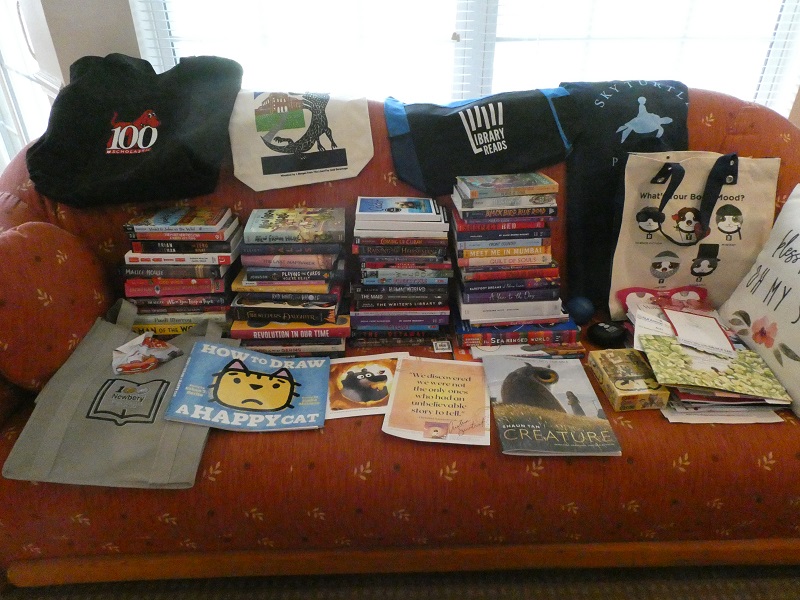
Monday morning, June 27, 2022, I drove into DC for the fourth day of ALA Annual Conference. I began the day in the exhibits and got books signed by, among others, Travis Jonker and Varian Johnson. Here’s how my piles looked after the fourth day!
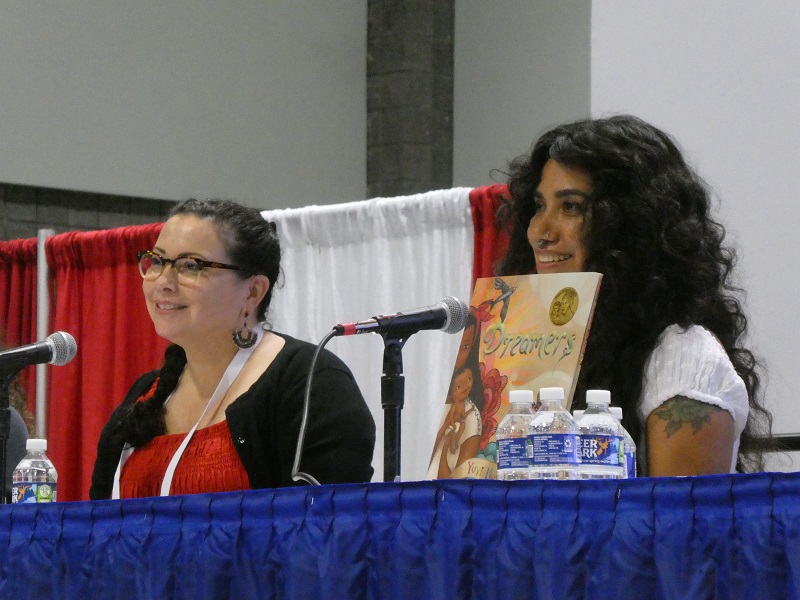
Then I went to a panel discussion with Yuyi Morales, whose book Dreamers (my personal favorite picture book from my Newbery year) was an important part of the story in this year’s Newbery-winning title, The Last Cuentista, by Donna Barba Higuera.
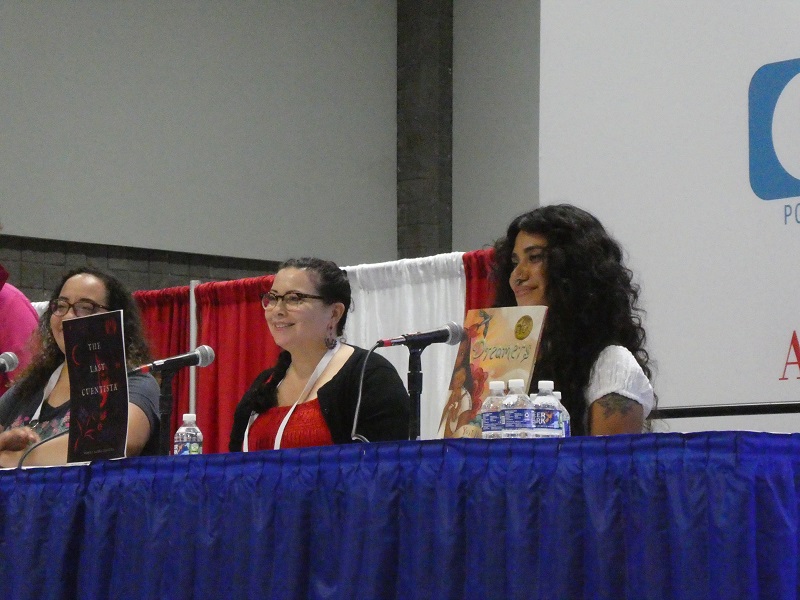
Shelly Diaz, the reviews editor of School Library Journal, was the moderator, so the first question she asked Donna was “When did you read Dreamers and what did you think?

DBH: In an earlier version, the book the little brother treasured was Frederick, but then she read Dreamers, and it changed everything. It’s about collecting vision and hope.

YM: She was very moved when she read The Last Cuentista. It made her cry. A connection she never would have dreamed of. The story felt as real as when other children see themselves in Dreamers. Seeing the book carried by Petra and Javier — told her she’s done her work.

SLJ: Who was a librarian who affected you?

DBH: Mrs. Hughes at a small rural library. She’d have books set aside for her to read. She knew what she liked and the worlds she was living in.

YM: Nancy, a children’s librarian, welcomed her. She didn’t understand either the language or the dynamics of the library, but Nancy and the other librarians created a space where she felt safe.

SLJ: What can we do?

DBH: Keep putting books in the hands of children. It’s a lot of pressure and easy for the public to say. Kids will find a way to get these books. Librarians are really doing a lot already.

YM: In Mexico, books aren’t used so much for education. We’re going to have to fight like warriors. Books still need to be created. We need to have and protect those books and get them in the hands of children. They should be everywhere.

DBH: It can’t just be librarians. Ask. There will be parents and teachers who support freedom to read.

SLJ: Has anyone seen something in your story that surprised you?

YM: All the time. The San Francisco main library filled her with wonder. She did a reading there and it felt like coming back home. A homeless woman said, “This is me and my child.” It’s written to give everyone the value of their stories.

DBH: She’s surprised by kids who know the folklore and mythology. As a kid, she’d thought they were something her grandma made up. She didn’t expect recognition from children — a satisfying surprise.

SLJ: Both books have focus on folklore and mythology.

DBH: She did lots of research. Oral tradition is one version. El Canejo in the moon is a story lots of kids haven’t heard — but she heard it as a child.

YM: Her favorite thing was that Petra made the stories her own — just like children in classrooms. Kids take from stories what they need, not what she intended.

She also does research. In Dreamers, she put in butterflies and other animals that migrate. Snakes make us fearful – but we’re about to learn something important. It has vital energy.

SLJ: What are you working on now?

DBH: Picture book about her own journey, and El Cuycuy story. Another sci-fi novel with lots of moving parts.

YM: The more books she makes, the longer they take. She has a very different process now, related to her own growth.

“Our biggest rebellion is to be happy.”

And happiness is connected to the well-being of everyone.
Review of Beverly, Right Here, by Kate DiCamillo

Beverly, Right Here

by Kate DiCamillo
read by Jorjeana Marie

Listening Library (Penguin Random House), 2019. 4 hours on 4 compact discs.
Review written February 12, 2020, from a library audiobook

Beverly, Right Here is the third book featuring one of the three friends introduced in the book Raymie Nightingale, this one featuring Beverly Tapinski, still in Florida in the 70s.

I was happy to spend time with Beverly, and I love the quirky characters of Kate DiCamillo’s world, especially Ayola, the old lady Beverly befriends.

However, I thought this book was sad and depressing. It begins as Beverly runs away, or as she puts it, leaves. Her dog Buddy has died, and her mother doesn’t care where she is. This book takes place a few years after the others, and Beverly is now fourteen years old. Her plan is to leave for good.

It’s sad to me that Beverly really doesn’t have compelling reasons to go back. But it seemed wildly unrealistic that the first place she walks into, she finds a job willing to not ask questions and pay her under the table. What’s more, she finds a place to live near that job.

I’m happy for Beverly things go so well, and it does make a wonderful story. But I sure do hope that kids reading it don’t think running away would go so well for them.

I did enjoy this audiobook and especially the friends Beverly made. But it made me sad for Beverly, and I was glad it was short. (It’s getting close to a young adult novel, since Beverly needs a job and a place to live. But it’s more the length of a children’s novel, and that fits better with the other two books.)

katedicamillo.com
listeninglibrary.com

Buy from Amazon.com

This review is only on the blog.

Disclosure: I am an Amazon Affiliate, and will earn a small percentage if you order a book on Amazon after clicking through from my site.

Disclaimer: I am a professional librarian, but I maintain my website and blogs on my own time. The views expressed are solely my own, and in no way represent the official views of my employer or of any committee or group of which I am part.

What did you think of this book?

48-Hour Book Challenge Finish Line

My 48-Hour Book Challenge is done, and my showing wasn’t as good as other times — too much sleeping and exceptions. And the 3000-piece puzzle on my table pulled me into more listening time than reading time, which isn’t nearly as efficient.

However — I did have a lovely time this weekend doing lots of reading! I really like the two audiobooks I’ve listened to this weekend — A Comb of Wishes (finished and reviewed) and These Wicked Walls (still a couple hours to go), so even if it wasn’t as efficient as reading, I enjoyed my time.

I did review all four books I finished (only four!), but haven’t gotten all the reviews posted yet. I did write two other reviews and have four more reviews I want to write, which I may do tonight. When it came to the end and I saw I hadn’t gotten much reading done, I wanted to do more of that.

Here are my stats for the last 48 hours:

8 hours, 10 minutes Reading
11 hours, 15 minutes Listening (I told you that puzzle snagged me.)
2 hours, 15 minutes writing reviews
50 minutes other blogging
2 hours, 15 minutes posting reviews (mostly while listening to audiobooks, not counted in above)

It all adds up to 24 hours, 45 minutes spent on books in the last 48 hours.

I finished 4 books, 2 of them from start to finish, but read parts of 13 books. I have several books I like to read a chapter per day, and worked on those. I read 719 pages in that time, which doesn’t count the audiobooks. I wrote 5 book reviews, including 3 of the books I finished. (I intentionally didn’t review one of the books. I enjoyed it, but would have pointed out too many flaws in a review — I think it’s better to just be quiet about it.) I wrote 2,492 words, posted 2 reviews on my website and 1 on the blog only. I posted 2 blog posts about ALA Annual Conference that were already written.

And there are much worse ways to spend a weekend! At this point, I may not be able to go to sleep without finishing up Within These Wicked Walls. And the puzzle is still calling!