Review of Bear & Hare: Where’s Bear? by Emily Gravett

Bear & Hare

Where’s Bear?

by Emily Gravett

Simon & Schuster Books for Young Readers, 2016. Originally published in Great Britain in 2014. 28 pages.
Starred Review

Here’s a sweet toddler-friendly story that provides counting practice along the way.

The text is simple. The first line is the most complicated one of the whole book:

Bear and Hare are playing hide-and-seek.

From there, the words are the numbers 1 through 10 written large, stretching across the page, showing Hare with his eyes covered. On the other side of the spread, next to the number 10, are the words “Where’s Bear?”

We turn the page and see Bear trying very inadequately to hide behind a lamp. Hare is pointing and saying, “There!”

The idea repeats.

After three tries where Bear is very easy to find, we see:

Maybe Hare should try hiding instead?

We’ve got the big numbers across the page again, this time with “Where’s Hare?”

Hare’s a lot harder to find. Sharp readers will spot his ears poking out. But when Bear looks under the blanket, the bed calls to him. Now Hare comes out and can’t find him!

It all ends with Hare shouting “I WANT BEAR!”

On the final page, we’ve got a cozy hug, and the words “There.”

You couldn’t ask for a cozier story to make toddlers feel clever – and get counting practice in, too.

emilygravett.com
simonandschuster.com/kids

Buy from Amazon.com

Find this review on Sonderbooks at: www.sonderbooks.com/Picture_Books/wheres_bear.html

Disclosure: I am an Amazon Affiliate, and will earn a small percentage if you order a book on Amazon after clicking through from my site.

Source: This review is based on a library book from Fairfax County Public Library.

Disclaimer: I am a professional librarian, but I maintain my website and blogs on my own time. The views expressed are solely my own, and in no way represent the official views of my employer or of any committee or group of which I am part.

What did you think of this book?

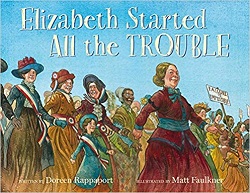
Review of Elizabeth Started All the Trouble, by Doreen Rappaport and Matt Faulkner

Elizabeth Started All the Trouble

written by Doreen Rappaport
illustrated by Matt Faulkner

Disney Hyperion, Los Angeles, 2016. 40 pages.

This is an accessible overview for elementary school children about the struggle for women’s rights. Reading it, I discovered that I hadn’t realized myself just how long the battle had taken.

The Elizabeth of the title was Elizabeth Cady Stanton. The book does begin earlier than Elizabeth Cady Stanton by mentioning Abigail Adams’ request to her husband when working on the Constitution to “Remember the ladies.”

Seventy-two years later, Elizabeth started the trouble when she and Lucretia Mott were forbidden to even be seen at a convention in London against slavery. They couldn’t be delegates, and had to sit behind a curtain to hear the men’s speeches.

After this, Lucretia and Elizabeth planned the first National Women’s Rights Convention, held in Seneca Falls, New York. Elizabeth modified the Declaration of Independence to be a Declaration of Sentiments, which was a rallying call for the women’s suffrage movement.

The book shows how long and slow and adamantly opposed that movement was. It also pictures many, many of the additional women who took part. One page shows many women who worked for the war effort during the Civil War on both sides.

Emancipation came for the slaves with the Thirteenth Amendment on January 31, 1865.

Then the lawmakers began debating giving the vote to black men.

Now, Elizabeth thought, now is our chance to get the vote, too.

But they didn’t

The next phase of working for women’s rights involved demonstrations, parades, and arrests. Some states individually gave votes to women. The people who started the struggle, including Elizabeth Cady Stanton, grew old and died.

The book ends with a double-page spread showing women from many time periods (including the present) standing together.

On August 26, 1920, the Nineteenth Amendment, granting women the right to vote, became law. The lawmakers had finally done what Abigail Adams wanted the Founding Fathers to do in that big room in Philadelphia so long ago.

The women had triumphed after battling for the vote for seventy-two years. But they knew their work was not over. There were still many unfair laws to change so that women could have true equality with men.

And we’re still working on it.

doreenrappaport.com
mattfaulkner.com
DisneyBooks.com

Buy from Amazon.com

Find this review on Sonderbooks at: www.sonderbooks.com/Childrens_Nonfiction/Elizabeth_started_all_the_trouble.html

Disclosure: I am an Amazon Affiliate, and will earn a small percentage if you order a book on Amazon after clicking through from my site.

Source: This review is based on a library book from Fairfax County Public Library.

Disclaimer: I am a professional librarian, but I maintain my website and blogs on my own time. The views expressed are solely my own, and in no way represent the official views of my employer or of any committee or group of which I am part.

What did you think of this book?

Review of Among a Thousand Fireflies, by Helen Frost and Rick Lieder

Among a Thousand Fireflies

poem by Helen Frost
photographs by Rick Lieder

Candlewick Press, 2016. 28 pages.

This story is simple. What makes it amazing are the photographs.

We meet one firefly among thousands. She finds her match by the pattern her lights flash.

Across a distance
wide and dark,
she looks out from
her flower
and sees –

Light. Dark.
Light. Dark.

Inside the flower,
her light flashes back,
pulsing through the night.

Here I am. She sends a silent call.
Over here.
Look! I’m here.

As I said, it’s a simple dramatization of a firefly finding its mate through the pattern of its flashes. But who knew that pictures of fireflies could be so stunning? I especially like the way her light lights up the flower she’s sitting on.

It’s simple. It’s short. But it will make you look twice. And it will help you notice the wonder of fireflies on the next summer night.

Mind you, kids are already good at noticing such things. I think this book will validate their wonder. And it may start a conversation about the science of fireflies, with some simple notes (so parents will know what they’re talking about) at the back of the book.

candlewick.com

Buy from Amazon.com

Find this review on Sonderbooks at: www.sonderbooks.com/Picture_Books/among_a_thousand_fireflies.html

Disclosure: I am an Amazon Affiliate, and will earn a small percentage if you order a book on Amazon after clicking through from my site.

Source: This review is based on a library book from Fairfax County Public Library.

Disclaimer: I am a professional librarian, but I maintain my website and blogs on my own time. The views expressed are solely my own, and in no way represent the official views of my employer or of any committee or group of which I am part.

What did you think of this book?

Review of Jumping Off Library Shelves, selected by Lee Bennett Hopkins

Jumping Off Library Shelves

A Book of Poems

selected by Lee Bennett Hopkins
illustrated by Jane Manning

Wordsong (Highlights), Honesdale, Pennsylvania, 2015. 32 pages.

A book of poems about libraries! Yes, please!

There are fifteen poems in this book, all by different authors except for Rebecca Kai Dotlich, who has the starting and ending poem. All the poems have something to do with libraries.

I’m going to simply quote some of my favorite lines.

From “Refuge,” by Nikki Grimes:

. . . smiling at the sweet kingdom of story
inviting me in
to rest, to explore –
to dream.

From “At the Library,” by Michele Krueger:

I’ve found a treasure,
a literal pleasure.

a book
I’ve not read
before.

From “Enchantment,” by Jane Yolen:

Stack by stack,
shelf by shelf,
I pick out books
all by myself.

Of course I like “Librarian,” by Joan Bransfield Graham

How do you
always find
the perfect
book?

You get that
look
in your eyes
and there
it is . . .

another
surprise
to savor.

From “The Poetry Section,” by Alice Schertle:

It reached out and grabbed me!
That poetry sound
set my heart singing,
spun me around

like a million bells ringing,
a hundred-piece band –
those poems made music
right there in my hand.

There’s even a poem about reading to dogs at the library, “Reading with Riley,” by Kristine O’Connell George:

all ears, all listen,
as we snuggle deeper
into story.

From “Book Pillows,” by Amy Ludwig Vanderwater:

With my head on a book
I dream of a place
where a pig loves a spider. . . .

Wild things on a rumpus!
Fat evil kings!
Boy wizards, girl witches!
Horses with wings!

And the beginning and ending poems imagine mice in the library at the start and end of the day. Of course at night they read the books! From “Midnight in a Library,” by Rebecca Kai Dotlich:

whiskers, tails twitch,
there’s magic in the air;

These poems are accessible for very young children as well as kids in school. And they celebrate libraries. What could be better?

leebennetthopkins.com
boydsmillspress.com

Buy from Amazon.com

Find this review on Sonderbooks at: www.sonderbooks.com/Childrens_Nonfiction/jumping_off_library_shelves.html

Disclosure: I am an Amazon Affiliate, and will earn a small percentage if you order a book on Amazon after clicking through from my site.

Source: This review is based on a library book from Fairfax County Public Library.

Disclaimer: I am a professional librarian, but I maintain my website and blogs on my own time. The views expressed are solely my own, and in no way represent the official views of my employer or of any committee or group of which I am part.

What did you think of this book?

Review of Apples and Robins, by Lucie Felix

Apples and Robins

by Lucie Felix

Chronicle Books, San Francisco, 2016. First published in France in 2013. 52 pages.

Here’s a simple picture book by a graphic designer. I was surprised by the high page count when I counted the pages – there are only a few words on each page, so it goes quickly. The point of the book is the art, not the words.

This book is done with simple shapes and cut-outs and bright colors. It shows how simple shapes can make recognizable things.

The book begins, “All you need for apples are circles and the color red.” On a red page, there are three white circles, but two of those circles are made from cut-outs. When you turn the page, the circles become red apples in a tree, with leaves and stems.

The next interesting transformation is this one:

All you need for a ladder are six rectangles: five short and one long.

When you turn the page, sure enough, the long rectangle cut-out turns the short rectangles into the spaces between the rungs of a ladder.

And the shapes and cut-outs get more complicated. My favorite is the robin, made from a circle cut-out placed around “three bright triangles like the robin’s whistle and a red oval like its round red breast.”

We’ve got a little bit of drama with a storm blowing down the bird house and later the arrival of Spring. But the point of this book is the fascinating transformations.

It will get kids thinking, seeing things from a new perspective, and perhaps trying out this kind of art themselves. This is a lovely and surprising picture book.

chroniclekids.com

Buy from Amazon.com

Find this review on Sonderbooks at: www.sonderbooks.com/Picture_Books/apples_and_robins.html

Disclosure: I am an Amazon Affiliate, and will earn a small percentage if you order a book on Amazon after clicking through from my site.

Source: This review is based on a library book from Fairfax County Public Library.

Disclaimer: I am a professional librarian, but I maintain my website and blogs on my own time. The views expressed are solely my own, and in no way represent the official views of my employer or of any committee or group of which I am part.

What did you think of this book?

Review of Measure for Measure, edited by Annie Finch and Alexandra Oliver

Measure for Measure

An Anthology of Poetic Meters

edited by Annie Finch and Alexandra Oliver

Everyman’s Library Pocket Poets, Alfred A. Knopf, New York, 2015. 256 pages.

Measure for Measure is like a college course on poetic meter. You learn about the different metric forms and then hear examples.like a college course on poetic meter. You learn about the different metric forms and then experience them.

The book explains various types of poetic meter – and then is filled with examples. This is a book that should be read aloud! There’s a nice selection of classic poems I’d heard before combined with more modern ones.

My one little complaint was that many examples were only excerpts from longer works, and I would have preferred the complete poem in most cases. But I have to say that this did keep the book short and manageable. The Everyman’s Library Pocket Poets come in a compact size, easily carried about, with a ribbon bookmark.

My method was to read aloud the poems on one double-page spread each morning. Hearing the poems, I quickly got a feel for the different meters.

Reading the names of the sections, you’ll understand that this book will teach you about new poetic forms. We’ve got: Accentual Poems, Trochaic Poems, Anapestic Poems, Dactylic Poems, Iambic Poems, Poems in Ballad Meter and Fourteeners, Amphibrachic Poems, Dipodic Poems, Poems in Sapphics and Alcaics, and Poems in Hendecasyllabics, Cretics, and Lesser Ionics.

This charming little book is both instructive and entertaining. And a must-read for aspiring poets.

randomhouse.com/everymans
everymanslibrary.co.uk

Buy from Amazon.com

Find this review on Sonderbooks at: www.sonderbooks.com/Nonfiction/measure_for_measure.html

Disclosure: I am an Amazon Affiliate, and will earn a small percentage if you order a book on Amazon after clicking through from my site.

Source: This review is based on a library book from Fairfax County Public Library.

Disclaimer: I am a professional librarian, but I maintain my website and blogs on my own time. The views expressed are solely my own, and in no way represent the official views of my employer or of any committee or group of which I am part.

What did you think of this book?

2018 Sonderbooks Stand-outs and Newbery Notes

It’s time to post my 2018 Sonderbooks Stand-outs! *Here’s the link added later: 2018 Sonderbooks Stand-outs*

It’s time — but I’m not going to do it!

I’m on the 2019 John Newbery Medal Selection Committee — and I can’t say one word about eligible books until after our winner is announced on January 28, 2019.

I am compiling my list today, though — so you can be absolutely sure that the choices reflect my opinion only and not the opinion of anyone else on the committee.

The list will also just be a ranking of how much I, personally, enjoyed the book, and not a ranking of how I distinguished I think the book is. They are two different things. I will stress that again when I post the Stand-outs. I can say even now that the order of the Stand-outs does not reflect my nominations or my votes for the Newbery.

I also will break the children’s books into categories — for example contemporary fiction, historical fiction, and speculative fiction, so I don’t have to compare as many books with each other.

But they are about spreading the word about good books! I have read so many, many wonderful books that we will not be able to honor!

In fact, I’ve written 315 reviews of eligible books that I haven’t been able to post. I hope to get them posted, eventually, after the Newbery is announced. After all, this year, I’ve been able to catch up on posting reviews from 2016 and 2017 that I hadn’t gotten posted yet. Or at least I’ll be caught up after posting 18 more reviews.

But let me give the numbers for my 2018 calendar year of reading. I was reading for the Newbery, so not too many adult books. I did read:

4 novels for grown-ups (all on audiobook)
38 nonfiction books for adults or young adults
49 novels for teens
174 books of children’s fiction
207 books of children’s nonfiction (many of those picture books)
595 picture books
13 books reread

My Newbery totals have been somewhat different. I began reading in 2017. And I only counted eligible books — which means a lot of picture books in translation were left out. The Newbery totals so far, counting books I reread in with the total are:

904 books read, 592 of them being picture books, for a total of 102,390 pages read, with 22,168 of those pages coming from picture books.

Now that it is 2019, a few friends mistakenly asked me about things winding down — again, they are not winding down but still ramping up.

I have 24 days before our discussion begins on January 25. The room is reserved for us from 8 am in the morning to 10 pm at night on both Friday and Saturday. Much shorter on Sunday, only 8 am to 10 am. We’re going to call the winner on 6 am on Monday morning, January 28, and the announcement ceremony happens at 8 am.

Now I am only reading nominated books (so I can’t just read 96 more picture books to get my total to 1,000). What I very much want to do is reread all the nominated books and take detailed notes and plan out what I think the strengths and weaknesses are.

I can’t tell how many books are nominated — it’s all top secret — but I will confess that there are more than 24. So realistically, I will probably not be able to reread them all as carefully as I would like to. I’m going to have to prioritize.

A fun thing about this stage of the process is how much you notice about books the second or third time through. You really do notice the strengths and weaknesses with fresh eyes. You begin to see all the craft that went into writing the book.

Anyway, it has been a wonderful ride… and I’d better get back to it!

Review of Follow Me! by Ellie Sandall

Follow Me!

by Ellie Sandall

Margaret K. McElderry Books, New York, 2016. First published in Great Britain in 2015. 32 pages.

I’m going to use this book in Toddler Storytime this week. It’s got lilting, simple language with not a lot of text on each page.

The pictures show lots of lemurs, exploring with their striped tails high in the air.

It’s time to wake up!
Come down from the tree.
Follow me,
follow me,
follow me! . . .

Things to hunt,
things to chase,
things to scare,
things to race.
Follow me,
follow me,
follow me!

When their explorations bring them face-to-face with a crocodile, all the lemurs quickly follow the leader the other direction, back to the tree.

This is a fun story with lots to look at. It ends with a cozy pile of sleeping lemurs.

simonandschuster.com/kids

Buy from Amazon.com

Find this review on Sonderbooks at: www.sonderbooks.com/Picture_Books/follow_me.html

Disclosure: I am an Amazon Affiliate, and will earn a small percentage if you order a book on Amazon after clicking through from my site.

Source: This review is based on a book from Fairfax County Public Library.

Disclaimer: I am a professional librarian, but I maintain my website and blogs on my own time. The views expressed are solely my own, and in no way represent the official views of my employer or of any committee or group of which I am part.

What did you think of this book?

Review of Emu, by Claire Saxby, illustrated by Graham Byrne

Emu

by Claire Saxby
illustrated by Graham Byrne

Candlewick Press, 2015. 30 pages.
Starred Review
Review written in 2016

Wow! This is a science picture book — telling about emus and how they raise their young — and the artwork is simply stunning.

There are two threads to the text. The story part begins like this:

In the open forest, where eucalyptus trees fringe tufty grasslands, honey-pale sunshine seeps to where Emu sits on a nest. Beneath him are eight granite-green eggs. Yes, him. For in Emu’s world, it is the male’s job to raise the fledgling.

On each spread, we get about that much more of the father emu’s story, as well as a paragraph of straight facts about emus.

The emu we’re following sits on his nest for eight weeks, without eating. He defends the eggs and then the fledglings from various predators. We watch the chicks grow until they are almost as tall and striking as their father.

The facts are good and the Australian setting makes them all the more interesting. Having the story of one family of emus alongside the facts is helpful. But what makes this book truly exceptional are the strikingly beautiful paintings. This book is a joy to leaf through.

This is another book I plan to booktalk in some elementary schools for this summer. It’s always a treat to find nonfiction that will draw kids in. That emu staring out from the front cover beckons kids to find out more.

candlewick.com

Buy from Amazon.com

Find this review on Sonderbooks at: www.sonderbooks.com/Childrens_Nonfiction/emu.html

Disclosure: I am an Amazon Affiliate, and will earn a small percentage if you order a book on Amazon after clicking through from my site.

Source: This review is based on a library book from Fairfax County Public Library.

Disclaimer: I am a professional librarian, but I maintain my website and blogs on my own time. The views expressed are solely my own, and in no way represent the official views of my employer or of any committee or group of which I am part.

What did you think of this book?

Review of Home at Last, by Vera B. Williams and Chris Raschka

Home at Last

by Vera B. Williams and Chris Raschka

Greenwillow Books, 2016. 36 pages.
Starred Review
Review written in 2016

I read about the creation of this book in Horn Book Magazine, so I was predisposed to like it. Vera Williams wrote the text many years ago, but set it aside until last year, when she felt the time was right. But she knew she was at the end of her life, so she’d need some help to finish the book, and she asked Chris Raschka. The result was that they collaborated on the book, and Chris completed it after she died on October 16, 2015.

The story might have been trite – an orphan child living in a home is being adopted – but this particular story is told with depth and warmth and love that makes it anything but typical. It’s also a long text for a picture book, so it’s not exactly a storytime selection, unless it’s for an elementary school classroom, but it would make lovely cozy family reading.

The book opens as Lester is waiting eagerly for the arrival of Daddy Albert, Daddy Rich, and their dog Wincka, who are going to finally adopt him.

When Lester moves in with them, they give him his own room. Lester needs his suitcase filled with action figures to protect him.

But every night, Lester wakes up in the night and stands by his daddies’ big bed, with Wincka sleeping at the foot. Every night, they wake to see him standing over them.

What Lester wanted was to climb into his parents’ bed, too. More than anything, he longed to wriggle right into the middle of that bed, with Daddy Rich on one side and Daddy Albert on the other side and fat old Wincka at his feet, and to have his action figures in their blue suitcase right on the floor beside them. That way he knew he would be safe from everything bad in the whole world.

Lester never told Daddy Rich and Daddy Albert about this. But every night, as though he had an alarm clock ringing in his belly, he grabbed his suitcase and made his expedition down the hall and through the door to the side of the bed.

Lester’s daddies have trouble with this. I appreciated the paragraph that expressed their thinking.

Daddy Rich and Daddy Albert had decided, long before they finished adopting Lester, that it was important for their new little boy to have his own room and his own bed. They had spent many weekends painting the room and finding the right bed for the boy who was coming to live with them. And they surely knew, from living with Wincka, how impossible it was to get a creature out of your bed once you have let that creature in, if only in an emergency . . . if only for a few nights.

The problem goes on though. The daddies try to help. They do lovely things together with Lester. They look forward to him settling in to school and feeling at home in the neighborhood. They do have some setbacks as well, but it’s clear they love Lester and want to do what’s best for him.

Finally, the solution – and a lovely one – comes from Wincka.

And I like the way the book doesn’t end with that solution – that’s only a part of Lester feeling at home. First, it talks about Sunday mornings when things are relaxed and everyone cuddles in the big bed and sleeps late and has pancakes together. The final spread goes further:

But he also loved when his new cousins – all four of them – stayed over on Saturday nights. They laughed and jumped around and played and played so much that they hardly slept a wink.

And at first light, they piled right on top of Daddy Rich and Daddy Albert.

“Help! We’re being attacked!” the daddies shouted, dashing through the house chased by cousins and Lester and Wincka and even Silver. And then it was pancakes for everyone. And then an entire day of more games and walks and snacks and fun together.

Lester was truly home at last.

Here’s a lovely warm book about a little lonely boy who needs a family – and finds one. I like the way it tackles head-on that he needs extra reassurance, and it isn’t easy – but he does find a home. And that reassurance.

This book is a lovely legacy for an outstanding picture book creator. I also love the way the pictures are a wonderful blend of her style with Chris Raschka’s, creating something new.

harpercollinschildrens.com

Buy from Amazon.com

Find this review on Sonderbooks at: www.sonderbooks.com/Picture_Books/home_at_last.html

Disclosure: I am an Amazon Affiliate, and will earn a small percentage if you order a book on Amazon after clicking through from my site.

Source: This review is based on a book from Fairfax County Public Library.

Disclaimer: I am a professional librarian, but I maintain my website and blogs on my own time. The views expressed are solely my own, and in no way represent the official views of my employer or of any committee or group of which I am part.

What did you think of this book?