Review of Two Friends, by Dean Robbins

two_friends_largeTwo Friends

Susan B. Anthony and Frederick Douglass

by Dean Robbins
illustrated by Sean Qualls & Selina Alko

Orchard Books (Scholastic), New York, 2016. 32 pages.

Here’s a simple picture book telling a story from history about Susan B. Anthony and Frederick Douglass. The two were friends and both lived in Rochester, New York. There’s a statue there showing the two of them having tea. This picture book dramatizes one such occasion, mostly using it as an opportunity to talk about both of their lives and how similar they were.

The language is easy for children to understand:

As a girl, Susan wanted to learn what boys learned.
But teachers wouldn’t let her. . . .

Susan wanted something more.
She read about rights in the United States.
The right to live free.
The right to vote.
Some people had rights, while others had none.
Why shouldn’t she have them, too?

Susan taught herself to give speeches.
Some people liked her ideas about rights for women.
Others didn’t.

The similar language used about Frederick Douglass highlights their similarities.

Frederick grew up as a slave in the South.
Slaves had to do everything the master said, but Frederick wanted something more.
He secretly learned to read and write.
New ideas thrilled him.

Frederick read about rights in the United States.
The right to live free.
The right to vote.
Some people had rights, while others had none.
Why shouldn’t he have them, too?

Frederick escaped from his master and headed north.
He taught himself to give speeches.
Some people liked his ideas about rights for African Americans.
Others didn’t.

Beyond this, there’s basic information about how the two supported each other and were friends. And the pictures are marvelous.

A lovely introduction to the topic of equal rights for young readers.

deanrobbins.net
seanqualls.com
selinaalko.com

Buy from Amazon.com

Find this review on Sonderbooks at: www.sonderbooks.com/Childrens_Nonfiction/two_friends.html

Disclosure: I am an Amazon Affiliate, and will earn a small percentage if you order a book on Amazon after clicking through from my site.

Source: This review is based on a library book from Fairfax County Public Library.

Disclaimer: I am a professional librarian, but I maintain my website and blogs on my own time. The views expressed are solely my own, and in no way represent the official views of my employer or of any committee or group of which I am part.

What did you think of this book?
Review of Ada Byron Lovelace and the Thinking Machine, by Laurie Wallmark

ada_byron_lovelace_largeAda Byron Lovelace and the Thinking Machine

by Laurie Wallmark
illustrated by April Chu

Creston Books, 2015. 40 pages.
Starred Review

Hooray! A picture book biography of Ada Lovelace, a great female mathematician, the person who wrote the first computer program.

Now, for me, I preferred the graphic novel version of fact mixed with fiction found in The Thrilling Adventures of Lovelace and Babbage, but this picture book is perfect for kids, firmly establishing that women can be truly great at math and computer science.

As a picture book biography, the book gives many pages to an incident in Ada’s childhood. Here’s the text that begins a section where Ada was trying to invent a flying machine and ended up playing in a cold pond and catching pneumonia:

And with her mother often traveling, Ada was lonely. Her journals, filled with pages of inventions and equations, kept her company.

The best part was when her sketches flew off the page and became real.

The accompanying picture shows birds flying just out of reach, including a mechanical bird. This may be unfortunately misleading – it looks like the book has turned to a book about a magic, rather than a factual biography. In fact, in the rest of the book, the illustrations simply show what’s described. Okay, there’s one exception where Ada was blind for a time from her illness, and we see what she’s imagining as she sits in the corner of the picture with eyes closed. But this flight of fancy is much more clear as a flight of fancy.

I came up with one other complaint. The book talks about Ada using Charles Babbage’s Difference Engine to calculate 12 times 15. The picture shows Ada looking closely at the machine with a completely different number showing. That’s a little confusing.

But those are admittedly minor complaints. The author nicely explains how Ada Lovelace wrote a computer program before a computer actually existed – based simply on Charles Babbage’s plans for one.

The paintings illustrating the book are gorgeous. Except for that one quibble where it’s not clear yet that the illustration is symbolic, they wonderfully accompany the story and shed light on the events, adding variety and interest.

Because Babbage never finished building the Analytical Engine, Ada never got to see her program run. But the influence of her work lives on. More than one hundred years before the invention of the modern computer, Ada had glimpsed the future and had created a new profession – computer programming.

Ada couldn’t know that one day a computer language would be named after her — Ada. And one of Ada’s uses? To guide modern flying machines.

The girl who needed crutches ended up flying after all!

lauriewallmark.com
aprilchu.com
crestonbooks.co

Buy from Amazon.com

Find this review on Sonderbooks at: www.sonderbooks.com/Childrens_Nonfiction/ada_byron_lovelace.html

Disclosure: I am an Amazon Affiliate, and will earn a small percentage if you order a book on Amazon after clicking through from my site.

Source: This review is based on a library book from Fairfax County Public Library.

Disclaimer: I am a professional librarian, but I maintain my website and blogs on my own time. The views expressed are solely my own, and in no way represent the official views of my employer or of any committee or group of which I am part.

What did you think of this book?
Sonderling Sunday – Fumo versus Zam-Zam, the Ritualized Threats

It’s time for Sonderling Sunday! That time of the week when I play with language by looking at the German translation of children’s books. This week it’s back to the Sonderbook that started it all, Der Orden der Seltsamen Sonderlinge, The Order of Odd-Fish, by James Kennedy.

Sonderlinge 2

I think of Sonderling Sunday as a very silly phrasebook for travelers. Because it’s too much fun imagining a situation where you could use these phrases if you were a tourist in Germany. And when it comes to using phrases in unusual ways, James Kennedy is a master. I also hope, by the way, that it piques my readers’ curiosity and they are tantalized into picking up the book to find out exactly how these phrases are used.

Last time, we left off on page 260 in the English edition, Seite 330 auf Deutsch.

“Raucous cheers and wild applause.”
= Jubel und wilder Applaus brandeten auf.

“hooted” = johlte

“stragglers” = irgendwelchen Nachzüglern

“cash box” = Geldkassette

Only in a James Kennedy book:
“Fumo, the Sleeping Bee, versus Zam-Zam, the Dancing Ant of Sadness!”
= Fumo, die schlafende Biene, gegen Zam-Zam, die Tanzende Ameise der Traurigkeit!

“boasts” = Schmährede

“armored ostrich” = gepanzerten Strauß

Okay, this is just fun to write out:
“One hundred forty-four thousand, four hundred forty-four”
= Einhundertvierundvierzigtausendvierhundertvierundvierzig

“ritualized threats and insults” = ritualisierte Drohungen und Beleidigungen

“exchange of insults” = Austausch von Beleidigungen

“jiggling antennae” = wippenden Fühlern

“stinger” = Stachel

We lost the alliteration here:
“sleek sheaths of segmented steel” =
eine Rüstung aus unterteilten Stahlplatten

“slumber” = Schlummer

Here’s an interesting sentence, which you probably shouldn’t use if you’re a tourist in Germany:
“When I am finished with you, your body shall be torn asunder by five wild boars and buried in five ignominious places, each one more shameful than the last!”
= Wenn ich mit der fertig bin, wird dein Leichnam von fünf wilden Keilern zerfetzt und an fünf schändlichen Orten verscharrt warden, von denen jeder schmachvoller ist als der andere!

“Bold words!” = Kühne Worte!

“Verily shall I construct honeycombs of your carcass”
= Wahrlich, ich werde Honigwaben um deinen Leichnam errichten

“retorted” = konterte

“ashes of defeat” = der Asche der Niederlage

“contemptuous joy” = verächtlicher Freude

“Vile boaster!” = Schändlicher Prahlhans!

“Quafmaf, the Pigeon of the Moon” = Quafmaf, die Taube des Mondes

“Nixilpilfi, the Gerbil Who Does Not Know Mercy”
= Nixilpilfi, die Wüstenmaus, die keine Gnade kennt

“the realm of obloquy” = Reich der Schmach

“force to your lips the flagon of infamy!”
= die Flasche der Schändlichkeit an deine Lippen zwingen!

While you’re learning all these insults, this is a good response to know:
“Idle threats, Fumo!” = Leere Drohungen, Fumo!

“Mizbiliades, the Bleeding Butterfly”
= Mizbiliades, den blutenden Schmetterling

“Paznarfalasath, the Rhinoceros Whose Laughter Destroys Worlds”
= Paznarfalasath, das Rhinozeros, dessen Lachen Welten zerstört

“Zookoofoomoot, the Maggot of Dismay”
= Zookoofoomoot, die Made der Bestürzung

“Pft the Mouse” = Pft, die Maus

“bed of disgrace” = das Bett der Ehrlosigkeit

“the lullaby of destruction” = das Wiegenlied der Verheerung

Interesting translation:
“a tea ceremony in the Grudge Hut in Snerdsmallow”
= einer Teezeremonie in der Grollhütte in Gimpelgarten

Better know this:
“Consider yourself challenged!”
= Betrachtet Euch als herausgefordert!

“Challenge accepted!” = Herausforderung angenommen!

And another sentence I’d love to find an opportunity to use:
“The lowliest cockroach would spit on you.”
= Selbst die ordinärste Kakerlake würde dich anspucken.

And I’ll finish as the fight finally starts:
“Oh, look, it’s starting!”
= Oh, sieh nur, es geht los!

Review of Winter, by Marissa Meyer

winter_largeWinter

The Lunar Chronicles, Book Four

by Marissa Meyer

Feiwel and Friends, 2015. 827 pages.

Ah! The Lunar Chronicles come to a satisfying end in this book. If you have read this far, I don’t have to say anything to get you to read the final volume, so let me make some comments about the series in general.

What I loved most was the fairy tale parallels. Cinder paralleled “Cinderella,” Scarlet paralleled “Little Red Riding Hood,” Cress paralleled “Rapunzel,” and this final book, Winter, parallels “Snow White.” However, all the characters from each of the previous books are still in the story – and by the final book, elements from Snow White’s story seemed forced. (Whereas in Cinder they arrived in natural and clever ways.) In particular, the part about the poisoned apple seemed totally unnecessary in the overall scheme, and I didn’t really believe that a disease would progress the way this one was portrayed.

But I do like the character of Winter, and even her status as Queen Levana’s stepdaughter worked well. I do like that each of the main characters is very different from the others.

I still didn’t really believe in the wolf-human hybrids, which has been a problem for me since Scarlet. I didn’t particularly like the additional information we got about that in this book – didn’t make it easier to believe.

At first when I opened this book, I thought, okay, we’ve got four couples. Two have matched up with the one they love but have some obstacles between them. Two are in love but haven’t admitted it to each other yet. And I knew all four would get together by the end of the book, and I thought that was a bit much. But I have to hand it to Marissa Meyers – she kept each romance distinct and interesting. All four plotlines are definitely not simple!

In fact, if anything the plot was a bit too convoluted with all those characters to juggle. But that did keep things from being at all boring or predictable and kept you turning pages. She is one of those authors who gives you a lot of interior monologue – which means it takes a little longer for actions to happen. This book is more than 800 pages long, since that’s what it took to tie everything together. In some spots, we were following three different sets of characters in different places, so that slowed things down, too.

However, all that said – in this book pulling all the threads together, Marissa Meyer accomplishes a well-earned Happily Ever After. Though I was able to put down the book and go to sleep, I was never even slightly tempted to set it aside altogether, and I began reading the same day my hold arrived. We’ve got life and death situations and the fate of earth at stake. We’ve got an intrepid band of rebels who go deep into the tyrant’s territory. Can they win the day?

marissameyer.com
thelunarchronicles.com
macteenbooks.com

Buy from Amazon.com

Find this review on Sonderbooks at: www.sonderbooks.com/Teens/winter.html

Disclosure: I am an Amazon Affiliate, and will earn a small percentage if you order a book on Amazon after clicking through from my site.

Source: This review is based on a library book from Fairfax County Public Library.

Disclaimer: I am a professional librarian, but I maintain my website and blogs on my own time. The views expressed are solely my own, and in no way represent the official views of my employer or of any committee or group of which I am part.

What did you think of this book?
Review of A Few of the Girls, by Maeve Binchy

few_of_the_girls_largeA Few of the Girls

Stories

by Maeve Binchy

Alfred A. Knopf, New York, 2016. 319 pages.
Starred Review

I do so love Maeve Binchy’s writing! This collection of short stories is classic Maeve Binchy. Her agent and editors selected many she had written over the years and collected them in this marvelous volume.

There are thirty-six stories with a wide variety of viewpoints. Some leave me inspired and thinking good thoughts, more ready to cope with life. Others leave me laughing at a character who got a worthy comeuppance. All are so true — true to human nature, whether the good side or the bad side of human nature. All are also entertaining.

I think my favorite was probably the woman who was dumped who met a woman who had also been dumped years ago and now spent her time repairing broken china, which remind her of broken hearts.

…she would see also how fragile things could be put together again if you realized that this was possible. Rather than just putting them in the back of a cupboard and pretending that the break hadn’t happened at all.

The stories are short and sweet. I ended up tearing through the collection with great enjoyment. Though I did pause in especially nice places, which is why I especially remember “Broken China.”

For insights on life and love, this is a wonderful collection, but it’s also good for spending time with “a few of the girls” who will feel like old friends.

maevebinchy.com
aaknopf.com

Buy from Amazon.com

Find this review on Sonderbooks at: www.sonderbooks.com/Fiction/few_of_the_girls.html

Disclosure: I am an Amazon Affiliate, and will earn a small percentage if you order a book on Amazon after clicking through from my site.

Source: This review is based on a library book from Fairfax County Public Library.

Disclaimer: I am a professional librarian, but I maintain my website and blogs on my own time. The views expressed are solely my own, and in no way represent the official views of my employer or of any committee or group of which I am part.

What did you think of this book?
few_of_the_girls_large

Review of The Most Wonderful Thing in the World, by Vivian French and Angela Barrett

most_wonderful_thing_in_the_world_largeThe Most Wonderful Thing in the World

by Vivian French
illustrated by Angela Barrett

Candlewick Press, 2015. 32 pages.
Starred Review

This is a fairy tale retold in “the time of your grandmother’s grandmother.” The beautiful paintings show clothing from the early twentieth century or late nineteenth century (I’m sure the illustrator could tell you precisely which). The paintings portray a Venice-like kingdom with a city set on a lagoon.

The king and queen decide that to find their daughter a husband, they will look for a young man who can show them the most wonderful thing in the world.

While princes and courtiers are bringing marvels to the king and queen (and here the illustrations are amazing), Princess Lucia has decided to see the city and to learn about its people.

Salvatore is the grandson of Wise Old Angelo, who gave the king and queen the advice. Salvatore brought the letter, and he’s sitting outside when the princess ventures out.

As Lucia came running out of the palace, she saw Salvatore sitting on the wall, playing with a little tabby cat.

“Excuse me, she said, pulling her cloak closer to cover her silk dress, “do you know the city?”

Salvatore smiled proudly, “Of course! I have lived in the kingdom all my life. Nobody knows the city better than I do, pretty lady. North, south, east, and west.”

“Can you show it to me?” Lucia asked. “Today?”

Salvatore was surprised. “But it would take longer than a day. Much longer.”

The princess put her hand on his coat sleeve. “Please?”

The young man bowed low. “I am Salvatore, pretty lady, and I am entirely at your service. Today, tomorrow, and the next day, until you have seen all that you want.”

“Thank you,” said the princess, and they walked away toward the heart of the city.

You can see where this is going! But the natural progression is carried out so beautifully and satisfyingly. The suitors bring some truly amazing things, but none of them is the most wonderful thing in the world. What the answer is, of course, is perfect.

The paintings in this book are very small and detailed, though truly wonderful, so it wouldn’t necessarily work for reading to a large group.

But anyone who likes an illustrated fairy tale will find a treasure in this book.

candlewick.com

Buy from Amazon.com

Find this review on Sonderbooks at: www.sonderbooks.com/Picture_Books/most_wonderful_thing_in_the_world.html

Disclosure: I am an Amazon Affiliate, and will earn a small percentage if you order a book on Amazon after clicking through from my site.

Source: This review is based on a library book from Fairfax County Public Library.

Disclaimer: I am a professional librarian, but I maintain my website and blogs on my own time. The views expressed are solely my own, and in no way represent the official views of my employer or of any committee or group of which I am part.

What did you think of this book?
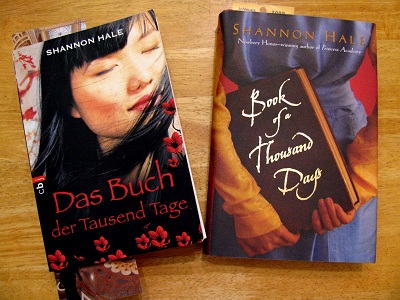
Review of Imaginary Fred, by Eoin Colfer and Oliver Jeffers

imaginary_fred_largeImaginary Fred

by Eoin Colfer
illustrated by Oliver Jeffers

Harper, 2015. 48 pages.

I have to admit, I have a problem with Imaginary Friend books. Including award-winning ones. Somewhere, the mechanism (that they do have a life of their own) breaks down. My suspension of disbelief is never perfect, and I can’t thoroughly enjoy the book.

That said, this one has less lack of logic than most. And the illustrations are by Oliver Jeffers!

Perhaps I was won over that the book acknowledges right from the start that not everyone who wishes for an imaginary friend gets one. It will only happen if “the conditions are just right, and if you add a little electricity, or luck, or even magic.”

Fred is an imaginary friend who likes it when he’s summoned. He tries to be a good imaginary friend.

But no matter how hard Fred tried, the same thing happened every time. One day, his friend would find a real friend in the real world.

A friend who did not have to be ignored when grown-ups were around.

When this day came, as it always did, Fred would feel himself fade.

Eventually, the wind would blow him up to a cloud, where he’d wait to be summoned by another lonely child.

When Sam summons Fred, Fred knows he’s different. They share more interests than any friend Fred has had before. When Sam makes a real friend, Sammi, Fred is sure he’s doomed… until he meets Sammi’s imaginary friend Frieda.

From there, things don’t proceed as they have before. Eventually we learn that “friendship is friendship. Imaginary or not, the same laws apply.”

Part of the fun of this book is in the details. Sam and Fred, who both love to read, are pictured reading the authors’ books, Artemis Fowl and Lost and Found. When the four friends perform in a quartet, grown-ups in the audience are very confused. I like when the friends practice speaking French.

Okay, there are still quibbles. If there’s an “imaginary community” as we learn at the end, how is this the first friendship between two imaginary friends, anyway?

But when it comes down to it, I can overlook my quibbles, because I kept coming back to and enjoying this book. If it tried to be general it would fail, but as a story about these particular four friends? This is an entertaining story which rewards repeated readings and gets you thinking about imagination and friendship and how they come together.

eoincolfer.com
oliverjeffersworld.com
harpercollinschildrens.com

Buy from Amazon.com

Find this review on Sonderbooks at: www.sonderbooks.com/Picture_Books/imaginary_fred.html

Disclosure: I am an Amazon Affiliate, and will earn a small percentage if you order a book on Amazon after clicking through from my site.

Source: This review is based on a library book from Fairfax County Public Library.

Disclaimer: I am a professional librarian, but I maintain my website and blogs on my own time. The views expressed are solely my own, and in no way represent the official views of my employer or of any committee or group of which I am part.

What did you think of this book?
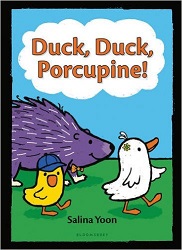
Review of The Princess in Black and the Hungry Bunny Horde, by Shannon Hale and Dean Hale

hungry_bunny_horde_largeThe Princess in Black and the Hungry Bunny Horde

by Shannon Hale and Dean Hale
illustrated by LeUyen Pham

Candlewick Press, 2016. 90 pages.
Starred Review

A third book about the Princess in Black! She’s a pretty and prissy princess in pink most of the time, but she has a secret identity – she’s the Princess in Black! She fights monsters with ninja moves!

As this book begins, Princess Magnolia is going about her ordinary business, ready to have a princessly brunch with her friend Princess Sneezewort. But then her glitter-stone ring rings! The monster alarm!

When the Princess in Black arrives at the goat pasture, where the hole leading to Monsterland opens, she doesn’t see anything scary. She sees a whole throng of fluffy purple bunnies.

The bunnies don’t look threatening. In fact, they look adorably cute. But there are hundreds of them. And they are terribly hungry. They eat all the grass in the goat pasture. Then they eat an entire tree. They eat a goat horn. They have their eyes on the Princess in Black.

In this case, it is Blacky the Pony (the secret identity of Frimplepants the Unicorn) who saves the day. The bunnies of the hungry bunny horde all speak the language of Cuteness.

Cute sniffles. Cute wiggles.

Cute hops. Only other cute animals could understand.

And that was why Blacky understood.

Because Blacky was not just Blacky the pony.

He was also Frimplepants.

Frimplepants the unicorn.

And Frimplepants the unicorn was as cute as they come.

This book came in at just the right time, when I was scheduled to read to a third grade class on Read Across America Day, and this book seemed perfect. Third graders might believe themselves to be too sophisticated for picture books (even though I know better). This book has 12 chapters and 90 pages. The text I quoted above covers three pages, and there are illustrations on every page (or at least every spread). So the book is accessible for someone who hasn’t been reading long but is ready for chapters – and there’s absolutely nothing boring about it.

And what I love about it is that the story is good enough that younger children who can’t read yet will love it, and older children who are completely capable of reading longer chapters will enjoy it as well. And adults won’t get tired of reading it either. There is much humor in the situation of cute bunnies creating such havoc.

Why should something easy to read and simple to understand be boring? The Princess in Black is the opposite of that.

squeetus.com
candlewick.com

Buy from Amazon.com

Find this review on Sonderbooks at: www.sonderbooks.com/Childrens_Fiction/hungry_bunny_horde.html

Disclosure: I am an Amazon Affiliate, and will earn a small percentage if you order a book on Amazon after clicking through from my site.

Source: This review is based on a library book from Fairfax County Public Library.

Disclaimer: I am a professional librarian, but I maintain my website and blogs on my own time. The views expressed are solely my own, and in no way represent the official views of my employer or of any committee or group of which I am part.

What did you think of this book?
Review of My Pet Human, by Yasmine Surovec

my_pet_human_largeMy Pet Human

by Yasmine Surovec

Roaring Brook Press, New York, 2015. 108 pages.

Here’s a delightful beginning chapter book with lots of pictures, told from the perspective of an adorable kitty.

There are five chapters. In the first one, “Mr. Independent,” the cat introduces himself.

I’m a lucky cat. I live a carefree life.

This is my territory. I know these streets like the back of my paw. Lots of cats are tied down by staying with their pet humans, but not me. I’m my own cat, and the only one I have to look out for is myself. I wouldn’t have it any other way.

The cat knows how to get food from various humans along his route.

It took me a while to master “the Look,” but it’s essential to getting what I want from humans. And let’s just say, I always get what I want. I mean, who can resist this face? I’m adorable.

Of course, the pictures show the wide-eyed look, which is indeed adorable.

The cat has friends (a dog, a rat, another cat) who all have pet humans. But he likes not being tied down.

Then a family moves into the abandoned house across the street from the tree where the cat likes to sleep. He happens to be hungry, and a window is open.

The young human inside proves to be easy to train, with enough rewards for good behavior. Her mother, however, is a different story.

Kids will enjoy this easy-reading tale, told from a slightly different perspective. The language isn’t dumbed down, but there are enough pictures, it almost has the feel of a graphic novel, and is very non-threatening.

This is a nice twist on your standard new-to-the-neighborhood story. What does it take to find the perfect pet human?

mackids.com

Buy from Amazon.com

Find this review on Sonderbooks at: www.sonderbooks.com/Childrens_Fiction/my_pet_human.html

Disclosure: I am an Amazon Affiliate, and will earn a small percentage if you order a book on Amazon after clicking through from my site.

Source: This review is based on a library book from Fairfax County Public Library.

Disclaimer: I am a professional librarian, but I maintain my website and blogs on my own time. The views expressed are solely my own, and in no way represent the official views of my employer or of any committee or group of which I am part.

What did you think of this book?
Review of Headstrong, by Rachel Swaby

headstrong_largeHeadstrong

52 Women Who Changed Science – and the World

by Rachel Swaby

Broadway Books, New York, 2015. 273 pages.
Starred Review

I was going to write that all parents of daughters should read this book. Then it occurred to me that this would be a fabulous book to hand to a teenage daughter. Then I realized that all educators should read this book. Finally, I realize that I think this is a book everyone should read.

Quick, name a scientist who was female and who changed the world with her work. Most people think of Marie Curie and draw a blank when they try to come up with any further names. Rachel Swaby specifically left out Marie Curie from this book. But she found 52 other women who did world-changing scientific work.

I heard Rachel Swaby speak at the 2015 National Book Festival. She was wonderful, so delighted and intrigued by the stories she’d uncovered about these amazing women. I checked out the book and since then have been reading one chapter a day. The fifty-two chapters are an easily digestible 3-4 pages, but highlight the way these women changed the world.

The author chose women who are already dead (“whose life’s work has already been completed”) and she leaned toward women who overcame obstacles, so these stories are inspiring as well as informative. She includes women who worked in the fields of medicine, biology, genetics, physics, geometry, astronomy, math, technology, and invention.

The Introduction explains why this book is so needed:

This book about scientists began with beef stroganoff. According to the New York Times, Yvonne Brill made a mean one. In an obituary published in March 2013, Brill was honored with the title “world’s best mom” because she “followed her husband from job to job and took eight years off from work to raise three children.” Only after a loud, public outcry did the Times amend the article so it would begin with the contribution that earned Brill a featured spot in the paper of record in the first place: “She was a brilliant rocket scientist.” Oh right. That.

The error – stroganoff before science; domesticity before personal achievement – is so cringe-worthy because it’s a common one. In 1964, when Dorothy Crowfoot Hodgkin won the greatest award that chemistry has to offer, a newspaper declared “Nobel Prize for British Wife,” as if she had stumbled upon the complex structures of biochemical substances while matching her husband’s socks. We simply don’t speak of men in science this way. Their marital status isn’t considered necessary context in a biochemical breakthrough. Employment as an important aerospace engineer is not the big surprise hiding behind a warm plate of noodles. For men, scientific accomplishments are accepted as something naturally within their grasp. . . .

We need not only fairer coverage of women in science, but more of it. . . .

As girls in science look around for role models, they shouldn’t have to dig around to find them. By treating women in science like scientists instead of anomalies or wives who moonlight in the lab as well as correcting the cues given to girls at a young age about what they’re good at and what they’re supposed to like, we can accelerate the growth of a new generation of chemists, archeologists, and cardiologists while also revealing a hidden history of the world.

By her own standards, Hertha Ayrton was a good scientist. So was the detail-oriented seismologist Inge Lehmann, and the firecracker neuroembryologist Rita Levi-Montalcini, too. The scientists in this book aren’t included because they were women practicing science or math in a time when few women did – although by that criterion, many would fit. They’re included because they discovered Earth’s inner core, revealed radioactive elements, dusted off a complete dinosaur skeleton, or launched a new field of scientific inquiry. Their ideas, discoveries, and insights made earth-shaking changes to the way we see the world (and that goes for the seismologist, too). . . .

So instead of calling every standout woman in science the Marie Curie of her field, the next time someone really lives for their work, let’s call them the Barbara McClintock of their specialty. If a scientist charts new territory, let’s refer to them as the Annie Jump Cannon of their particular exploration. If a researcher puts herself in physical danger for an experiment, let’s say she’s like any number of the scientists here who worked with radioactivity or mustard gas.

There are fifty-two profiles in this book. Read one a week, and in a year you’ll know whose research jump-started the Environmental Protection Agency, who discovered wrinkle-free cotton, and even whose ingenious score has now saved generations of struggling newborns. So little coverage has been dedicated to these scientists elsewhere that, in going through these profiles, I hope you’ll feel like you’ve gained a breadth of knowledge that rivals that of Salome Waelsch.

This book hit home to me because I was one of a small minority of women in a graduate mathematics department in the 1980s. It would have done me good to know that outstanding scientists and mathematicians who were women were nothing new at all.

And the book is interesting, too! Each brief biography begins with an intriguing paragraph and then gives you the rest of the story about these women who indeed overcame challenges and accomplished great things.

This book would be a fantastic place to start for novelists looking for actual historical characters with fascinating lives. I say this because I’ve already read a wonderful novel about one of the featured scientists, Sophie Kowalevski, Beyond the Limit, by Joan Spicci. I’m left wanting to know more about most of these amazing women.

Here are a few introductory paragraphs to get you intrigued:

Maria Sibylla Merian loved bugs long before scientists had uncovered their mysteries, loved them at a time when few people were interested in those vile, disgusting things. Acquantances assigned credit or blame for her unusual passion to her mother, who had looked at a collection of insects while Merian was still in the womb. Something about those pinned and polished bodies, shimmering powdery wings, and articulated legs instilled a fascination in the child growing inside her.

Two members of the division of war research at Columbia University spent an entire day grilling Chien-Shiung Wu about her work in nuclear physics. Regarding their own top-secret projects, the interviewers remained dutifully mum until the very end of the day, when they asked if Wu had any idea what they were up to. She cracked a smile. “I’m sorry, but if you wanted me not to know what you’re doing, you should have cleaned the blackboards.” They asked her to start work the next morning.

During the last two and a half decades of her 103 years, Italians liked to joke that everyone would recognize the pope, so long as he appeared with Rita Levi-Montalcini. Though she stood only five feet, three inches, the stories of her work and her life were as large and dramatic as her iconic sideswept hair.

Alice Hamilton’s professional successes – of which there were many – fell at the intersection of science and social issues. Although she earned a degree in medicine from the University of Michigan, gaining further training in bacteriology and pathology at the University of Leipzig and the University of Munich, she didn’t think herself capable of becoming anything more than a “fourth-rate bacteriologist.” But what she lacked in bravado, she made up for in her dedication to problems both “human and practical”: typhoid outbreaks, lead poisoning, and the widespread horror of occupational disease.

Learn the fascinating stories of these and forty-eight other women and along the way become better informed about history and better understand how capable women are and have long been at being scientists.

rachelswaby.com
broadwaybooks.com

Buy from Amazon.com

Find this review on Sonderbooks at: www.sonderbooks.com/Nonfiction/headstrong.html

Disclosure: I am an Amazon Affiliate, and will earn a small percentage if you order a book on Amazon after clicking through from my site.

Source: This review is based on a library book from Fairfax County Public Library.

Disclaimer: I am a professional librarian, but I maintain my website and blogs on my own time. The views expressed are solely my own, and in no way represent the official views of my employer or of any committee or group of which I am part.

What did you think of this book?