Review of How to Swallow a Pig, by Steve Jenkins and Robin Page

how_to_swallow_a_pig_largeHow to Swallow a Pig

Step-by-Step Advice from the Animal Kingdom

by Steve Jenkins & Robin Page

Houghton Mifflin Harcourt, Boston, 2015. 32 pages.

Here’s another amazing children’s science book by Steve Jenkins and Robin Page. Again it’s illustrated with Steve Jenkins’ incredibly realistic cut-paper illustrations, which look so life-like.

This book encourages curiosity. There’s a lot of information on each page, with clear illustrations that draw the eye.

The gimmick for this book is the How-to format. The authors cover how animals do various unusual things, but told as a How-to book. Some of the steps won’t be easy for a kid to carry out!

For example, in Step 2 of “How to Build a Nest Like a Wasp,” “You’ll need to find a source of wood, such as an old log or unpainted fence. To make paper pulp, bite off a small piece of wood and chew it thoroughly, mixing it with your saliva.” And in Step 5 of the title piece, “How to Swallow a Pig Like a Python,” you’ll need to “unhinge your jaw (this takes practice). Starting with the head, begin to work the pig down your throat.”

Besides these, the other tasks the authors demonstrate and give step-by-step directions for include:
“How to Trap Fish Like a Humpback Whale”
“How to Sew Like a Tailorbird”
“How to Repel Insects Like a Capuchin”
“How to Woo a Ewe Like a Mountain Sheep”
“How to Crack a Nut Like a Crow”
“How to Build a Dam Like a Beaver”
“How to Disguise Yourself Like an Octopus”
“How to Hunt Like a Reddish Egret”
“How to Build a Nest Like a Wasp”
“How to Spin a Web Like a Spider”
“How to Decorate Like a Bowerbird”
“How to Warn of Danger Like a Vervet Monkey”
“How to Farm Like a Leaf-Cutter Ant”
“How to Catch a Meal Like a Crocodile”
“How to Defend Yourself Like an Armadillo”
“How to Catch an Insect Like an Ant Lion”
“How to Dance Like a Grebe”

All of these activities are given with fairly simple (but sometimes impossible for humans) numbered steps and eye-catching illustrations.

There are more details at the back about all the featured animals.

I think my favorite feature is “How to Crack a Nut Like a Crow,” because crows have clearly adapted their methods.

Crows are intelligent birds, and they have learned to crack nuts by carrying them into the air and dropping them on rocks or pavement. But, some nuts are too tough, and even this treatment won’t break them open. In some places, crows have found a solution.

It’s probably best not to try this technique until you learn how to fly.

1) Find a nut.
A walnut or other tough-shelled nut is a good choice.
2) Select your perch.
Find a spot near a traffic signal above a busy road.
3) Drop your nut.
Choose a place where the nut will get run over by a car or truck.
4) Wait for the light to change.
Don’t try to collect the pieces of your smashed snack until the light has changed and traffic has stopped.
5) Enjoy!
Now you can swoop down, eat your nut, and take off before the light changes again.

All the above is contained on one page, with an illustration for each step and a large picture in the middle. So it’s a nice nonthreatening mix of words and pictures.

Curious kids will get a kick out of imagining how it would be if they could carry out these directions.

stevejenkinsbooks.com
hmhco.com

Buy from Amazon.com

Find this review on Sonderbooks at: www.sonderbooks.com/Childrens_Nonfiction/how_to_swallow_a_pig.html

Disclosure: I am an Amazon Affiliate, and will earn a small percentage if you order a book on Amazon after clicking through from my site.

Source: This review is based on a library book from Fairfax County Public Library.

Disclaimer: I am a professional librarian, but I maintain my website and blogs on my own time. The views expressed are solely my own, and in no way represent the official views of my employer or of any committee or group of which I am part.

What did you think of this book?

Review of Furiously Happy, by Jenny Lawson

furiously_happy_largeFuriously Happy

A Funny Book About Horrible Things

by Jenny Lawson

Flatiron Books, New York, 2015. 329 pages.
Starred Review

Jenny Lawson is The Bloggess, the author of one of the funniest blogs on the Internet. I listened to her first book, Let’s Pretend This Never Happened, and laughed and laughed. I’m trying to remember why on earth I didn’t review it, and suspect it’s probably because I was embarrassed to recommend someone who uses so much coarse language to my prim and proper friends? But I’ve since recommended some of her columns, particularly the one about Beartrum, to enough friends to be sure that the laughter far outweighs any outrage. (And maybe my friends aren’t so prim and proper after all?)

This one, too, has plenty of coarse language and plenty of talk about body parts that don’t usually come up in polite society. But oh my goodness, Jenny Lawson is just so funny. And this book has some open and honest talk about mental illness, which makes it all the better and gives it a great message even beyond making you laugh.

This is not, I’m afraid, a good book to bring to a doctor appointment to read in the waiting room. I brought it, realizing that it’s a good book to dip in and out of, and knowing I wouldn’t be bored. However, I hadn’t stopped to think how I would sound giggling nonstop or letting out random chuckles and snorts. I tried to contain them, but didn’t completely succeed. At the very least, I was smiling ridiculously, looking pretty similar to the raccoon on the cover.

As Jenny says in the disclaimer:

This is a funny book about living with mental illness. It sounds like a terrible combination, but personally, I’m mentally ill and some of the most hysterical people I know are as well. So if you don’t like the book then maybe you’re just not crazy enough to enjoy it. Either way, you win.

The “Furiously Happy” title comes from a blog post the author wrote about being Vehemently, Furiously Happy, just to spite her depression.

This didn’t mean that I wasn’t still depressed or anxious or mentally ill. I still spent my share of weeks in bed when I simply couldn’t get up. I still hid under my office desk whenever the anxiety got too heavy to battle standing up. The difference was that I had a storeroom in the back of my mind filled with moments of tightrope walking, snorkeling in long-forgotten caves, and running barefoot through cemeteries with a red ball gown trailing behind me. And I could remind myself that as soon as I had the strength to get up out of bed I would again turn my hand to being furiously happy. Not just to save my life, but to make my life.

Yes, there’s serious and very helpful talk about mental illness, but there are also random funny bits and hilarious stories. I can’t think of a better way to review this book than to quote a few. I’ll try to limit it to bits without swearing. (If swearing really bothers you, alas, you should avoid this book. Also, you might not want to listen to it in the family car.)

“I’m not going to say I told you so” is pretty much the same thing as saying “I told you so.” Except worse because you’re saying “I told you so” and congratulating yourself for your restraint in not saying what you totally just said.

The phrase “Rest in peace” seems incredibly self-serving. It basically means, “Stay in your grave. Don’t haunt me.” The opposite would be “Fitfully toss” or “Go jogging.”

I don’t understand why people keep pushing that “Don’t be some random person. BE UNIQUE” message. You’re already incredibly unique. Everyone is incredibly unique. That’s why the police use fingerprints to identify people. So you’re incredibly unique . . . but in the exact same way that everyone else is. (Which, admittedly, doesn’t really sing and is never going to make it on a motivational T-shirt.) So none of us are unique in being unique because being unique is pretty much the least unique thing you can be, because it comes naturally to everyone.

People who think it’s so hard to find a needle in a haystack are probably not quilters. Needles find you. Just walk on the haystack for a second. You’ll find the needle. They’re worse than floor-Legos.

Talking about Rory, the taxidermied raccoon on the cover:

Victor thinks taxidermy is a waste of money, claiming that “there are only so many things you can do with a dead raccoon.” But I have proven him wrong time and time again. Victor pointed out that what he’d actually said was “There are only so many things you should do with a dead raccoon,” and honestly that does sound more like something he’d say, but I still disagree.

There’s an essay about when her doctor prescribed antipsychotics. I like this paragraph. She knows how to look on the bright side and make you laugh, too.

Truthfully, though, there are some advantages to being on antipsychotics. First off, you can say you’re on antipsychotics. This might seem silly but when you go to the pharmacy and you’re standing in line with twenty germy people sneezing all over the place you can honestly say, “Would you mind if I went first? I have to pick up my antipsychotic meds and I REALLY needed them yesterday.” This tactic also works for grocery lines, the DMV, and some buffets.

Here’s some good logic:

Technically, if I were farther away from the center of the Earth then I’d be subjected to less gravity and then I would weigh less. So I’m not really fat. I’m just not high enough. Victor says I sound pretty high already but I suspect he’s just being insulting.

But the simple fact is, there’s no such thing as real weight. Only mass. Weight depends entirely upon the gravity of wherever you are, which is why if you weigh yourself on the top of Mount Everest you’d be closer to outer space and you would weigh slightly less than you would at home. But you’d have to lug a scale up to the top of Mount Everest to prove it, which would suck. Honestly, they should just leave a scale up there for people. Although, maybe they already have one, because who’s going to drag a scale back down Mount Everest? That would be crazy. Frankly, I never understood why people climb that thing in the first place, but if there’s a scale up there telling you that you’re skinnier than you think then I guess I can see the draw. . . .

Regardless, on the moon I weigh about as much as a large toaster, so using that logic I’m not overweight. I’m simply overgravitated. Spell-check says that I can’t be “overgravitated” because that isn’t a real word and suggested that I probably meant to say that I’m “overly aggravating.” Victor says spell-check has a point.

Spell-check and Victor are both dead to me.

Perhaps if people are so concerned with obesity they should just work on making the Earth have less mass so there’s less gravity. . . . Victor says this is a clear case of “deflection” and I agree because I assume “deflection” is something scientific used to deflect mass from Earth and, thus, make us all lighter. Victor says he thinks I don’t know what “deflection” means. I think Victor doesn’t know what “being supportive” means. (It means letting me lean on him a little when I’m standing on the bathroom scale.) I think this is all pretty commonsense. Victor says it’s not at all.

And the Bloggess is so good at helpful ways to think about yourself!

I try not to get caught up in appearance issues though because my grandmother always used to say, “It’s what’s inside that counts.” And that’s probably true because with my luck my best feature would be hidden deep, deep inside my body. I suspect my best feature is my skeleton, which is a shame because it might be the most elegant and hauntingly graceful skeleton ever but I’ll never get complimented on it while I’m still fleshy enough to appreciate it. That’s why I’d like people to say “Nice skeleton” to me now. Just give me the benefit of the doubt, you know?

I’ve started handing out similar compliments to strangers, but not about their skeletons, because that would seem disingenuous or even sarcastic since I’m already pretty sure I have the sexiest skeleton ever. It’s dead sexy. See what I just did there? I credit my skeleton with that joke. Clever and beautiful. No, instead I say things like “I’d wager you have an exquisite pancreas.” Or “I bet your tendons are fantastic.” People are usually so overwhelmed that they move away very quickly or tell me they don’t have any money on them. No one is ever prepared to accept compliments from strangers about their internal organs, which just goes to show how seldom we compliment them.

Along those same lines, I love the part where she explains that the person we should be comparing ourselves to is Galileo. But first I have to include where she explains the Spoon Theory:

The Spoon Theory was created by a friend of mine, Christine Miserandino, to explain the limits you have when you live with chronic illness. Most healthy people have a seemingly infinite number of spoons at their disposal, each one representing the energy needed to do a task. You get up in the morning. That’s a spoon. You take a shower. That’s a spoon. You work, and play, and clean, and love, and hate, and that’s lots of spoons . . . but if you are young and healthy you still have spoons left over as you fall asleep and wait for the new supply of spoons to be delivered in the morning.

But if you are sick or in pain, your exhaustion changes you and the number of spoons you have. Autoimmune disease or chronic pain like I have with my arthritis cuts down on your spoons. Depression or anxiety takes away even more. Maybe you only have six spoons to use that day. Sometimes you have even fewer. And you look at the things you need to do and realize that you don’t have enough spoons to do them all. If you clean the house you won’t have any spoons left to exercise. You can visit a friend but you won’t have enough spoons to drive yourself back home. . . .

Really, the only people you should be comparing yourself to would be people who make you feel better by comparison. For instance, people who are in comas, because those people have no spoons at all and you don’t see anyone judging them. Personally, I always compare myself to Galileo because everyone knows he’s fantastic, but he has no spoons at all because he’s dead. So technically I’m better than Galileo because all I’ve done is take a shower and already I’ve accomplished more than him today. If we were having a competition I’d have beaten him in daily accomplishments every day of my life. But I’m not gloating because Galileo can’t control his current spoon supply any more than I can, and if Galileo couldn’t figure out how to keep his dwindling spoon supply I think it’s pretty unfair of me to judge myself for mine.

You’ll even get complimented if you read this book:

How can we be expected to properly judge ourselves? We know all of our worst secrets. We are biased, and overly critical, and occasionally filled with shame. So you’ll have to just trust me when I say that you are worthy, important, and necessary. And smart.

You may ask how I know and I’ll tell you how. It’s because right now? YOU’RE READING. That’s what the sexy people do. Other, less awesome people might currently be in their front yards chasing down and punching squirrels, but not you. You’re quietly curled up with a book designed to make you a better, happier, more introspective person.

You win. You are amazing.

But my favorite bit of all is when she recounts what her husband Victor said to her. He’s a gem. (I won’t get into how this contrasts with something specific my ex-husband said to me about the chronic headaches I used to get. Let’s just say I love Victor vicariously for this sentence.)

Last month, as Victor drove me home so I could rest, I told him that sometimes I felt like his life would be easier without me. He paused a moment in thought and then said, “It might be easier. But it wouldn’t be better.

Well look at that. I was only going to quote a few good bits. There are far too many! And there are many, many more where that came from! If any of these made you smile, read the book! I can honestly say it left me happier, encouraged, and feeling much better about my own failings and my own quirky, wonderful life.

It didn’t, however, give me the slightest inclination to start collecting taxidermy. However, I am glad that The Bloggess does, and thus brings joy to people all over the world.

TheBloggess.com
flatironbooks.com

Buy from Amazon.com

Find this review on Sonderbooks at: www.sonderbooks.com/Nonfiction/furiously_happy.html

Disclosure: I am an Amazon Affiliate, and will earn a small percentage if you order a book on Amazon after clicking through from my site.

Source: This review is based on a library book from Fairfax County Public Library.

Disclaimer: I am a professional librarian, but I maintain my website and blogs on my own time. The views expressed are solely my own, and in no way represent the official views of my employer or of any committee or group of which I am part.

What did you think of this book?

Review of The Sleeper and the Spindle, by Neil Gaiman

sleeper_and_the_spindle_largeThe Sleeper and the Spindle

by Neil Gaiman
illustrated by Chris Riddell

Harper, 2015. 69 pages.
Starred Review

This is an illustrated fairy tale. And how much do I love that an illustrated fairy tale has been published?

This story is beautiful and eerie at the same time. It feels familiar, but twists things in unexpected ways.

The reader thinks they’ve got a Sleeping Beauty story going, or perhaps Sleeping Beauty twisted with Snow White, but nothing turns out as the reader expects.

The book starts out with some dwarves going under some mountains to get finest silk for their queen, who is soon to be married. On the other side of the mountains, they find an enchanted sleep spreading. It is spreading out from a castle with a princess who was cursed, as in the traditional tale, and has been sleeping for years. But now it’s not only the servants in the castle who are sleeping as well. The sleep is spreading to all the surrounding villages.

The tale first starts going in unexpected directions when the queen decides to go break the spell.

“I am afraid,” said the queen, “that there will be no wedding tomorrow.”

She called for a map of the kingdom, identified the villages closest to the mountains, sent messengers to tell the inhabitants to evacuate to the coast or risk royal displeasure.

She called for her first minister and informed him that he would be responsible for the kingdom in her absence, and that he should do his best neither to lose it nor to break it.

She called for her fiancé and told him not to take on so, and that they would still be married, even if he was but a prince and she a queen, and she chucked him beneath his pretty chin and kissed him until he smiled.

She called for her mail shirt.

She called for her sword.

She called for her provisions, and for her horse, and then she rode out of the palace, toward the east.

Neil Gaiman knows the language of fairy tales. But he also knows how to surprise the reader.

The illustrations are also wonderful. Looking at them a second time, I’m finding new details everywhere. They are black and white with gold highlights, and extremely detailed.

There’s a place where hundreds of sleeping people, completely covered with cobwebs, start sleepwalking toward the queen. The illustrations here are incredibly sinister.

The story doesn’t take long to read, and every spread has illustrations, but this is not a picture book, nor is it written for preschoolers.

Here’s the scene where villagers tell the dwarves about the plague of sleep:

“. . . And brave men,” continued the pot-girl. “Aye, and brave women too, they say, have attempted to travel to the Forest of Acaire, to the castle at its heart, to wake the princess, and, in waking her, to wake all the sleepers, but each and every one of those heroes ended their lives lost in the forest, murdered by bandits, or impaled upon the thorns of the rosebushes that encircle the castle –“

“Wake her how?” asked the middle-sized dwarf, hand still clutching his rock, for he thought in essentials.

“The usual method,” said the pot-girl, and she blushed. “Or so the tales have it.”

“Right,” said the tallest dwarf. “So, bowl of cold water poured on the face and a cry of ‘Wakey! Wakey!’?”

“A kiss,” said the sot. “But nobody has ever got that close. They’ve been trying for sixty years or more. They say the witch –“

“Fairy,” said the fat man.

“Enchantress,” corrected the pot-girl.

“Whatever she is,” said the sot. “She’s still there. That’s what they say. If you get that close. If you make it through the roses, she’ll be waiting for you. She’s old as the hills, evil as a snake, all malevolence and magic and death.”

mousecircus.com
chrisriddell.co.uk

Buy from Amazon.com

Find this review on Sonderbooks at: www.sonderbooks.com/Childrens_Fiction/sleeper_and_the_spindle.html

Disclosure: I am an Amazon Affiliate, and will earn a small percentage if you order a book on Amazon after clicking through from my site.

Source: This review is based on a library book from Fairfax County Public Library.

Disclaimer: I am a professional librarian, but I maintain my website and blogs on my own time. The views expressed are solely my own, and in no way represent the official views of my employer or of any committee or group of which I am part.

What did you think of this book?

KidLitCon 2015 – Part Three

I’ve already posted about the first day of KidLitCon 2015 in Baltimore.

Since Baltimore is driving distance, I chose to drive rather than stay at the hotel, but my goodness it was quicker on Saturday (both directions) than it was on Friday!

KidLitCon8

Saturday began with a keynote speech from Tracey Baptiste, author of The Jumbies.

It never occurred to Tracey that she was writing horror — she thought she was writing a fairy tale! She loves the adventure and bravery found in fairy tales.

She took from the mythical characters — the Jumbies — that she’d grown up with in Trinidad.

She does believe that the majority of stories about a culture should be told from deep inside the culture. The more personal a story is, the more universal they seem to be.

Stories that come out of great need are stories we all need.

After Tracey’s talk came the most entertaining panel of the day — the Comic Book Panel

KidLitCon13

Moderator Miriam DesHarnais, fitting to the theme, had made pictures and word cards and arrows to use for the panel. She’s on the right in this picture. The other woman is Maggie Thrash, author of Honor Girl. The tall guy in back is Jay Hosler, author of Last of the Sandwalkers, and the other two men are Jorge Aguirre (on the left) and Rafael Rosado, authors of Giants Beware! and Dragons Beware!.

The panel was entertaining, including game-show-style questions. I’ll list a few gems.

Maggie said: Teens are brave. They like reading about people different from themselves.

Jay (a college biology professor) said: In kids, the desire to participate is huge. This is lost by the time they’re college students who don’t want to stand out. They don’t want to question authority.

Each author has someone in their books who says, “You can’t do things this way.” And the main character challenges that.

Maggie: Girls are told it’s not nice to excel.

Jay: It’s a glorious time to be a cartoonist. Put your stuff on the internet. Don’t wait. You’ll never be good enough in your head.

Galileo made the first comic: Stars next to the moon. Something happens when words and pictures are put together. More learning happens. It contextually motivates learning.

Rafael: Connections are made in between the panels.

Jorge: Between the panels, action happens in your head — so there’s more interaction between the book and the reader.

Maggie: Comics are so intimate. They bring you there. To see a body slump adds more empathy than to read about it. Also, you can linger more than over a movie.

And Jay says his next book involves this question: What do you do when your best friend turns out to be a parasite coming out of someone else’s head?

What indeed?

The next panel I attended was called “Intersectionality: The Next Step in Diverse Books”

The panel was to have included Zetta Elliott, but she wasn’t able to come, and her opening talk was read by Mary Fan. The other panelists were Mary Fan and twins Guinevere and Libertad Tomas.

KidLitCon14

Zetta Elliott pointed out that each person is at the intersection of multiple aspects of our identities.

When you’re reviewing a book, publicly locate yourself and notice your own positionality.

Guinevere Tomas: She used to wonder why marginalized characters had to die off. The sisters are black, but also Cuban. Why did one or the other identity have to be sacrificed? Then there are religious, gender, sexuality identities. She doesn’t want to leave part of her identity behind.

The Tomas Twins blog at Twinja Book Reviews. They’ve written a fantasy book called The Mark of Noba.

Libertad was looking at random YA Queer book lists — all are about cis white people.
Muslim lists — don’t reflect black and Latino.
Disabled lists — all white.
Latino lists — all have the same brown skin color.
When you’re at the intersection of many of these, you have to walk around with someone defining your identity for you.
She was so happy when she read a book with a main character who was like her.

Mary Fan: None of us fit into boxes. At the end of the day, we’re all “Us,” and the only “them” is ignorance.

How to keep up? Keep reading.

You have to be uncomfortable to change it.

When white people review books, they often don’t mention people of color or queer people. Libertad does want to know when marginalized people are represented. Tell if the books have diversity and if the diversity is on point.

Mary Fan gave a cynical definition of dystopia: “What if all the horrible things in the world also happened to white people?”

The next panel I attended, “Authentic Voices,” had a similar theme. It was led by Liz Burns and Pam Margolis.

In particular, they talked about books for the blind. Like anyone else, they’d like to see themselves in the books. Everyone would like to be the main character some time.

Pam looks at the author and asks questions like:
Why are they writing about this? Does it seem authentic? What’s their motive?

Do you know how to tell the publishers what you want? Buy books that have diversity.

The next panel I attended was “Middle Grade Madness.”

KidLitCon15

On the left in this picture is moderator Sam Musher, then Wendy Shang, Elisabeth Dahl, Carol Weston, Erica Perl, and Elissa Brent Weissman.

They were talking about writing for middle grade readers. They all appreciate the humor you need to put into the books, but also the importance of dealing with the characters’ emotions.

In middle grade: Who you’ll sit with in the cafeteria is more important than whom you’ll grow up and marry.

Erica: These kids have one foot in childhood and one foot out the door. They’re not in between; they’re both!

Carol: These kids go through things in such a big way. And a young reader who loves your books is totally in love and will read them over and over.

All agreed that there’s a playfulness to middle grade writing that is refreshing.

And the final panel of the day was “Connecting with Debut Authors,” led by Kathy MacMillan and Alyssa Susannah. Here’s Kathy:

KidLitCon16

Kathy has a debut novel coming out in January 2016, and talked about debut groups and how bloggers can find them.

Debut authors are “tender little souls, like soft shell crabs.” And the publishing process is long and slow and crazy-making. So please don’t tag a new author with your review unless you liked their book!

But debut authors will be especially appreciative of reviews — and that’s the best way you can support them.

***

That’s my wrap-up of KidLitCon 2015 in Baltimore. Of course, the panels and talks are only a small part of the experience. What’s beautiful about KidLitCon is the small setting, getting to meet authors, and especially the other bloggers whose work you’ve read and who have served on the Cybils and made their voices heard in various ways.

Most of all, Children’s Book Bloggers are *my people*! It was a huge treat to be among them again.

Sonderling Sunday – To Stop the Belgische Scherzkeks

It’s time for Sonderling Sunday! That time of the week when I look at the German translation of children’s books and devise a Useful Phrasebook for Very Silly Travelers.

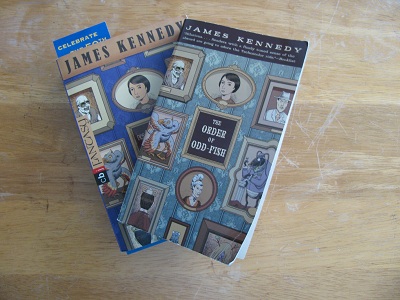
This week, we’re continuing in Chapter 19 of The Order of Odd-Fish, by James Kennedy, otherwise known as Der Orden der Seltsamen Sonderlinge.

Sonderlinge3

Last time, we left off on page 249 in the English edition, Seite 315 in the German edition.

The first sentence of the next section is a useful one, especially if you’re traveling in Germany:
“The rainy season had started.”
= Der Regenzeit hatte begonnen.

This sounds nicer in English:
“a dim, drizzling morning”
= ein düsterer, verregneter Morgen

What a sad way to think of the morning!
“dawn” = Morgengrauen (“morning-gray”)

Here’s a great word!
“soaked with sweat” = schweißüberströmt (“sweat-over-flowing”)

This isn’t said quite the same way:
“happily exhausted” = fröhlich und erschöpft (“happy and exhausted”)

“rushed past” = vorbeistürmten

Here’s a phrase to know:
“the peevish croak of ostriches waking up”
= das gereizte Krächzen der aufwachenden Strauße

“armor clanking” = klapperten die Rüstungen

“It doesn’t matter.”
= Das spielt keine Rolle.
(“That plays no role.”)

“The Belgian Prankster has made his move.”
= Der Belgische Scherzkeks hat seinen Schachzug gemacht
(“The Belgian Joke-cookie has his chess-move made.”)

“A gunshot went off in Jo’s stomach.”
= In Jos Magen schien etwas zu explodieren.
(“In Jo’s stomach seemed something to explode.”)

This one really is a handy phrase to know:
“I was wrong.”
= Ich habe mich geirrt.

“tinkering” = herumgebastelt

“zigzagging pole” = gezackten Stange

“stuck all over with prongs, wheels, and corkscrews”
= die überall mit Zacken, Zahnrädern und Korkenziehern bestückt

“wrapped up in fur” = mit Fell umwickelt

“the jury-rigged thing”
= das notdürftig zusammengeflickte Teil
(“the makeshift [hardship-meager] together-patched part”)

“spattering storm” = prasselnden Regensturm (“roaring rain-storm”)

“The rain pelted Jo.”
= Der Regen peitschte auf sie herunter.

And I’ll finish the section with a sentence I hope you never need:
“She was soaked and terrified.”
= Innerhalb weniger Sekunden war sie klatschnass und vollkommen verängstigt.
(“Within a few seconds was she scandal-wet and fully frightened.”)

If you are ever schweißüberströmt, here’s hoping you are also fröhlich und erschöpft! Bis bald!

My Prime Factorization Hairnet

ModelingHairnet

Our church is having a Stop Hunger Now Food Packaging Event next Sunday, October 18, 2015. As a form of publicity for the event, they’ve asked us to decorate a hairnet and take a selfie.

That was the moment I realized: I have a Prime Factorization Sweater, a Prime Factorization Cardigan, a Prime Factorization Scarf, a Prime Factorization T-Shirt, and have made Prime Factorization Blankets. But I didn’t have a Prime Factorization Hairnet!

Well, I soon remedied that!

Hairnet

Okay, it’s not knitting. But I printed a chart I’d made of numbers color-coded with their prime factorization for the Prime Factorization T-shirt. Then I simply cut out the individual squares and glued them to the hairnet in a spiral pattern. So it goes from 1 to 100.

How it works? Each prime number gets a new color. Composite numbers are divided into sections with a section for each factor. Each section is colored according to that prime’s color. For example, 42 = 2 x 3 x 7, so the square for 42 is divided into three sections, colored blue for 2, red for 3, and green for 7.

This selfie not only shows the Prime Factorization Hairnet, it also gives a glimpse of infinity!

Hairnet+Infinity

Oh, and I’m gathering all my Mathematical Knitting (and other mathematical creations) at Sonderknitting. Eventually, I’ll add mathematical explanations and patterns and activities and other good things.

I can safely say that mine is the most educational hairnet selfie posted yet!

Review of Beyond Magenta, by Susan Kuklin

beyond_magenta_largeBeyond Magenta

Transgender Teens Speak Out

written and photographed by Susan Kuklin

Candlewick Press, 2014. 182 pages.
Starred Review
Stonewall Honor Book, 2015.

I checked out this book after it won a Stonewall Honor. It looked interesting, but I had a lot of books to read, and I figured this one didn’t really apply to me, and wasn’t really anything I needed to know about, so I turned it back in. (Oh such arrogance!) Then this summer, my 27-year-old son told me they were changing gender, so now they are my daughter. When I got home, one of the first things I did was check out this book.

Whether you have such a personal connection or not, this book helps you see the world through other people’s eyes. I think one reason some have a problem with transgender people is a failure of empathy, and an inability to even imagine how someone could possibly want to be identified as anything other than the gender they were assigned at birth. This book goes a long way toward helping the reader understand.

The author tells the stories, with photos, of six individuals. She chose a diverse group of teens and young adults. She uses the highlighted individual’s actual words from in-depth interviews, interspersed with her own narration.

There’s a great deal of variety in the people featured, their gender expressions, their ethnicities, their backgrounds, and their ways of telling their stories. I like the way the book finishes up with a poet-performer.

Most of all, I wish I had read this book before I had such a personal reason. This is a book of people’s stories. Those stories are far outside my experience. As I try to understand their stories, I believe I grow as a person in empathy and compassion.

Yes, transgender people are in the news and popular culture more than ever before. I’m coming to realize that I may have been encountering many without even knowing it. I love that this book gives a group of transgender teens a voice. It helps others know that they are not alone, and helps cisgender folks understand that those who are different are people, too, people with hopes and dreams and interesting loves and lives.

And even if it weren’t for the timely topic, this book is an outstanding work of art in the way it presents these six lives.

I like what the first featured individual has to say:

When most trans men go through transition, they don’t want anything to do with femininity. They don’t want anything to do with being a woman. They just want to be completely accepted in the straight world. When I first started my transition, I wanted it to be complete, from one side to the other. But now I’m embracing my in-between-ness. I’m embracing this whole mix I have inside myself. And I’m happy. So forget the category. Just talk to me. Get to know me.

This book is a way to do that, to see the people under the outward appearance.

candlewick.com

Buy from Amazon.com

Find this review on Sonderbooks at: www.sonderbooks.com/Nonfiction/beyond_magenta.html

Disclosure: I am an Amazon Affiliate, and will earn a small percentage if you order a book on Amazon after clicking through from my site.

Source: This review is based on a library book from Fairfax County Public Library.

Disclaimer: I am a professional librarian, but I maintain my website and blogs on my own time. The views expressed are solely my own, and in no way represent the official views of my employer or of any committee or group of which I am part.

What did you think of this book?

KidLitCon 2015 – Part Two

I’ve already told about my first morning at KidLitCon 2015 in Baltimore.

After lunch, I got to hear Carrie Mesrobian, author of Sex and Violence (really!) talk. And I was won over, and loved listening to her.

She teaches teens and writes about them. Both are extremely creative endeavors — but that’s all they have in common. As a teacher, she wants them to have everything good (though it’s impossible to save them). As a writer, she lets them suffer.

We teach ourselves about reality through story. All our lessons come in story form. The trouble with reality: It’s ubiquitous. But everyone’s ubiquitous reality is different.

Do we ever say, “strong male character”? What are our default assumptions?

Being outside the kingdom of white middleclassville makes some nervous. They either see it as terrifying or of no value.

Readers may get emotional cover talking about sexual violence of fictional characters. When we quarrel with fictional reality, the end result is loss.

After Carrie’s talk, there was a panel made up of people who have been on multiple award committees. They agreed that reading for awards changes how you read and makes you self-aware of your own prejudices. They also reminded us not to second-guess the committees. They are the only ones who have read all the eligible books in that much depth.

They also told us to be sure to suggest books to the various committees! (And Cybils nominations are open for one more day as I’m posting this!)

After this session, there was an Author signing and meet and greet. And we finished up the night with a Cybils birthday dinner and bowling. I got to bowl with author Jacqueline Jules and her husband.

Here is Anne Boles Levy, who began the Cybils, celebrating with us:

KidLitCon7

It was a wonderful first day of KidLitCon!

KidLitCon 2015, Part One

I spent Friday and Saturday of this weekend at KidLitCon in Baltimore!

KidLitCon is a gathering of bloggers who focus on children’s books. The location rotates between the East Coast, the Midwest, and the West Coast. I’ve been to three previous KidLitCons. With it happening so close to me, I had to attend this year!

I went to a variety of interesting panels and author talks. I’ll list some gems I gathered in my notes.

One thing I liked from the panel on putting Science and Math into novels: They can use novels to show kids that failing is an important part of science.

Kids’ curiosity will never change, so they are interested in science.

In the Middle Grade Horror panel, it was fun to hear Dan Poblocki interact with Mary Downing Hahn, whose books he loved to read when he was in middle school.

KidLitCon1

This picture is of Mary Downing Hahn and Ronald L. Smith, who wrote Hoodoo.

Mary Downing Hahn thinks that scary books appeal to middle grade students because you get to have a scary adventure while safe in your own home.

The next panel I attended was moderated by my friend Susan Kusel (whom I first met at KidLitCon 09). It was about Visual Storytelling and featured some outstanding illustrators.

KidLitCon2

From left to right, at the table we have Kevin O’Malley (illustrator of many classic picture books), Minh Le (book blogger and author of an upcoming picture book), Shadra Strickland (author and illustrator of Sunday Shopping among others), Matt Phelan (author and illustrator of The Storm in the Barn and Bluffton), and Susan Kusel, who was on last year’s Caldecott committee.

(It’s always fun, when experiencing an illustrator panel, to imagine each illustrator as one of their own illustrations. It’s funny how easy that is to do!)

The conversation between the panelists was a lot of fun. They talked about the kind of paper they like, the different media they use, and things about the book illustrating process.

When Matt Phelan is given a manuscript to illustrate, he first figures out the visual tone, then matches the media to the story.

KidLitCon4

The illustrators together had a message to reviewers: Be open to different things. Realize that art doesn’t have to be ultrarealistic to be skilled. Be careful of over-valuing one style.

Recognize your own bias. Art is like music: It’s an emotional response.

Here are the panelists posing for a photo at the end:

KidLitCon5

Then we had lunch. I got to have lunch with some fellow Cybils panelists — and Minh Le from the picture book panel. But I took a picture of Susan Kusel in animated conversation with Kevin O’Malley. He saw me coming!

KidLitCon6

I complimented the picture he was doodling, and he gave it to me.

KidLitCon17

Sonderling Sunday – Momo – Imaginary Adventures

It’s time for Sonderling Sunday! That time of the week when I play with language by looking at the German translation of children’s books — or in this case, looking at the English translation of a German children’s book. Sort of a Very Silly Phrasebook for Travelers.

Momo1

Tonight I want to go back to one of my favorite children’s books of all, originally written in German, Momo, by Michael Ende. Last time I looked at Momo, we left off toward the end of Chapter 3, on Seite 36 auf Deutsch, page 22 in English.

[And before I get started, I’d like to give a shout-out to Alex Baugh, who was at KidLitCon this weekend. She blogs at Randomly Reading, and I learned that she was a German literature major and reads Sonderling Sunday! I didn’t know anyone did besides James Kennedy and me! 🙂 Glad to meet you this weekend, Alex!]

We were right in the middle of a dramatic (imaginary) ocean voyage:
Meter für Meter kämpfte sich die >Argo< , alle Maschinen auf Volldampf, gegen die Urgewalt dieses Taifuns vorwärts.
= “With all engines running full ahead, the Argo inched her way forward against the elemental might of the storm.”
(“Meter by meter battled itself the Argo, all engines on full steam, against the elemental power of the typhoon forward.”)

Machinisten und Heizer = “engineers and stokers”

Kesselräume = “boiler rooms”

Übermenschliches = “superhuman efforts”

dicken Tauen = “stout ropes”

grausamen Schlingern und Stampfen des Schiffes
= “the ship’s violent pitching and tossing”

innerste Kern des Wirbelsturms = “innermost eye of the storm”
“innermost core of the cyclone [whirl-storm]”

Auf der Meeresoberfläche, die hier spiegelglatt war, weil alle Wellen einfach von der Gewalt des Sturmes flachgefegt wurden, tanzte ein riesenhaftes Wesen.
= “Gyrating on the surface of the sea, which had been ironed flat as a pancake by the sheer force of the sorm, was a huge figure.”
(“On the seas-over-surface, that here mirror-smooth was, because all waves simply from the violence of the storm flat-swept were, danced a gigantic being.”)

ein Brummkreisel von der Größe eines Berges
= “a mountainous humming top”
(“a humming top of the size of a mountain”)

This is better in German:
Ein Schum-Schum gummilastikum!
= “A Teetotum elasticum!”

allersten Zeiten der Erdentwicklung
= “the earliest phase of life on earth”

Es ist ein Jammer!
= “What a shame”

Das einzige Exemplar = “The sole surviving specimen”

Kontrafiktions-Kanone = “antifriction gun”
(Google: “Contraindications-Fiction Cannon” Is this a case where the translator changed the meaning to a similar-sounding word? It is, after all, an imaginary creature, so an Anti-Fiction Gun might work.)

Riesenkreisel = “giant spinning top”

Stichflamme = “tongue of flame”

Zwillingsrohr = “twin barrels”

leuchtende Geschoß = “flaming missiles”

Es ist zwecklos! = “It’s no use.” (“It is purposeless.”)

Erste Steuermann = “first mate”

Wandernden Taifun = “Traveling Tornado”

Überlieferungen = “traditions”

wahrer Kern = “grain of truth”

bestimmte Tonschwingungen = “certain sonic vibrations”

Nice big words in this section! Appropriate since a child is pretending to be an important scientist.
Lebensbedingungen = “mode of existence”

höchst eigentümlichen Gesang = “most peculiar song”

Donnernd schlossen sich die Wassermassen über ihm.
= “With a thunderous roar, the sea closed over it.”

patschnaß = “soaked” (“smack-wet”)

I’ll finish with the last sentence of chapter 3:
So wie bei Momo konnte man sonst nirgends spielen.
= “The games they played with Momo were more fun than any others.”
(“So as with Momo could one otherwise nowhere play.”)

That’s it for tonight! It’s good to be back! May you avoid any Whirl-storms before we come back to Momo!