Kwame Alexander at #alamw17
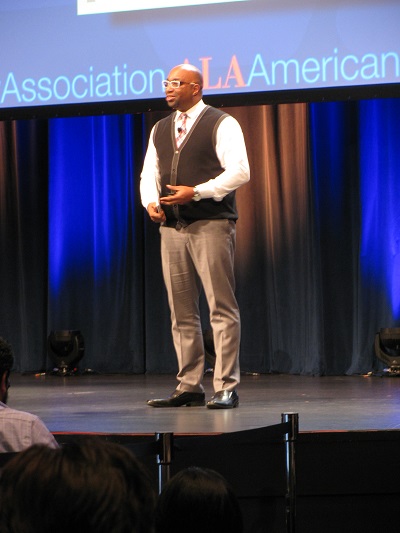
I always love hearing Kwame Alexander talk.  His speeches are also poetry.

He began by saying that we need to feel that we aren’t going backwards.  As Langston Hughes said, “But I don’t care, I’m still here!”

What should we do?

Remember:  We are the army!

He read a poem using book titles.  Librarians, fire your cannons!  Books have a job to do and words plant seeds.

He told about his work with kids in Ghana.  Books connect us to each other.  Books don’t segregate.  We do.
What should we do?

Remember.  Recognize.  Resist.

You have to sing somewhere.  Words connect us all.  You’ll feel empowered if you lift your voice, wheher people listen or not.

We’ve been here before.  This is just one more river to cross.  Wrap yourself in a mountain of prayer.  Rise into the wonder of daybreak.

The alternative is unimaginable.  Fortunately, in this room, we are nothing if not imaginative.

The rest of these notes are from answers to audience questions, so the topics flit around:

He tells kids, If you can’t travel, read a book.

Poetry helps people deal with things.  It calms us, soothes us.

Kids from all over the world, all over the country, want to be engaged, want power, and want you to sign their forehead.

Poetry isn’t the only answer, but it’s an answer.

He writes for everybody.  He writes for all of us.  His characters are universal.  We all laugh, cry, smile, and love the same.

Novels in verse work with kids because in 15 lines you get a beginning, a middle, and an end.  Poetry is the opposite of intimidating, and it’s a bridge to other literature.

“Books are like amusement parks.  Sometimes you have to let kids choose the rides.”

To get kids excited about poetry, model that excitement.  We’ve all been a little afraid of poetry.  We send them from Silverstein to Shakespeare.  Give them a bridge.  Teach accessible poetry.  Show them how much fun it is.  Let it energize and excite you.

Poetry is the answer to draw people to reading.  It works everywhere.

And when Kwame recites it, it certainly does!

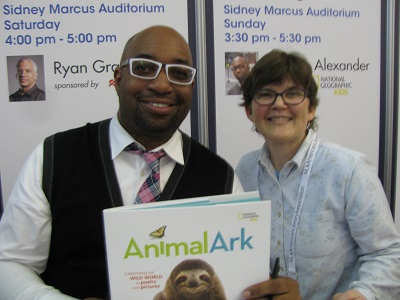
Then he signed copies of his new book with National Geographic Kids, Animal Ark
Shipping Books at #alamw17

“It’s a sickness.”  
“At least we all have it.”

That was my conversation with a stranger-I-just-met on the Exhibit Hall floor, talking about the free books we aren’t capable of resisting.

If you consider yourself a Book Addict — No ALA conference will ever cure you.  And you’ll be surrounded by other Book Addicts confronted with piles of their drug of choice.

I DO want to proudly declare that yesterday, I did not step into the Exhibit Hall even once!  
I know!  Am I amazing or what?

However — today I went to a Scholastic Preview where they gave me a bag of six Advance Reader Copies.  Combined with the four signed books I got yesterday and the books I’m going to get by going to the Morris Award ceremony — I know it’s already more than I can comfortably carry in my suitcase and carry on.  (I could fit them, but I’m not supposed to carry heavy things.)

So — since I decided I needed to do another shipment — might as well make the shipment count!  I went into the Exhibit Hall and began taking ARCs.  In about two minutes, I’d filled my rolling bag.  After about five minutes, both the bag and a tote bag were full.

The good news — There is a post office in the Exhibit Hall.  The bad news is that it closes before the exhibits do, so you have to plan things carefully.  But this is where my lightning-quick bag-filling came in handy.  I had plenty of time.

And this is where the Book Addicts hang out.  I had a nice conversation while waiting in line about our mutual problem.  I even saw someone I’d encouraged yesterday about grabbing ARCs and told her you can ship them home.  Always happy to Enable a new friend!

I should say that the employees at the Atlanta post office today were extra helpful!  A man was putting boxes together for us and bringing around tape.  I shipped two flat-rate boxes.  I didn’t count how many books it was, but I will when I get back.

I like to use middle-grade ARCs as prizes for a games program.  When the books are prizes, they are all the more valued, and may get read.

As my friend told me when I was shipping my first box, “It’s for the children!”  I don’t have a problem at all….

Publisher Previews at #alamw17

My main activity at ALA Midwinter Meeting today was two publisher previews – Scholastic and Boyds Mills Press.  The second one fed me lunch, which was much nicer than waiting in line for high-priced fast food.

Even more than the books previewed, the sessions were a nice chance to talk with more children’s book people whom I haven’t seen since the last conference or to make new connections.

It’s gotten where I love the world of ALSC – These are my people!

A lot of the faces I’ve seen many times before.  Perhaps after awhile we’ll remember exactly when and where we met — but I know they’re children’s book folks, and thus my people!

As for books — It sounds like it’s going to be another good year!  I liked that Wendy Wan-Long Shang and Madelyn Rosenberg wrote a book about a boy who is half Jewish and half Chinese (This Is Not a Test).  I wonder if they know about the book I heard about yesterday by Susan Tan about a girl with the same ethnicity.  (The books sound completely different, but both very interesting.)

It was fun to hear Gordon Korman talk about his new book.  I didn’t realize that he got his first book published when he was 12, in 1976.  That means he’s the same age as me, which doesn’t surprise me, because my 28-year-old heard Gordon Korman speak at her school when she was in middle school.

His new book, Restart, is about a bully who hits his head and gets amnesia.  It seems like an opportunity to become someone different — but that turns out to be harder than it might seem.

We also heard from Natasha Tarpley, author of The Harlem Charade, a story about three 7th graders and some interlocking mysteries.  It celebrates the history of Harlem.  She reminded us that you can create change through stories.  Libraries are important to help kids discover their own stories.

At the Boyds Mills Press lunch, we saw some fantastic picture books.  I especially liked Puppy! Puppy! Puppy!  There was a nonfiction picture book called The Secret Life of a Red Fox with simply glorious art. And there were books for older readers, including an oh-so-timely biography of Alice Paul.

Also, I was given a bag of 6 more Advance Reader Copies.  Guess I might as well go into the exhibits and make another shipment….

Arts and Crafts at #alamw17

I just posted about a program I attended at ALA Midwinter Meeting about Creativity brought into the library using an Open Art Studio approach. They talked at length about how doing Art is not the same thing as doing crafts.

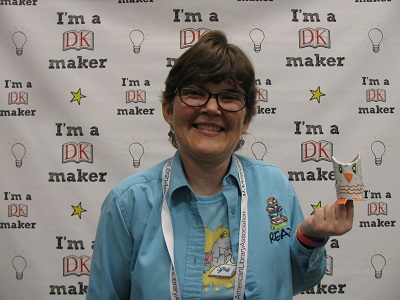
This was somewhat ironic timing, because I had just spent an hour at a program called “DK Maker Break.”

DK was promoting a new book coming out called Out of the Box about making things from cardboard.

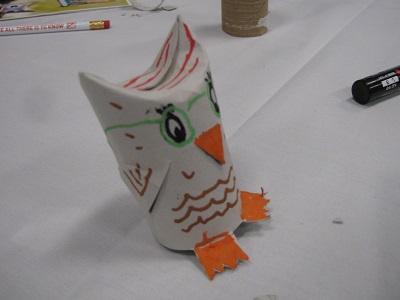
We all made owls.

Now, I had a lot of fun, and the book is packed full of ideas and projects.

But — I could really see the point that was going to be made in the next session I attended.

First, I could easily see that my owl wasn’t very “good,” especially compared to the examples we were shown. Even compared to the people next to me making owls. My conclusion: I’m not very good at this.

Those are all things we don’t want kids to feel or think after making something in the library.

Second, I have absolutely no emotional investment in the owl. I plan to throw it away before I go home.

If it were a project I had come up with, I might care about the result. But the whole idea of making this was imposed by others. It’s cute, and it makes a fun picture. But it doesn’t express who I am or say anything about my life.

Finally, if I were a kid, and my mother decided to display the owl I made — I’d be just plain embarrassed! I know it’s not very good. If my mother tried to say it was, I would be far less inclined to trust her judgment about my art in the future! And I don’t have any emotional investment in the product, so it’s not something I want to be reminded of again and again.

It really made me think, and strongly supported the point made in the Creativity program.

Now, Out of the Box is a beautiful book. I absolutely do think it’s a great idea to make the book available to kids, along with a variety of art supplies. But a context where they can browse and choose something they’d like to make would be far more meaningful to the artist, and far more likely to make Art.

I may be a DK Maker, but the experience combined with the next workshop also has made me a person who believes in letting kids make art rather than coercing them into making crafts.

The Creative Edge at #alamw17

My first afternoon session today at ALA Midwinter Meeting 2017 was run by two people from Avon Public Library in Connecticut, “The Creative Edge: How One Small Library Is Leading the Way in Creative Arts Programming.”

Mary Fletcher’s official title is Creativity Specialist.  She has been in charge of a program where they have brought the arts into the library.

Arts are not crafts.  Art is an open-ended process.  Art has no planned product.  Art is open-ended.  Art has no adult sample to copy.  Art can be spontaneous.

A pre-planned craft can discourage creative choices.

The presenters showed us many pictures from their Open Art Studio.  I liked the image of a wall covered with buildings made of paper.  No two buildings are exactly alike.  Together, they form a wonderfully diverse town.

I was writing furiously.  I’ll include some good nuggets below:

Art is guided by the child’s choices.

When children are fascinated, they make amazing things.

We encourage exploration without imposing our ideas.

When self-motivated, kids will persist despite difficulties.

In their Open Art Studio, frustration is rare.  They gain self-confidence and self-reliance.

Creativity is intelligence having fun.  In the future creativity will be needed more and more.

Creative confidence hits a slump around 4th grade, when kids start wanting to conform.  Creativity must be nurtured to survive.

Open-ended art encourages imaginative play and storytelling.

Scribbling is to writing as babbling is to speaking.  With art, the library can support early writing as well as early reading.

A table anywhere will work, even if you don’t have the budget for a dedicated space!

The beauty of a library is that it’s not a school.  They will learn, but it’s child-guided exploration.  We can encourage imaginative tangents.  Facilitators are intentionally quiet and unobtrusive.

Facilitators get to serve at the banquet!  They provide materials designed to encourage experimentation.

They also encourage art through movement, and have hosted three Family Dances at the library.

They do a reading buddies program pairing teens with young children and spending a half-hour reading and a half-hour doing art together.

The program inspired me.  Though we may not be able to have an actual studio open all the time, it made me think about having more programs involving open-ended art.

Author Panel and Book Signing at #alamw17


This morning I had the privilege of listening to an author interview in the big auditorium at ALA Midwinter 17 moderated by Dan Kraus, featuring Scott Westerfeld, LeUyen Pham, and Susan Tan, who all have new books coming out soon.  He began by asking them about their new books.

LP:  Real Friends is a graphic novel memoir written by Shannon Hale. It’s her story about her first group of friends.  After you read it, you realize the same thing happened to you.  She captures the pain of what happens whe you get ousted from your group.  It’s about very young friendships, but complete with all the emotion of that, and feels universal.

ST – Her debut novel is Cilla Lee Jenkins, Future Author Extraordinaire.  Her protagonist is growing up in a mixed race family, just like the author.  She’s 8 1/2 years old and getting a new sister.  She’s asked “what are you?” Because of being mixed race, and decides that what she is is a best-selling novelist.  She decides to write her novel before the baby is born so her parents can’t forget about her.

SW – His new book is a graphic novel named Spill Zone.  It’s about a 19-year-old raising her 10-year-old sister.  Their town was destroyed in a disaster no one understands.  He was into climbing buildings and urban exploration in college.  Those spaces are natural places to think about loss and about life.  He started it in 2006, after the tsunami when he realized the drama in having your home town disappear.

LP:  All three books are about sisters.

ST:  Working with the illustrator shaped the novel.  The illustrator found the heart of the scenes, sometimes in a way the author hadn’t realized.

LP:  Writing a graphic novel, especially a memoir, is trickier than writing a picture book and needs a lot more interaction with the author.  She usually strips out the art notes first, but does send the writer editing notes.  It’s like choreography.  A graphic novel gives you the perspectives of more characters.  And the faces of the characters make a big difference in the emotions conveyed.

SW:  The graphic novel gives you the ability to easily jump in and out of different points of view.  But you can still be inside someone’s head. Teenagers have lots of investment in reading to become another person.

ST:  Her book is in first person, but there’s lots of misunderstanding that the reader can see, and the illustrations helped with that.  It’s a child’s confrontation with a larger world.

SW:. Kids are still learning how Point of View works.  For them, books are a machine for becoming another person.

LP:  Writing a graphic novel with her husband when she was pregnant was good practice for parenting.  They had to learn to tell a story together.

They talked about working with an illustrator.

SW:  It’s not good in a movie when character’s say, “He’s getting away!” There’s a balance on when the pictures can and should do the work of telling the story.

Moderator:. All three of these books are earnest, without irony and sarcasm.

ST:  It was important to her to write a confident and exuberant character.  She wanted to capture her indomitable spirit without diminishing it.  Some day, this girl’s deep self-confidence will get shaken…
SW:  Good books for children don’t minimize the pain of being a kid and the pain of making choices.
On Diversity:
SW:  The explosion of the popularity of manga did a great thing for graphic novels.  They even have a different way of telling stories.  Kids are good at reading through difference and reading diversely.
Audience question:  All 3 books are about sisters.  Did you have relationships you pulled from?

LP & ST: Yes

SW:  He has an older sister who’s bad-ass and does real spelunking.  The artist did a great job making his character look like a knight.  She’s more overwhelmed by having to be a parent than by the monsters in the spill zone.  She’s bad-ass like his sister.

After that, we stood in line to get advance copies of all three books signed.  LeUyen Pham drew a picture of the person getting it signed! (Or she substituted a picture of Shannon.)  As usual, I met some great librarians for youth in the line.

Another inspiring session that gave me insight on the process of creating a children’s book and got me excited about three upcoming titles.

The Running of the Librarians at #ALAMW17

Here are librarians milling around, waiting for the Exhibits to open at 5:30 pm.  When they do open, the crush is not insignificant.

This year, I had a mission:  I wanted an Advance Reader Copy of Megan Whalen Turner’s fifth book in the Queen’s Thief series, Thick as Thieves.  I even reread the rest of the series this week.

I checked the publisher (HarperCollins), learned the booth number (2016), and headed straight for it.

I got a copy!

Mind you, they were in the back — you had to ask.  I got a tip from a friend years ago that if there are books you know you want, to be ready to ask for them.

But then — Book Frenzy began.  Publishers placed out Advance Reader Copies (and even some finished books) free for the taking.

You roam the crowded aisles walking past them.

I don’t have it in me to resist.  I’m afraid that I’m in good company.

What’s more, I have a medical reason why I should not carry bags of heavy books on my right shoulder, so I get to bring a wheeled bag onto the floor (with a doctor’s note).

Alas!  That tends to make me show even less restraint.

I came away with 35 books tonight.  (Well, 5 of those were from the Mini-Institute.)  I will use the ones for middle grade readers as prizes for a games program I do at the library.  Some, like Thick as Thieves and Frog Kisser!, a new Garth Nix book, I will probably read before I get home.

The only solution to Book Frenzy seems to be to stay OUT of the Exhibit Hall.  Unfortunately, some programs I want to attend are happening at the Pop Top stage or Book Buzz Theater in the back of the Exhibit Hall.  And I got a ticket to the YALSA Morris and Nonfiction Awards event, where they give you books if you attend.

I’m afraid once I pick up one book, I’ll figure I might as well fill my bag.

So the question of the conference for me becomes, can I learn restraint?

And also, where shall I ship today’s load of books?  FedEx in the hotel or the Post Office on the Exhibit floor?  (But if I go to the Post Office, I’m sure to pick up more books on the way….)

I’m not going to cart these books back to the conference, so it will be FedEx, but which morning should I bring them down?  If I don’t do it tomorrow, I’ll be tempted to keep adding to the load….

The trouble is, these are lovely problems to have.  I’m also afraid I’m quite unrepentant.  Which doesn’t bode well for my future self-restraint.

Jacqueline Woodson at ALSC Mini-Institute

Our Closing Session speaker at today’s ALSC Mini-Institute was Jacqueline Woodson.

She talked about how in view of what today is, that it’s good to be with librarians.  We have to transform silence into action, and Libraries do Transform.

We can have empathy for those we disagree with because we all know what it is to have fear.

Begin a conversation across misunderstanding.

Memory keeps her moving forward.

Keep hope in the room and in your lives.

Don’t forget to vote at the local level, too.  We do have the power to create change.  It’s important to hold onto history.

We had a mini-Institute because we decided not to meet in North Carolina.  She said, “This country has always messed with bathrooms.”  She’s deeply proud of the Institute organizers for taking a stand, as a person deeply committed to making this place safe across lines.

These conversations are disruptive, but healing.  Healing begins by being willing to talk with people.

Conversations can begin in the library.

You’re so much stronger than you think you are — because look at the history that got you here.

Writing is a way of healing, a way to make sense out of this journey.

When you tell your story, some will be eager to hear who you are.

Carmen Agra Deedy at ALSC Mini-Institute

Carmen Agra Deedy was our lunchtime speaker at ALSC Mini-Institute today, so I didn’t take notes.

But I can tell you what her talk was about:  Storytelling!

And she told stories to tell us about storytelling.  She kept us laughing, on the edge of our seats, and deeply moved in turn.

She also read from her wonderful new picture book, The Rooster Who Would Not Be Quiet.

The power of words mean everyone can talk.  We each fight the good fight.  In the end, where is your voice?

There is a time to be silent and a time to speak.

There are always those who resist being silenced.

May we be among them!

Early Literacy at ALSC Mini-Institute

Going to ALSC Mini-Institute Break-out Sessions was a little overwhelming, because many of the programs presented seemed way beyond the scope of something I could do in my own library.

But I came away challenged, inspired, and invigorated.  I was reminded of the need out there and that Librarians are shining lights and touching people’s lives.

I recently got put as the only librarian on a Neighborhood School Readiness Team — so I chose as my focus programs about getting children ready for Kindergarten, “ECRR: The Next Generation,” “Fighting Intergenerational Literacy,” and “Kindergarten Bootcamp.”

All of them had a focus on teaching parents how to get their own children ready for Kindergarten.  They all have a lot more staff to devote to their programs than I do at my branch — but I think I can move in that direction, and it’s nice to see what big things can be done.

Just a few things that jumped out at me:

From Denver Public Library, I loved their summer activities for Early Literacy, especially their series of Saturday activities with passive programming that’s out all day:  Things like a Box Day (creating things with cardboard boxes), a Mo Willems Day, and Going on a Bear Hunt Day.  They create a setting where the kids explore and play and talk, and the parents get to talk with other parents and be there with their kids.

They also have Play and Explore Centers for babies and toddlers.  Again, the children play and the parents talk.

They’ve got a “Little University” program, mostly bringing in outside groups, but teaching the children in various topics.

They’ve got some YouTube videos of Early Literacy tips with a tip at the beginning, and then an example of carrying it out.

I love what they do with Early Learning Spaces — including 52 activities in English and Spanish, which they put out to do in the library.  An example was a Color Hunt.  (“Look for anything green….”)

They’ve got a central library of Early Learning materials.  I liked the idea of taking giant Legos to outreach events.  Kids can play with the giant Legos while the parents talk with the librarians at the table.

I liked the Mailbox that moves around the library, with varying prompts.  Children write letters to librarians.  Prompts can be as simple as “Say something kind.” Or for MLK Day, “Write about your dream.”

Their approach to parents is: “How can we partner with you?”  They might ask parents to write down a life goal for their child, and then point out that we’re working on that right now.  They honor parents as lifelong curious learners.

The next speaker, Jonathan Dolce, talked about doing Intergenerational Family programs to combat illiteracy.  They meet once a week for six weeks.

He showed books representing diversity and inclusion.  They talk about the books together and do activities based on the books — He gave us examples like making guacamole, watching author interviews, and dancing together.  They call it Family Reading Connection.

The Kindergarten Boot Camp with Phoenix Public Library is a 7-week program targeting children who haven’t gone to preschool, helping the parents learn how to help them get ready for Kindergarten.

All their outcomes are about the parents’ behavior.  And the curriculum was developed based on the state standards for Kindergarten.  They developed it with a staff member who is a former Kindergarten teacher.  They have a program for certifying the additional staff who offer the program.

Between all three of these programs together, I tried not to get overwhelmed, but I was prompted to think about what ways my own library can do more to help parents actively prepare their children for Kindergarten.