Prime Progress

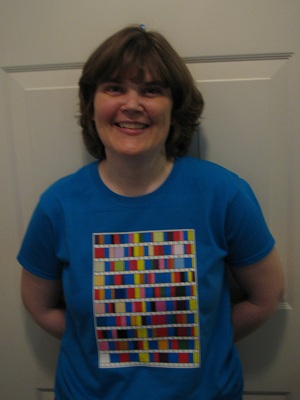
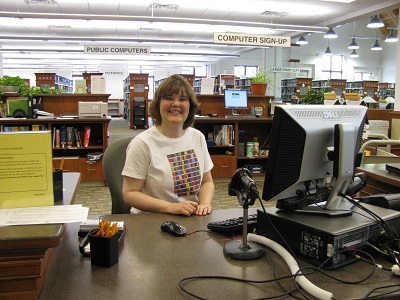
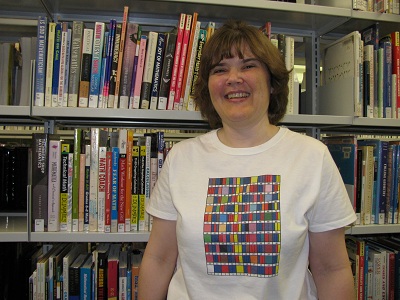
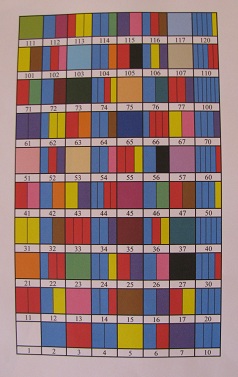
Woo-hoo! After getting my prototype Prime Factorization t-shirt from my new Cafepress Shop, I tweaked the colors to make the chart brighter. I also made shirts on different colored backgrounds. As luck would have it, the new shade for 2 almost perfectly matches the “Caribbean Blue” background. My new revised shirt came this week, and I love it!

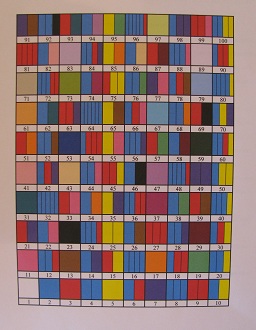
For those just coming in on this, the chart is 10 rows of 10, beginning at the bottom left. (Because I can’t bring myself to have higher numbers down lower on the shirt.) Each prime number gets its own color, and the prime factors of each number are displayed by color. Unlike the sweater, the numbers are listed on the shirt.

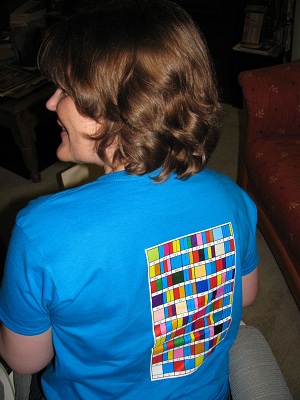
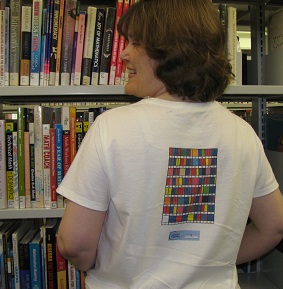
Like the sweater, I couldn’t resist putting rows of 8 on the back. And of course, I had to list those numbers in their Octal representation. But since that adds to the cost, I’m also offering t-shirts that have only the chart on the front.

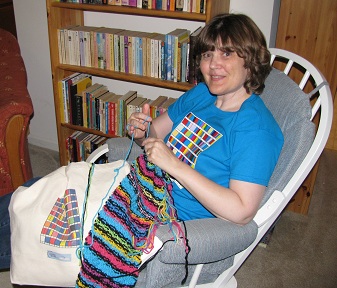
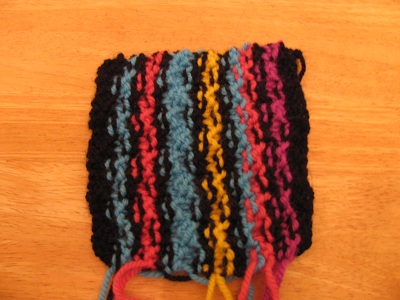
Now, as long as I was so happily wearing my prime factorization t-shirt, I had to spend some time making progress on my prime factorization scarf. The biggest problem with the scarf is that I need to carry around lots of skeins of yarn. Fortunately, I ordered a Prime Factorization Tote Bag from my Cafepress Shop! (The pictured one was ordered before I brightened up the colors.)

I am super happy about how the prime factorization scarf is turning out. The original sweater is kind of pointless if you don’t know what it represents, but the scarf is aesthetically pleasing totally aside from the mathematics.

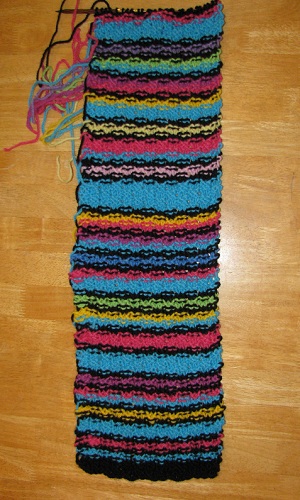
Here is my progress earlier this week, up to 24. (Today I finished 30, and, honestly, it’s hard to stop, because it’s so much fun to see how the next number will turn out!)

This one starts at the bottom. Though with a scarf, you can hold it any direction you like.

Once again, the background color, black, represents 1. It’s used between the other numbers.

The first stripe of blue is our first prime, 2.

Then we have pink for 3.

4 = 2 x 2. It’s not quite as easy to tell on the scarf, but the next blue stripe is twice as wide as the original.

5 gets a new color, yellow.

6 = 2 x 3, so a stripe with blue, then pink.

7 gets purple.

8 = 2 x 2 x 2, so that stripe of blue is three times as wide as the original.

And so it goes. I love the way the colors flow. You can quickly see that blue is showing up every second stripe, and that every second blue stripe is fatter. You can see the pinks showing up every third stripe and the yellows every fifth. As I said, I think it makes a lovely art object totally apart from the math behind it. And the math makes it completely cool.

Also, with a scarf, you don’t have to decide your colors ahead of time. I am using a certain progression. I’m afraid going to 100 is going to be ridiculously long, but I may do it anyway. After all, I’m doing it more for the math than anything else. But when I’m done, I’m planning to make a cuff-to-cuff cardigan using the same design, and that one cannot go so high.

I’ll continue to show my progress. Such fun!

My posts on Mathematical Knitting and related topics are now gathered at Sonderknitting.

My Prime Factorization T-Shirt Shop Is Ready!

My Prime Factorization T-shirt Shop is ready!

Now, the motivation was that when the math community found out about my Prime Factorization Sweater, many commenters said I should make a T-shirt. I “happen” to have several of the charts already created in Word, because I’ve written a children’s book about using these ideas to learn about other mathematical bases and make cyphers and patterns using the mathematical principles. So I used two of those charts to make a shirt. But I did want to see if the colors came out distinct enough before I offered it for sale.

Monday night, the shirt I ordered arrived, so I wore it to work yesterday:

And here I am among the Math books:

On the back, as with the sweater, I’ve got rows of 8, so you can see that the patterns change.

Now, there were two things I wasn’t quite happy about with the shirt.

First, one thing I was happy about was that the colors came out exactly as they looked when I printed out the charts. However, that was also the first thing I was not happy about. The blue shade for 2, on my computer screen, is nice and bright and easy to spot. On the print-out, and on the shirt, it looks much darker.

The second thing I was unhappy about was that the numbers were blurry. This was because I hadn’t been able to save my Word table as a jpeg file. My son came up with the solution of taking a screenshot and merging the two pictures into a jpeg. It was good enough, but I really noticed the little imperfections.

Then, at work, wearing the shirt, I had a brainstorm. Surely in publisher, you can turn files into jpeg files? Sure enough! So yesterday evening I went home, opened my book manuscript, and pasted the prime factorization table into publisher. It worked! My test shirt hasn’t arrived yet, but I’m confident the numbers will be more clear.

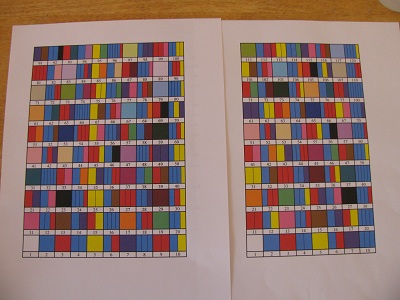
While I was at it, I changed the colors, and lightened up some factors that are used several times in the chart, particularly the blue for 2. Since my graphic looks different when it’s printed, I’ll post a picture of how the print-out looks, because that’s how it will look on the shirt:

I also added various colors, by popular demand. I now have a Caribbean Blue shirt on order with the new charts.

One other thing I should mention. For “Super Geeks” (like me), I did put rows of 8 on the back. All the charts have the numerical values under the color code, but on the back, I gave those numbers their Octal representation. So after 7 comes 10, after 10 comes 11, after 17 comes 20, after 77 comes 100, and so on. A couple times, when I was looking at the back, I forgot I was looking at the back and thought I had factored incorrectly! With the colors, you could use this as a handy-dandy way to convert from decimal to octal! (Just what everyone needs, right? But if you’re ever on an alien planet….)

I do like the way the two charts with the same colors show how the patterns change. Particularly look at yellow (5). In the decimal chart, because it’s a factor of 10, it lines up. In the octal chart, because it’s relatively prime with 8, it does not line up.

So, I’m looking forward to my new shirt coming in! And I do feel ready to offer my shirts for sale!

The URL is http://www.cafepress.com/sonderbooks.

Prime Factorization Swatches

I finished three swatches and decided on how I’m going to approach my new Prime Factorization Scarf.

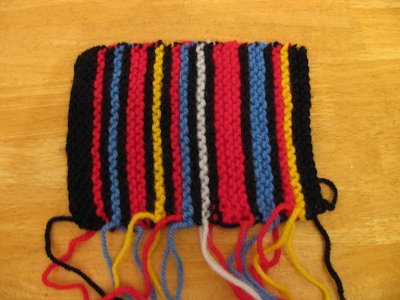
First, I tried garter stitch. It’s a reversible stitch, and I thought it would work for the scarf. No pun intended, I thought I’d begin with the primary colors, since they are clearly “red,” “blue,” and “yellow.” Here’s how that swatch turned out:

The colors do stand out in this version. Black is 1, the background color. The pattern starts on the left. 2 is red. One ridge clearly stands out for the factor. When you get to 1 again, you stop multiplying and start a new number. Primes will always be one ridge. Next is 3, which is blue. Then comes 4, clearly showing as two ridges of red, 2 x 2. Then black, so you start a new number. Then comes 5, a new color, yellow. Then black. Then we have a ridge of red with a ridge of blue, 2 x 3 = 6. A ridge of black. Then 7, a new color. Black. Three ridges of red, 2 x 2 x 2 = 8. Black. Two ridges of blue, 3 x 3 = 9. Black. A ridge of red and a ridge of yellow, 2 x 5 = 10.

What I like about this swatch? The colors pop out and clearly show how many of each factor you want.

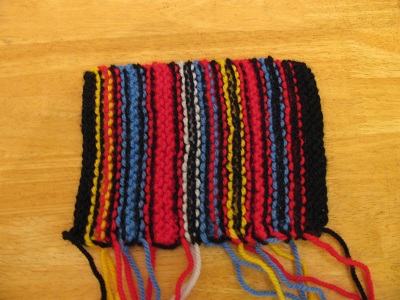
Problems with this swatch? Well, I completely forgot that garter stitch with colors is not reversible. Here’s the other side:

The garter stitch pattern would work great in a sweater, where you only see one side. But a scarf is better when it’s reversible, since it’s not easy to keep only one side of a scarf showing.

One other problem was that I didn’t like the colors. In the picture on the web, the red looked like a pretty cherry red. In real life, it was so bright, it almost glowed in the dark. Next to black, it feels glaring.

So I decided to experiment with the colors I think are the prettiest of all the ones in the box. After all, the color for 2 is going to get used in every other stripe. Might as well use a color I like to look at, right?

I needed to pick a stitch that would be reversible in color. I chose the Double Seed Stitch, which gives a nice textured look. You alternate two knit stitches with two purl stitches, and you do two rows that line up with each other. Then you do two rows with the stitches staggered from the first two — The knit stitches in the two top rows are lined up with the purl stitches in the bottom two rows, and the purl stitches in the two top rows are lined up with the knit stitches in the bottom two rows.

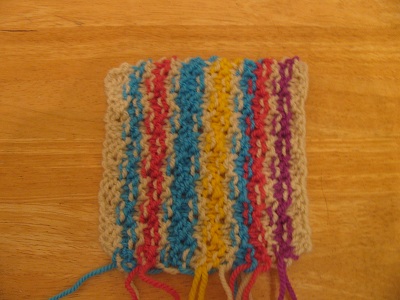
You can’t really tell the colors I used in the next swatch, but it’s a turquoise for 2 and pink for 3, yellow for 5, and purple for 7. I got happier and happier as I knitted. I think this is beautiful, and it will be the pattern I use for the scarf. Here’s that swatch:

Now, I acknowlege that it’s not nearly as easy to tell exactly where the numbers separate or exactly which factors are in the number. But it’s pretty. And I know which factors are where. And it’s completely reversible. The back looks exactly the same as the front.

I did one more swatch, to be absolutely sure I wanted to use a black background. I also wanted to see if using larger needles would make the fabric more drapey. The yarn band suggests size 8 needles, and that’s what I’d been using, and I think it would be nice for a sweater. But for a scarf, I’d like a little less firmness. So I made the next swatch with a cream-colored background and size 10 needles, but the same stitch and the same colors for the numbers. Here’s that swatch:

Yes, this combination is pretty. But I think it reminds me too much of my original prime factorization sweater, and I’m ready for something different. So I’m going to go with the black background.

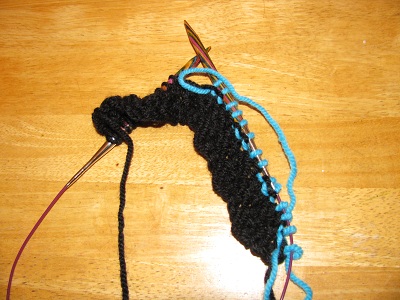
So I’ve begun! I’m using Size 10 needles, a black background, double seed stitch, and 26 stitches across. (The swatches used 20 stitches.)

Oh, one more thing: I hereby resolve that I will, I WILL, sew the ends in as I go, so that I don’t have to do them all at the end, like I did with the sweater. (Sigh. The worst thing about this whole project!)

I also plan to make a black edging along the sides, to hide the carried-along yarn. I can practice on the swatches.

And while I’m knitting, my mind will be spinning with ideas for a cardigan.

Stay tuned and watch my progress! One of the fun things about it is that I can wait to choose colors as I go. I don’t even have to stop at 100….

My posts on Mathematical Knitting and related topics are now gathered at Sonderknitting.

Review of Edgar Allan Poe’s Pie, by J. Patrick Lewis

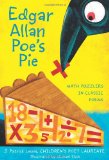
Edgar Allan Poe’s Pie

Math Puzzlers in Classic Poems

by J. Patrick Lewis
illustrated by Michael Slack

Harcourt Children’s Books, 2012. 37 pages.

I feel a tiny bit sheepish by how much fun I find in this book. J. Patrick Lewis, Children’s Poet Laureate, has parodied 14 classic poems that children may well be familiar with and has inserted… a math problem.

These problems are not particularly tricky. Though I suppose that depends on the child’s age. (There is some multiplication and division, so this is more for upper elementary grades.) At times it’s not totally clear exactly what they want you to figure out (though that is given in the upside-down answers on the next page). But the parodies are definitely playful.

Could there possibly be a better way to get a kid to do word problems for fun and without fear?

The poems, after the title, list the poem they are inspired by.

Here’s the end of “Edgar Allan Poe’s Apple Pie,” the one inspired by “The Raven”:

I ignored the frightful stranger
Knocking, knocking . . . I, sleepwalking,
Pitter-pattered toward the pantry,
Took a knife from the kitchen drawer,
And screamed aloud, “How many cuts
Give me ten pieces?” through the door,
The stranger bellowed, “Never four!”

Another favorite for me is the one that plays off a poem I love, “Us Two,” by A. A. Milne. Here’s the beginning:

Wherever I am, there’s always Boo.
Boo in the flowers with me.
The size of our garden is eight by two.
“How much wire for the fence,” says Boo,
“If it wraps all around as it ought to do?
Let’s guess together,” says Boo to me.
“Let’s guess together,” says Boo.

With some, like “Robert Frost’s Boxer Shorts,” he goes for silly. “Langston Hughes’s Train Trip” uses some trickier math. “Edward Lear’s Elephant with Hot Dog” is just a limerick.

That should give you an idea of what’s going on here. Some quite silly fun. With math!

Buy from Amazon.com

Find this review on Sonderbooks at: www.sonderbooks.com/Childrens_Nonfiction/edgar_allan_poes_pie.html

Disclosure: I am an Amazon Affiliate, and will earn a small percentage if you order a book on Amazon after clicking through from my site.

Source: This review is based on a library book from the Fairfax County Public Library.


Ready to Start My Prime Factorization Scarf!

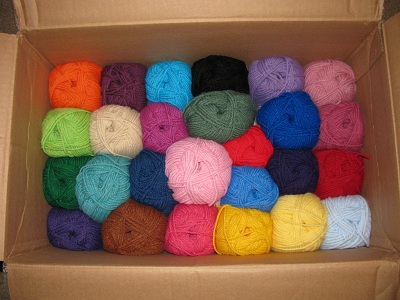
My yarn arrived tonight! 26 shades of Plymouth Encore yarn (on sale at yarn.com), so I can make a Prime Factorization Scarf that goes all the way up to 100!

Now, a lot of the shades ended up looking more alike than I hoped they would. But I can always hold those toward the end where they only turn up once. I also didn’t realize what large skeins I was getting — I will need to make a sweater after this, because I’m going to have all kinds of leftover yarn. But I can change the color scheme to keep it interesting.

My mission first: Decide which colors will be most dominant. I’m planning on black for 1 this time, but I’m going to swatch out some different combinations for 2, 3, 5, and 7, to decide how I like it. I was planning on red for 2, but it’s so bright — I might not want that much red in the scarf. And I really like the turquoise blue that came. So we shall see… I’ll make some small swatches before I try the actual scarf.

If anyone wants to play along and make a scarf with me, let me know! It might be a lot smarter to make this as a leftover-yarn project and use up old yarn, instead of buying all the same yarn. I wish I’d thought of that! Anyway, I will think in terms of using the yarn for a cardigan later. For now, I’m looking forward to playing with some swatches!

My posts on Mathematical Knitting and related topics are now gathered at Sonderknitting.

Prime Factorization Knitting Revisited

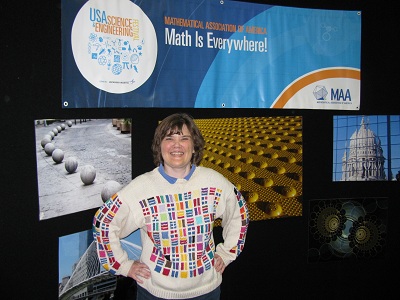
Yesterday I went to the US Science and Engineering Festival in DC, and made sure to stop at the Mathematical Association of America booth. I knew they’d be there because every day I make sure to do MAA Minute Math.

I was hoping it would be cool enough (weatherwise) to wear my prime factorization sweater (For the explanation, follow the link!), and to my joy it was. I was happy to get a picture taken at the MAA booth.

Well, that got the attention of many more math people, and today I found four new comments on my blog post about the sweater and a page about me on Hacker News!

Now, the good people at Hacker News did misread my age, so I will post something I just realized that will be true this year after my younger son and I have our birthdays. (I was so delighted when I realized it, I ran to tell my son, not realizing he’d just gone to bed.)

My age will have five prime factors.
My oldest son’s age will have four prime factors.
My youngest son’s age will have three prime factors.

A picture of the three of us should enable you to narrow it down. (I am not 72, and my youngest son is not 8.)
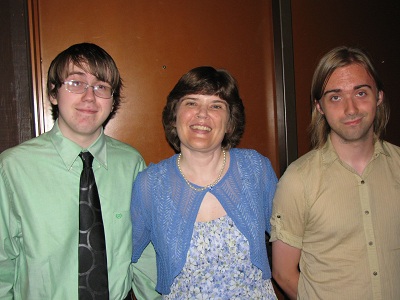
I’ll add one more cool set of facts to definitely set our ages:

In the year my oldest son was born, my age had four prime factors (as his does now).
In the year my youngest son was born, my age had three prime factors (as his will this year).

Let’s see. My youngest son’s age is still ambiguous. So I’ll add the clue that there are only three distinct prime factors in all the expressions above. That should do it.

So, all this establishes that I was thinking about prime numbers yesterday. And, yes, I think it’s time to make a prime factorization cardigan, which I can wear in warmer weather.

Some have said I should sell these. But let’s be honest. Having to buy all those shades of yarn costs around $100. Then it was definitely not my only knitting project, but it took me more than a year to knit. (Fun time, but not worth spending if it were for monetary gain and not for the fun of it.) Then it took me more than a month just to sew in all the yarn ends. Granted, if I made more with the same color scheme, that would spread out the cost. But by the time I finished, I’d had quite enough of the project. It has taken ten years for me to be at all interested in doing anything similar, and I’m NOT going to use the same yarn and color scheme as before; you can be sure of that.

With a cardigan, you wouldn’t have room for a chart on both sides. So I was thinking about how else to express it. Last night, I ordered some Plymouth Encore yarn from yarn.com to make a scarf.

Why Plymouth Encore? Well, first, it’s on sale right now. Needing 26 different colors to go up to 100, any savings per ball helps. I also decided that my cotton sweater (the original was made in Cotton Classic), while soft and comfortable, is a little bit droopy, and wasn’t the greatest choice for the intarsia work. Wool by itself risks being too scratchy. Most of all, this had enough colors, which I hope will be distinct.

This is my plan this time:
I think I’ll use a black background this time. I don’t look good in black is the one reason I didn’t use that on my sweater. (The original partial picture of a blanket that gave me the idea used a black background.) But in a scarf, the background won’t be as prominent.

I’m thinking I’ll use garter stitch, with two rows and one ridge for each factor. I will probably put two stitches of black (one) along the sides, in order to (I hope) hide the two and three factor colors being carried along the edge of the sweater. (I absolutely WILL sew in ends as I go this time. I will. I WILL!)

So here’s how it will work. I’ll start with however many rows of black looks good at the beginning. This is 1. Then I’ll choose a color for 2 and knit two rows (one ridge) in that color. Then I’ll do two rows of black. That represents a factor of 1, and also tells you that we’re starting on a new number. 3 will get two rows of a new color. Then two rows of 1. 4 is 2 x 2. So 4 will be expressed with four rows (two ridges) of the 2 color. Then two rows of 1. Then a new color for 5. Then two rows of 1. Then 6 = 2 x 3, so two rows of 2 directly followed by two rows of 3. Then two rows of 1.

Get the idea? Numbers with lots of prime factors will take up more space than prime numbers.

Mind you, I’ll swatch it out, with some different color choices, and see what looks best. (You definitely want your favorite colors as 2 and 3.) I will post pictures when I get there.

Once I have a scarf done? Well, what I might try with a cardigan is a chart like the old sweater on the back (in new colors and yarn) and maybe stripes as in the scarf on the front sides. Or maybe I’ll be sick of it and give it a rest for awhile.

Based on the new comments, it’s time for me to design a t-shirt! Stay tuned. I have written a children’s book which I called Colors and Codes that talks about using these ideas to make cyphers and patterns using colors or shapes combined with math. As part of the book, I made several charts on my computer. I will see how hard it is to transfer these charts to a t-shirt in Cafe Press.

By the way, I haven’t tried to sell this book yet. I had been working on selling a middle grade novel, and lately I’ve been letting both efforts rest while I dealt with some medical issues. But if anyone knows of an agent or a publisher who’d like to take on something a little unorthodox but extremely cool to math geeks, let me know!

It’s been about ten years since I designed and knitted the sweater. (So I was WAY young then!) Let me stress that the idea of visualizing the prime numbers through colors in knitting was not my own. By all means, spread the word! The article I read (and I should definitely track it down. It was in Interweave Knits in the late 90’s or 2000 or so.) talked about how the blanket that had been made inspired kids who didn’t think they were good in math. As I say in my book, you can attach the numbers to the letters of the alphabet and use these ideas to knit or color messages into things. The sky’s the limit, and it’s lots of fun.

Once I have some swatches, I’ll take some pictures and post the results!

Edited to add: I found the inspiration! It was an article in the Fall 2003 issue of Interweave Knits, called “geekchic” by Brenda Dayne, regarding the work of Pat Ashcroft and Steve Plummer. They have a fabulously cool website at woollythoughts.com. Here’s what the article said about an afghan they created:

“Across the Atlantic Ocean and far from the research laboratories and hallowed halls of Academia, a young girl, age thirteen, stands mesmerized in front of a knitted afghan displayed at the annual North-East Math Fair in Lancashire, England. Constructed of one hundred brightly colored squares, the intricately striped fabric is the creation of Pat Ashforth and Steve Plummer (www.woollythoughts.com). Knitters, teachers, mathematicians, and partners, Pat and Steve have found that basic mathematical principles make for beautiful knitwear designs, and that knitting is an excellent way of explaining complex theorems to their students.

“Vibrating with color, and reminiscent of African Kente cloth, the Counting Panes afghan is so beautiful it’s hard to accept that it was created as a teaching tool. Within its one hundred brightly colored squares, in ten columns and ten rows, however, lie lessons in multiplication, division, pattern, and numerical relationships… If a square contains yellow, it contains a number divisible by two, if it contains red, then the number divides by three. The more colors in a square, the more numbers it divides by.”

Now, they only had a photograph of a very small part of the afghan, so I couldn’t see how it worked. That part would not work on my sweater at all — there are several squares that appear to just be dark blue, and it’s stated elsewhere that green always appears with baby blue. So maybe that quilt is just showing factors of numbers, and not the prime factorization? Maybe beyond a certain point primes don’t get new colors?

But anyway, having the fondness for math that I do, that much information made me realize that I could knit a prime factorization chart. But I wanted to wear it, not just look at it! I still can’t make sense of what, exactly, their afghan was doing, but they are the ones who gave me the idea behind my design. I graphed it out, figured out how many stitches across I needed, and then found a basic sweater pattern from the book Picture Knitting to use as my canvas. Thank you so much for the germ of the idea!

My posts on Mathematical Knitting and related topics are now gathered at Sonderknitting.
Review of Mathematics 1001, by Dr. Richard Elwes

Mathematics 1001

Absolutely Everything That Matters in Mathematics in 1001 Bite-Sized Explanations

by Dr. Richard Elwes

Firefly Books, 2010. 415 pages.
Starred Review
2011 Sonderbooks Stand-out: # 5 Other Nonfiction

Boy, I wish I’d had this book 25 years ago, before I started grad school in Mathematics! Come to think of it, I would have loved to have it as an undergrad, to get a much wider grasp of the subject. As it is, when I began reading this book, a couple pages or a section a day, I decided this was a book I had to own, and I ordered myself a copy.

Now, I grant you that I have no idea if this book will be interesting to any of my readers. I found it absolutely fascinating. In grad school, I got an inkling of the things mathematicians study, but this book presents an overview of the subject in all its splendor.

Dr. Elwes is brilliant at giving the reader the broad perspective, with enough details to fascinate, rather than confuse. Many of the topics cover the foundations of an area of mathematics, and others cover unsolved problems, and everything in between.

When I put this book on hold and my copy came to the library, I was delighted with the topic I happened to open to when I was glancing through it:

Librarian’s nightmare theorem

“If customers borrow books one at a time, and return them one place to the left or right of the original place, what arrangements of books may emerge? The answer is that, after some time, every conceivable ordering is possible. The simplest permutations are the transpositions, which leave everything alone except for swapping two neighbouring points. The question is; which more complex permutations can be built from successive transpositions? The answer is that every permutation can be so constructed.

“In cycle notation, (1 3 2) is not a transposition, as it moves three items around: 1 to 3, 3 to 2, and 2 to 1. But this has the same effect as swapping 1 and 2, and then swapping 2 and 3. That is to say, (1 3 2) = (1 2)(2 3). The librarian’s nightmare theorem guarantees that every permutation can similarly be expressed as a product of transpositions.”

Is that not a delightful merging of my two fields of study? (Don’t answer that!)

I highly recommend this book for any student considering math as their future field of study, as well as anyone who ever enjoyed studying math. For that matter, this book would also be good for anyone who finds math at all intriguing. If you can resist it, go ahead. But if reading the paragraphs above makes you happy, you’ll find a thousand more where that came from.

Buy from Amazon.com

Find this review on Sonderbooks at: www.sonderbooks.com/Nonfiction/mathematics_1001.html

Disclosure: I am an Amazon Affiliate, and will earn a small percentage if you order a book on Amazon after clicking through from my site.

Source: This review is based on my own copy, purchased via Amazon.com.

Review of Here’s Looking at Euclid, by Alex Bellos

Here’s Looking at Euclid

A Surprising Excursion Through the Astonishing World of Math

by Alex Bellos

Free Press, New York, 2010. 319 pages.

I’ve already confessed to being a certified Math Nut. So no one will be surprised that I could not resist a book with this title and snapped it up and enjoyed it thoroughly.

This author takes the human approach. He does talk about some fascinating mathematical concepts, but mostly it’s through meeting and talking with people who are even bigger Math Nuts than me. (I say that with reverence, by the way.) I like his chapter descriptions in the Table of Contents, which give you an idea of where he’s going. For example, here’s the first chapter, Chapter Zero:

“In which the author tries to find out where numbers come from, since they haven’t been around that long. He meets a man who has lived in the jungle and a chimpanzee who has always lived in the city.”

Another chapter, “The Life of Pi,” is described:

“In which the author is in Germany to witness the world’s fastest mental multiplication. It is a roundabout way to begin telling the story of circles, a transcendental tale that leads him to a New York sofa.”

So this is one of those books that covers lots of fascinating mathematical ideas, but also about the people who deal with them. And that’s probably enough for my readers to know if they’re interested or not.

I’ll conclude with the end of the author’s Preface:

“When writing this book, my motivation was at all times to communicate the excitement and wonder of mathematical discovery. I also wanted to show that mathematicians can be funny. They are the kings of logic, which gives them an extremely discriminating sense of the illogical. Math suffers from a reputation that it is dry and difficult. Often it is. Yet math can also be inspiring, accessible and, above all, brilliantly creative. Abstract mathematical thought is one of the great achievements of the human race, and arguably the foundation of all human progress.

“The world of mathematics is a remarkable place. I would recommend a visit.”

Let me add that this author makes a wonderful tour guide for your visit.

www.SimonandSchuster.com

Buy from Amazon.com

Find this review on Sonderbooks at: www.sonderbooks.com/Nonfiction/heres_looking_at_euclid.html

Disclosure: I am an Amazon Affiliate, and will earn a small percentage if you order a book on Amazon after clicking through from my site.

Source: This review is based on a library book from the Fairfax County Public Library.

Percentiles, Gifted Education, and a Statistics Rant

Years ago, I taught Intro to Statistics college classes. I used to look for misuses of statistics to share with my class, and my radar is still out for them. Last night, a post on Twitter led me to a prime example in Education Week: “Early Achievers Losing Ground, Study Says.”

Here’s basically what the article says: They did a study of kids scoring in the 90th percentile or above in math or reading in third grade, then checked how many of those kids were in the 90th percentile or above in eighth grade. Then they drew some wild conclusions from the results, apparently not understanding how percentiles work.

Here are the results:
“Tracking the individual scores of nearly 82,000 students on the Measures of Academic Progress, a computerized adaptive test, the study found, for example, that of the students who scored at the 90th percentile or above in math as 3rd graders, only 57.3 percent scored as well by the time they were 8th graders. The MAP test was developed by the Northwest Evaluation Association, a nonprofit group based in Portland, Ore. As an adaptive test, its difficulty is adjusted to the student’s performance.

“Analysis of MAP scores in the study also found that of more than 43,000 6th graders who scored in the top tenth on the reading test, only 52.4 percent were scoring as well as 10th graders.”

Okay, those results are given clearly. But I claim that they by no means allow you to conclude that we are not serving gifted kids adequately.

Suppose you have a group of 100 students. At the start of a month, you test them on their basketball skills and rank them. The top ten students probably have some exposure to basketball, and there are some in the bottom ranks who have never touched a basketball before. Now give all of them a month’s intense basketball training. Is it reasonable to assume the top ten students will not change? What if some kids who never touched a basketball before end up incredibly talented? And that’s not to say the original top ten students aren’t still great at basketball or haven’t been served. It’s just that they aren’t still necessarily the ten best. If some of them went down in rank, someone else by definition moved up.

Because that’s how percentiles work.

You could use this same study to say, “Hooray! Our school system is doing great! Some kids who were not in the top tenth compared with others have now risen to that level!”

Look at this paragraph:
“‘Is helping kids at the bottom improve hurting kids at the top?’ he said, acknowledging that bringing up that point as a topic of discussion can be difficult, but arguing that it’s necessary. ‘Let’s be honest about the trade-offs. It doesn’t make you a bad person or a racist.'”

Let’s change his question slightly. “Does helping kids at the bottom get into the top ten percent mean that some of the kids who were in the top ten percent before now have a lower ranking?” Umm, yes. That’s a matter of math, not sociology.

The article actually says:

“The new study also found that while some high-achieving students faltered, other students developed into high performers as they got older, although those students were likely to have scored between the 50th and 80th percentiles in the first place. In addition, many of the initially high-achieving students whose test scores fell below the 90th percentile after a few years didn’t fall far. Many scored in the 70th percentile or higher years later.”

Did this actually surprise them? That’s the definition of percentiles. It’s just how you rank compared with the other students. If some at the top go down, that means others have gone up. In fact, maybe now EVERYONE is achieving really well. It doesn’t say anything at all about the top kids doing worse.

The following paragraph made me laugh out loud:

“The study, “Do High Flyers Maintain Their Altitude?,” builds on a previous report from Fordham that suggests nationwide policies aimed at making schools more accountable for improving low-performing students’ achievement are hurting the brightest students. That 2008 report found that from 2000 to 2007, achievement for students who were the highest performers on the National Assessment of Educational Progress was flat, while the lowest-performing students improved dramatically.”

If you’re measuring achievement by percentiles, how can you expect the scores for the highest performers to be anything but flat or dropping? What did you want? For them to reach the hundred-and-fifth percentile? Are they going to start giving extra credit on the SAT so the top scorers can improve?

Take my son as an example. When he was five years old, he learned that he could prolong bedtime indefinitely with the magic words, “Just one more math problem, Mommy, please?” I absolutely did not have the power to resist those words. So he learned to multiply before he entered first grade, and could multiply two-digit numbers in his head.

No surprise, he was tested in first grade in the 99.9th percentile in math. Other kids didn’t have such crazy parents. Now that he’s a senior in high school, if he’s not still in the 99.9th percentile in math, can I say the schools haven’t served him well? Nonsense! Other bright kids have had a chance to catch up. So he still does well, but not necessarily at the tip-tip-top. (And do standardized tests even really provide valid tests for the very top students? That’s a whole other question.) Less than the 99.9th percentile does NOT mean he’s achieving at a lower level in math than he was in first grade!

Here’s another statement made in the article that seemed a completely invalid conclusion from the study:

“NCLB’s emphasis on getting all students to reach proficiency on math and reading tests may have a negative effect on high-achieving students, he suggested, especially when combined with other policies such as those that encourage more students, regardless of their academic records, to take Advanced Placement courses. Teachers working with students with a mix of abilities, he said, may not be able to cover as much material or in as much depth as they might if a majority of students in a class are high-performing.”

Excuse me? In the first place, eighth grade scores don’t have anything at all to do with Advanced Placement courses. But let’s think about it more deeply. Couldn’t you just as well cheer that kids who were at lower percentiles are now breaking into the top?

Again, let’s look at an example. When I was in high school, many years ago, not too many students took AP Calculus. I did, and it gave me a nice big advantage on standardized tests and math competitions. Other students just as bright as me may not have had the opportunity to learn as much, so they may not have scored as well. For my sons, taking AP Calculus is much more common, so it’s not going to give them as much of an advantage. Does this mean they’re not as smart as I was? I certainly don’t think so!

With the study based on percentiles, all it’s really saying is that the group at the top has changed from third grade to eighth grade. The overall level may be much higher; we don’t know. All we know is that the ranking has changed. There are many, many factors that may have gone into this change of rankings. Maybe we’re not serving the gifted well. But maybe we’re doing a really great job with the late bloomers. There’s no way to tell by comparing percentiles. If some go up, others will go down, even if they are achieving just as well as ever.

I was ranting about this to my son, enjoying someone listening who understood what I was saying. He came up with another good example. It’s like baseball. Years ago, there were many outstanding performers who had much higher batting averages than anyone else. But over the years, everyone has gotten better, so all the batting averages are higher, and great performers don’t stand out quite as much — because the overall level has gone up. He’s currently taking AP Statistics, and he said, “The average has gone up, but the standard deviation has gotten smaller.” (That’s my boy!)

What would we conclude if the study had gone differently? What if we found that the exact same kids in the top tenth in third grade were also in the top tenth in eighth grade? That would not necessarily mean we were serving those children well. I think you could make a stronger case that we were being elitist and providing the best resources to those who bloomed early. We were deciding who was smart early and teaching them the most. It might support the idea that some kids are born “gifted,” and you can’t change that with teaching.

Now, don’t get me wrong — I believe strongly in differentiated gifted education. I think you should make advanced classes available to those who are ready for them.

I’m just saying be careful what conclusions you draw from statistics. Are they really saying what you claim they are saying? Look at the facts from several different angles.

Remember, when you’re working with rankings or percentiles, for some to go up, others absolutely must go down. Everybody can’t be above average. But the average can go up. And that is not something percentiles will ever show.

Review of You Can Count on Monsters, by Richard Evan Schwartz

You Can Count on Monsters

The First 100 Numbers and Their Characters

by Richard Evan Schwartz

A. K. Peters, Ltd., Natick, Massachusetts, 2011.
Starred Review

When I first heard of this book, I was delighted, and rushed to order my own copy. I was even more delighted when I read the book. I requested that the library system order it as well. This book would have been absolutely perfect when my sons were young and exploring numbers. I hope I get a chance to share it with a child.

I love it so much because of my experience making my prime factorization sweater. I chose a color for each prime number, then made a chart of all the natural numbers up to 100, showing their prime factorization with colors. I loved all the patterns that resulted.

Richard Evan Schwartz uses a similar idea, but adds a lot of creativity: For each prime number, he creates a monster! Then composite numbers are shown with the monsters from their prime factorization interacting together. It’s a lot of fun to look through the pictures and see the way he’s worked in the monsters. He’s also got an arrangement of dots on each page that demonstrates more about the number and the way it’s composed.

He says he created the monsters to explain prime numbers and factoring to his daughter, and I would love to share this book with a child. You can look at it again and again.

There’s a lovely simple explanation of multiplication and factoring at the front of the book. Then he explains the method behind the monsters:

“Each monster has something about it that relates to its number, but sometimes you have to look hard (and count) to find it.”

“For the composite numbers, we factor the number into primes and then draw a scene that involves the monsters that match those primes.

“It isn’t always easy to recognize the monsters in a scene. For instance, here is the scene for the number 56. You should see three 2-monsters buzzing around one 7-monster. Recognizing the monsters in the different scenes is part of the fun of the book!”

This book would also be great support for a child learning the multiplication tables. If you visualize monsters, they’ll be much easier to remember!

Most of all, I love the way this book showcases the playful, creative, and beautiful side of mathematics. You can count on Monsters to show you just how much fun math can be!

Buy from Amazon.com

Find this review on Sonderbooks at: www.sonderbooks.com/Childrens_Nonfiction/you_can_count_on_monsters.html

Disclosure: I am an Amazon Affiliate, and will earn a small percentage if you order a book on Amazon after clicking through from my site.

Source: This review is based on my own copy of the book.