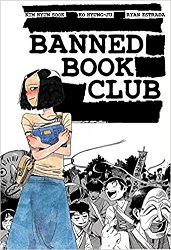
Review of Banned Book Club, by Kim Hyun Sook and Ryan Estrada, art by Ko Hyung-Ju

Banned Book Club

written by Kim Hyun Sook and Ryan Estrada
art by Ko Hyung-Ju

Iron Circus Comics, 2020. 198 pages.
Review written September 22, 2020, from a library book

I didn’t realize until I’d finished the book that this is a graphic memoir, not a graphic novel. Even thinking it was a novel, I realized I had no idea that free speech had been suppressed in South Korea in 1983. This book points out that I need to separate out nonfiction for teens from my children’s nonfiction page – this has gritty and difficult material, more suitable for teens and adults than children. [Note: I’m posting this much later, and did, in fact, make a page for Teen Nonfiction.]

The setting is South Korea, 1983. Yes, that’s South Korea, not North Korea. I had to go back and check. Hyun Sook was a teen wanting to start college. Her mother didn’t want her to go because there had been student protests, which were being stopped by the government. Her father was supportive, so she does head off to school, trying to separate herself from the protesters.

Sure enough, when Hyun Sook gets to college, she tries to stay out of trouble. She even joins a Masked Folk Dance Team to do something that’s not political. But she learns that they do folk dances with stories that have political ramifications and are a cover for protests. Then the friends she makes on the team pull her into a Banned Book Club with a contact at a bookstore who gets them banned books.

I was amazed at the range of books that they were not permitted to read. Both western literature and Communist literature from North Korea were on the list. There is a spy in the group, and some of her friends get arrested and beaten and she herself gets interrogated by police and I won’t say more about the plot to not give spoilers. I will say that I was shocked by basic freedoms that were violently repressed.

The book ends with a reunion of the Banned Book Club in 2016. We learn about the history of fascism in South Korea when one of her friends outlines the protests he’s been part of since 1983. In 2016, they were protesting for the removal of a president who was the daughter of the dictator they protested against in 1983.

A note on the final page tells us what happened after the close of this book:

In March 2017, President Park Geun-Hye was impeached, removed from office, and imprisoned for corruption. The final vote was struck by her own judges, many of whom she had personally placed in office. A special election was held, and the new president was Moon Jae-in.

This book is frightfully timely and tells a true story of fascism that is not from 1930s Germany. It makes the reader value their freedom to read and freedom to speak up. May we never let those go. Please don’t tolerate book banning, whatever the excuse.

Buy from Amazon.com

Find this review on Sonderbooks at: www.sonderbooks.com/Teen_Nonfiction/banned_book_club.html

Disclosure: I am an Amazon Affiliate, and will earn a small percentage if you order a book on Amazon after clicking through from my site.

Source: This review is based on a book from Fairfax County Public Library.

Disclaimer: I am a professional librarian, but the views expressed are solely my own, and in no way represent the official views of my employer or of any committee or group of which I am part.

What did you think of this book?
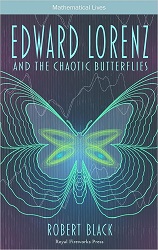
Review of Edward Lorenz and the Chaotic Butterflies, by Robert Black

Edward Lorenz and the Chaotic Butterflies

by Robert Black

Royal Fireworks Press, 2022. 127 pages.
Review written January 8, 2022, from my own copy.

Edward Lorenz and the Chaotic Butterflies is a short but thorough biography of one of the founders of Chaos Theory.

Edward Lorenz got interested in meteorology because that happened to be where the U.S. War Department could use his mathematical skills when World War I started.

The book explains how the science of meteorology was developing as computers were developing. And when they tried to model the math of weather forecasting, it was so complex that those two things went together. In fact, because Edward Lorenz had a desk-sized computer in his office at M.I.T., he was able to notice things that other researchers had a harder time studying.

They talk about his initial discovery. He wanted the computer to repeat some calculations but go farther, so he started by typing in the results from already-calculated numbers. But the results the second time through were completely different. He realized that was due to a rounding error — he hadn’t printed out all decimal places of the solutions, so he was actually starting with slightly different numbers.

But why did slightly different starting numbers make a huge difference in results?

I like the way the book describes the equations he used as both unpredictable and stable. The equations are relatively simple, but the results vary wildly. The book even shows how you can do the same thing with a home computer (much smaller than a desk) and an Excel spreadsheet.

I did gloss over some of the equations, but I got the idea of how it all works, and I think students can do the same as me or dive in deeper if they want to know more.

A quick biography of a notable mathematician who started a whole new field of study and showed that not all of reality is linear and predictable.

rfwp.com

Buy from Amazon.com

Find this review on Sonderbooks at: www.sonderbooks.com/Teen_Nonfiction/edward_lorenz.html

Disclosure: I am an Amazon Affiliate, and will earn a small percentage if you order a book on Amazon after clicking through from my site.

Disclaimer: I am a professional librarian, but the views expressed are solely my own, and in no way represent the official views of my employer or of any committee or group of which I am part.

What did you think of this book?
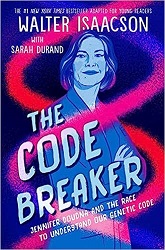
Review of The Code Breaker, by Walter Isaacson with Sarah Durand

The Code Breaker

Jennifer Doudna and the Race to Understand Our Genetic Code

by Walter Isaacson
with Sarah Durand

Simon & Schuster Books for Young Readers, 2022. Adapted from The Code Breaker, by Walter Isaacson, 2021. 320 pages.
Review written January 8, 2023, from a library book
Starred Review

This is the young readers’ adaptation of the book for adults by Walter Isaacson. Honestly, I had trouble with the density of this book, so I’m glad I read the young adult version! This was much slower reading than a typical young adult novel, and was packed with details and facts.

But despite the density, this is fascinating reading. The introduction begins with a story of a woman cured of sickle-cell anemia with gene therapy. Then they talk about some other possibilities of these techniques that came from breaking the human genetic code — learning how DNA and RNA work.

The book is the story of the career of Jennifer Doudna, who ended up being a pioneer in the field of gene-editing research and technology. But her story goes much deeper than simply one woman’s accomplishments. This is a section from the introduction:

Doudna’s life offers an up-close look at how science works. Her story helps answer: What actually happens in a lab? To what extent do discoveries depend on individual genius, and how has teamwork become more critical? And has the competition for individual prizes, money, and fame stopped people from working together for the common good?

Most of all, Doudna’s story conveys the importance of basic science, meaning quests that are curiosity-driven rather than geared toward immediate, practical results. Curiosity-driven research plants the seeds — sometimes in unpredictable ways — for later discoveries. For example, a few scientists decided to research basic physics simply because it excited them, and their discoveries eventually led to the invention of the microchip. Similarly, the findings of a handful of researchers who took an interest in an astonishing method that bacteria use to fight off viruses helped generate a revolutionary gene-editing tool that humans now use in their own struggle against viruses.

Jennifer Doudna is the perfect example of that brand of curiosity. Hers is a tale filled with the biggest of questions, from the origins of the universe to the future of the human race. Yet it begins with a sixth-grade girl who loved searching for “sleeping grass” and other fascinating phenomena amid the lava rocks of Hawaii, and who came home from school one day to find on her bed a detective tale about the people who discovered what they believed to be “the secret of life.”

The story in this book is very immediate, with the entire last section talking about using CRISPR technology to detect and fight coronaviruses.

I think it’s especially apt to adapt this book for young adults, since this technology will be something they’re growing up with. The entire last half of the book raises questions about ethics and the morality of editing the genes of humans and possibly our descendants. As more and more becomes possible, it is good to bring to young people’s attention the need to think about ethical concerns.

The science in this book is fascinating, and might end up being something very much a part of young people’s lives. I can’t say that it gave me a new understanding of gene editing, because saying I understand it would be exaggerating. But it at least gave me a new appreciation.

Buy from Amazon.com

Find this review on Sonderbooks at: www.sonderbooks.com/Teen_Nonfiction/code_breaker.html

Disclosure: I am an Amazon Affiliate, and will earn a small percentage if you order a book on Amazon after clicking through from my site.

Disclaimer: I am a professional librarian, but the views expressed are solely my own, and in no way represent the official views of my employer or of any committee or group of which I am part.

What did you think of this book?
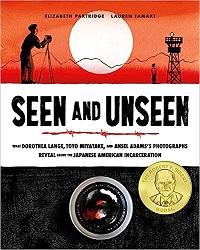
Review of Seen and Unseen, by Elizabeth Partridge and Lauren Tamaki

Seen and Unseen

What Dorothea Lange, Toyo Miyatake, and Ansel Adams’s Photographs Reveal About the Japanese American Incarceration

by Elizabeth Partridge
illustrated by Lauren Tamaki

Chronicle Books, 2022. 124 pages.
Review written February 26, 2023, from a library book
Starred Review
2023 Sibert Award Winner

Seen and Unseen won the Sibert Award for the best informational book for children published in 2022. The book tells the story of the imprisonment of Japanese Americans during World War II, especially looking at the testimony of three photographers.

Here’s the beginning of Dorothea Lange’s section:

In the San Francisco Bay area, Dorothea Lange was asked to photograph the roundup and forced relocation of all Japanese and Japanese Americans on the West Coast. Officials wanted documentary photos to show it was being carried out in a humane, orderly way.

Dorothea was horrified by the government’s plan. The prisoners would be held without charges filed against them and without the right to a trial. That was illegal in the United States. But there was a war on, and Japanese Americans’ rights were suspended.

Dorothea could have refused, but she ws eager to take the job. She wanted her photographs to show what the government was doing was unfair and undemocratic.

We see many of the pictures she took in the pages that follow, along with descriptions of what was going on. But most of the ones we see are labeled “Impounded” — they were withheld from the public during the war, to try to hide the brutal conditions of the imprisonment of American citizens.

Meanwhile, photographer Toyo Miyatake was imprisoned in the camps. He smuggled in his camera lens and took photos, giving a starker and more realistic picture of life in the camp.

Later in the war, he was asked to open an official photography studio to document special events like weddings and funerals. But in a silly and humiliating bit of red tape, they wouldn’t let him press the button on the camera and they hired a white American to do that.

The final photographer featured is Ansel Adams. He came in 1943, paid by the government, to support “loyal” Japanese Americans being resettled in other parts of America. They showed him happy faces — not necessarily the true story.

This book as a whole shows how a terrible national tragedy was presented to the public in general at the time. The book is full of illustrations as well as photographs and vividly presents what happened.

I thought this page was particularly striking, with a picture of a father talking to a little boy:

“I don’t know what’s going to happen to your mother and me,” future US Congressman Norman Mineta’s Issei father told him and his four siblings. “But just remember: All of you are US citizens and this is your home. There is nothing anyone can do to take this away from you.”

He was wrong.

elizabethpartridge.com
laurentamaki.com
chroniclekids.com

Buy from Amazon.com

Find this review on Sonderbooks at: www.sonderbooks.com/Teen _Nonfiction/seen_and_unseen.html

Disclosure: I am an Amazon Affiliate, and will earn a small percentage if you order a book on Amazon after clicking through from my site.

Disclaimer: I am a professional librarian, but the views expressed are solely my own, and in no way represent the official views of my employer or of any committee or group of which I am part.

What did you think of this book?
Review of Still Stace, by Stacey Chomiak

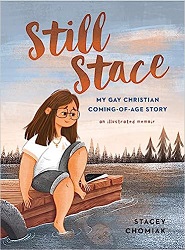
Still Stace

My Gay Christian Coming-of-Age Story

by Stacey Chomiak

Beaming Books, 2021. 270 pages.
Review written May 8, 2023, from a library book.
Starred Review

Still Stace is a memoir about an earnest and devoted Christian teen girl who found herself attracted to other girls. She was told by her parents, friends, leaders, and even a Christian counselor that this was disgusting and sinful and she needed to change. Stace tried and tried. She prayed about her “struggle” for years. In fact, she sprinkles her story with prayers she wrote in her journals at the time. She desperately wanted God to change her, to give her victory over her desires. Over the years, she was told if she just prayed harder, she’d change and be okay.

Then when she went to an Exodus International event, hoping to become ex-gay, and met a girl who flirted with her and made out with her — she concluded that being ex-gay wasn’t possible. At the same time, her best friend confessed she was falling in love with Stace.

So she entered another relationship, but continued to feel guilty. And she hated hiding who she was from her parents.

But I love the chapter where she came to terms with how God saw her and how God made her. It involved a week-long retreat of praying and seeking God. In the end, after much agonizing, God answered her questions and flooded her with peace.

Full, soft, healing . . . peace. In that moment, I finally allowed this truth to enter my heart and resonate deep within. The fears in my head and fears of what God’s people thought of me were no match for the perfect love of God himself.

God said to me: I made you. ALL of you. Fearfully and wonderfully.

And the story continues as she experienced God’s abundant life, as the person she truly is.

This book is beautiful and was hard for me to stop reading. It’s not a graphic memoir, but she’s an animator, and fills the pages with wonderful illustrations. I grew up in an evangelical church and went to an evangelical university. I didn’t have the same struggle as Stace, but I had her same heart for following Christ and believing that meant following the rules I’d been told. I remember the struggles and shame once I did get a boyfriend, trying to not give into temptation. We solved that difficulty by getting married. And when I learned that some friends were gay, I was so sad for them. It all helps me begin to imagine what she must have gone through and have sympathy for her agonizing.

Now, I’ve since that time come to understand that what we read in the Bible in English today isn’t necessarily even close to what it meant to the Hebrew and Greek speakers when the Bible was written. But what I can trust in the Bible is that God created us. And God loves us. And I love the way Stace’s story reflects that same message.

beamingbooks.com

Buy from Amazon.com

Find this review on Sonderbooks at: www.sonderbooks.com/Teen_Nonfiction/still_stace.html

Disclosure: I am an Amazon Affiliate, and will earn a small percentage if you order a book on Amazon after clicking through from my site.

Disclaimer: I am a professional librarian, but the views expressed are solely my own, and in no way represent the official views of my employer or of any committee or group of which I am part.

What did you think of this book?
Review of Sunshine, by Jarrett J. Krosoczka

Sunshine

How One Camp Taught Me About Life, Death, and Hope

by Jarrett J. Krosoczka

Graphix (Scholastic), 2023. 240 pages.
Review written May 6, 2023, from a library book.
Starred Review

Sunshine is another graphic novel memoir from the brilliant Jarrett Krosoczka. But this one, unlike Hey, Kiddo isn’t about his difficult growing-up years so much as about a transformational experience he had the summer he was sixteen — working as an intern at Camp Sunshine, a camp for families who have a child with a life-threatening illness.

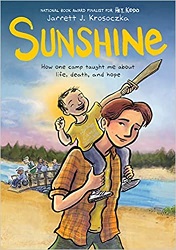
I’ll say right up front that I did not read this at a good time, and don’t actually recommend it to anyone in my family. It’s too much right now. Because two weeks ago my six-year-old niece Meredith was diagnosed with relapsed leukemia. After being initially diagnosed at three years old, she’s been through two years of treatments, and then a year we all thought she was fine, and now she’s relapsed. So when the sweet little kid pictured on the cover of this book had the exact same diagnosis as Meredith — and in the last chapter relapsed and died (some time after the camp experience) — it just had me sobbing.

It is a terrible thing when kids die.

But the beauty of the camp experience was that they gave those kids a chance to be the normal ones, a chance to goof off and play with friends and just be kids. And a chance for their personalities to shine through, way past the fact that they were sick. And a chance for people working at the camp to come to love them.

The author says right at the start:

Just about everyone who asks about the experience seems to have the same knee-jerk reaction: It must have been so sad.

But that could not be further from the truth. I mean, a camp for pediatric cancer patients shouldn’t be sad — those kids already have enough to deal with.

No, camp was happy, the happiest place I’ve ever been. It was a space where illness didn’t define the campers while they defied their diagnoses. It was uplifting, celebratory.

The kids I met weren’t dying — they were living. Living life to its fullest.

All these years later, there isn’t a day that goes by when I don’t think of them.

So yes, this book will touch your heart. And even though it struck way too close to home for me, I’m glad I read it. And I love the way he celebrated the lives of those kids. And showed that even kids whose lives are way too short make this world a better place, just by being ordinary kids.

[And medicine is constantly getting better and that was many years ago and we don’t even know Meredith’s prognosis yet.]

Excuse me, I’m going to go cry a bit more.

studiojjk.com
scholastic.com

Buy from Amazon.com

Find this review on Sonderbooks at: www.sonderbooks.com/Teen_Nonfiction/sunshine.html

Disclosure: I am an Amazon Affiliate, and will earn a small percentage if you order a book on Amazon after clicking through from my site.

Disclaimer: I am a professional librarian, but the views expressed are solely my own, and in no way represent the official views of my employer or of any committee or group of which I am part.

What did you think of this book?
Review of My Name Is Jason. Mine Too, by Jason Reynolds and Jason Griffin

My Name Is Jason. Mine Too.

Our Story. Our Way.

by Jason Reynolds and Jason Griffin

Atheneum, 2022. (First created in 2009.)
Review written February 26, 2023, from a library book
2022 Cybils Finalist – Poetry Collections

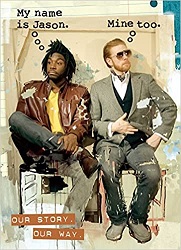
My Name Is Jason. Mine Too. is from the same two Jasons who created the award-winning Ain’t Burned All the Bright. This book came first, and was recently reissued. It’s a memoir in poetry and art — about two young guys who moved to New York City after college. One dreamed of being a poet and the other an artist. They were twenty and twenty-two years old.

It wasn’t an easy road for them. They were hungry. Their parents weren’t thrilled. And they thought maybe they were making a big mistake.

Now, I’m an old fogey. There’s probably lots of symbolism in the art that I’m not getting. But together with the words, there’s something powerful going on here. The book paints a portrait of two guys, trying to be adults in the world and yet also make art.

And wow! One of them went on to become the National Ambassador for Young People’s Literature.

I hope there will be more collaborations in the future with these two Jasons.

jasonwritesbooks.com

Buy from Amazon.com

Find this review on Sonderbooks at: www.sonderbooks.com/Teen_Nonfiction/my_name_is_jason.html

Disclosure: I am an Amazon Affiliate, and will earn a small percentage if you order a book on Amazon after clicking through from my site.

Disclaimer: I am a professional librarian, but the views expressed are solely my own, and in no way represent the official views of my employer or of any committee or group of which I am part.

What did you think of this book?
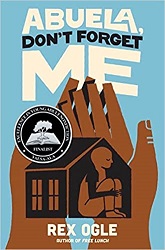
Review of Abuela, Don’t Forget Me, by Rex Ogle

Abuela, Don’t Forget Me

by Rex Ogle

Norton Young Readers, 2022. 198 pages.
Review written February 26, 2023, from a library book
Starred Review
2023 YALSA Excellence in Nonfiction for Young Adults Award Finalist

Rex Ogle is the author of the amazing Free Lunch and Punching Bag, both of which were Sonderbooks Stand-outs. Those books tell about his difficult childhood and difficult teen years, dealing with poverty and abuse.

This book doesn’t continue the story so much as look at the story again, this time in the light of the constant in his life — his abuela.

Abuela now has dementia. Rex Ogle wrote this about writing this book:

A few years ago, after a particularly difficult call with Abuela – in which she forgot who I was halfway through – I sat down and cried. Then I wrote out a few words. Those words led to fragments of sentences. Those fragments led to verses. Those verses formed a poem, and before I knew it, the memories were flying out of me, all of them in verse.

In the foreword to this book of poems, he writes this tribute:

My abuela is the woman who encouraged me to read and write at an early age. Who bought groceries when my mom was unemployed and we were living on food stamps. She is the woman who offered her home to me when the violence at my mom’s became too much. Abuela is the woman who got me off the streets after my father kicked me out for being gay. She told me if I wanted to be a novelist, then I should pursue it, that if I worked hard, I could accomplish anything. By every definition of the word, my grandmother is an angel. My own personal fairy godmother. Abuela is the only parent I’ve ever known who showed me truly unconditional love, kindness, and support.

This book is another version of the author’s childhood and teen years. In this version, his abuela shines as a bright and beautiful example of unselfish, generous, unconditional love – going to a kid who needed it.

nortonyoungreaders.com

Buy from Amazon.com

Find this review on Sonderbooks at: www.sonderbooks.com/Teen_Nonfiction/abuela_dont_forget_me.html

Disclosure: I am an Amazon Affiliate, and will earn a small percentage if you order a book on Amazon after clicking through from my site.

Disclaimer: I am a professional librarian, but the views expressed are solely my own, and in no way represent the official views of my employer or of any committee or group of which I am part.

What did you think of this book?
Review of American Murderer, by Gail Jarrow

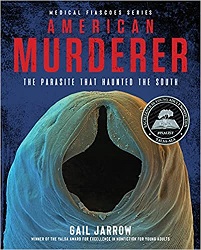
American Murderer

The Parasite That Haunted the South

by Gail Jarrow

Calkins Creek, 2022. 159 pages.
Review written January 15, 2023, from a library book
Starred Review
2023 YALSA Excellence in Nonfiction Finalist
2022 Cybils Award Finalist, High School Nonfiction

I’m squeamish, so I didn’t expect to enjoy this book from the “Medical Fiascoes Series” as much as I did. But Gail Jarrow, a past winner of the YALSA Excellence in Nonfiction Award, makes the story of this medical mystery fascinating.

It’s all about a parasite. Scientists in Europe discovered that hookworms were making people sick in the late 1800s. But in 1902, a scientist named Charles Wardell Stiles discovered a distinct type of hookworm in America. He named it Necator americanus, which means “American murderer.”

But after discovering the new parasite came the dawning realization that more than 40% of rural southern families were infected with it, up to 2 or 3 million people.

Afflicted people complained of diarrhea and a bloated abdomen. Their skin was paler than normal. Children were physically underdeveloped. Adults didn’t have enough endurance to perform even minor work, and they were usually poor because they couldn’t earn a living. Some people had experienced these symptoms for years, and family members had died with the same ailments. None of them knew why they’d been plagued for generations. They just accepted it.

The rest of the community considered these people sluggish and lazy. Because pica was a common symptom, the infected were often mocked as “dirt-eaters.” No one understood that the symptoms were not a sign of weak character or low mental ability. They were evidence of a tiny worm — actually hundreds of worms — slowly sucking blood from a victim’s small intestine.

Living during the Covid-19 pandemic, it’s easy to understand why most of this book is about convincing people — and doctors — that hookworm was real and convincing them to get treatment. Scientists also worked to get them to change things about their everyday lives. The worm gets into people through skin — mostly when people walk with bare feet on infected ground soiled with infected human feces.

So besides getting people to get tested and treated, there was also a campaign for sanitary privies. But those were expensive, as were shoes for growing children.

But the whole story of fighting the bug is an amazing success story with millions of lives saved and improved. I especially liked the many photos of infected people before and after treatment. The last chapter covers ways parasites still endanger people today, yes, even in America.

Overall, this is an abundance of clear information about a major public health problem from a hundred years ago that I previously knew absolutely nothing about. Almost every spread has photos or side bars, and the story is riveting as Gail Jarrow tells it. An amazing achievement.

gailjarrow.com

Buy from Amazon.com

Find this review on Sonderbooks at: www.sonderbooks.com/Teen_Nonfiction/american_murderer.html

Disclosure: I am an Amazon Affiliate, and will earn a small percentage if you order a book on Amazon after clicking through from my site.

Disclaimer: I am a professional librarian, but the views expressed are solely my own, and in no way represent the official views of my employer or of any committee or group of which I am part.

What did you think of this book?
Review of Victory. Stand!: Raising My Fist for Justice, by Tommie Smith, Derrick Barnes, and Dawud Anyabwile

Victory. Stand!

Raising My Fist for Justice

by Tommie Smith, Derrick Barnes, and Dawud Anyabwile

Norton Young Readers, 2022. 204 pages.
Review written January 18, 2023, from a library book
Starred Review
2023 Coretta Scott King Author Award Winner
2023 Coretta Scott King Illustrator Honor
2022 National Book Award Finalist
2023 YALSA Excellence in Nonfiction Finalist
2022 Cybils Award Finalist, High School Nonfiction
2023 Capitol Choices Selection

This graphic novel memoir tells the story of world-record-breaking track star Tommie Smith, who raised his fist on the gold medal podium of the Mexico City Olympics in 1968 to protest racial injustice in the United States.

The book weaves in scenes from that pivotal race through the whole book, while telling the story of Tommie’s life. He started out as the seventh child of a sharecropping family in Texas, and left with a busload of other Black folks to California. There, he got to go to school regularly, and his life changed.

I love the way graphic novel memoirs show you the emotions of the characters. We see Tommie grow and develop into an athlete. He won a college scholarship in three sports — football, basketball, and track. But when he began breaking records in track, that became his focus.

At the same time, the Civil Rights Movement was gaining steam and Tommie wanted to bring attention to the cause, using the platform of being a world-class athlete.

But when he raised his fist during the anthem at the Olympic games, he was sent home immediately and his athletic career ended. He also became a target of hate and couldn’t even find a job for a while.

I like the way the book describes his emotions and thoughts while standing there on the platform. “We had to be seen because we were not being heard.”

Eighty seconds.
That’s how long we stood
there as the anthem played.

Those fists in the air were
dedicated to everyone at home,
back in the projects in Chicago,
Oakland, and Detroit,
to everyone in the boroughs
of Queens and Brooklyn,
to all of the brothers
and sisters, fathers and mothers
in Birmingham, Atlanta, Dallas,
Houston, St. Louis, New Orleans,
to everyone struggling, working
their fingers to the bone
on farms across America,
to everyone holding out hope
that things will get better . . .

. . . that was for you,
from John and me.

This is a powerful story of someone who gave up so much in order to make a statement about people who were being overlooked.

Buy from Amazon.com

Find this review on Sonderbooks at: www.sonderbooks.com/Teen_Nonfiction/victory_stand.html

Disclosure: I am an Amazon Affiliate, and will earn a small percentage if you order a book on Amazon after clicking through from my site.

Disclaimer: I am a professional librarian, but the views expressed are solely my own, and in no way represent the official views of my employer or of any committee or group of which I am part.

What did you think of this book?