First Second, 2023. 320 pages.
Review written March 12, 2023, from a library book
Starred Review
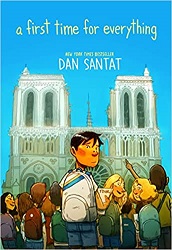
Here it is! Yet another book that convinces me that the absolutely perfect material for the graphic novel format is the middle school memoir. A First Time for Everything joins books like Smile, Real Friends, El Deafo, and many others that all brilliantly express the emotions and awkwardness of middle school — showing kids that they are not alone.
Caldecott-winning artist Dan Santat got to go to Europe the summer after his eighth grade year. It was an experience that changed his life.
First, he expertly shows some of his humiliations in middle school, so we understand his lack of self-confidence. Some girls who always tease him are along on the trip, but so are some kids from other parts of the United States, including a girl who seems to think he’s cool.
And they see Europe! They start in Paris and travel to places like Switzerland, Salzburg, Vienna, and London. The adults on the trip give them a lot of freedom (the Author’s Note in the back comments on that), and we really get the feeling of a kid experiencing Europe, meeting new people, and learning about himself.
I lived in Germany for ten years and visited many of the places portrayed in this book, so I loved that aspect of reading it as well. It made me want to go back. So much. (But then, most things do.) And when I do, I’m going to drink a Fanta and think of Dan Santat. (Well, and my kids. They love Fanta, too.)
This book is completely wonderful. He managed to put on the page the awkwardness of middle school plus the wonder of Europe plus the challenge of trying new things — and the way all that makes you grow. You could see the kid Dan gaining confidence and liking himself more as the story went on.
Disclosure: I am an Amazon Affiliate, and will earn a small percentage if you order a book on Amazon after clicking through from my site.
Disclaimer: I am a professional librarian, but the views expressed are solely my own, and in no way represent the official views of my employer or of any committee or group of which I am part.
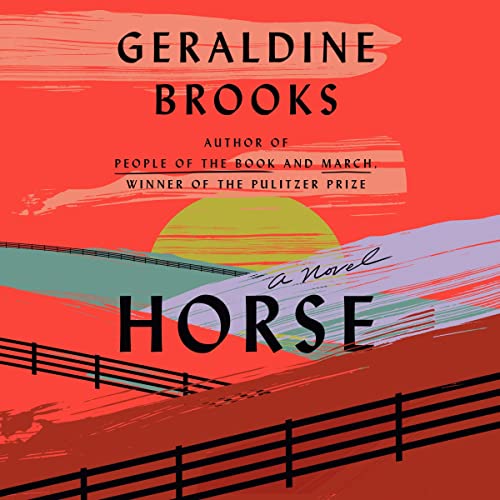
by Geraldine Brooks
read by James Fouhey, Lisa Flanagan, Graham Halstead, Katherine Littrell, and Michael Oblora
Penguin Audio, 2022. 14 hours, 6 minutes.
Review written March 18, 2023, from a library eaudiobook
Starred Review
A big thank you to my friend Keith, who persistently recommended this book to me. When he first recommended it, I was reading for the Cybils and didn’t get to it. Then at the start of the year when he said it was the best book he’d read in 2022, I put the audiobook on hold again, and this time when it came in a couple months later, I made a point of listening, and was glad I did.
This book is a rich tapestry. It’s set in 2019 and also in the 1850s. The two viewpoint characters in 2019 are working behind the scenes at the Smithsonian. One of those is an African American grad student writing an article for Smithsonian magazine on restoring a painting he found when his neighbor put it out in the trash. And his dissertation is about the depiction of African Americans in 19th century American equestrian art. Those two things come together.
And along the way he meets Jess, who works behind the scenes at the Smithsonian with animal skeletons. A British researcher has come to examine a particular skeleton, and Jess has to do some research to find it. The label just says “Horse,” but records show it’s the skeleton of Lexington, one of the greatest thoroughbreds of all time.
This book is the story of Lexington. The main viewpoint character from the past is Jarret, an enslaved boy who was present when Lexington was foaled. He manages to stay with Lexington for the horse’s whole life, and this book tells that story, mixed in with the story of restoring the painting and the skeleton in 2019.
The story is wonderfully told. And this audio production, using different readers for all the different viewpoint characters, makes it all the more immersive.
I was very surprised at the end to learn that Lexington was a real horse with an actual stellar career as a racer and as a sire. I had assumed she’d have to make up a fictional horse. His skeleton actually did spend time in the Smithsonian labeled as “Horse.” Most of the historical characters were real people, but the author brought them to life through the eyes of Jarret, the African American groom who loved him and knew him best. Jarret’s life is the fictional part, though with enough plausibility, you can tell yourself this is what really happened.
As she says in the afterword, because African Americans were so crucial to American racing in the nineteenth century, her story of a racehorse had to become a story of race. I have to say that I completely hated some things that happened toward the end of the book, though I see why she put them in. But I sure would have liked the story to go a different way. However, even with that reservation, this was an amazing book that I won’t forget any time soon.
Disclosure: I am an Amazon Affiliate, and will earn a small percentage if you order a book on Amazon after clicking through from my site.
Disclaimer: I am a professional librarian, but the views expressed are solely my own, and in no way represent the official views of my employer or of any committee or group of which I am part.
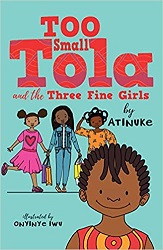
Candlewick Press, 2022. 96 pages.
Review written March 10, 2023, from a library book
Starred Review
You can’t help but love Too Small Tola. This is the second early chapter book about her, and the author quickly brings you up to speed:
Tola lives in a run-down block of apartments in the megacity of Lagos, in the country of Nigeria. Tola’s sister, Moji, is much cleverer than Tola. Tola’s brother, Dapo, is much faster than Tola. And even short-short Grandmommy is taller than Tola. Which makes Tola feel so small-o!
There are three stories in this book. I loved the first one. On a Saturday, when Grandmommy is out selling groundnuts by the road, the kids are supposed to clean stones out of the rice, but Tola’s stuck doing it herself. I love the way she tricks her siblings into doing all the work instead. It’s essentially their own fault, too.
The second story made me sad. Grandmommy is very sick with malaria. The kids have to get into her secret stash of cash for medicine, and then they have to go sell groundnuts at Grandmommy’s station for two weeks while she’s still sick, instead of going to school. The punchline to all that is that Dapo gets a good job as an auto mechanic, but it was hard for me to be happy for him, since he’s now a kid working and providing for his family instead of going to school. It’s not presented as a sad story, and it opens American kids’ eyes to another world, but it made me sad.
The final story has Tola envying three fine girls — and by the end those same three girls are envying her. It definitely ends the story on a happy note and reminds the reader that you can have a happy life even if you’re poor.
The chapters are short, with plenty of illustrations. The stories reflect kid concerns — but this kid lives in Nigeria, which immediately makes the stories all the more interesting.
Disclosure: I am an Amazon Affiliate, and will earn a small percentage if you order a book on Amazon after clicking through from my site.
Disclaimer: I am a professional librarian, but the views expressed are solely my own, and in no way represent the official views of my employer or of any committee or group of which I am part.
Today I livestreamed the Walter Dean Myers Awards and Symposium from We Need Diverse Books.
First, I highly recommend watching it yourself. Super inspirational.
I was a little sorry I hadn’t taken the trouble to go into DC and attend in person. But when I found out they were livestreaming it, it was way too tempting to watch from home.
I do take notes to help me pay attention. And then transcribing the notes helps me absorb what I heard. But instead of transcribing everything I wrote down, let me just give some highlights.
First, check out the winners on the We Need Diverse Books site. The program was emceed by Jacqueline Woodson, and first up was a round table discussion with three Honor Book authors, moderated by Ellen Oh, one of the founders of We Need Diverse Books. Some gems from that talk:
Ibi Zoboi became a writer after she read a book by Edwidge Danticat where her mother’s hometown in rural Haiti is mentioned right at the start. She felt validated and that she could be a writer, too.
Sonora Reyes was in a mental hospital when they read a book that was a rom-com centering a trans boy. It was full of joy and funny and happy and it saved their life.
When asked about book bans, Sabaa Tahir responded that you can look at the history of marginalized people. They don’t give up! We’re all going to keep writing! More books! Louder books! We absolutely refuse to be silenced. We’ll keep yelling until you’re ready to join that shout.
Ibi Zoboi thinks about dystopias. Even if somehow all books were destroyed, there would still be stories. Kids are telling stories already. That is impossible to stop.
Even though Sabaa Tahir switched from fantasy novels to realistic, they all focus on Hope through difficult times. The question she’s asking in all her books is, “Why do we treat each other this way?”
Ellen Oh asked them all if they had advice for young writers.
Sonora Reyes: Keep in mind that a lot of advice out there won’t work for you, and that’s okay. Test out writing advice and keep only what works.
Ibi Zoboi: Octavia Butler wrote about empaths. Many artists and writers are feeling people. Lean into that. Question your feelings. “We need more heart people in the world.”
Sabaa Tahir went with the practical: You need to get words on the page, so bribe yourself. She uses chocolate. Even if it’s garbage, put words on the page.
Next, recent Newbery winner Amina Luqman-Dawson spoke. She was a recipient of a writer’s mentorship from We Need Diverse Books. In 2018, the last time Jacqueline Woodson emceed the awards, she was sitting in the auditorium, clutching her manuscript that later won the Newbery Medal.
She talked about fighting book banners who claim that young people need to be protected from feeling bad. If that were true, we’d be talking about gun control.
The war on books isn’t about how young people feel. It’s a war to control your minds. It’s about the power of your ideas. The ideas in your minds can and likely will change the world. They worry if you learn, you might stand up for change.
Remember you have power to change the world!
Then it was time to give the trophies, and the winners gave speeches. First up was Angela Joy, who write the words for Choosing Brave.
She was at a writer’s conference feeling like a chocolate chip in a sea of marshmallows and heard about We Need Diverse Books as a call to action.
Lots of people were skeptical of a picture book about Emmett Till’s mother. Lots of Americans don’t want to hear his story at all. But that story is still being played out, and our youth see this. We need to help them process the trauma. Books are tools for conversations.
She wanted their book to be age-appropriate but honest, factual but inspiring. Once they landed on the theme of bravery, they had the handle for that balance.
Mamie’s life inspires her, and she’s trying to spread that with Choosing Brave.
Future leaders of tomorrow’s hate groups are being indoctrinated as babes in arms. We should be just as intentional about teaching our kids.
Then she sang a wonderful and beautiful song, “You’ve got to be carefully taught to hate.”
Let us also teach with intention.
Then illustrator Janelle Washington spoke. She talked about all the books she loved as a kid. Books are her forever friends and wise teachers.
Our connections with each other give us the strength to be brave in the face of everyday diversity.
Then it was time for the Teen category winners. Andrea Rogers, author of winner Man Made Monsters spoke and introduced herself in Cherokee.
She got serious about writing when her kids were faced with the same lack of stories about Indians as she had seen. Many times, other kids told her kids that they couldn’t be Indian, because all the Indians are dead.
For her, reading is a way of escape, but writing is a way to say, “We are here!” “I write, therefore I am.”
Her tribe’s story doesn’t end with the Trail of Tears.
How do you thank people for finally seeing you?
Everything in life is made up. Help children make up a better future.
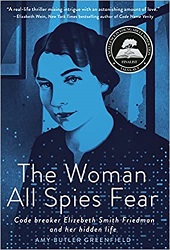
Code Breaker Elizebeth Smith Friedman and Her Hidden Life
by Amy Butler Greenfield
Random House Studio, 2021. 328 pages.
Review written February 26, 2023, from a library book
2022 YALSA Excellence in Nonfiction Award Finalist 2022 Cybils Award Winner – High School Nonfiction
Starred Review
Okay, I meant to read this book once it was named as a Finalist for the YALSA Excellence in Nonfiction Award last year. When this year it won the Cybils Award for High School Nonfiction, that intention took on new urgency. On top of that, a book for younger kids about Elizebeth Friedman, Code Breaker, Spy Hunter, by Laurie Wallmark, was a 2021 Sonderbooks Stand-out and a 2023 Mathical Book Prize Honor Book. And I watched a PBS documentary about her online, “The Codebreaker.” This book for older readers gives many more details about her fascinating life.
Elizebeth Smith was born in 1892 and got started in code breaking by working for an eccentric millionaire, looking for hidden codes from Francis Bacon in the works of Shakespeare. That search came to nothing, but it was there that Elizebeth met her husband-to-be William Friedman, who turned out to be an equally brilliant code breaker.
Elizebeth ended up using her skills for the government to unravel and create coded messages during World War I, during Prohibition against rum runners, and during World War II and beyond. She and her husband helped found cryptanalysis as a science, and trained the nation’s corps of codebreakers.
Her career spanned world wars that happened before computers were used to solve codes, and she brilliantly could spot and break multi-layered cyphers of many different types and in many different languages, using paper and pencil.
This book is packed with amazing stories of her skills, with plenty of personal details about what was going on in her life. Her husband ended up battling mental illness, but Elizebeth carried on, a working mother when that wasn’t the norm. It tells about interagency rivalry as well as national security secrecy that kept her from getting credit for her amazing work.
I enjoyed the frequent “Code Breaks” in the book that looked in more detail at a specific kind of coded message. Those gave me new appreciation for Elizebeth’s intricate level of skill, showing how messages would get coded in multi-step processes — and she would still break them. (Though I was able to solve the simple cypher the author put in the Acknowledgements.)
This book tells a wonderful story of a brilliant woman who, in a time when women’s brains weren’t valued, used hers to defeat bad guys.
Disclosure: I am an Amazon Affiliate, and will earn a small percentage if you order a book on Amazon after clicking through from my site.
Disclaimer: I am a professional librarian, but the views expressed are solely my own, and in no way represent the official views of my employer or of any committee or group of which I am part.
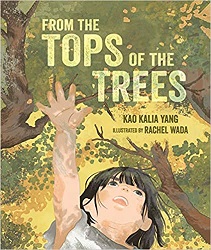
Carolrhoda Books, 2021. 32 pages.
Review written 2/3/2023, from a library book.
Starred Review
2023 Asian/Pacific American Literature Award Winner, Picture Books
I’m so glad I checked out award winners and found this book. Kao Kalia Yang has taken an incident from when she was a small child in a refugee camp on the border of Thailand and has made a beautiful picture book from it, assisted by the wonderful paintings of Rachel Wada.
Since Kalia was small and didn’t remember anything but living in a refugee camp, she asked her father if the whole world is a refugee camp. He told her No, but wasn’t able to explain what the wide world is like.
So one day, he had her mother dress her up in her good clothes, and he climbed with her on his back to the top of a tree. From there, she could see far beyond the refugee camp. Her mother took a picture of them.
“Father, the world is so big,” I say.
My father answers, “Yes, it is.” He says softly, “One day my little girl will journey far into the world, to the places her father has never been.”
My father tells me to smile at the camera, but I can’t because I now know that the world is bigger than anything I had imagined. My little legs will have to carry me far.
I love that the Author’s Note at the back includes the photograph that inspired the story.
Disclosure: I am an Amazon Affiliate, and will earn a small percentage if you order a book on Amazon after clicking through from my site.
Disclaimer: I am a professional librarian, but the views expressed are solely my own, and in no way represent the official views of my employer or of any committee or group of which I am part.
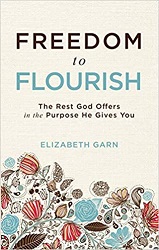
P & R Publishing, 2021. 187 pages.
Review written February 28, 2023, from my own copy, purchased via amazon.com
Starred Review
Disclaimer first: I met the author of this book at a writers’ group meeting, and we quickly hit it off. We had lunch and I heard about this book and loved the concept, so, yes, I was predisposed to enjoy it.
And yes, I did enjoy it tremendously. I’m co-leading a ladies’ small group, and I’m going to suggest this book as our next choice for a study guide.
This book looks at the creation account and talks about God’s calling for women.
And “Freedom to Flourish” is a perfect description of that calling. Elizabeth Garn looks into the actual words used in Genesis in their context and shows us that God’s calling for women is much more than making babies.
She looks at what it means to be made in God’s image – both male and female – and what it means to be fruitful and multiply and fill the earth as image bearers of God.
Art, music, hospitality, gardening, cooking, writing, storytelling, mathematics, programming . . . creating of any kind imitates God! You fill the earth by doing anything that adds beauty and life and fullness to the world around you, whether you prepare a simple meal, start a business, or create a work of art. The job of an image bearer is to use your gifts to mimic the passionate, creative work of God.
Oh, and her explanation of what it means to be an ezer (“helper”) is just plain empowering. And she points out that Eve was made for that outside the context of marriage and before the two were married. All women can be mighty helpers and defenders of humanity and all creation, not simply married ones. It’s not a subordinate role, and is even used in other places to describe God.
I also love the way she shook up my concept of Adam and Eve cast out of the garden in shame, dressed in some kind of wooly loincloths. She points out that the same word used to describe the priestly garments worn by Aaron and his descendants is used about the garments God gave Adam and Eve. They still bore God’s image and were sent out, not in shame, but with a calling.
Please, read the book to understand the scholarship and insights that the author uses to bring us to this place. But let me quote from a concluding paragraph so you know where she ends up:
God loves us! Not because of anything we do but because of who he is. And he has created us with freedom to live lives that display him in stunning ways. Far from the exhaustion and the striving, he has set us free to be women of God: image bearers of the King. It’s an extravagant calling! His plan for us is bigger and better than I ever dared to imagine. I want to stand on the rooftops and scream that we matter! That our hearts matter. Our minds matter. our passions and gifts and graces matter! The women he has made us to be matter. And all of that matters because we are his image bearers.
The view presented in this book has a liberating and expansive view of our calling as humans. And it’s strongly rooted in Scripture, pointing out insights I hadn’t noticed from the original language of these familiar passages.
Disclosure: I am an Amazon Affiliate, and will earn a small percentage if you order a book on Amazon after clicking through from my site.
Disclaimer: I am a professional librarian, but the views expressed are solely my own, and in no way represent the official views of my employer or of any committee or group of which I am part.
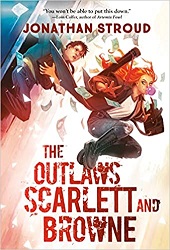
Listening Library, 2021. 12 hours, 19 minutes.
Review written February 26, 2023, from a library eaudiobook.
Starred Review
Hooray! Jonathan Stroud has a new series out about teens doing exploits in a world not quite like our own. I was already a devoted fan of his Lockwood & Co. series, which is now a Netflix series and gaining new fans. (Hooray!) This one has much the same feel, the same cleverness and banter between the characters and is wonderful in every way. I’m kind of glad I didn’t get this first book read as soon as it came out, because now I only need to wait a couple months for the next one.
Scarlett McCain lives in Britain in the far distant future, after the Cataclysm and the Great Dying. Britain is now a set of islands with fortified towns and a wilderness in between. There’s a lagoon where London used to be.
The book begins as Scarlett pulls off a bank robbery. She needs the money to pay back some folks who will kill her if she fails. Everything goes smoothly, but in the wilderness she comes across a bus that has met with a horrific accident, and all the passengers were eaten by wild beasts. She stops to see if they left any valuables, planning to leave before dark.
In the bus, she hears a sound coming from the toilet. Sure enough, a boy comes out. He’d locked himself in while the others were being eaten. His name’s Albert Browne and he’s naive and awkward, and Scarlett doesn’t quite have the heart to leave him to try to make it to a town on his own. So she takes him into her care, planning to get him to the nearest town.
The next day, though, they get chased by men with dogs and guns. Scarlett’s never known anyone to be so persistent after a bank robbery. But just before she escapes by jumping into a river (after pushing Albert in), one of the gunmen laughs and asks why she thinks they’re chasing after her. Turns out there’s much more to Albert than meets the eye.
The book is full of more exploits. And danger. Albert has heard that the Free Isles — which lie in the London Lagoon — will take anyone, despite blemishes or oddities. But it’s not easy to get there, and they’re still being chased.
Fair warning: The book is full of violence and gore. Another terror is the zombie-like “tainted” who eat human flesh. The animals are all more fearsome than in our day, too. One of the terrors of the Thames is the river otters that can devour the unwary. Scarlett does some killing, but it does feel warranted.
Also in that future day, instead of individual religions, there are Faith Houses that offer all religions humans have ever observed. And they are wary of the evolution that has happened to the animals and have strict rules against any blemishes or deviations in people in order to live in the towns. I’m never thrilled to read a book where the villains are powerful religious people, because that’s not how religion should be. However, then I had to reflect that in the Gospels themselves, the villains are powerful religious people. Scarlett and Browne are being tracked by the most powerful people of their society, and the reader is rooting for them.
Sophie Aldred does a wonderful job reading this one. I always love an English accent, but on top of that, she puts so much personality into Albert’s voice. We hear his naivete and his earnestness, his wonder at the wider world and just how annoying he must be to Scarlett. Though I’m tempted to preorder the next book, I think I’m going to check out another audiobook instead. This is just wonderful.
Disclosure: I am an Amazon Affiliate, and will earn a small percentage if you order a book on Amazon after clicking through from my site.
Disclaimer: I am a professional librarian, but the views expressed are solely my own, and in no way represent the official views of my employer or of any committee or group of which I am part.
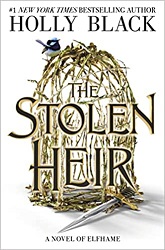
Hachette Audio, 2023. 10 hours, 10 minutes.
Review written February 24, 2023, from a library eaudiobook.
Starred Review
Oh my goodness, Holly Black has done it again! The Stolen Heir begins a new duology set in Elfhame. (Yay! We only have to wait for one more book!) These events happen eight years after the trilogy The Cruel Prince, The Wicked King, and The Queen of Nothing. So those who were children in the earlier books have grown. You don’t have to have read the trilogy to enjoy this book, but why not? It made me want to go back and reread them.
This book features Suren, who was once the child queen of The Court of Teeth, but bridled and manipulated by Lady Nore of the Court of Teeth. She was then betrothed to Oak, the young heir to Elfhame, as Lady Nore planned to use her to take over Elfhame.
Now Suren is in exile in the human world. She scrounges a life in the forest and spies on the human family with whom she spent the first seven years of her life, before Lady Nore stole her back and tormented and abused her. Without glamour, she’s a thing of horror to humans, with the teeth of a predator.
Oak, on the other hand, has been living a life of luxury at court. He’s beautiful, smooth and well-spoken, makes everyone at ease. Although like all the Fae, he can’t lie, he does know how to deceive and manipulate.
Suren thinks she’s at least safe in her lair in the woods. But then one day a storm hag comes hunting for her. She’s rescued by Oak and his knight and their prisoner — someone who wears the very bridle that once controlled Suren.
They tell Suren that they are going to the Court of Teeth to recover Mab’s Bones, which Lady Nore has acquired and is using to create deadly creatures and wield power. Suren is Lady Nore’s one vulnerability, having been given the power to command her. But because of that, Suren is now in danger. Lady Nore’s simplest way to stop the vulnerability is to kill Suren.
Suren agrees to go on the quest. The storm witch coming after her has convinced her that Oak is right and her life is in danger unless she commands Lady Nore to stop. But she quickly realizes that Oak isn’t telling her everything.
What follows is another story from Holly Black full of twists and turns that keep you guessing. What is Oak not telling Suren? And what is she keeping back herself? And how, exactly, do they feel about each other? As they travel on the journey, Suren must also confront the trauma of her past and think about how she wants to go forward.
The book is full of danger, schemes and counterschemes, and unexpected actions that weren’t part of the schemes but are consistent with the complex characters. Suren has been told all her life that she’s worthless and useless, so we’re pulling for her as she tries to come into her own — and figure out what that means.
The book ends in a satisfying place — and yet an infuriating one, because the story is by no means complete, and we’re dying to know what happens next.
Disclosure: I am an Amazon Affiliate, and will earn a small percentage if you order a book on Amazon after clicking through from my site.
Disclaimer: I am a professional librarian, but the views expressed are solely my own, and in no way represent the official views of my employer or of any committee or group of which I am part.
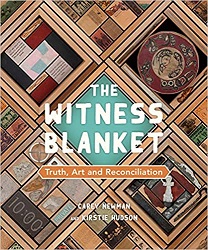
Orca Books, Canada, 2022. 92 pages.
Review written January 31, 2023, from a library book
Starred Review
The Witness Blanket is a powerful book about a stunning and beautiful, but hard-hitting work of art. The Witness Blanket itself isn’t what I think of as a blanket — but it’s a sort of solid patchwork quilt, with panels fastened together so that the exhibit can travel.
The Witness Blanket was assembled from thousands of objects, photographs and letters that all bear witness to Indigenous people’s experiences in the residential schools of Canada, which operated from the mid-1800s to the late 1990s.
Author Carey Newman tells about how he is an intergenerational survivor, with trauma passed down from his father.
My father was born in 1937 in the remote town of Alert Bay, British Columbia. At age seven he was taken from his parents and sent to a residential school far away from home. Residential schools were started by the Canadian government and run by churches. The goal was to erase Indigenous cultures by making children like my father think, speak and behave less like their own people and more like European settlers. At residential school my father wasn’t allowed to speak Kwak’wala, the language of his people. He couldn’t learn about their traditional ways of living or cultural ceremonies. School authorities wouldn’t even let him talk with his siblings. Losing these experiences hurt his connection to family and culture. It also changed how he thought of himself and altered who he grew up to be.
The idea Carey Newman got for making the Witness Blanket came from the work of the Truth and Reconciliation Commission of Canada, who were looking for a way to document and commemorate the experiences of Survivors of the residential schools.
This book takes a gentle approach to documenting those experiences as well, gently showing the reader different objects that people sent in to include in the blanket and explaining their stories — thus casting light on the experiences of many people. It also tells of the thought and care that went into putting the pieces together into the finished exhibit.
All along the way, we get detailed photos and explanations of individual pieces that went into the Witness Blanket. This makes it all the more moving to see the full-spread photographs of the completed project at the back.
I was surprised by how much this book affected me. Some day I would like to see this work of art and testimony in person. But in the meantime, I highly recommend this book.
Disclosure: I am an Amazon Affiliate, and will earn a small percentage if you order a book on Amazon after clicking through from my site.
Disclaimer: I am a professional librarian, but the views expressed are solely my own, and in no way represent the official views of my employer or of any committee or group of which I am part.
 A First Time for Everything